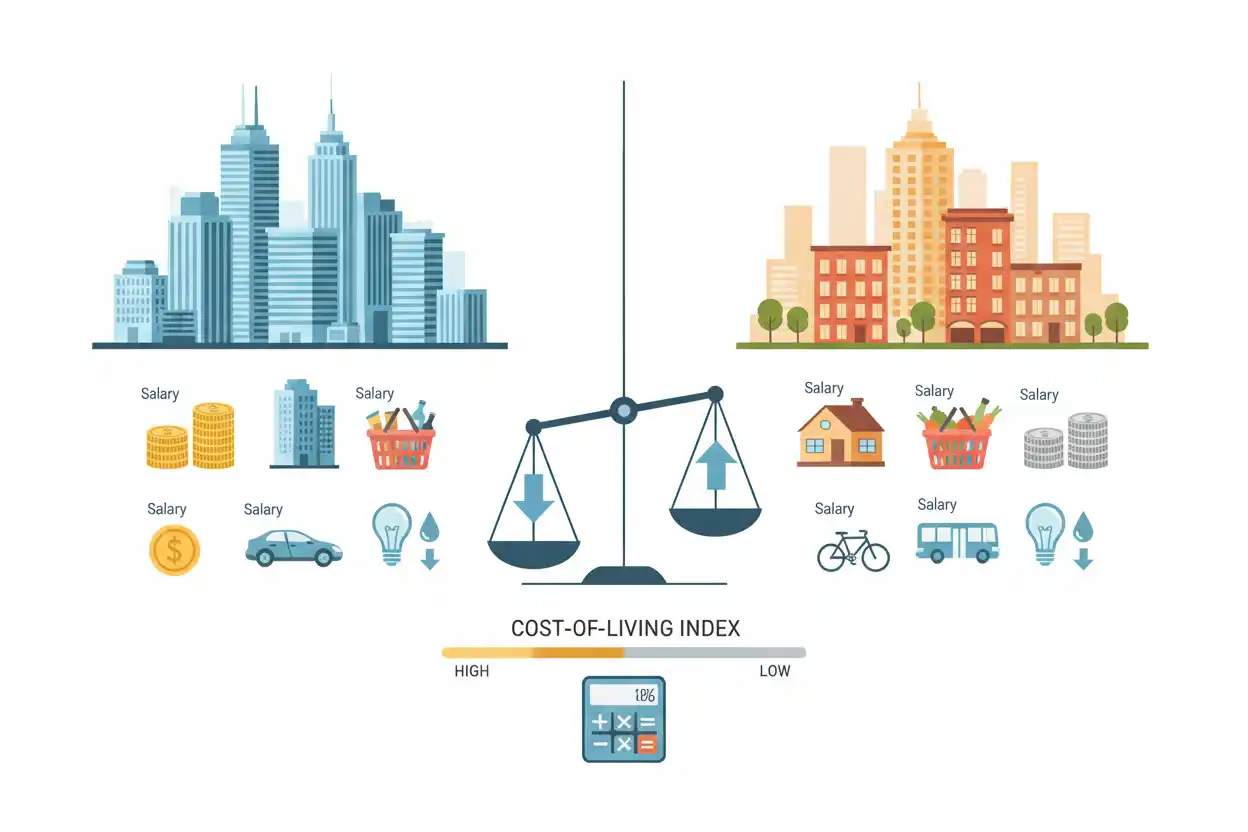

Cost of living describes how much money a household needs to purchase a particular combination of housing, food, transportation, utilities, healthcare, and other expenses in a place or period.
Cost-of-living indexes try to turn those different expenses into a comparable number.
The resulting index can help compare cities, estimate an equivalent salary, or evaluate a move. However, an index is only as useful as the basket, weights, geographic definitions, and assumptions behind it.
A city that is 20% more expensive according to one index is not necessarily exactly 20% more expensive for every household.
What Is Cost of Living?
Cost of living is the amount required to maintain a specified standard of consumption.
Important categories can include:
- housing;
- groceries;
- transportation;
- utilities;
- healthcare;
- insurance;
- taxes;
- childcare;
- education;
- entertainment and miscellaneous expenses.
Different households spend very different percentages on these categories.
A renter without children can therefore experience a city differently from a homeowner supporting a family, even if both live in the same area.
What Is a Cost-of-Living Index?
A cost-of-living index summarizes relative expense levels using a reference value.
A simplified index may assign a base location or average a value of 100.
Under that convention:
- index of 100 = reference level;
- index of 120 = 20% above the reference;
- index of 85 = 15% below the reference.
However, not every provider uses the same baseline, basket, or methodology.
Always compare values from the same index source and methodology when possible.
Cost-of-Living Comparison Formula
If two cities use the same index system, the relative-cost ratio can be calculated as:
Relative Cost Ratio = Destination Index ÷ Current City Index
Suppose:
- City A index = 120
- City B index = 150
Then:
Relative Cost Ratio = 150 ÷ 120
Relative Cost Ratio = 1.25
Under this simplified comparison, City B is 25% more expensive than City A according to that particular index.
Equivalent Salary Formula
A common use of cost-of-living indexes is estimating what salary might provide equivalent purchasing power in another city.
Equivalent Destination Salary = Current Salary × Destination Index ÷ Current Index
Suppose you earn $60,000 in City A, where the index is 120, and are considering City B with an index of 150.
Equivalent Salary = $60,000 × 150 ÷ 120
Equivalent Salary = $75,000
Under the simplified index assumptions, approximately $75,000 in City B corresponds to $60,000 in City A.
This is an index-based estimate, not a guarantee of identical financial circumstances.
Why You Should Not Compare Index Differences Directly
Suppose City A has an index of 80 and City B has an index of 100.
It is tempting to say City B is 20% more expensive because:
100 − 80 = 20
But the percentage difference relative to City A is:
(100 − 80) ÷ 80 × 100
20 ÷ 80 × 100 = 25%
So City B is 25% more expensive relative to City A under that index.
The denominator matters.
Housing Can Dominate the Comparison
Housing is often one of the largest household expenses, so differences in rent or homeownership costs can have an outsized effect.
Suppose monthly expenses are:
City A
Housing: $1,500
Other costs: $2,000
Total = $3,500 per month
City B
Housing: $2,500
Other costs: $2,100
Total = $4,600 per month
The total difference is:
$4,600 − $3,500 = $1,100
Percentage increase:
$1,100 ÷ $3,500 × 100 ≈ 31.43%
Even though non-housing costs rose only modestly, the housing difference substantially changed the total budget.
Build a Personal Cost-of-Living Comparison
A broad index is useful for orientation, but a household-specific budget can be more actionable.
Create comparable monthly categories for both places:
Total Monthly Cost = Housing + Food + Transport + Utilities + Healthcare + Taxes + Other Costs
For example:
| Expense | City A | City B |
|---|---|---|
| Housing | $1,600 | $2,200 |
| Food | $650 | $700 |
| Transportation | $500 | $400 |
| Utilities | $250 | $280 |
| Healthcare | $450 | $450 |
| Other | $800 | $850 |
| Total | $4,250 | $4,880 |
Difference:
$4,880 − $4,250 = $630 per month
Annual difference:
$630 × 12 = $7,560
City B costs approximately $7,560 more per year under this household-specific example.
Cost of Living vs Inflation
Cost of living and inflation are related but not identical concepts.
Inflation measures how prices change over time for a defined basket.
A cost-of-living comparison can also compare different places at the same point in time.
For example:
- comparing 2026 prices with 2025 prices is primarily a time comparison;
- comparing City A with City B today is primarily a geographic comparison.
A household’s personal cost increase can also differ from a broad inflation measure because its spending pattern may differ from the index basket.
Projecting Future Living Costs
If expenses rise at a constant assumed rate, compound-growth mathematics can estimate a future amount.
Future Cost = Current Cost × (1 + Growth Rate)^Years
Suppose current annual living expenses are $50,000 and you assume 3% annual growth for 10 years.
Future Cost = $50,000 × 1.03^10
Future Cost ≈ $67,195.82
That does not mean future expenses are known.
It shows the result if the 3% assumption occurred consistently.
The mechanics are the same type of exponential growth explained in compound interest, although living costs are expenses rather than an interest-bearing balance.
Using CAGR to Measure Historical Cost Growth
Compound annual growth rate can summarize how a specific expense changed between two dates.
Suppose annual rent increases from $18,000 to $24,000 over five years.
CAGR = ($24,000 ÷ $18,000)^(1 ÷ 5) − 1
This gives an annualized historical growth rate.
It can help describe what happened, but historical CAGR should not automatically be treated as the rate future rent will follow.
Gross Salary vs Spendable Income
A cost-of-living salary comparison can become misleading if it compares only gross salaries.
Suppose one city requires an estimated 15% higher spending level but produces a significantly different after-tax income.
The gross-salary ratio may not capture the household’s true disposable-income position.
A more complete comparison can evaluate:
Disposable Income = After-Tax Income − Essential Expenses
Then compare how much remains after required costs.
This is often more meaningful than comparing salaries alone.
Location Changes Can Alter More Than Prices
Moving between cities can affect:
- commuting distance;
- whether a car is needed;
- housing size;
- childcare arrangements;
- insurance costs;
- utility usage;
- local taxes;
- salary opportunities;
- family support;
- lifestyle spending.
Therefore, a generic index should be treated as a starting point rather than a complete relocation budget.
Cost of Living and Cash Budgeting
Once projected costs are translated into actual spending, careful counting cash and transaction tracking can help reconcile physical money, petty cash, or cash-envelope budgets.
However, counting currency answers only how much cash is present.
A cost-of-living analysis asks how much spending is required.
The concepts connect through budgeting but have different core intents.
Cost of Living and Interest Costs
Higher living expenses can affect borrowing and saving decisions.
If someone relies on debt to cover recurring expenses, cumulative interest can make the eventual cost significantly larger than the original spending gap.
Likewise, additional savings created by living in a lower-cost area may have the opportunity to compound over time.
The relevant comparison is therefore not always limited to this month’s rent difference.
What Convexity Has to Do With Cost Comparisons
Specialized financial measures should not be substituted for household cost metrics.
For example, convexity measures curvature in a bond’s price-yield relationship. It has no role in determining whether groceries, housing, or transportation are cheaper in one city than another.
Keeping formulas tied to their intended purpose prevents misleading comparisons.
How to Compare Cities More Accurately
A stronger comparison uses both a broad index and a personal budget.
First, use an index to identify the likely overall difference.
Then replace generic assumptions with actual expected expenses for the household.
Housing deserves particular attention because choosing a different neighborhood, property type, or commuting pattern can materially change the comparison.
Finally, compare expected after-tax income with the resulting budget rather than relying only on gross salary.
Cost-of-Living Index Limitations
Indexes can differ because providers may use different:
- spending baskets;
- category weights;
- geographic boundaries;
- data-collection periods;
- housing assumptions;
- tax treatments;
- household types.
An index should therefore not be treated as a universal measurement that applies identically to every person.
Common Cost-of-Living Comparison Mistakes
One mistake is comparing index numbers from unrelated methodologies.
Another is assuming a 20-point index difference automatically equals a 20% difference.
People also frequently focus on salary while ignoring taxes and benefits.
Finally, a national or citywide average may not reflect the neighborhood or lifestyle actually being considered.
Frequently Asked Questions
What does cost of living mean?
Cost of living describes the amount of money required to purchase a specified combination of housing, food, transportation, healthcare, utilities, and other expenses.
What is a cost-of-living index?
It is a relative measure designed to compare expense levels across places or periods using a defined basket and methodology.
What does an index of 120 mean?
If the index uses 100 as its reference level, 120 means the measured basket is 20% above that reference. The exact interpretation depends on the index methodology.
How do I compare two cost-of-living indexes?
If both come from the same methodology:
Relative Cost Ratio = Destination Index ÷ Current Index
How do I calculate an equivalent salary?
Equivalent Salary = Current Salary × Destination Index ÷ Current Index
Is a city with an index of 120 exactly 20% more expensive for me?
Not necessarily. Your personal spending pattern may differ from the basket used by the index.
Is cost of living the same as inflation?
No. Inflation primarily describes price changes over time, while cost-of-living analysis can compare locations or estimate household spending needs.
Why is housing important in city comparisons?
Housing is often a large budget category, so substantial differences in rent or ownership costs can dominate the overall comparison.
Should I compare gross or after-tax salary?
After-tax income generally provides a better foundation for evaluating what remains available to pay living expenses.
Can I project future living costs?
Yes, using an assumed growth rate, but the result is a scenario rather than a guaranteed forecast.
Are online cost-of-living indexes always comparable?
No. Different providers can use different baskets, weights, baselines, and geographic definitions.
How should cost of living affect financial planning?
It can influence emergency savings, housing choices, retirement assumptions, relocation decisions, and other parts of a broader Savings & Investing plan.