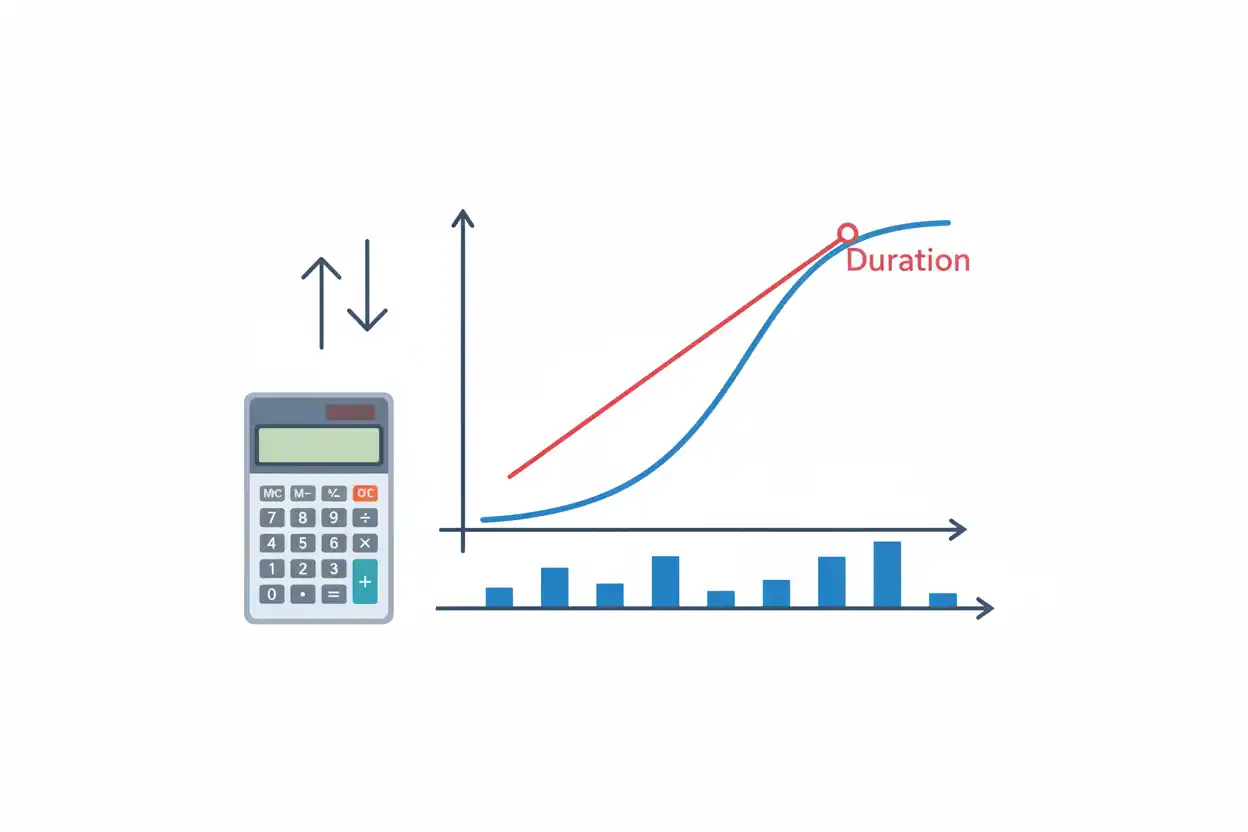

Convexity measures the curvature in the relationship between a bond’s price and its yield.
Duration provides a useful first-order estimate of how a bond’s price may respond to a change in yield, but duration treats the relationship approximately as a straight line. Actual bond price behavior is curved.
Convexity adds a second-order adjustment that can make the estimated price change more accurate, particularly when yields move by larger amounts.
What Is Convexity?
For a conventional bond without unusual embedded features, price and yield generally move in opposite directions.
When yield rises, bond price falls.
When yield falls, bond price rises.
However, the relationship is not linear.
If yield changes by the same number of percentage points upward and downward, the corresponding price changes are generally not perfectly symmetrical.
Convexity measures that curvature.
Why Duration Is Not Enough
A simplified modified-duration estimate is:
Approximate % Price Change ≈ −Modified Duration × Change in Yield
Suppose a bond has modified duration of 5.
If yield rises by 1 percentage point:
Approximate Price Change ≈ −5 × 0.01
Approximate Price Change ≈ −5%
This is a linear approximation.
For small yield changes it can work reasonably well, but it ignores the fact that the true bond-price curve bends away from the tangent line.
Convexity corrects part of that error.
Bond Convexity Formula
For a conventional bond paying once per year, one form of the convexity formula is:
Convexity = [Σ CFₜ × t(t + 1) ÷ (1 + y)^(t + 2)] ÷ Bond Price
Where:
- CFₜ = cash flow in period t;
- t = period number;
- y = yield per period;
- Bond Price = present value of the remaining cash flows.
For other payment frequencies, the formula must be adjusted to keep yield, period counts, and annualization consistent.
Convexity Price-Change Approximation
Duration and convexity can be combined:
ΔP ÷ P ≈ −Dₘₒd × Δy + ½ × Convexity × (Δy)²
Where:
- ΔP ÷ P = estimated percentage change in price;
- Dₘₒd = modified duration;
- Δy = change in yield in decimal form.
The first term is the duration effect.
The second term is the convexity adjustment.
Convexity Example
Consider a three-year bond with:
- Face value = $1,000
- Annual coupon rate = 5%
- Annual coupon = $50
- Yield to maturity = 6%
- Annual coupon payments
Its cash flows are:
- Year 1: $50
- Year 2: $50
- Year 3: $1,050
First calculate the bond price.
Price = $50 ÷ 1.06 + $50 ÷ 1.06² + $1,050 ÷ 1.06³
The present values are approximately:
Year 1 PV = $47.17
Year 2 PV = $44.50
Year 3 PV = $881.60
Therefore:
Bond Price ≈ $973.27
Calculate Modified Duration
For this bond, Macaulay duration is approximately:
Macaulay Duration ≈ 2.8573 years
Modified duration is:
Modified Duration = Macaulay Duration ÷ (1 + Yield)
Modified Duration = 2.8573 ÷ 1.06
Modified Duration ≈ 2.6956
This means the duration-only approximation suggests that a one-percentage-point increase in yield would reduce price by approximately 2.70%.
Calculate Convexity
Using the annual-payment convexity formula:
Convexity = [Σ CFₜ × t(t + 1) ÷ (1.06)^(t + 2)] ÷ $973.27
Evaluating the three cash flows produces:
Convexity ≈ 10.0045
Rounded:
Convexity ≈ 10.00
Now the convexity value can be combined with modified duration.
Yield Rises by 1 Percentage Point
Suppose yield rises from 6% to 7%.
Therefore:
Δy = 0.01
Duration-only estimate:
ΔP ÷ P ≈ −2.6956 × 0.01
ΔP ÷ P ≈ −0.026956
Estimated Change ≈ −2.6956%
Now add convexity:
Convexity Adjustment = ½ × 10.0045 × 0.01²
Convexity Adjustment ≈ 0.0005002
That equals approximately 0.0500%.
Combined estimate:
Estimated Change ≈ −2.6956% + 0.0500%
Estimated Change ≈ −2.6456%
The exact repriced bond at a 7% yield is approximately $947.51, corresponding to an actual decline of about 2.6464%.
The convexity-adjusted estimate is therefore very close in this example.
Yield Falls by 1 Percentage Point
Now suppose yield falls from 6% to 5%.
Δy = −0.01
Duration effect:
−2.6956 × (−0.01) = +2.6956%
Convexity adjustment remains positive because the yield change is squared:
½ × 10.0045 × (−0.01)² ≈ +0.0500%
Combined estimate:
Estimated Price Change ≈ 2.6956% + 0.0500%
Estimated Price Change ≈ 2.7456%
The bond reprices to approximately $1,000, an actual increase of about 2.7464%.
The example shows why convexity matters: the same one-percentage-point move downward creates a slightly larger gain than the loss associated with a one-percentage-point move upward.
Positive Convexity
Many conventional option-free bonds have positive convexity.
With positive convexity:
- price gains from falling yields are larger than a straight-line duration estimate;
- price losses from rising yields are smaller in magnitude than the same duration-only estimate.
This does not mean positive-convexity bonds cannot lose money.
It describes the shape of their price-yield relationship.
Negative Convexity
Some securities can exhibit negative convexity over certain yield ranges.
This can occur when cash flows are affected by embedded options or borrower behavior.
For example, if declining rates make an issuer more likely to call a bond or cause borrowers to refinance underlying loans, the investor may not receive the same upside that an option-free bond would provide.
In that region, the price-yield curve can bend differently.
Convexity and Compounding
Convexity calculations depend on present-value mathematics.
Understanding compound interest helps because discounting is essentially the reverse of compounding.
Compounding moves a value forward:
Future Value = Present Value × (1 + r)^t
Discounting moves a cash flow backward:
Present Value = Future Cash Flow ÷ (1 + r)^t
Convexity examines how those discounted values change as the discount rate changes.
Convexity vs CAGR
Compound annual growth rate measures annualized growth between a beginning and ending value.
Convexity does not measure investment growth.
A bond could have high positive convexity and still produce a negative holding-period return if market conditions move unfavorably.
The two metrics answer separate questions:
- CAGR: how quickly value compounded through time;
- convexity: how curved the bond price-yield relationship is.
Convexity and Long-Term Planning
Fixed-income positions may appear within long-term portfolios used for goals such as college cost planning.
When bonds may need to be sold before maturity, interest-rate sensitivity can matter because market value can change before the funds are required.
Convexity is one tool for refining that sensitivity analysis. It does not determine the correct education-savings allocation by itself.
Convexity vs Household Cost Measures
Financial formulas can use similar language while serving entirely different purposes.
The cost of living compares household expenses across places or periods, whereas convexity concerns fixed-income price sensitivity.
Likewise, simply counting cash measures nominal currency on hand; it does not account for the present-value effects that produce bond duration and convexity.
Keeping those intents separate prevents unrelated percentages and dollar totals from being treated as interchangeable measures.
Why Convexity Is More Useful for Larger Yield Changes
The convexity term contains:
(Δy)²
When the change in yield is extremely small, its square is even smaller, so the convexity adjustment contributes relatively little.
As the yield move gets larger, the second-order term becomes more important.
Duration alone is therefore generally most accurate for very small changes, while duration plus convexity provides a better approximation as the move becomes more material.
Convexity Is Still an Approximation
Adding convexity improves the estimate, but it does not turn the approximation into an exact pricing model for every security.
Real-world complications can include:
- embedded options;
- changing expected cash flows;
- credit-spread movements;
- yield-curve changes that are not parallel;
- liquidity changes;
- different compounding conventions.
For precise valuation, the actual cash flows should be repriced under the relevant assumptions.
Common Convexity Mistakes
One frequent mistake is forgetting to convert basis-point or percentage-point changes into decimals.
A 1 percentage point change is:
1% = 0.01
A 25-basis-point change is:
25 bp = 0.25% = 0.0025
Another mistake is using inconsistent compounding periods between yield, cash flows, duration, and convexity.
Finally, convexity should not be interpreted as a standalone measure of total bond risk.
Frequently Asked Questions
What is convexity in bonds?
Convexity measures the curvature of a bond’s price-yield relationship.
Why is convexity useful?
It improves on the linear duration estimate by adding a second-order adjustment for changes in yield.
What is the duration and convexity formula for price changes?
ΔP ÷ P ≈ −Dₘₒd × Δy + ½ × Convexity × (Δy)²
Is higher convexity always better?
Not automatically. Positive convexity can improve price behavior for a given duration and yield change, but valuation, yield, credit risk, cash flows, and other factors still matter.
What does positive convexity mean?
It means the price-yield curve bends so that price gains from declining yields are generally larger than the corresponding duration-only estimate, while losses from rising yields are generally smaller.
What is negative convexity?
Negative convexity occurs when the price-yield curve bends in the opposite direction over a relevant range, often because expected cash flows can change.
Does convexity measure return?
No. Convexity measures price sensitivity curvature, not historical or expected return.
Is convexity the same as duration?
No. Duration provides the first-order slope approximation. Convexity measures curvature and supplies a second-order adjustment.
Why is convexity more important for large rate moves?
Because the convexity adjustment depends on the square of the yield change, making its effect larger as the yield move increases.
Can convexity be negative?
Yes. Securities with embedded options or changing expected cash flows can exhibit negative convexity in certain ranges.
Does convexity eliminate interest-rate risk?
No. It helps measure the shape of price sensitivity but does not remove the underlying risk.
Where does convexity fit in investing?
It is a specialized fixed-income risk measure that can complement duration and broader portfolio analysis within Savings & Investing.