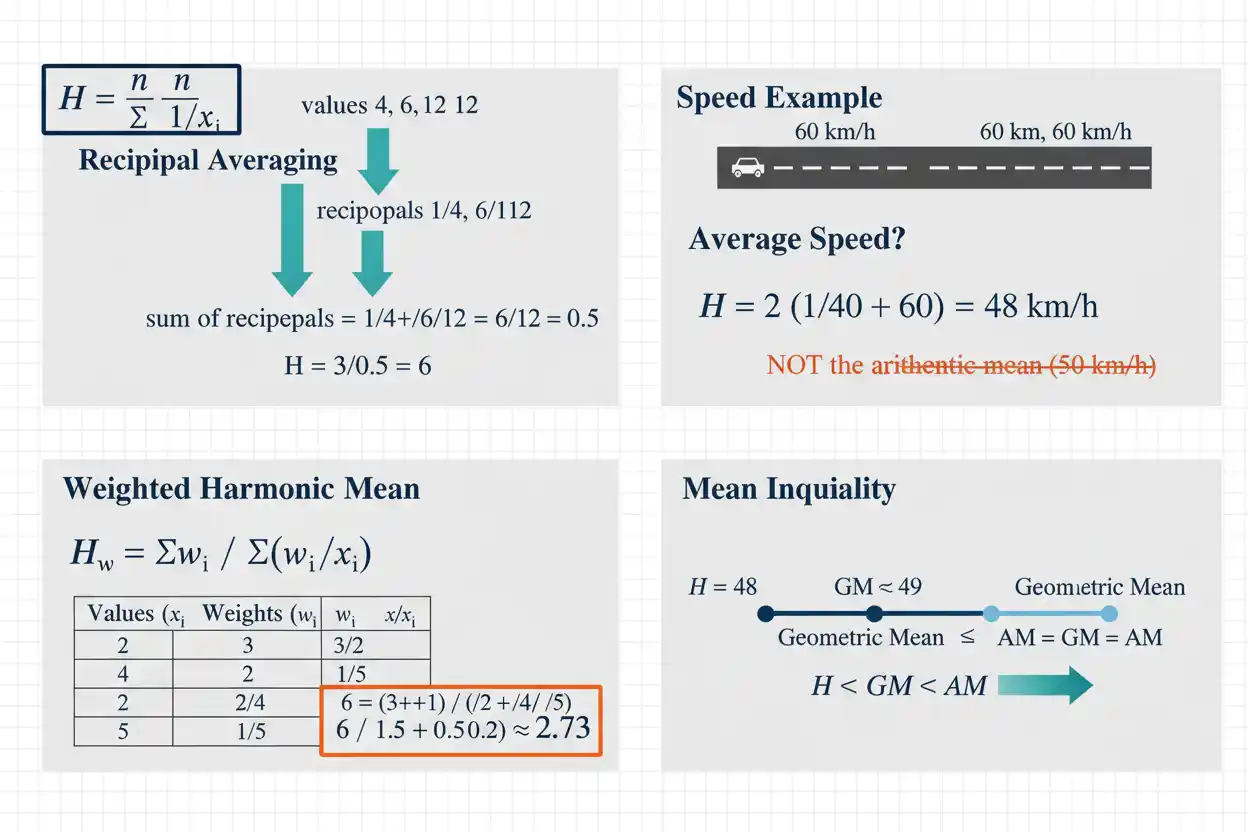

The harmonic mean is a measure of central tendency calculated by dividing the number of observations by the sum of their reciprocals, making it especially useful when averaging positive rates, ratios, or quantities whose denominators play the central role in the calculation. For positive observations x₁, x₂, …, xₙ, the harmonic mean is H = n / Σ(1/xᵢ), so smaller values receive greater influence than they would under the arithmetic mean because their reciprocals are larger. This property makes the harmonic mean the correct average in classic problems such as average speed over equal distances: traveling the same distance at 30 km/h and 60 km/h gives an overall average speed of 40 km/h rather than the arithmetic average of 45 km/h, because the slower segment consumes more time. The harmonic mean also extends naturally to weighted observations and frequency tables, while its relationship with the geometric and arithmetic means gives the inequality H ≤ GM ≤ AM for positive data. However, the harmonic mean requires careful interpretation around zero, negative values, and data that do not possess a meaningful reciprocal structure, because it should not be selected simply because a set of numbers happens to contain rates.
The harmonic mean belongs to the broader family of averages within descriptive statistics and Statistics & Probability. Its purpose is narrower than the ordinary arithmetic average: it answers problems in which the reciprocals of the observations combine additively, particularly when a fixed numerator quantity such as distance, work, or exposure is repeated across observations.
What Is the Harmonic Mean?
For n nonzero observations:
x₁, x₂, …, xₙ
the harmonic mean is:
H = n / Σ(1/xᵢ)
For positive data, this can be written explicitly as:
H = n / (1/x₁ + 1/x₂ + … + 1/xₙ)
The procedure has three basic steps:
- take the reciprocal of each observation;
- calculate the arithmetic mean of those reciprocals;
- take the reciprocal of that mean.
Therefore:
H = 1 / Mean(1/x)
This reciprocal structure distinguishes the harmonic mean from both the arithmetic and geometric mean.
Harmonic Mean Formula for Two Numbers
For two positive values a and b:
H = 2 / (1/a + 1/b)
Combining the fractions gives:
H = 2ab/(a + b)
Suppose:
a = 4
b = 12
Then:
H = 2(4)(12)/(4 + 12)
= 96/16
= 6
Therefore:
Harmonic mean = 6
The arithmetic mean of 4 and 12 is:
8
while the geometric mean is:
√48 ≈ 6.928.
Thus:
6 < 6.928 < 8.
Simple Harmonic Mean Example
Find the harmonic mean of:
2, 4, 8
First calculate the reciprocals:
1/2
1/4
1/8
Their sum is:
1/2 + 1/4 + 1/8
= 4/8 + 2/8 + 1/8
= 7/8
There are:
n = 3
observations.
Therefore:
H = 3/(7/8)
= 24/7
≈ 3.429
The harmonic mean is approximately:
3.43
Harmonic Mean as the Reciprocal of the Mean Reciprocal
The harmonic mean can also be understood as:
H = 1 / [(1/n)Σ(1/xᵢ)]
Suppose:
2, 4, 8
have reciprocals:
0.5, 0.25, 0.125
Their arithmetic mean is:
(0.5 + 0.25 + 0.125)/3
= 0.875/3
≈ 0.291667
Take the reciprocal:
H ≈ 1/0.291667
≈ 3.429
This interpretation is often the easiest way to understand why small values have such a strong effect.
Why Small Values Matter More
The reciprocal function:
1/x
changes rapidly when x is small.
For example:
1/2 = 0.5
while:
1/20 = 0.05.
Therefore, the value 2 contributes ten times as much to the reciprocal sum as the value 20.
This means a low rate can pull the harmonic mean downward strongly.
That behavior is useful in rate problems because a slow rate often consumes disproportionately more time, exposure, or denominator quantity.
It also means the harmonic mean can become unstable when observations approach zero.
Arithmetic Mean vs Harmonic Mean
The arithmetic mean is:
AM = Σxᵢ/n
while the harmonic mean is:
H = n/Σ(1/xᵢ).
The arithmetic mean is appropriate when the observed quantities themselves combine additively.
The harmonic mean is appropriate when their reciprocals combine additively because a common numerator quantity is being accumulated.
For example, if equal amounts of time are spent traveling at two speeds, arithmetic averaging of speed can be correct.
If equal distances are traveled at two speeds, harmonic averaging is the appropriate structure.
The weighting mechanism determines the answer.
Average Speed Over Equal Distances
Suppose a vehicle travels:
60 km
at:
30 km/h
and another:
60 km
at:
60 km/h.
Total distance is:
120 km.
Time for the first segment:
60/30 = 2 hours
Time for the second:
60/60 = 1 hour
Total time:
3 hours.
Therefore:
Average speed = 120/3
= 40 km/h
The harmonic mean gives the same result:
H = 2/(1/30 + 1/60)
= 40 km/h.
Why the Arithmetic Mean Gives the Wrong Equal-Distance Speed
The arithmetic mean would be:
(30 + 60)/2
= 45 km/h.
However, the vehicle does not spend equal amounts of time at the two speeds.
It spends:
2 hours
at 30 km/h and only:
1 hour
at 60 km/h.
The slower speed therefore influences the total travel time more strongly.
The harmonic mean automatically incorporates this effect through reciprocals.
This is one of the clearest practical demonstrations of why averaging rules depend on the structure of the problem.
Equal Time Uses the Arithmetic Mean
Suppose instead the vehicle travels for:
1 hour at 30 km/h
and:
1 hour at 60 km/h.
The distances are:
30 km
and:
60 km.
Total distance:
90 km.
Total time:
2 hours.
Therefore:
Average speed = 90/2
= 45 km/h.
Now the arithmetic mean:
(30 + 60)/2 = 45
is correct because the time weights are equal.
Equal distance and equal time are different averaging problems.
General Weighted Average Speed
Suppose segment i has distance:
dᵢ
and speed:
vᵢ.
Time for the segment is:
tᵢ = dᵢ/vᵢ.
Therefore:
Total distance = Σdᵢ
and:
Total time = Σ(dᵢ/vᵢ).
Overall average speed is:
v̄ = Σdᵢ / Σ(dᵢ/vᵢ)
This is a weighted harmonic mean of the speeds with distances acting as weights.
If every distance dᵢ is equal, the formula reduces to the ordinary harmonic mean.
Weighted Harmonic Mean
For positive observations xᵢ with positive weights wᵢ, the weighted harmonic mean is:
H_w = Σwᵢ / Σ(wᵢ/xᵢ)
If the weights sum to 1:
H_w = 1 / Σ(wᵢ/xᵢ)
The weighted version allows observations to represent unequal amounts of the common numerator quantity.
For speed, distance can serve as the weight.
For other rate problems, the appropriate weights depend on the physical or statistical structure.
Weighted Harmonic Mean Example
Suppose a vehicle travels:
100 km at 50 km/h
and:
200 km at 80 km/h.
Using distances as weights:
H_w = (100 + 200) / (100/50 + 200/80)
Calculate the denominator:
100/50 = 2
200/80 = 2.5
Therefore:
H_w = 300/4.5
≈ 66.67 km/h
The simple unweighted harmonic mean would be different because the two distances are not equal.
Verify the Weighted Speed Example
Total travel time is:
2 + 2.5
= 4.5 hours.
Total distance is:
300 km.
Therefore:
Average speed = 300/4.5
≈ 66.67 km/h.
The weighted harmonic mean reproduces exactly the physical definition:
Average speed = Total distance / Total time.
This verification shows why weights should follow the underlying quantity rather than being chosen arbitrarily.
Harmonic Mean From a Frequency Distribution
If positive values xᵢ occur with frequencies fᵢ, frequency acts as a weight.
The formula is:
H = Σfᵢ / Σ(fᵢ/xᵢ)
Since:
Σfᵢ = n,
this is equivalent to expanding every repeated observation individually.
Suppose a frequency distribution is:
| Value | Frequency |
|---|---|
| 2 | 2 |
| 4 | 3 |
| 8 | 1 |
Then:
n = 6
and:
Σ(f/x) = 2/2 + 3/4 + 1/8
= 1 + 0.75 + 0.125
= 1.875
Therefore:
H = 6/1.875
= 3.2
Expanded Verification of the Frequency Example
The expanded observations are:
2, 2, 4, 4, 4, 8.
Their reciprocals are:
1/2, 1/2, 1/4, 1/4, 1/4, 1/8.
Sum:
1 + 0.75 + 0.125
= 1.875.
Therefore:
H = 6/1.875
= 3.2.
The frequency formula simply performs the same calculation without repeatedly writing identical observations.
Harmonic Mean From Grouped Data
If exact observations are unavailable and only class intervals are known, an approximate harmonic mean can be calculated using class midpoints:
H ≈ Σfᵢ / Σ(fᵢ/mᵢ)
where:
mᵢ = class midpoint.
This procedure treats every observation in a class as though it were equal to the midpoint.
Therefore, the result is approximate.
The approximation can be poor if classes are broad or observations are highly uneven within them.
Grouped Harmonic Mean Example
Suppose:
| Interval | Frequency | Midpoint |
|---|---|---|
| 10–20 | 4 | 15 |
| 20–30 | 6 | 25 |
| 30–40 | 5 | 35 |
Total:
n = 15.
Calculate:
Σ(f/m) = 4/15 + 6/25 + 5/35
approximately:
0.2667 + 0.2400 + 0.1429
= 0.6496
Therefore:
H ≈ 15/0.6496
≈ 23.09
The estimated harmonic mean is approximately:
23.09.
Harmonic Mean From Cumulative Frequency
Cumulative frequencies should not be inserted directly into the harmonic-mean formula because earlier observations are repeatedly included in successive running totals.
Suppose cumulative frequencies are:
3, 8, 12.
Recover ordinary frequencies:
f₁ = 3
f₂ = 8 − 3 = 5
f₃ = 12 − 8 = 4.
Then use:
H = Σf / Σ(f/x).
This is another reason to distinguish a frequency table from its cumulative version before performing numerical calculations.
Harmonic Mean and Reciprocal Rates
The harmonic mean is especially natural when observations are rates:
x = Quantity / Denominator.
Taking the reciprocal gives:
1/x = Denominator / Quantity.
If the numerator quantity is fixed across observations, the denominators add naturally.
For speed:
Speed = Distance / Time
so:
1/Speed = Time / Distance.
When equal distances are traveled, these time-per-distance quantities are averaged arithmetically before converting back to speed.
That is exactly what the harmonic mean does.
Work-Rate Example
Suppose one machine completes a fixed job at a rate of:
4 jobs/hour
and another comparable segment operates at:
6 jobs/hour.
If each machine is responsible for the same number of jobs sequentially, the effective rate across equal job quantities follows harmonic averaging.
For one job completed at each rate:
Time₁ = 1/4 hour
Time₂ = 1/6 hour.
Total jobs:
Total time:
1/4 + 1/6
= 5/12 hour.
Therefore:
Average rate = 2/(5/12)
= 24/5
= 4.8 jobs/hour.
This equals the harmonic mean of 4 and 6.
Cost Per Unit Example
Suppose equal monetary amounts are spent at different unit prices.
If:
$100
is spent at:
$5 per unit
then:
20 units
are obtained.
If another:
$100
is spent at:
$10 per unit
then:
10 units
are obtained.
Total cost:
$200
Total units:
Average cost per unit:
200/30
≈ $6.67.
The harmonic mean of 5 and 10 is:
2/(1/5 + 1/10)
= 6.67.
Equal expenditures create the reciprocal weighting structure.
Equal Quantities vs Equal Weights
The harmonic mean is not automatically correct whenever values are expressed “per unit.”
The relevant question is what remains equal across observations.
For speed:
- equal distances → harmonic mean;
- equal times → arithmetic mean.
For price:
- equal expenditures → harmonic mean of prices;
- equal quantities purchased → arithmetic mean of prices.
Thus, the denominator structure and weighting scheme matter more than the label attached to the variable.
Harmonic Mean vs Geometric Mean
The geometric mean is:
GM = (Πxᵢ)^(1/n)
while the harmonic mean is:
H = n/Σ(1/xᵢ).
The geometric mean is natural when positive factors compound multiplicatively.
The harmonic mean is natural when reciprocals aggregate additively.
For example:
- compound growth factors → geometric mean;
- equal-distance speeds → harmonic mean.
The two averages solve different problems despite both being generally lower than the arithmetic mean for unequal positive data.
Harmonic–Geometric–Arithmetic Mean Inequality
For positive observations:
H ≤ GM ≤ AM
where:
H = harmonic mean
GM = geometric mean
AM = arithmetic mean.
Equality occurs only when:
x₁ = x₂ = … = xₙ.
This relationship provides a useful calculation check.
If positive unequal observations produce:
H > AM,
then at least one calculation is incorrect.
H–G–A Example
Take:
3 and 12.
Harmonic mean:
H = 2(3)(12)/(3 + 12)
= 72/15
= 4.8
Geometric mean:
GM = √36
= 6
Arithmetic mean:
AM = (3 + 12)/2
= 7.5
Therefore:
4.8 ≤ 6 ≤ 7.5.
The unequal observations create strict inequalities.
Why Harmonic Mean Is Usually the Smallest
Small positive values create large reciprocals.
Because the harmonic mean averages those reciprocals before reversing the transformation, small observations exert substantial downward influence.
For example:
1 and 100
have arithmetic mean:
50.5
geometric mean:
10
and harmonic mean:
2/(1 + 0.01)
≈ 1.980.
The harmonic mean remains close to the smaller value because the reciprocal of 1 dominates the reciprocal sum.
Harmonic Mean and the Median
The median is determined by ordered position.
The harmonic mean depends on every reciprocal magnitude.
Consider:
1, 10, 100
Median:
10
Harmonic mean:
H = 3/(1 + 0.1 + 0.01)
= 3/1.11
≈ 2.703.
The low value 1 strongly pulls the harmonic mean downward.
The median remains 10 because it depends primarily on rank.
For highly dispersed positive rate data, the difference can be substantial.
Harmonic Mean and the Five-Number Summary
A five-number summary describes minimum, Q₁, median, Q₃, and maximum, preserving important information about rank, central spread, and tails.
The harmonic mean reduces the observations to one reciprocal-weighted center.
Two data sets can have identical harmonic means while possessing different quartiles and extremes.
Therefore, a harmonic mean should not be treated as a complete distributional description.
When skewness or extreme values matter, positional summaries can provide essential context.
Harmonic Mean and Histograms
A histogram reveals how observations are distributed across intervals.
This is useful because a harmonic mean can be heavily influenced by small positive observations that may represent:
- a legitimate lower tail;
- a distinct subgroup;
- measurement errors;
- a concentration near zero.
The harmonic mean alone cannot reveal which explanation applies.
Examining the distribution helps determine whether the reported average represents a coherent population or hides important structure.
Harmonic Mean and Kurtosis
Measures such as kurtosis describe aspects of distributional tail behavior, whereas the harmonic mean describes a particular type of center.
The two should not be confused.
A distribution can have a well-defined harmonic mean yet contain heavy tails or unusual concentrations near zero.
Because low positive observations exert strong reciprocal influence, understanding the distribution’s lower tail can be especially important before interpreting the harmonic mean.
Scale Property
If every positive observation is multiplied by a positive constant c:
yᵢ = cxᵢ
then:
H_Y = cH_X.
Proof:
H_Y = n / Σ[1/(cxᵢ)]
= n / [(1/c)Σ(1/xᵢ)]
= c[n/Σ(1/xᵢ)]
= cH_X.
Thus, multiplying all speeds by the same unit-conversion factor multiplies the harmonic mean by that factor as well.
Unit Conversion Example
Suppose speeds are:
50 km/h
and:
100 km/h.
Their harmonic mean is:
H = 2/(1/50 + 1/100)
= 66.67 km/h.
Convert both speeds to another unit by multiplying each by the same positive conversion factor c.
The new harmonic mean is simply:
66.67c.
This shows that ordinary multiplicative unit conversion preserves the relative structure of the harmonic mean.
Adding a Constant Does Not Preserve Harmonic Structure
Suppose:
2 and 8
have harmonic mean:
H = 3.2.
Add 10 to both values:
12 and 18.
Their harmonic mean is:
H = 2/(1/12 + 1/18)
Find a common denominator:
1/12 + 1/18 = 5/36
so:
H = 2/(5/36)
= 14.4.
This is not:
3.2 + 10 = 13.2.
The harmonic mean is therefore compatible with multiplicative scaling but not simple additive shifts.
Reciprocal Relationship
An elegant property of the harmonic mean is:
H(x₁,…,xₙ) = 1 / AM(1/x₁,…,1/xₙ)
This means that if the reciprocals are the natural variables, the harmonic mean on the original scale is simply the reciprocal of their arithmetic mean.
For example, averaging:
time per kilometer
arithmetically and then inverting gives the harmonic average of:
kilometers per hour
when distances are equally weighted.
This reciprocal duality is fundamental to the method.
Can the Harmonic Mean Include Zero?
The ordinary formula contains:
1/xᵢ.
If any observation equals:
0,
the reciprocal is undefined.
Therefore, the conventional harmonic mean is not defined for a data set containing zero.
In some limiting contexts, one might say the mean tends toward zero as an observation approaches zero from the positive side, but this does not make division by zero valid.
A zero rate often also has important substantive meaning, such as infinite time required to cover a positive distance.
Values Near Zero
Even when all observations are positive, one value close to zero can dominate the harmonic mean.
Suppose:
10, 20, 0.1.
The reciprocal sum is:
0.1 + 0.05 + 10
= 10.15.
Therefore:
H = 3/10.15
≈ 0.296.
Despite two values being 10 and 20, the harmonic mean is below 0.3 because the reciprocal of 0.1 dominates.
This sensitivity is mathematically correct but must make sense for the application.
Negative Values
The harmonic-mean formula can sometimes produce a real number when observations are negative or mixed in sign, provided no denominator becomes zero.
However, the standard statistical interpretation becomes problematic.
For example:
−2 and −4
give:
H = 2/(−1/2 − 1/4)
= 2/(−3/4)
= −8/3.
Mixed positive and negative values can create reciprocal cancellation, potentially making the denominator near zero and the mean enormous or undefined.
For ordinary descriptive use, the harmonic mean is most interpretable for strictly positive values.
Reciprocal Cancellation
Consider:
−1 and 1.
The reciprocal sum is:
−1 + 1
= 0.
Therefore:
H = 2/0
which is undefined.
Thus, even when no observation itself is zero, mixed signs can make the harmonic mean undefined because reciprocal terms cancel.
This is another reason positive-domain applications are preferred.
Harmonic Mean of Identical Values
If every observation equals c:
c, c, …, c
then:
H = n/[n(1/c)]
= n/(n/c)
= c
for:
c ≠ 0.
Thus, if all rates are:
50 km/h,
their harmonic mean is:
50 km/h.
The arithmetic and geometric means are also equal to 50.
No difference among averaging methods appears when every observation is identical.
Harmonic Mean Cannot Exceed the Arithmetic Mean for Positive Data
For positive observations:
H ≤ AM.
Suppose:
5, 10, 20.
Harmonic mean:
H = 3/(1/5 + 1/10 + 1/20)
= 3/(0.35)
≈ 8.571.
Arithmetic mean:
AM = 35/3
≈ 11.667.
The harmonic mean is smaller.
This inequality is useful both theoretically and as an error check.
Effect of Dispersion
When positive observations are nearly identical, harmonic, geometric, and arithmetic means are close together.
For:
9, 10, 11
the three averages differ only slightly.
When observations are highly dispersed:
1, 10, 100
the differences become much larger.
This occurs because arithmetic, geometric, and harmonic averaging respond differently to scale variation.
The divergence among them can therefore provide some descriptive insight into multiplicative dispersion, although it is not itself a formal dispersion statistic.
Harmonic Mean and Outliers
The harmonic mean reacts differently to high and low outliers.
A very large positive observation has a reciprocal close to zero, so its direct effect on the reciprocal sum can be modest.
A very small positive observation has a very large reciprocal and can dominate the calculation.
Therefore, the harmonic mean is especially sensitive to low values.
This asymmetry is the reverse of many arithmetic-mean problems, where exceptionally large values can dominate the sum.
High-Value Outlier Example
Consider:
10, 10, 10
The harmonic mean is:
Replace one value with:
Then:
H = 3/(1/10 + 1/10 + 1/1000)
= 3/0.201
≈ 14.925.
The mean increases, but nowhere near the arithmetic mean:
The reciprocal transformation substantially reduces the influence of the huge upper value.
Low-Value Outlier Example
Now use:
10, 10, 0.1.
Then:
H = 3/(0.1 + 0.1 + 10)
= 3/10.2
≈ 0.294.
A single small value pulls the harmonic mean dramatically downward.
Therefore, low measurement errors or values close to zero deserve particular attention when harmonic averaging is used.
Harmonic Mean for Ratios
Suppose observations are positive ratios with a common numerator interpretation.
The harmonic mean may be appropriate if averaging should preserve total numerator over total denominator.
If ratios are:
rᵢ = A/Bᵢ
with equal A for each observation, then:
Bᵢ = A/rᵢ.
Adding denominators across observations naturally creates:
Σ(1/rᵢ),
which leads to the harmonic mean.
This provides a general mathematical explanation for why equal-distance speeds and equal-expenditure prices follow harmonic averaging.
When Ratios Should Not Use Harmonic Mean
Not every ratio belongs in a harmonic average.
Suppose ratios represent:
successes / trials
with very different trial counts.
The correct combined ratio is:
Total successes / Total trials,
which corresponds to denominator-weighted averaging rather than automatically taking a simple harmonic mean.
Likewise, percentage rates measured over different exposures require weights consistent with those exposures.
The presence of a division sign in the original variable is not enough to determine the averaging method.
Parallel Resistance Connection
For positive electrical resistances connected in parallel:
1/R_eq = Σ(1/Rᵢ).
Therefore:
R_eq = 1/Σ(1/Rᵢ).
The harmonic mean is:
H = n/Σ(1/Rᵢ).
Thus:
H = nR_eq
or:
R_eq = H/n.
The equivalent parallel resistance is therefore related to, but is not itself equal to, the harmonic mean except in a trivial one-resistor case.
This distinction prevents a common misuse of the formula.
Harmonic Mean and Reciprocal Units
Suppose x is measured in:
kilometers per hour.
Then:
1/x
has units:
hours per kilometer.
The harmonic-mean calculation averages these reciprocal units and then takes the reciprocal again.
The final result returns to:
kilometers per hour.
This unit behavior provides a useful interpretive check.
If reciprocal units have no meaningful interpretation in the problem, harmonic averaging may not be appropriate.
Sample Harmonic Mean
For observed positive sample values:
x₁,…,xₙ
the sample harmonic mean is:
H = n/Σ(1/xᵢ).
This is a descriptive sample statistic.
If the observations are a random sample from a population, the sample harmonic mean can be considered an estimator of a corresponding population quantity.
However, inference for the population harmonic mean can be complicated because the reciprocal transformation can create skewness and strong sensitivity to observations near zero.
Population Harmonic Mean
For a finite population of positive values:
x₁,…,x_N
the population harmonic mean can be written:
H_pop = N/Σ(1/xᵢ).
If the population is described probabilistically through a positive random variable X, an analogous harmonic-type population quantity can be defined as:
H = 1/E(1/X)
provided:
E(1/X)
exists and is finite.
This expectation form connects the finite-sample calculation with probability theory.
Harmonic Mean and Distribution Shape
A harmonic mean alone cannot reveal whether the underlying distribution is:
- symmetric;
- skewed;
- multimodal;
- concentrated near zero;
- heavy-tailed.
For rate data, a few very small observations can dominate the result.
Examining the full distribution before interpretation is therefore important.
Tables, graphs, and rank-based summaries can reveal whether one reciprocal-sensitive region is controlling the reported average.
Frequency Data and Distribution Shape
Suppose most rates lie between:
40 and 60
but one observation equals:
A simple frequency table makes the rarity of that low value visible.
The harmonic mean can fall sharply because:
1/1 = 1
is much larger than:
1/50 = 0.02.
Without the distributional context, a surprisingly low harmonic mean might appear mysterious.
This is why a central statistic should be accompanied by an understanding of the observations that generate it.
Common Harmonic Mean Mistakes
A common mistake is using the arithmetic mean for equal-distance speed problems. Equal distances make travel times proportional to reciprocal speeds, which leads to harmonic averaging.
Another error is using the harmonic mean whenever numbers are labeled as rates without checking the weighting structure.
Analysts may also calculate a simple harmonic mean when segments have unequal distances; the correct result is then a weighted harmonic mean.
Another mistake is including zero without recognizing that the reciprocal is undefined.
Mixed positive and negative values can also create unstable or undefined results through reciprocal cancellation.
For frequency data, using cumulative frequencies instead of ordinary frequencies produces double-counting.
Grouped-data calculations based on class midpoints should be described as approximate.
Finally, the harmonic mean should not be interpreted as a robust general-purpose average simply because very large positive observations have less influence; very small positive observations can dominate it dramatically.
How to Calculate the Harmonic Mean Step by Step
Begin by determining whether reciprocal averaging matches the problem. For rates, identify what quantity is being held equal and what forms the denominator.
For raw positive observations:
- calculate each reciprocal;
- add the reciprocals;
- count the observations;
- divide n by the reciprocal sum.
That is:
H = n/Σ(1/xᵢ)
For weighted observations:
H_w = Σwᵢ/Σ(wᵢ/xᵢ)
For frequency data, use frequencies as weights.
Finally, verify that no observation is zero and that the result makes substantive sense for the measurement structure.
Full Worked Harmonic Mean Example
Find the harmonic mean of:
4, 6, 12
Step 1: Calculate Reciprocals
1/4
1/6
1/12
Step 2: Add Them
Using denominator 12:
1/4 = 3/12
1/6 = 2/12
1/12 = 1/12
Therefore:
Sum = 6/12
= 1/2
Step 3: Count the Observations
n = 3
Step 4: Calculate H
H = 3/(1/2)
= 6
Therefore:
Harmonic mean = 6
Compare the Three Means
For:
4, 6, 12
Arithmetic mean:
AM = (4 + 6 + 12)/3
= 22/3
≈ 7.333
Geometric mean:
GM = ∛(4 × 6 × 12)
= ∛288
≈ 6.604
Harmonic mean:
H = 6
Therefore:
6 ≤ 6.604 ≤ 7.333
which satisfies:
H ≤ GM ≤ AM.
Full Equal-Distance Speed Example
A vehicle travels three equal:
100 km
segments at:
40 km/h
60 km/h
80 km/h.
Because the distances are equal, calculate the harmonic mean:
H = 3/(1/40 + 1/60 + 1/80)
Use denominator 240:
1/40 = 6/240
1/60 = 4/240
1/80 = 3/240
Therefore:
Reciprocal sum = 13/240
and:
H = 3/(13/240)
= 720/13
≈ 55.38 km/h
Verify the Three-Speed Example
Time at 40 km/h:
100/40 = 2.5 hours
Time at 60 km/h:
100/60 ≈ 1.6667 hours
Time at 80 km/h:
100/80 = 1.25 hours
Total time:
≈ 5.4167 hours
Total distance:
300 km
Therefore:
Average speed = 300/5.4167
≈ 55.38 km/h
which matches the harmonic mean.
Full Unequal-Distance Example
Suppose a vehicle travels:
50 km at 30 km/h
and:
150 km at 90 km/h.
The distances are unequal, so use the weighted harmonic mean:
H_w = (50 + 150)/(50/30 + 150/90)
Calculate:
50/30 ≈ 1.6667
150/90 ≈ 1.6667
Total denominator:
≈ 3.3333
Therefore:
H_w = 200/3.3333
≈ 60 km/h
The simple harmonic mean of 30 and 90 would be:
45 km/h
and would therefore be incorrect for these unequal distances.
Why the Weighted Result Is 60 km/h
The vehicle spends equal time on both segments:
about 1.6667 hours each.
Therefore, the ordinary time-weighted arithmetic mean of speeds is:
(30 + 90)/2
= 60 km/h.
This is not a contradiction.
The same physical trip can be expressed either as:
a distance-weighted harmonic mean
or:
a time-weighted arithmetic mean.
Correct weighting makes the two approaches agree.
How to Report the Harmonic Mean
A useful report should explain why harmonic averaging is appropriate rather than presenting the number without context.
For example:
“The two equal-distance segments were traveled at 30 km/h and 60 km/h, giving a harmonic mean speed of 40 km/h.”
For weighted data:
“Weighting the rates by the corresponding distances produced a weighted harmonic mean of 66.67 km/h.”
When the distribution contains very small positive values, report enough context to show whether they legitimately dominate the reciprocal calculation.
The harmonic mean is most informative when its averaging structure is transparent.
Frequently Asked Questions About the Harmonic Mean
What is the harmonic mean?
The harmonic mean is the reciprocal of the arithmetic mean of the reciprocals of nonzero observations.
What is the harmonic mean formula?
H = n/Σ(1/xᵢ)
What is the harmonic mean of two numbers?
H = 2ab/(a+b)
for nonzero a and b when the expression is defined.
What is the harmonic mean of 4 and 12?
H = 6
What is the harmonic mean of 2, 4, and 8?
H = 24/7 ≈ 3.43
When should the harmonic mean be used?
It is especially useful when averaging positive rates or ratios under a common-numerator or reciprocal-additive structure.
Why is harmonic mean used for average speed?
It is appropriate when equal distances are traveled because travel time per unit distance is the reciprocal of speed.
Is harmonic mean always used for speed?
No. Equal-time speed averages use the arithmetic mean, while unequal segments require appropriate weighting.
What is the weighted harmonic mean formula?
H_w = Σwᵢ / Σ(wᵢ/xᵢ)
What weights are used for average speed?
Distances can serve as weights when combining speeds across unequal-distance segments.
Can frequency be used as a weight?
Yes:
H = Σfᵢ / Σ(fᵢ/xᵢ)
Can cumulative frequency be used directly?
No. Convert cumulative counts back to ordinary frequencies first.
Can harmonic mean be calculated from grouped data?
Yes, approximately, using class midpoints.
Is a grouped harmonic mean exact?
Usually not.
What is the relationship between harmonic and arithmetic mean?
For positive observations:
H ≤ AM.
What is the relationship among harmonic, geometric, and arithmetic means?
H ≤ GM ≤ AM
for positive observations.
When are all three means equal?
When every observation is identical.
Why is harmonic mean smaller than arithmetic mean?
The reciprocal transformation gives relatively greater influence to smaller positive observations.
Is harmonic mean affected by outliers?
Yes, especially very small positive values.
Do very large values strongly affect harmonic mean?
Usually less strongly than they affect the arithmetic mean because their reciprocals are small.
What happens when a value approaches zero?
Its reciprocal becomes extremely large, pulling the harmonic mean toward zero.
Can harmonic mean include zero?
No. Division by zero makes the ordinary formula undefined.
Can harmonic mean be negative?
It can mathematically be negative for some nonzero negative data, but ordinary statistical interpretation is clearest for strictly positive observations.
Can positive and negative values be mixed?
The formula may become unstable or undefined because reciprocals can cancel, so mixed-sign data are generally unsuitable for standard harmonic-mean interpretation.
Is harmonic mean the same as reciprocal mean?
More precisely, it is the reciprocal of the arithmetic mean of reciprocals.
Does multiplying all observations by 10 multiply the harmonic mean by 10?
Yes.
Does adding 10 to every observation add 10 to the harmonic mean?
No.
Does the harmonic mean have the same units as the original observations?
Yes, when the calculation is valid.
Why are reciprocal units important?
They reveal the denominator quantity being averaged, such as hours per kilometer for speeds expressed in kilometers per hour.
Is harmonic mean appropriate for compound growth rates?
Generally no. The geometric mean is the natural average for multiplicative compounding.
Is harmonic mean appropriate for equal-distance travel speeds?
Yes.
Is harmonic mean appropriate for equal-time travel speeds?
No. The arithmetic mean applies when time weights are equal.
Can harmonic mean be used for prices?
It can be appropriate when equal amounts of money are spent at different unit prices.
Why?
Because quantity purchased is inversely proportional to price when expenditure is fixed.
Is harmonic mean appropriate for all ratios?
No. The correct average depends on what quantities and weights are being combined.
What is the harmonic mean of reciprocals related to?
If Y = 1/X, then:
H(X) = 1/AM(Y).
Can two data sets have the same harmonic mean but different distributions?
Yes.
Does harmonic mean show skewness?
No. Distributional graphs and positional summaries are needed to understand shape.
Is harmonic mean robust?
No. Although high positive values often have limited influence, values near zero can dominate it.
What is the main advantage of the harmonic mean?
It gives the mathematically correct average for many reciprocal-rate problems in which equal numerator quantities or suitable weights are being combined.
What is its main limitation?
It is highly sensitive to values near zero and becomes inappropriate or undefined when the reciprocal structure of the data is not meaningful.
What is the most important rule when using the harmonic mean?
Use it because the structure of the problem requires reciprocal averaging—not simply because the observations are rates—and identify the correct weights whenever the underlying distances, expenditures, workloads, or other numerator quantities are unequal.