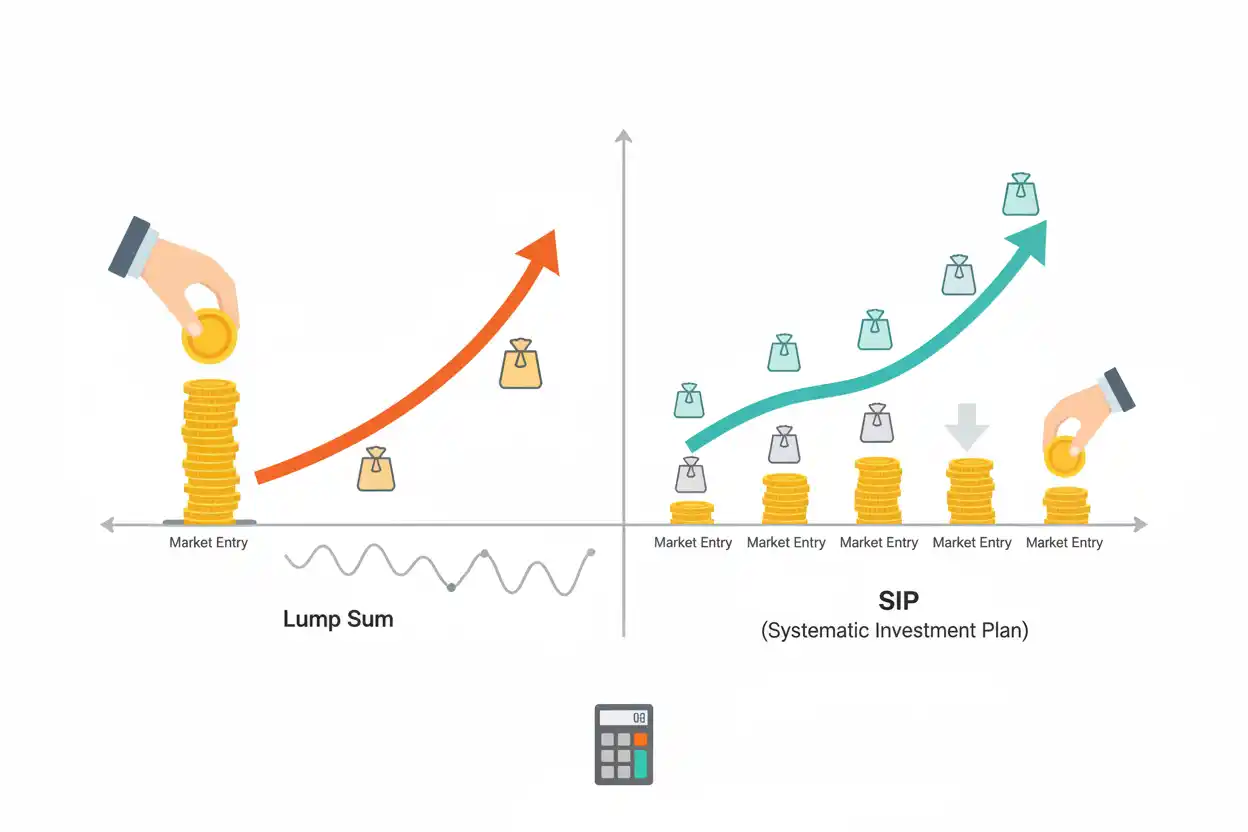
Lump sum vs SIP compares two different ways of putting available investment capital into the market.
A lump sum invests the available amount at once.
A SIP, or systematic investment plan, invests fixed amounts at regular intervals.
Neither approach guarantees a higher return.
If markets rise after the starting date, investing earlier can benefit because more money receives the full period of market growth. If markets decline after the initial date, phased investing can purchase later units at lower prices and reduce the impact of committing everything at the initial price.
The better result depends on the actual path of future prices.
What Is Lump-Sum Investing?
Lump-sum investing means investing an available amount immediately rather than deliberately spreading purchases across future dates.
If $12,000 is available today:
Lump Sum Investment = $12,000 Today
The entire amount receives market exposure from the start.
This maximizes time in the market for the available capital, but it also means the investor experiences the full impact of any decline immediately after investing.
What Is SIP Investing?
A SIP divides investment purchases into regular contributions.
For example:
$1,000 per month × 12 months = $12,000
Instead of buying everything at today’s price, the investor purchases units at 12 different prices.
If prices fall, later contributions buy more units.
If prices rise, later contributions buy fewer units.
Lump Sum vs SIP: Constant Return Example
Suppose $12,000 is available at the beginning of a 12-month period.
Assume a hypothetical nominal return of 8% per year compounded monthly.
Monthly rate:
Monthly Rate = 8% ÷ 12
Monthly Rate ≈ 0.6667%
Lump Sum
The entire $12,000 is invested for 12 months:
FV = $12,000 × (1 + 0.08 ÷ 12)^12
FV ≈ $12,995.99
SIP
Now invest $1,000 at the end of each month:
FV = $1,000 × [(1 + 0.08 ÷ 12)^12 − 1] ÷ (0.08 ÷ 12)
FV ≈ $12,449.93
Difference:
$12,995.99 − $12,449.93
≈ $546.07
Under a smooth positive-return assumption, the lump sum ends approximately $546 higher because more capital was invested earlier.
Why Lump Sum Wins in the Constant-Growth Example
The difference does not occur because lump-sum investing has a special return formula.
It occurs because the $12,000 receives the full 12 months of growth.
With SIP:
- the first contribution receives almost the full period;
- later contributions receive progressively less time;
- the final contribution receives almost no compounding before the measurement date.
When returns are consistently positive, earlier exposure mathematically has an advantage.
What If SIP Payments Are Made at the Beginning of Each Month?
Beginning-of-month contributions receive one additional compounding period.
Using the same assumptions:
Beginning-of-Month SIP FV = End-of-Month SIP FV × (1 + Monthly Rate)
≈ $12,449.93 × 1.0066667
≈ $12,532.93
The result improves, but the original lump sum still ends higher under the smooth positive-return assumption because all $12,000 was invested from day one.
Unit-Purchase Example
Suppose an investor has $4,000 and considers four monthly $1,000 purchases.
Prices are:
- Month 1 = $100;
- Month 2 = $80;
- Month 3 = $50;
- Month 4 = $100.
SIP purchases:
Month 1:
$1,000 ÷ $100 = 10 units
Month 2:
$1,000 ÷ $80 = 12.5 units
Month 3:
$1,000 ÷ $50 = 20 units
Month 4:
$1,000 ÷ $100 = 10 units
Total:
52.5 units
Average cost:
$4,000 ÷ 52.5
≈ $76.19 per unit
The simple arithmetic average of the four market prices is:
($100 + $80 + $50 + $100) ÷ 4 = $82.50
The investor’s actual average purchase price is lower because more units were bought at lower prices.
Lump Sum in the Same Price Sequence
Suppose instead the full $4,000 was invested at the first $100 price.
Units Purchased = $4,000 ÷ $100
Units Purchased = 40
At the ending $100 price:
Ending Value = 40 × $100
Ending Value = $4,000
The SIP investor owns 52.5 units worth:
52.5 × $100 = $5,250
In this specific hypothetical price path, SIP performs better because prices fell substantially after the initial date and later recovered.
This does not prove SIP always produces better returns. It demonstrates why market sequence determines the comparison.
Rising-Market Example
Suppose prices instead rise:
- $50;
- $60;
- $70;
- $80.
A $4,000 lump sum at $50 buys:
$4,000 ÷ $50 = 80 units
At $80:
Ending Value = 80 × $80
Ending Value = $6,400
Four $1,000 SIP contributions buy:
$1,000 ÷ $50 = 20 units
$1,000 ÷ $60 ≈ 16.67 units
$1,000 ÷ $70 ≈ 14.29 units
$1,000 ÷ $80 = 12.5 units
Total:
≈ 63.45 units
Ending value:
63.45 × $80 ≈ $5,076
The lump sum performs better because it purchases more units before prices rise.
Lump Sum vs SIP Is Mainly a Timing Decision
If the full investment amount is already available, the decision concerns when to expose it to the market.
Lump sum:
More immediate market exposure
SIP:
Gradual market exposure
If money is not yet available—for example, it arrives monthly from salary—then recurring investing is not really competing with a lump sum of money that exists today.
The investor cannot invest capital that has not yet been earned.
This distinction is crucial when comparing strategies fairly.
Lump Sum vs Dollar-Cost Averaging
SIP resembles dollar-cost averaging because both involve repeated fixed investments.
The core mechanism is:
Units Purchased = Contribution ÷ Unit Price
Lower prices result in more units.
Higher prices result in fewer.
The approach reduces dependence on one entry price but does not guarantee a profit or protect against a prolonged decline.
Lump Sum Investing and Time in the Market
The dedicated lump-sum investing approach emphasizes putting already available capital to work immediately.
The argument is mathematical: when expected returns are positive, waiting keeps part of the capital outside the market.
However, expected return does not tell you what happens immediately after investing.
A severe decline can occur the day after a lump sum is invested.
SIP and Behavioral Risk
Some investors may find gradual investing psychologically easier.
Suppose someone invests $100,000 at once and the market immediately falls 20%.
The account would decline to:
$100,000 × 0.80 = $80,000
Even if the investor’s long-term plan remains sound, the emotional impact can lead to panic selling.
A phased strategy may reduce regret around one entry date, although it cannot eliminate losses after the capital is eventually invested.
Lump Sum vs SIP and Maximum Drawdown
Maximum drawdown measures the largest peak-to-trough decline experienced by an investment or portfolio.
If a lump sum is invested immediately before a major drawdown, the full capital experiences the decline.
With SIP, some planned capital may still be uninvested while the market falls.
However, once the SIP is fully invested, it is also exposed to future drawdowns.
SIP changes the timing of exposure rather than eliminating market risk.
Lump Sum vs SIP and Investment Growth
Investment growth depends on:
- contributions;
- returns;
- time;
- withdrawals;
- costs.
The lump sum vs SIP choice changes the amount of time each dollar participates in those returns.
A lump sum maximizes investment time immediately.
A SIP distributes investment time across many contributions.
Lump Sum vs SIP and Inflation
Cash waiting to be invested can lose purchasing power because of inflation.
Suppose capital remains in low-yield cash while the investor phases into the market over several years.
Even if the phased approach reduces market-entry risk, uninvested capital can experience inflation drag.
The return earned on the waiting cash should therefore be included in a fair comparison.
Lump Sum vs SIP Inside an IRA
An IRA can receive a permitted contribution or rollover, after which the cash can be invested.
Depositing money into an IRA does not automatically mean the money has been invested.
An IRA owner can therefore face a separate timing decision:
- invest available account cash immediately;
- invest it gradually.
The account’s tax status and the investment-entry strategy are distinct.
Compare Equal Amounts
A fair comparison should use the same total capital.
Suppose Strategy A invests:
$12,000 lump sum
while Strategy B invests:
$500 × 12 = $6,000
Comparing their ending balances does not isolate strategy because the amount invested differs.
Always normalize:
- total capital;
- time horizon;
- costs;
- investment exposure.
Include the Return on Waiting Cash
During a SIP schedule, money not yet invested may remain in:
- cash;
- a savings account;
- another short-term vehicle.
If that waiting money earns interest, include it in the comparison.
Otherwise, the analysis gives the lump-sum strategy full investment returns while assuming the uninvested SIP capital earns nothing.
That may not reflect reality.
Fees Can Change the Result
If every investment transaction carries a fixed cost, frequent SIP purchases can create more transaction expenses.
Suppose:
- monthly contribution = $100;
- transaction fee = $5.
Only:
$100 − $5 = $95
is actually invested.
The fee consumes:
$5 ÷ $100 = 5%
of each contribution.
Where transaction costs are negligible, this concern is much smaller.
Taxes Can Matter
In taxable accounts, investment timing can affect:
- acquisition dates;
- cost basis;
- realization of gains or losses;
- dividend timing.
The exact tax impact depends on jurisdiction and individual circumstances.
Tax effects should therefore be separated from the basic market-return comparison.
Lump Sum Does Not Mean One Investment
“Lump sum” describes timing, not diversification.
An investor can put a lump sum into:
- one stock;
- a diversified fund;
- several asset classes.
Similarly, a SIP can repeatedly buy either a diversified portfolio or one concentrated asset.
Diversification and entry timing are separate decisions.
SIP Does Not Guarantee a Lower Average Cost
If prices rise continuously, each new SIP contribution buys at a higher price.
For example:
$20 → $25 → $30 → $35
The average purchase cost can be higher than the original $20 entry price.
SIP reduces dependence on a single starting price; it does not guarantee that later prices will be lower.
Which Strategy Has Higher Expected Return?
If:
- the entire capital is available now;
- the investment has a positive expected return;
- risk and asset allocation are identical;
earlier investment gives the capital more expected time to earn that return.
That creates an expected-return advantage for lump-sum investing.
But actual realized returns depend on the path markets take after the starting date.
Expected outcome and guaranteed outcome are not the same thing.
When SIP Can Be Practical
SIP can be practical when:
- money becomes available gradually;
- an investor wants automated recurring contributions;
- committing a large amount at once creates behavioral difficulty;
- the investor deliberately chooses to reduce immediate entry exposure.
The choice should be intentional rather than based on the belief that SIP mathematically prevents losses.
When Lump Sum Can Be Practical
Lump-sum investing can be practical when:
- capital is already available;
- the investor has a long horizon;
- the portfolio is appropriately diversified;
- the investor can tolerate immediate market volatility;
- holding uninvested cash has little strategic purpose.
The correct decision still depends on the investor’s circumstances.
Common Lump Sum vs SIP Mistakes
One mistake is comparing different total investment amounts.
Another is assuming SIP always lowers average cost.
People also frequently ignore returns earned on uninvested cash.
A further mistake is judging the strategy from one historical period and assuming the result must repeat.
Finally, lump sum vs SIP should not substitute for asset-allocation and risk decisions.
Frequently Asked Questions
What is the difference between lump sum and SIP?
A lump sum invests available capital immediately. SIP spreads investments across recurring future dates.
Which usually has more time in the market?
Lump-sum investing, because the entire available amount is invested from the start.
Does SIP guarantee better returns?
No. Returns depend on future market prices.
Does lump sum guarantee better returns?
No. A market decline immediately after investment can cause substantial losses.
Why can SIP perform well in falling markets?
Later contributions can purchase more units at lower prices.
Why can lump sum perform well in rising markets?
More units are purchased before prices rise, and the full amount receives more time in the market.
How do I calculate average SIP cost?
Average Cost per Unit = Total Amount Invested ÷ Total Units Purchased
Should I simply average all purchase prices?
No. Fixed-dollar purchases acquire different quantities at each price, so total dollars divided by total units is the correct average cost.
Is SIP the same as dollar-cost averaging?
They use a similar recurring-investment mechanism, although terminology and implementation can vary by market and product.
Should I compare SIP with lump sum if I do not have the lump sum available?
Not really. If money becomes available only gradually, investing it periodically is different from deliberately delaying already available capital.
Does inflation affect the decision?
Yes. Money held outside the market can lose purchasing power if its return does not keep pace with inflation.
Which approach should I choose?
The choice depends on when capital is available, time horizon, risk tolerance, behavioral preferences, investment costs, and the broader Savings & Investing strategy.