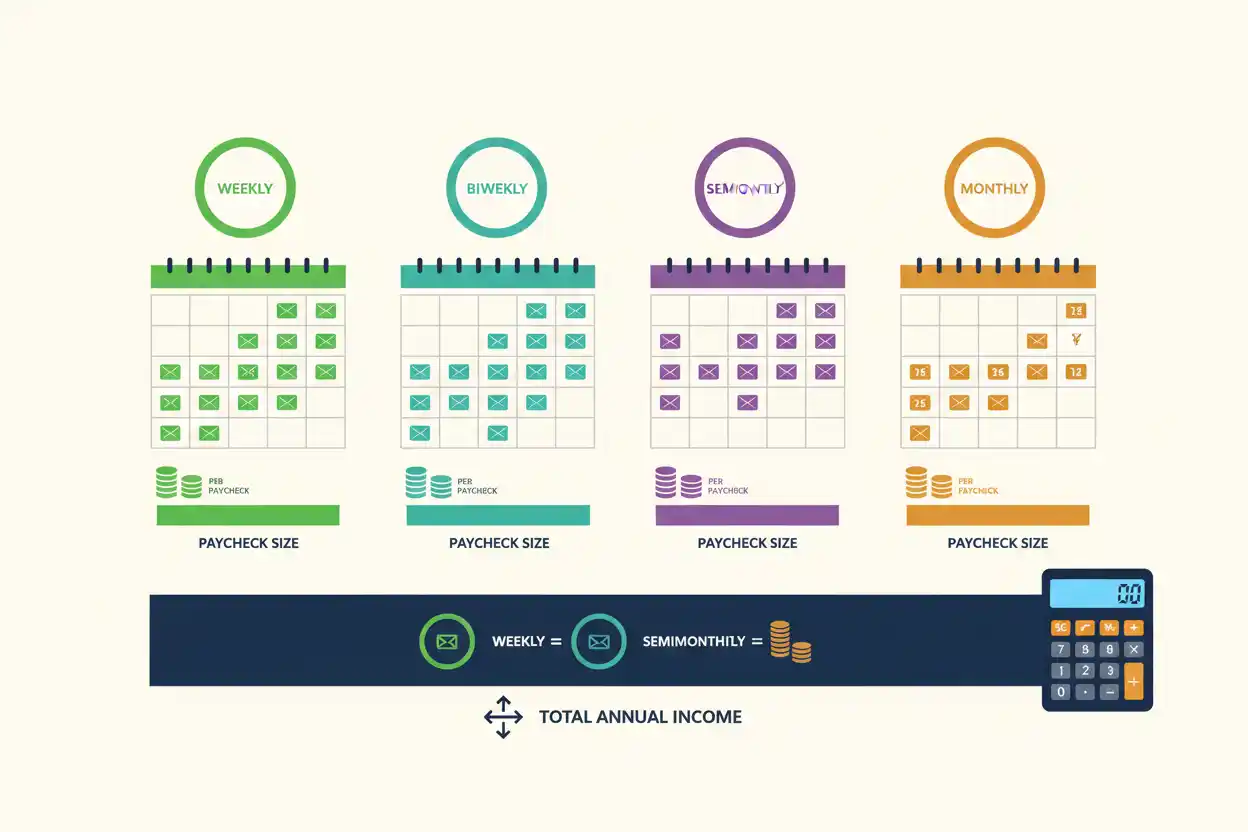

Pay frequency describes how often an employee receives a paycheck.
A $78,000 annual salary produces very different individual paycheck amounts depending on whether payroll is weekly, biweekly, semimonthly, or monthly.
With the same $78,000 annual salary, regular gross pay is $1,500 weekly, $3,000 biweekly, $3,250 semimonthly, or $6,500 monthly.
The annual compensation does not change simply because the pay schedule changes.
Pay Frequency Formula
When annual pay is known:
Pay per Period = Annual Pay ÷ Number of Annual Pay Periods
Common planning frequencies are:
Weekly = 52 Pay Periods
Biweekly = 26 Pay Periods
Semimonthly = 24 Pay Periods
Monthly = 12 Pay Periods
Actual payroll calendars should be checked because calendar alignment and employer practices can create exceptions.
Weekly Pay Example
Suppose:
Annual Salary = $78,000
Weekly gross pay:
$78,000 ÷ 52
= $1,500
The employee receives smaller checks more frequently.
Biweekly Pay Example
With 26 regular pay periods:
$78,000 ÷ 26
= $3,000
A biweekly employee is normally paid every two weeks.
Semimonthly Pay Example
With 24 pay periods:
$78,000 ÷ 24
= $3,250
Semimonthly commonly means two regular pay dates per calendar month.
Monthly Pay Example
With 12 pay periods:
$78,000 ÷ 12
= $6,500
The paycheck is larger because there are fewer payments.
Same Annual Pay, Different Check Size
The examples produce:
Weekly:
$1,500 × 52 = $78,000
Biweekly:
$3,000 × 26 = $78,000
Semimonthly:
$3,250 × 24 = $78,000
Monthly:
$6,500 × 12 = $78,000
The total is the same.
Pay frequency changes the timing and size of payments rather than automatically changing annual compensation.
Biweekly vs Semimonthly
These schedules are frequently confused.
Biweekly means every two weeks and commonly produces 26 checks.
Semimonthly means twice per month and produces 24 checks.
At $78,000:
Biweekly = $3,000
Semimonthly = $3,250
The semimonthly check is $250 larger because the same annual amount is divided among two fewer paychecks.
Why Biweekly Checks Create Extra-Paycheck Months
A biweekly schedule is based on a 14-day cycle rather than calendar months.
Most months contain two pay dates, but some contain three.
This explains why monthly income from biweekly pay should be calculated as:
Biweekly Pay × 26 ÷ 12
rather than simply:
Biweekly Pay × 2
Average Monthly Income by Pay Frequency
Suppose annual income is $62,400.
Average monthly income is always:
$62,400 ÷ 12 = $5,200
If weekly pay is:
$1,200
then:
$1,200 × 52 ÷ 12 = $5,200
If biweekly pay is:
$2,400
then:
$2,400 × 26 ÷ 12 = $5,200
Frequency changes the payment schedule, not the annual average.
Pay Frequency and Net Pay
Net pay can also be distributed across different frequencies.
Suppose annual net compensation is:
$52,000
Weekly:
$52,000 ÷ 52 = $1,000
Biweekly:
$52,000 ÷ 26 = $2,000
Semimonthly:
$52,000 ÷ 24 ≈ $2,166.67
Monthly:
$52,000 ÷ 12 ≈ $4,333.33
The annual total remains $52,000 under the simplified model.
Pay Frequency and Overtime
Overtime pay can make individual checks vary even when base salary or hourly rate stays unchanged.
Suppose normal biweekly gross pay is:
$2,000
and one pay period includes:
$350 of Overtime
Gross check:
$2,350
The employee is still on a biweekly schedule.
A larger paycheck does not change pay frequency.
Pay Frequency and Pay Raise Percentage
Suppose a pay raise percentage increases annual salary by 8%.
Old salary:
$65,000
New salary:
$65,000 × 1.08
= $70,200
Biweekly check before raise:
$65,000 ÷ 26 = $2,500
After raise:
$70,200 ÷ 26 = $2,700
The $200-per-check increase reflects the raise while the biweekly frequency remains unchanged.
Pay Frequency and Broader Pay Raises
A broader pay raise comparison can include the dollar increase and its effect on annual compensation.
Frequency determines how that annual increase appears on each paycheck.
Suppose an annual raise is:
$5,200
Weekly increase:
$5,200 ÷ 52 = $100
Biweekly increase:
$5,200 ÷ 26 = $200
Semimonthly increase:
$5,200 ÷ 24 ≈ $216.67
Monthly increase:
$5,200 ÷ 12 ≈ $433.33
Converting Weekly Pay to Biweekly Pay
When annual compensation is constant:
Biweekly Equivalent = Weekly Pay × 2
For:
Weekly Pay = $1,200
Biweekly equivalent:
$2,400
This conversion works because one biweekly period contains two weeks.
Converting Semimonthly to Biweekly
Directly converting one semimonthly paycheck to one biweekly paycheck requires annualization.
Suppose:
Semimonthly Pay = $3,000
Annual income:
$3,000 × 24
= $72,000
Biweekly equivalent:
$72,000 ÷ 26
≈ $2,769.23
Simply dividing or multiplying by two would be incorrect.
Annualizing a Paycheck
General formula:
Annual Pay = Pay per Period × Pay Periods per Year
If weekly:
Pay × 52
If biweekly:
Pay × 26
If semimonthly:
Pay × 24
If monthly:
Pay × 12
The pay-frequency label determines the correct multiplier.
A 27-Pay-Date Year
Calendar alignment can occasionally produce 27 biweekly pay dates.
That does not mean every salaried worker automatically receives one full extra annual salary installment.
Payroll systems can handle such years differently.
For compensation planning, use the employer’s actual payroll calendar and salary policy rather than assuming:
Normal Biweekly Pay × 27
must equal the year’s contractual salary.
Budgeting With Weekly Pay
Weekly pay provides frequent cash inflows.
Suppose net weekly income is:
$1,000
Average monthly amount:
$1,000 × 52 ÷ 12
≈ $4,333.33
A monthly budget can use the annualized average while maintaining enough cash to handle calendar timing.
Budgeting With Biweekly Pay
Suppose net biweekly pay is:
$2,000
A household might plan ordinary monthly spending around two checks:
$4,000
while directing the two extra annual checks toward irregular expenses or savings.
Alternatively, income can be smoothed at:
$2,000 × 26 ÷ 12
≈ $4,333.33 per Month
Both methods can work when cash timing is managed deliberately.
Budgeting With Semimonthly Pay
Semimonthly schedules align more naturally with monthly expenses because two regular checks arrive in every month.
If each net check is:
$2,100
monthly net income is:
$4,200
The exact pay dates may still matter when bills are due early or late in the month.
Pay Frequency Does Not Change Hourly Wage
Suppose an hourly employee earns:
$25 per Hour
Changing payroll from weekly to biweekly does not make the underlying hourly rate:
$50 per Hour
The employee simply receives two weeks of accumulated wages in each ordinary biweekly paycheck.
Pay Frequency Does Not Determine Tax Rate
A worker paid weekly and another paid monthly can have the same annual compensation.
Different paycheck withholding amounts can result from payroll calculations, but pay frequency does not itself create a different statutory annual tax rate.
Annual tax liability depends on the broader tax calculation.
Common Pay Frequency Mistakes
A common mistake is treating biweekly and semimonthly as synonyms.
Another is multiplying biweekly pay by 24, converting semimonthly pay directly to biweekly without annualizing, or assuming a different pay schedule changes annual compensation.
Frequently Asked Questions
What is pay frequency?
It is how often an employee receives payroll payments.
How many weekly pay periods are there?
A common annual planning assumption is 52.
How many biweekly pay periods are there?
Normally 26.
How many semimonthly pay periods are there?
How many monthly pay periods are there?
Is biweekly the same as twice monthly?
No.
How do I calculate pay per period?
Pay per Period = Annual Pay ÷ Annual Pay Periods
Does changing pay frequency change salary?
Not by itself.
Why are biweekly and semimonthly check amounts different?
The same annual compensation is divided across 26 versus 24 payments.
Can biweekly years ever contain 27 pay dates?
Yes, depending on calendar alignment.
Does pay frequency change overtime eligibility?
Not by itself.
Why is pay frequency important?
It determines paycheck timing and conversion math, which affects cash-flow planning even when annual compensation remains unchanged.