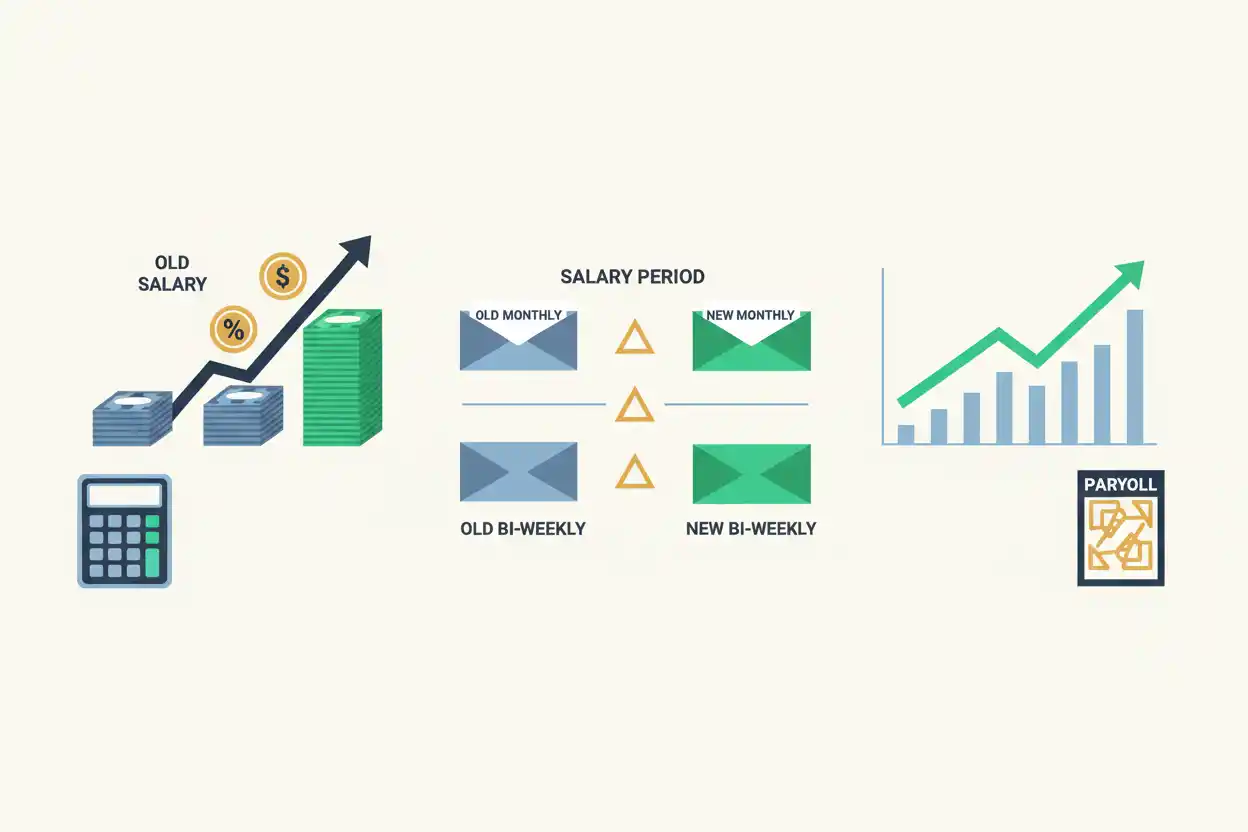

Pay raises increase an employee’s compensation from an existing salary or wage to a new amount. A raise can be expressed as a dollar increase, a percentage increase, or both.
If annual salary rises from $60,000 to $64,800, the employee receives a $4,800 annual increase.
Pay Raise = $64,800 − $60,000 = $4,800
Relative to the old salary:
Pay Raise Percentage = $4,800 ÷ $60,000 × 100 = 8%
The employee’s new salary is therefore $64,800 after an 8% raise.
How to Calculate a Pay Raise
When the old salary and raise percentage are known:
New Salary = Old Salary × (1 + Raise Rate)
Suppose the current salary is $72,000 and the employee receives a 6% raise.
New Salary = $72,000 × 1.06
= $76,320
Annual dollar increase:
$76,320 − $72,000
= $4,320
The employee earns $4,320 more in gross annual salary.
Calculate the Raise Percentage From Old and New Pay
When both salaries are known:
Pay Raise Percentage = (New Pay − Old Pay) ÷ Old Pay × 100
Suppose salary rises from:
$80,000 to $86,000
Increase:
$6,000
Then:
$6,000 ÷ $80,000 × 100
= 7.5%
The dedicated pay raise percentage calculation is especially useful when the percentage itself is the main question. A broader pay raise analysis also considers what the increase means for annual, monthly, hourly, and paycheck compensation.
Monthly Effect of a Raise
Using the original $60,000 to $64,800 example:
Old monthly gross salary:
$60,000 ÷ 12 = $5,000
New monthly gross salary:
$64,800 ÷ 12 = $5,400
Monthly gross increase:
$5,400 − $5,000 = $400
An $4,800 annual raise therefore creates a $400 increase in average monthly gross compensation.
The increase in take-home cash will normally be smaller because payroll taxes, income-tax withholding, benefits, and other deductions can change.
Biweekly Effect of a Raise
Suppose the employee is paid every two weeks.
Old biweekly gross pay:
$60,000 ÷ 26 ≈ $2,307.69
New biweekly gross pay:
$64,800 ÷ 26 ≈ $2,492.31
Increase per regular paycheck:
$2,492.31 − $2,307.69
≈ $184.62
The annual raise remains $4,800. Pay frequency determines how that amount is distributed among individual checks.
Semimonthly Effect
If the same employee receives 24 semimonthly checks:
Old paycheck:
$60,000 ÷ 24 = $2,500
New paycheck:
$64,800 ÷ 24 = $2,700
Increase:
$200 per Paycheck
The semimonthly increase is larger than the biweekly increase because the same annual raise is divided across 24 rather than 26 checks.
Weekly Effect
For weekly payroll:
Annual Raise ÷ 52
Using a $4,800 raise:
$4,800 ÷ 52
≈ $92.31 per Week
This is the gross increase before payroll deductions.
Hourly Pay Raise
Pay raises can also apply to hourly compensation.
Suppose the hourly wage rises from:
$22 to $24
Dollar increase:
$2 per Hour
Percentage increase:
$2 ÷ $22 × 100
≈ 9.09%
If the employee works a modeled 2,080 paid hours annually:
Old annualized pay:
$22 × 2,080 = $45,760
New annualized pay:
$24 × 2,080 = $49,920
Annualized increase:
$4,160
The calculation assumes 2,080 paid hours. Actual annual income can differ when hours fluctuate.
Raise From a Dollar Amount
Suppose management says:
Your Annual Raise Is $5,000
and current salary is:
$70,000
New salary:
$75,000
Raise percentage:
$5,000 ÷ $70,000 × 100
≈ 7.14%
A dollar raise should be evaluated relative to existing compensation before comparing it with another employee’s raise.
Comparing Dollar and Percentage Raises
Employee A earns $40,000 and receives $4,000 more.
Raise = 10%
Employee B earns $100,000 and receives $6,000 more.
Raise = 6%
Employee B receives the larger dollar increase, while Employee A receives the larger proportional increase.
Neither comparison is inherently more correct. They answer different questions.
Successive Pay Raises Compound
Suppose salary begins at $60,000.
A 5% raise produces:
$60,000 × 1.05 = $63,000
The following year, a 7% raise applies to $63,000:
$63,000 × 1.07
= $67,410
Cumulative increase:
$67,410 − $60,000
= $7,410
Cumulative percentage increase:
$7,410 ÷ $60,000 × 100
= 12.35%
Simply adding 5% and 7% would produce 12%, which slightly understates the compounded increase.
General Formula for Multiple Raises
For several successive raises:
New Pay = Original Pay × (1 + r₁) × (1 + r₂) × … × (1 + rₙ)
This approach is more accurate than simply adding percentages.
For 3%, 4%, and 5% raises:
Cumulative Growth Factor = 1.03 × 1.04 × 1.05
≈ 1.12476
Total increase:
≈ 12.48%
rather than exactly 12%.
Raise Needed to Reach a Target Salary
Suppose current salary is:
$68,000
and the target is:
$75,000
Required dollar increase:
$75,000 − $68,000 = $7,000
Required raise percentage:
$7,000 ÷ $68,000 × 100
≈ 10.29%
A 10% raise would produce only:
$68,000 × 1.10 = $74,800
which is $200 below the target.
Reverse a Raise
Suppose someone currently earns:
$66,000
after a 10% raise.
The old salary is not $59,400.
Instead:
Old Salary = New Salary ÷ (1 + Raise Rate)
$66,000 ÷ 1.10
= $60,000
The raise was calculated from the old salary, so reversing it requires division.
Pay Raises and Salary Conversions
A new salary can be translated into other frequencies using salary conversions.
Suppose salary rises to $78,000.
Monthly:
$78,000 ÷ 12 = $6,500
Biweekly:
$78,000 ÷ 26 = $3,000
Weekly:
$78,000 ÷ 52 = $1,500
Using the same annual amount across each conversion prevents pay-frequency comparisons from becoming inconsistent.
Pay Raises and Overtime
A higher base hourly wage can also increase overtime pay when overtime is calculated as a multiple of the regular rate.
Suppose an employee’s wage rises:
$20 → $22
At a 1.5× overtime multiplier:
Old overtime rate:
$20 × 1.5 = $30
New overtime rate:
$22 × 1.5 = $33
The $2 base-wage increase creates a $3 increase in the overtime hourly rate.
Pay Raises and Payroll Tax
A pay increase can also increase applicable payroll tax amounts because a larger amount of wages is being paid.
Suppose annual gross pay rises by $5,000.
If a particular illustrative payroll tax applied to those additional wages at 1.5%:
Additional Tax = $5,000 × 1.5%
= $75
The gross raise remains $5,000. Payroll effects determine part of the difference between gross and net compensation.
Nominal Raise vs Real Raise
Inflation affects the purchasing power of a raise.
Suppose salary rises 8% while prices rise 3%.
A quick approximation gives:
Approximate Real Raise ≈ 8% − 3% = 5%
The more precise calculation is:
Real Raise = (1 + Nominal Raise) ÷ (1 + Inflation) − 1
= 1.08 ÷ 1.03 − 1
≈ 4.85%
An 8% nominal raise therefore produces approximately 4.85% real improvement under the 3% inflation assumption.
Raise Equal to Inflation
Suppose both salary and prices rise 4%.
Nominal salary is higher, but real purchasing power is approximately unchanged:
1.04 ÷ 1.04 − 1 = 0%
This is why the size of a raise should sometimes be considered in both nominal and inflation-adjusted terms.
Raise Below Inflation
Suppose salary rises 3% while inflation is 5%.
Real Change = 1.03 ÷ 1.05 − 1
≈ −1.90%
The employee receives more nominal dollars but loses purchasing power under the simplified assumptions.
Raise Percentage vs Take-Home Increase
Suppose gross annual salary increases 10%.
The employee’s net annual pay may rise by:
7%, 8%, 9%, or Another Amount
depending on tax and deduction changes.
Therefore:
Gross Raise Percentage ≠ Automatically Net Pay Increase Percentage
The gross raise should be measured first, then payroll deductions should be recalculated separately.
Raise Effective Midyear
Suppose salary is $60,000 and an 8% raise takes effect exactly halfway through the year.
Old annual rate:
$60,000
New annual rate:
$64,800
Six months at old rate:
$30,000
Six months at new rate:
$32,400
Actual gross pay for that calendar year:
$62,400
The employee’s new salary rate is $64,800, but current-year earnings are only $62,400 because the raise did not apply for the full year.
Raise Effective for Three Months
Using the same salaries, suppose the raise applies only for the final three months.
Nine months at old rate:
$60,000 × 9 ÷ 12 = $45,000
Three months at new rate:
$64,800 × 3 ÷ 12 = $16,200
Total annual gross:
$61,200
This distinction matters when reconciling year-end compensation.
Raise Plus Bonus
Suppose salary increases from $70,000 to $75,000 and a $5,000 bonus is also awarded.
New base salary:
$75,000
First-year salary plus bonus:
$80,000
The permanent base increase is:
$5,000
The bonus adds another $5,000 only for the period in which it is earned.
A one-time bonus should not be incorporated into future salary unless the compensation agreement actually changes the base.
Common Pay Raise Mistakes
A common mistake is dividing the increase by the new salary instead of the old salary. Another is adding successive percentage increases rather than compounding them.
Employees can also confuse the annual salary rate with actual current-year earnings when a raise begins partway through the year, or assume the entire gross increase will appear in take-home pay.
Frequently Asked Questions
How do I calculate a pay raise?
New Pay = Old Pay × (1 + Raise Rate)
How do I calculate the raise percentage?
(New Pay − Old Pay) ÷ Old Pay × 100
What is an 8% raise on $60,000?
$60,000 × 1.08 = $64,800
How much is that per month?
The gross increase is:
$4,800 ÷ 12 = $400 per Month
Does an 8% raise increase take-home pay by exactly 8%?
Not necessarily.
How do two consecutive raises combine?
Multiply the growth factors rather than simply adding the percentages.
Do two 10% raises equal 20%?
No. They produce 21% cumulative growth.
How do I reverse a raise?
Old Pay = New Pay ÷ (1 + Raise Rate)
Does a raise increase overtime rates?
It can when overtime is calculated as a multiple of the regular hourly rate.
What if a raise starts halfway through the year?
Only the portion of the year after the effective date receives the new rate.
Is a raise above inflation a real increase in purchasing power?
Generally yes, although the exact real increase should be calculated using the ratio of the salary and inflation growth factors.
Is a bonus the same as a pay raise?
No. A raise changes the recurring compensation rate, while a bonus can be a one-time or variable payment.