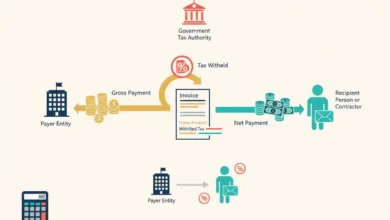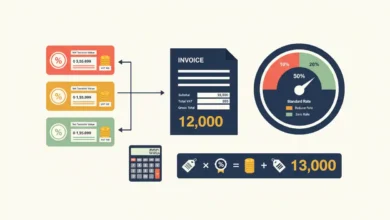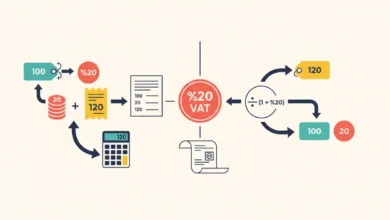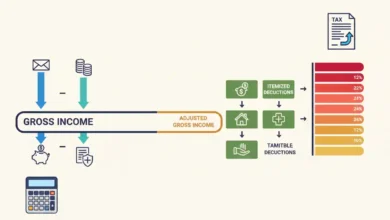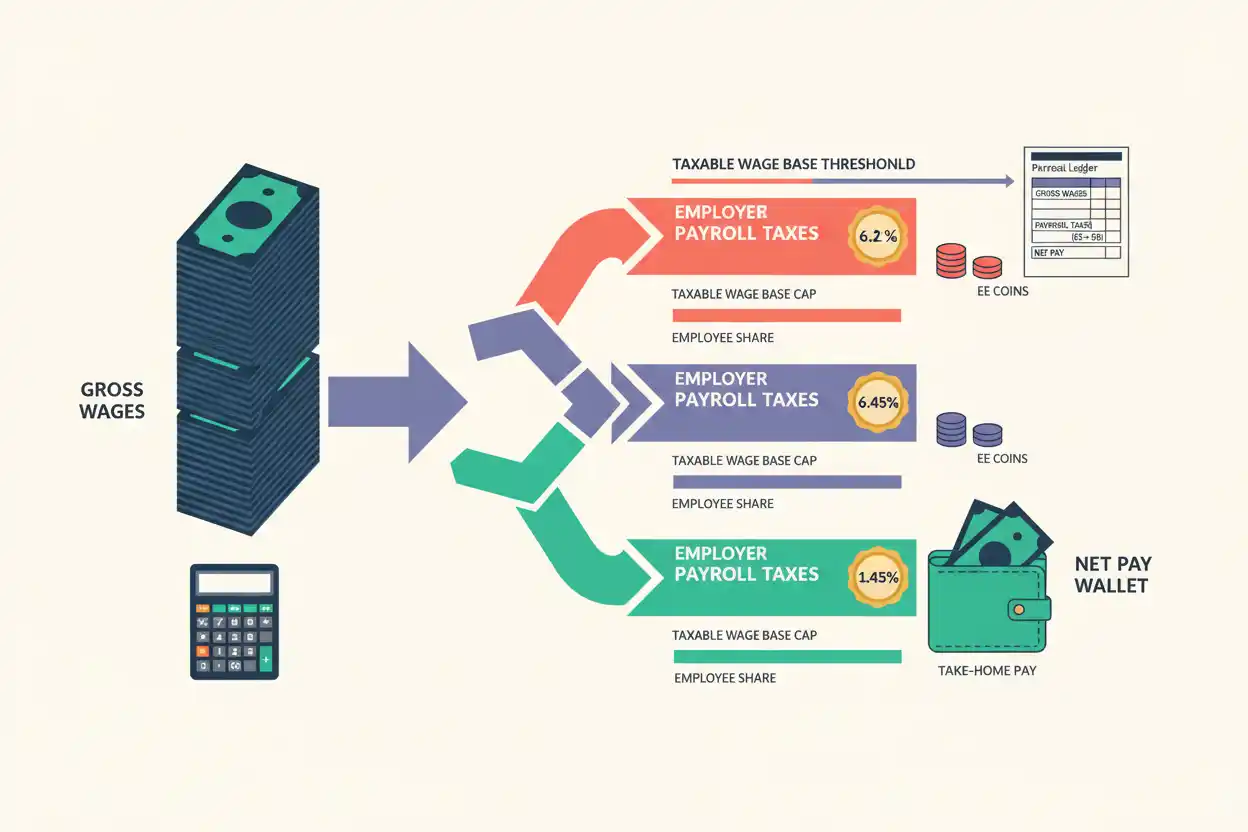

Payroll tax is a tax calculated from wages or other covered payroll compensation.
The basic arithmetic is:
Payroll Tax = Taxable Payroll Wages × Applicable Payroll Tax Rate
However, payroll tax is not always one single percentage. Different components can apply to different wage bases, some taxes are withheld from employees, some are paid by employers, and certain taxes can stop or change after an annual wage threshold is reached.
Suppose a hypothetical payroll tax applies at 6% to $5,000 of taxable wages.
Payroll Tax = $5,000 × 6%
= $300
If the employee pays the $300 through withholding, it reduces take-home pay. If the employer owes a separate $300 tax, that employer amount increases labor cost without being deducted from the employee’s gross paycheck.
Payroll Tax Formula
For one tax component:
Payroll Tax = Taxable Wages × Tax Rate
When several payroll taxes apply:
Total Payroll Tax = Tax Component 1 + Tax Component 2 + …
This component-by-component method is more reliable than applying one combined rate without first checking whether every component uses the same taxable wage base.
Employee Payroll Tax Example
Suppose:
Gross Pay = $5,000
and the employee’s applicable taxable wage base for an illustrative payroll tax is also $5,000.
At an illustrative rate of 6%:
Employee Payroll Tax = $5,000 × 0.06
= $300
If no other deductions existed:
Pay After This Tax = $5,000 − $300
= $4,700
Real payroll normally contains additional taxes and deductions.
Employer Payroll Tax Example
Suppose the employer separately owes an illustrative 7% payroll tax on the same $5,000 wage base.
Employer Payroll Tax = $5,000 × 7%
= $350
Simplified employer compensation cost:
$5,000 Wages + $350 Employer Payroll Tax
= $5,350
The employee’s gross pay remains $5,000.
Employer payroll tax is not automatically an employee deduction.
Employee vs Employer Payroll Tax
This distinction is central.
Suppose:
Employee Payroll Tax = $300
Employer Payroll Tax = $350
Combined tax associated with the payroll:
$650
But employee net pay should not be reduced by the full $650.
Only the employee’s applicable withholding belongs in the employee-side net-pay calculation.
Multiple Payroll Tax Components
Suppose a simplified payroll contains two employee taxes:
Tax A:
$4,000 × 5% = $200
Tax B:
$4,000 × 1.5% = $60
Total employee payroll tax:
$200 + $60 = $260
Combined employee rate:
$260 ÷ $4,000
= 6.5%
This combined shortcut works only because both taxes use the same $4,000 wage base in the example.
Different Wage Bases
Now suppose Tax A applies to:
$4,000
while Tax B applies to only:
$3,500
At the same rates:
Tax A:
$4,000 × 5% = $200
Tax B:
$3,500 × 1.5% = $52.50
Total:
$252.50
Applying 6.5% directly to $4,000 would produce $260 and overstate the result by $7.50.
The wage base matters as much as the rate.
Payroll Tax vs Income Tax
Payroll tax and income tax are not interchangeable.
Payroll tax generally begins with covered wage compensation.
Income tax uses a broader tax calculation involving income, adjustments, deductions, credits, and tax brackets.
A paycheck can therefore contain both payroll-tax withholding and income-tax withholding.
Adding them together and labeling the entire amount “payroll tax” can be misleading.
Payroll Tax and Pay Raises
Pay raises can increase payroll-tax amounts because taxable wages rise.
Suppose annual salary rises:
$60,000 → $64,800
Increase:
$4,800
If an illustrative payroll tax applies to all additional wages at 6%:
Additional Payroll Tax = $4,800 × 6%
= $288
The employee’s gross annual raise remains $4,800.
The tax affects how much of that increase ultimately remains as net cash.
Payroll Tax and Pay Raise Percentage
The pay raise percentage measures compensation growth rather than tax.
Suppose salary rises 8%.
It does not follow that:
Payroll Tax Rate Also Rises 8%
If the tax rate stays constant and the entire wage increase remains taxable, the dollar tax may rise approximately in proportion with wages while the tax rate stays unchanged.
Payroll Tax and Salary Conversions
Salary conversions can help translate an annual wage base into each payroll period.
Suppose salary is:
$78,000
Biweekly gross pay:
$78,000 ÷ 26 = $3,000
If a hypothetical tax applies at 5% to the entire biweekly amount:
$3,000 × 5% = $150
Across 26 identical periods:
$150 × 26 = $3,900
which also equals:
$78,000 × 5% = $3,900
The annual and per-period calculations reconcile.
Payroll Tax and Salary Reduction
A salary reduction percentage can reduce taxable payroll compensation when the reduction changes actual wages.
Suppose annual salary falls from:
$80,000 to $72,000
and an illustrative 5% tax applies to all wages.
Old tax:
$80,000 × 5% = $4,000
New tax:
$72,000 × 5% = $3,600
Tax difference:
$400
The wage reduction changes the dollar tax even though the rate remains 5%.
Payroll Tax and Pay Frequency
Pay frequency changes how annual payroll tax appears across individual checks.
Suppose annual employee payroll tax totals:
$3,900
Weekly average:
$3,900 ÷ 52 = $75
Biweekly:
$3,900 ÷ 26 = $150
Semimonthly:
$3,900 ÷ 24 = $162.50
Monthly:
$3,900 ÷ 12 = $325
The annual total is unchanged under the simplified assumptions.
Wage Limits
Some payroll taxes can apply only up to a specified annual wage base.
Suppose a hypothetical tax rate is:
5%
and the annual taxable wage limit is:
$100,000
For an employee earning $90,000:
Tax = $90,000 × 5% = $4,500
For an employee earning $130,000:
Taxable Wages = $100,000
Tax = $100,000 × 5% = $5,000
The additional $30,000 is outside this hypothetical tax’s wage base.
Why a Combined Rate Can Fail Above a Wage Limit
Suppose Payroll Tax A stops at $100,000 while Payroll Tax B applies to all wages.
At lower income, the two rates might be combined conveniently.
Above $100,000, they must be separated because one tax has stopped while the other continues.
This is why payroll systems often calculate each tax independently.
Taxable Wages vs Gross Wages
Suppose:
Gross Pay = $5,000
but a qualifying payroll adjustment causes the taxable wage base for a particular tax to be:
$4,600
At 5%:
Tax = $4,600 × 5%
= $230
Applying 5% to the full $5,000 would produce:
$250
Difference:
$20
Gross pay and taxable payroll wages should not automatically be treated as identical.
Employer Cost Percentage
Suppose:
Employee Gross Wages = $100,000
and employer payroll taxes total:
$8,000
Employer payroll-tax cost as a percentage of wages:
$8,000 ÷ $100,000 × 100
= 8%
If benefits add another $20,000:
Total Employer Cost = $128,000
The payroll-tax percentage alone does not describe total compensation cost.
Payroll Tax on a Bonus
Suppose an employee receives:
Regular Gross Pay = $3,000
plus:
Bonus = $2,000
Total payroll wages before applicable adjustments:
$5,000
If the bonus is subject to the same illustrative payroll tax:
Additional Payroll Tax From Bonus = $2,000 × Rate
The actual withholding mechanics can differ by tax type, but bonus compensation should not be assumed tax-free simply because it is paid separately.
Payroll Tax on Overtime
The same concept applies to overtime.
Suppose overtime adds:
$500
of covered wages.
At an illustrative 6% employee payroll-tax rate:
Additional Payroll Tax = $500 × 6%
= $30
Additional net pay before other deductions would therefore be:
$500 − $30 = $470
under this isolated example.
Marginal Payroll Tax on Additional Wages
When an employee remains below all relevant wage limits and the tax rates remain unchanged:
Additional Payroll Tax ≈ Additional Taxable Wages × Applicable Rate
This is a marginal calculation.
Once a wage cap or threshold is crossed, the formula may need to be split into multiple portions.
Payroll Taxes and Net Pay
Suppose:
Gross Pay = $4,000
Employee payroll taxes:
$300
Income-tax withholding:
$450
Benefits:
$250
Net pay:
$4,000 − $300 − $450 − $250
= $3,000
The $1,000 difference is not all payroll tax.
Only $300 belongs to that category in this simplified paycheck.
Payroll Taxes and Employer Hiring Cost
Suppose an employer is comparing two salary offers:
Employee A:
Salary = $60,000
Employee B:
Salary = $80,000
If employer payroll-tax cost averages an illustrative 8% of applicable wages:
A:
$60,000 × 8% = $4,800
B:
$80,000 × 8% = $6,400
Difference in employer payroll-tax cost:
$1,600
Payroll taxes therefore affect the employer’s cost of compensation beyond the stated salary.
Current-Year Rules Matter
Payroll tax rates, wage bases, unemployment-tax rules, supplemental wage treatment, and other payroll requirements can change.
The durable calculation is:
Taxable Wage Base × Applicable Rate
The applicable legal inputs should be taken from the payroll year and jurisdiction being processed.
Common Payroll Tax Mistakes
A common error is subtracting employer payroll taxes from employee net pay.
Another is applying one combined rate to wages when individual tax components use different wage bases.
People can also confuse gross wages with taxable wages, payroll tax with income tax, or continue applying a capped tax after its annual wage limit has been reached.
Frequently Asked Questions
What is payroll tax?
Payroll tax is tax calculated from covered employee compensation under applicable payroll-tax rules.
What is the basic formula?
Payroll Tax = Taxable Payroll Wages × Applicable Rate
Does the employee pay every payroll tax?
No. Some taxes are employee obligations, some are employer obligations, and some have both components.
Is employer payroll tax deducted from employee gross pay?
Not automatically.
Is payroll tax the same as income tax?
No.
Why can taxable wages differ from gross pay?
Some compensation or deductions can receive different payroll-tax treatment.
Can payroll taxes have wage limits?
Yes.
Does a raise increase payroll tax?
It can increase the dollar tax when additional wages remain within the applicable taxable base.
Does pay frequency change annual payroll tax?
Not by itself.
Does overtime count toward payroll wages?
It can when the overtime compensation is covered by the applicable tax.
Why shouldn’t I always use one combined payroll-tax rate?
Different taxes can use different rates, wage bases, and thresholds.
Why should payroll rates be checked each year?
The legal inputs can change even though the fundamental tax formula remains the same.