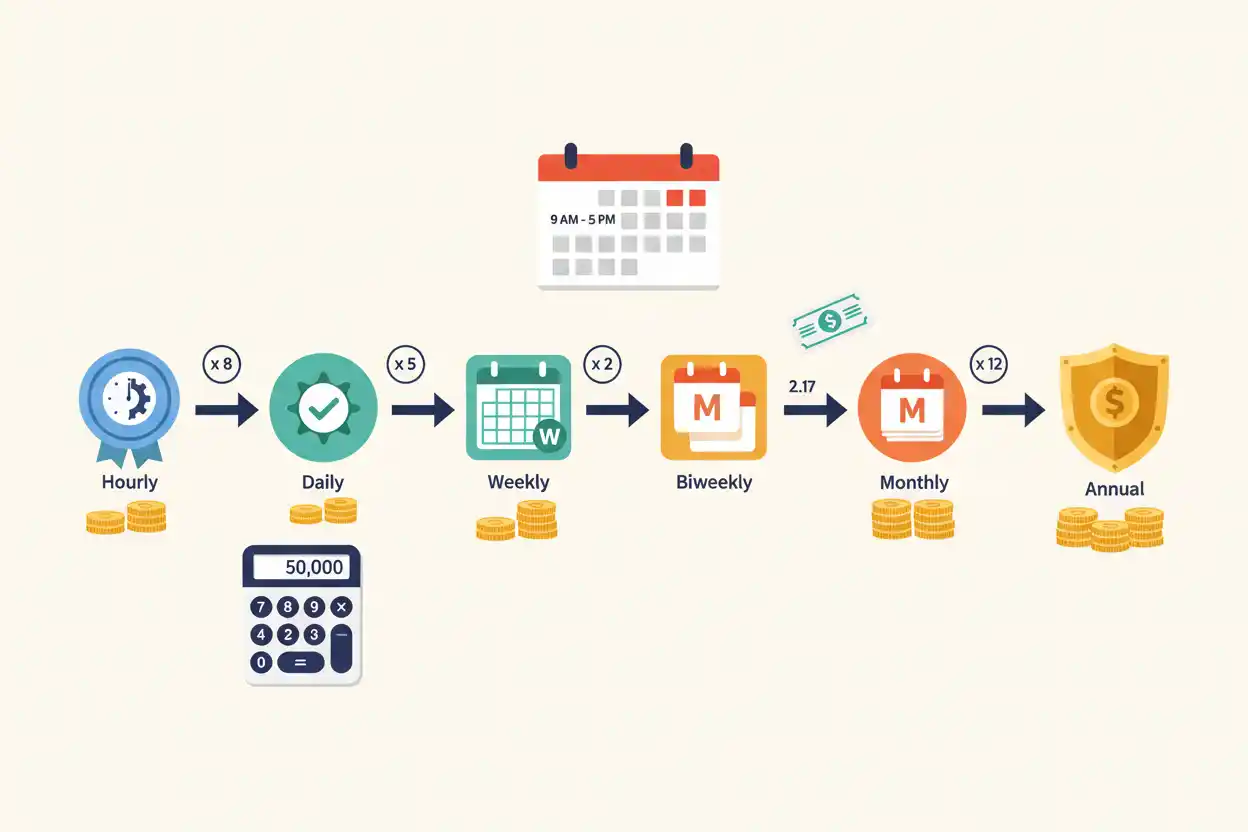

Salary conversions express the same compensation amount across different periods.
A $37.50 hourly equivalent becomes $78,000 annually when the calculation assumes 40 paid hours per week for 52 weeks:
$37.50 × 40 × 52 = $78,000
The same $78,000 annual salary converts to $6,500 per month, $3,000 biweekly, $3,250 semimonthly, and $1,500 per week.
The formulas are straightforward, but every result depends on the assumptions used for hours and pay periods.
Hourly to Annual Salary Formula
Annual Pay = Hourly Wage × Paid Hours per Week × Paid Weeks per Year
For a conventional 40-hour, 52-week comparison:
Annual Pay = Hourly Wage × 2,080
because:
40 × 52 = 2,080 Hours
Hourly to Annual Example
Suppose:
Hourly Wage = $32
Hours per Week = 40
Paid Weeks = 52
Then:
Annual Pay = $32 × 40 × 52
= $66,560
The annualized gross compensation is $66,560.
Annual Salary to Hourly
Reverse the formula:
Hourly Equivalent = Annual Salary ÷ Annual Paid Hours
Suppose:
Annual Salary = $78,000
and annual hours are:
2,080
Then:
Hourly Equivalent = $78,000 ÷ 2,080
= $37.50
This is a comparison equivalent. A salaried employee’s compensation may not legally or contractually operate as a $37.50 hourly wage.
Why 2,080 Hours Is Not Universal
The 2,080-hour assumption represents:
40 Hours × 52 Weeks
Suppose an employee instead works:
35 Paid Hours per Week
for:
50 Paid Weeks
Annual paid hours:
35 × 50 = 1,750
For the same $78,000 annual salary:
Hourly Equivalent = $78,000 ÷ 1,750
≈ $44.57
The assumed work schedule changes the hourly equivalent by more than $7.
Annual to Monthly Salary
Monthly Salary = Annual Salary ÷ 12
For $78,000:
$78,000 ÷ 12
= $6,500
This is a gross monthly equivalent before taxes and payroll deductions.
Annual to Weekly Salary
Weekly Salary = Annual Salary ÷ 52
For $78,000:
$78,000 ÷ 52
= $1,500
Annual to Biweekly Salary
For a standard 26-pay-period schedule:
Biweekly Salary = Annual Salary ÷ 26
$78,000 ÷ 26
= $3,000
Annual to Semimonthly Salary
Semimonthly pay generally uses 24 pay periods:
Semimonthly Salary = Annual Salary ÷ 24
$78,000 ÷ 24
= $3,250
Biweekly and semimonthly pay are therefore not interchangeable.
Annual to Daily Salary
A daily equivalent requires an assumed number of workdays.
Suppose:
Annual Salary = $78,000
Workdays = 260
Then:
Daily Equivalent = $78,000 ÷ 260
= $300 per Workday
A different workday assumption produces a different result.
Weekly Pay to Annual
Annual Pay = Weekly Pay × 52
Suppose:
Weekly Pay = $1,280
Then:
Annual Pay = $1,280 × 52
= $66,560
This reconciles with a $32 hourly rate at 40 hours per week.
Biweekly to Annual
Annual Pay = Biweekly Pay × 26
Suppose:
Biweekly Gross Pay = $2,560
Then:
Annual Pay = $2,560 × 26
= $66,560
Semimonthly to Annual
Annual Pay = Semimonthly Pay × 24
Suppose:
Semimonthly Pay = $2,773.33
Then annualized pay is approximately:
$2,773.33 × 24 ≈ $66,559.92
The small difference results from rounding the paycheck amount to cents.
Monthly to Annual
Annual Pay = Monthly Pay × 12
At:
$5,546.67 per Month
annualized pay is approximately:
$66,560.04
Again, slight differences can occur when monthly equivalents are rounded before annualization.
Convert Weekly to Monthly Correctly
A common mistake is:
Weekly Pay × 4
A more accurate annualized monthly average is:
Weekly Pay × 52 ÷ 12
For $1,500 weekly:
$1,500 × 52 ÷ 12
= $6,500
Multiplying by four would produce only $6,000.
Convert Biweekly to Monthly
Use:
Biweekly Pay × 26 ÷ 12
For $3,000:
$3,000 × 26 ÷ 12
= $6,500
Simply multiplying by two would produce $6,000 and understate the average.
Salary Conversions and Pay Raises
After pay raises, the new annual salary can be converted into each pay period.
Suppose salary rises:
$72,000 → $77,760
New monthly salary:
$77,760 ÷ 12 = $6,480
New biweekly salary:
$77,760 ÷ 26 ≈ $2,990.77
The underlying annual raise should be calculated before converting it across payroll frequencies.
Salary Conversions and Pay Raise Percentage
If only the old and new salary are known, pay raise percentage can identify the rate of change.
Suppose salary rises:
$72,000 → $77,760
Increase:
$5,760
Percentage:
$5,760 ÷ $72,000
= 8%
That same 8% proportional increase carries through the equivalent monthly, weekly, or hourly calculations when the underlying work assumptions remain unchanged.
Salary Conversions and Salary Reductions
A salary reduction percentage works in the opposite direction.
Suppose salary falls from $80,000 to $72,000.
The annual reduction is $8,000, or 10%.
Under a 2,080-hour comparison:
Old hourly equivalent:
$80,000 ÷ 2,080 ≈ $38.46
New hourly equivalent:
$72,000 ÷ 2,080 ≈ $34.62
The same 10% proportional reduction appears in both annual and hourly equivalents.
Salary Conversions and Payroll Tax
A payroll tax calculation should use taxable wages rather than an arbitrary salary conversion.
Suppose annual salary is $78,000 and a tax is processed biweekly.
The annual-to-biweekly conversion can establish the ordinary gross paycheck:
$78,000 ÷ 26 = $3,000
The payroll system then determines the correct taxable wage base and applies the relevant tax rules.
Salary Conversions and Sales Tax
Sales tax is unrelated to salary conversion even though both often use percentage calculations.
An hourly rate multiplied by hours converts labor compensation.
A sales-tax rate multiplied by a taxable purchase calculates transaction tax.
The formulas should remain separate.
Annual Salary With Unpaid Weeks
Suppose an hourly worker earns:
$30 per Hour
for:
40 Hours per Week
but has two unpaid weeks.
Annual paid weeks:
50
Actual gross annual estimate:
$30 × 40 × 50
= $60,000
Using 52 weeks would produce:
$62,400
Difference:
$2,400
The correct conversion depends on paid time, not just the hourly rate.
Part-Time Conversion
Suppose:
Hourly Wage = $25
Hours per Week = 24
Paid Weeks = 52
Annualized gross:
$25 × 24 × 52
= $31,200
A standard 2,080-hour shortcut would incorrectly produce $52,000.
Variable Hours
Suppose a worker’s average schedule is:
32.5 Hours per Week
at:
$28 per Hour
Annualized pay:
$28 × 32.5 × 52
= $47,320
Using actual average hours can provide a more meaningful estimate for variable-hour employment.
Salary With Overtime
A base salary or hourly annualization should usually be separated from overtime.
Suppose normal annualized wages are:
$52,000
and overtime adds:
$7,000
Total gross employment pay:
$59,000
Calling the entire $59,000 “base salary” would misrepresent the compensation structure.
Salary With Bonus
Similarly:
Base Salary = $70,000
Bonus = $10,000
First-year gross salary-plus-bonus amount:
$80,000
But monthly base salary remains:
$70,000 ÷ 12 ≈ $5,833.33
rather than:
$80,000 ÷ 12 ≈ $6,666.67
unless the bonus is genuinely recurring and the calculation explicitly seeks average total compensation.
Converting Net Pay
The same frequency formulas can convert net annual cash flow.
Suppose annual net pay is:
$52,000
Monthly average:
$4,333.33
Biweekly:
$2,000
Weekly:
$1,000
However, net conversions are cash-flow equivalents, not salary rates.
Rounding Differences
Suppose a calculated biweekly amount is:
$2,990.769230…
Payroll may display:
$2,990.77
Multiplying the rounded amount by 26 can differ from annual salary by a few cents.
Small rounding differences are normal when recurring amounts are displayed to two decimal places.
Common Salary Conversion Mistakes
A common error is using 2,080 hours without checking whether the work schedule actually contains 2,080 paid hours.
Another is treating biweekly and semimonthly pay as equivalent.
People also multiply weekly pay by four for monthly income, include overtime or bonuses in base salary without labeling them, or compare a gross salary with a net paycheck.
Frequently Asked Questions
How do I convert hourly pay to annual salary?
Hourly Rate × Weekly Hours × Paid Weeks
What does $32 per hour equal annually at 40 hours for 52 weeks?
$66,560
How do I convert annual salary to hourly?
Annual Salary ÷ Annual Paid Hours
What is $78,000 annually per hour using 2,080 hours?
$37.50 per Hour
How do I convert annual salary to monthly?
Annual Salary ÷ 12
How do I convert annual salary to biweekly?
Annual Salary ÷ 26
for a standard biweekly schedule.
How do I convert annual salary to semimonthly?
Annual Salary ÷ 24
Why isn’t weekly pay multiplied by four a precise monthly average?
Because there are 52 weeks across 12 months, or about 4.33 weeks per month on average.
Does a higher hourly equivalent mean someone earns more annually?
Not necessarily if annual paid hours differ.
Should overtime be included in salary conversion?
Only when the calculation explicitly seeks total expected compensation.
Do bonuses count as salary?
They can contribute to total compensation but should normally remain separate from base salary.
Why state the work-hour assumption?
Without it, an hourly-to-annual conversion can appear precise while using the wrong number of paid hours.