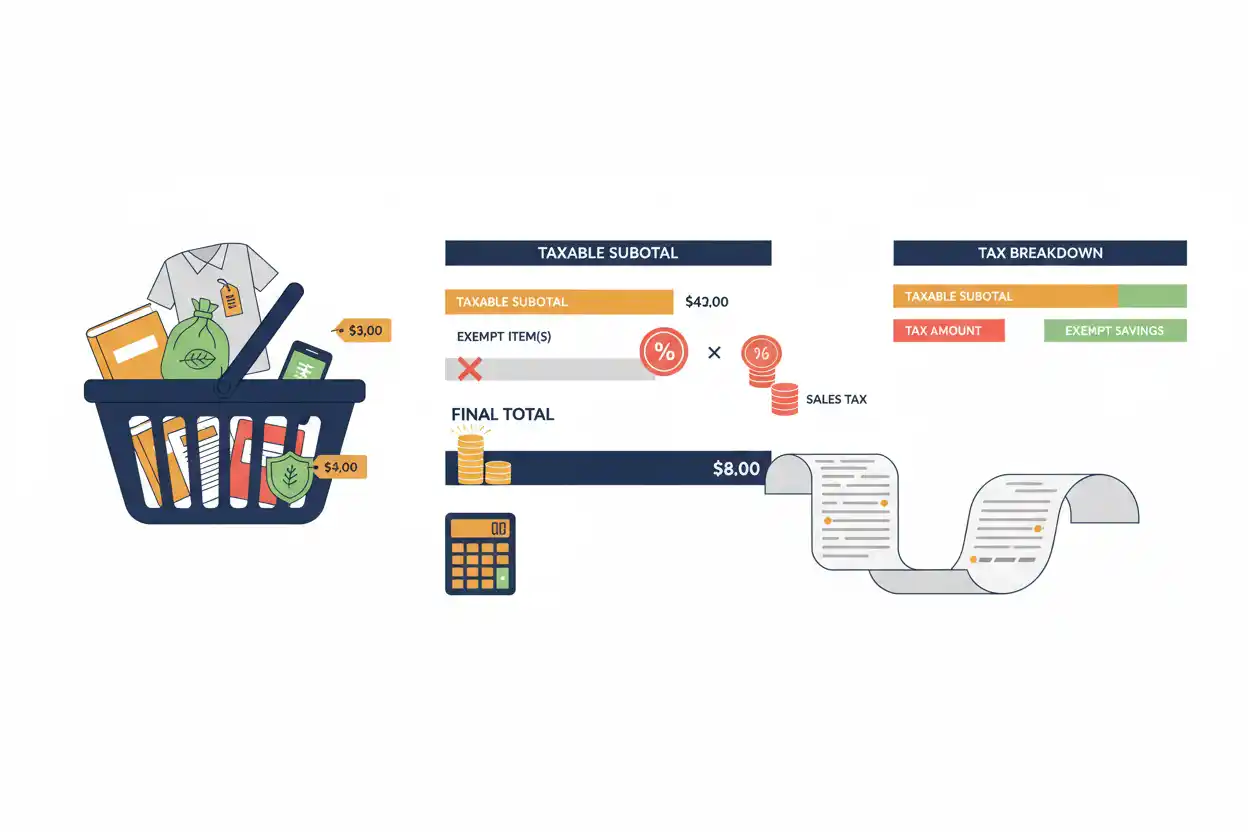

Sales tax is a transaction tax commonly calculated as a percentage of the taxable purchase price.
If a taxable item costs $240 and the applicable sales tax rate is 8.25%:
Sales Tax = $240 × 8.25%
= $19.80
Total price:
$240 + $19.80
= $259.80
The important word is taxable. A receipt can contain items that receive different rates or exemptions, so the sales-tax calculation should begin with the taxable portion rather than automatically applying one percentage to the full purchase.
Sales Tax Formula
Sales Tax = Taxable Purchase Amount × Sales Tax Rate
Then:
Total Price = Taxable Amount + Sales Tax
When the entire purchase is taxable:
Total Price = Purchase Price × (1 + Sales Tax Rate)
For an 8.25% rate:
Total Price = Purchase Price × 1.0825
Basic Sales Tax Example
Suppose:
Taxable Purchase = $240
Sales Tax Rate = 8.25%
Convert the percentage to decimal form:
8.25% = 0.0825
Tax:
$240 × 0.0825
= $19.80
Total:
$240 + $19.80
= $259.80
Calculate the Total Directly
Instead of calculating tax separately:
Total Price = $240 × 1.0825
= $259.80
Both methods produce the same answer.
The first approach is more useful when the tax amount itself must be shown.
Sales Tax Rate From Tax Paid
The separate sales tax rate calculation can be recovered when tax and taxable subtotal are known.
Sales Tax Rate = Sales Tax ÷ Taxable Price × 100
Suppose:
Taxable Price = $200
Tax = $15
Then:
Rate = $15 ÷ $200 × 100
= 7.5%
The tax rate is 7.5%.
Reverse a Tax-Inclusive Total
Suppose the final price is:
$108.25
and it includes sales tax at:
8.25%
The pre-tax price is not:
$108.25 − 8.25%
Instead:
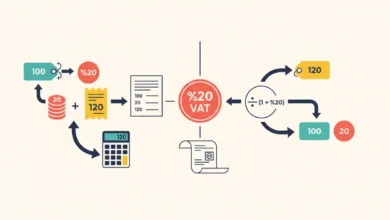
Pre-Tax Price = Tax-Inclusive Price ÷ (1 + Tax Rate)
$108.25 ÷ 1.0825
= $100
Tax:
$108.25 − $100
= $8.25
Why Subtracting the Percentage Is Wrong
Suppose someone calculates:
$108.25 × (1 − 8.25%)
That produces approximately:
$99.32
which is incorrect.
The 8.25% tax was calculated from the original $100 base, not from the $108.25 tax-inclusive total.
Reverse percentage calculations require division by the growth factor.
Exempt Item Example
Suppose a shopping basket contains:
Taxable goods:
$150
Exempt goods:
$50
Total merchandise:
$200
Assume an illustrative 8% tax applies only to the taxable goods.
Tax:
$150 × 8%
= $12
Final purchase total:
$200 + $12
= $212
Applying 8% to all $200 would incorrectly produce $16 of tax.
Partially Taxable Transaction
Suppose an invoice totals:
$1,000
but only:
$700
is subject to sales tax.
At 6%:
Tax = $700 × 6%
= $42
Total amount including tax:
$1,000 + $42
= $1,042
The taxable base and gross invoice total are not necessarily identical.
Multiple Tax Rates
Suppose a purchase contains:
Item A:
$100 taxed at 5%
Item B:
$150 taxed at 8%
Tax A:
$5
Tax B:
$12
Combined tax:
$17
Total merchandise:
$250
Final price:
$267
A single effective rate for the overall purchase is:
$17 ÷ $250
= 6.8%
The 6.8% is a blended rate, not the statutory rate for either item.
Combined State and Local Rate
Suppose a transaction is subject to an illustrative:
5% State Rate
plus:
2% Local Rate
If both rates apply to the same taxable base without compounding:
Combined Rate = 7%
On a $300 purchase:
Tax = $300 × 7%
= $21
The actual structure depends on the jurisdiction, so rates should be verified for the transaction location and product.
Sales Tax and Salary Reduction
A salary reduction percentage measures a change in income, not a transaction tax.
Suppose salary falls 10% while a taxable purchase still carries 8% sales tax.
Neither percentage changes the other.
However, the same $108 purchase consumes a larger share of available income after salary falls.
Sales Tax and Salary Conversions
Salary conversions can put income on a monthly or hourly basis, which helps show the affordability of tax-inclusive purchases.
Suppose take-home earnings are equivalent to $25 per hour and a purchase totals $250 after tax.
Ignoring other considerations:
Work-Hour Equivalent = $250 ÷ $25
= 10 Hours
This does not change the sales-tax calculation, but it provides a different way to interpret the total cost.
Sales Tax and Payroll Tax
Payroll tax is calculated from covered wages.
Sales tax is calculated from taxable purchases.
Suppose someone earns $5,000 and later buys a $500 taxable item.
The wage tax and transaction tax should be calculated separately because their bases are different.
Sales Tax and Self-Employment Tax
A self-employed worker can face self-employment tax on qualifying earnings while also paying sales tax on taxable purchases.
Likewise, a business may collect sales tax from customers without treating that collected amount as ordinary sales revenue for every accounting or tax purpose.
The tax type and legal obligation should be identified before the cash flow is classified.
Sales Tax on a Discounted Price
Suppose an item has:
Original Price = $200
Discount:
25%
Discount amount:
$200 × 25% = $50
Discounted price:
$150
If sales tax is calculated from the discounted taxable price at an illustrative 8%:
Tax = $150 × 8%
= $12
Final price:
$162
The applicable tax law determines whether a particular discount changes the taxable base.
Coupon Example
Suppose an item costs $100 and a $20 coupon is applied.
If the jurisdiction treats the taxable base as $80:
Tax at 7% = $5.60
If the relevant rules instead require tax on the original $100 in that particular coupon arrangement:
Tax = $7
The calculation depends on how the jurisdiction treats the discount or coupon.
Sales Tax on Shipping
Shipping or delivery charges can be taxable in some circumstances and exempt in others.
Suppose merchandise is:
$100
Shipping:
$10
If both are taxable at 8%:
Tax Base = $110
Tax = $8.80
If only the merchandise is taxable:
Tax = $8
The transaction rules determine which subtotal should be used.
Sales Tax and Tips
A voluntary gratuity and a mandatory service charge can receive different tax treatment depending on jurisdiction and transaction type.
The safest mathematical sequence is to determine the legally taxable subtotal first, then apply the rate.
Do not assume every amount appearing on a receipt belongs in the sales-tax base.
Sales Tax on a Refund
Suppose an item originally costs:
$100
with 8% tax:
$8
Total:
$108
If the entire taxable sale is reversed and the applicable rules require tax to be refunded:
Refund = $108
A partial refund requires identifying the corresponding taxable amount and associated tax.
Sales Tax on Several Units
Suppose:
Unit Price = $24.99
Quantity:
4
Taxable subtotal:
$24.99 × 4
= $99.96
At 7.5%:
Tax = $99.96 × 7.5%
= $7.497
The final displayed tax may be rounded according to the relevant currency and tax-calculation rules.
Rounding
Tax calculations often produce fractions of the smallest currency unit.
For example:
$99.96 × 7.5% = $7.497
Rounded to cents:
$7.50
Final price:
$107.46
Systems can differ in whether they round per line item or on the invoice total, potentially creating small differences.
Sales Tax Included in Price
Some jurisdictions or merchants display consumer prices with tax included.
Suppose displayed tax-inclusive price is $216 at an 8% rate.
Pre-tax amount:
$216 ÷ 1.08
= $200
Tax component:
$16
Understanding whether displayed prices are tax-exclusive or tax-inclusive prevents checkout surprises.
Exemption Certificate Example
A purchaser may qualify for an exemption under applicable law.
If a $5,000 purchase would normally carry 6% tax:
Normal tax:
$5,000 × 6%
= $300
If the entire transaction validly qualifies for exemption:
Sales Tax = $0
The exemption changes the taxable base or applicable tax treatment; it does not change the arithmetic of percentage multiplication.
Effective Sales Tax Burden
Suppose a basket contains $300 of merchandise but only $200 is taxable at 9%.
Tax:
$18
Tax relative to total merchandise:
$18 ÷ $300
= 6%
The statutory rate on taxable goods is 9%, while the effective tax burden across the entire basket is 6%.
Both percentages can be correct if labeled properly.
Sales Tax Increase
Suppose a tax rate increases:
6% → 7%
On a $1,000 taxable purchase:
Old tax:
$60
New tax:
$70
Dollar increase:
$10
The tax rate rose by:
1 Percentage Point
but tax dollars rose:
$10 ÷ $60 × 100
≈ 16.67%
Percentage points and percentage changes should not be confused.
Sales Tax and Business Pricing
Suppose a business wants the customer’s final tax-inclusive price to remain at:
$100
when the tax rate is 8%.
Maximum pre-tax price:
$100 ÷ 1.08
≈ $92.59
Tax:
≈ $7.41
If the business instead charges $100 before tax, the customer pays $108.
Common Sales Tax Mistakes
A common mistake is applying the rate to the total receipt even when some items are exempt.
Another is subtracting the tax percentage directly from a tax-inclusive price instead of dividing by the tax factor.
People can also confuse the statutory rate with the effective tax burden across a mixed basket or apply the wrong jurisdiction’s rate.
Frequently Asked Questions
What is sales tax?
Sales tax is a transaction tax calculated from a taxable purchase amount under applicable jurisdictional rules.
What is the formula?
Sales Tax = Taxable Purchase Amount × Sales Tax Rate
How do I calculate the final price?
Total Price = Taxable Price + Sales Tax
when the whole price is taxable.
What is 8.25% tax on $240?
$19.80
What is the final price?
$259.80
How do I find the pre-tax price from a tax-inclusive total?
Pre-Tax Price = Total Price ÷ (1 + Tax Rate)
Are exempt items included in the taxable subtotal?
No, when they validly qualify for exemption under the applicable rules.
Can different items have different sales-tax rates?
Yes.
Is sales tax the same as payroll tax?
No.
Can discounts change the tax base?
Potentially, depending on the type of discount and jurisdiction rules.
Why can tax totals differ by a cent?
Rounding methods can differ across line items and invoice totals.
Why must the location and product be checked?
Sales-tax rates, exemptions, sourcing rules, and taxable categories vary by jurisdiction.