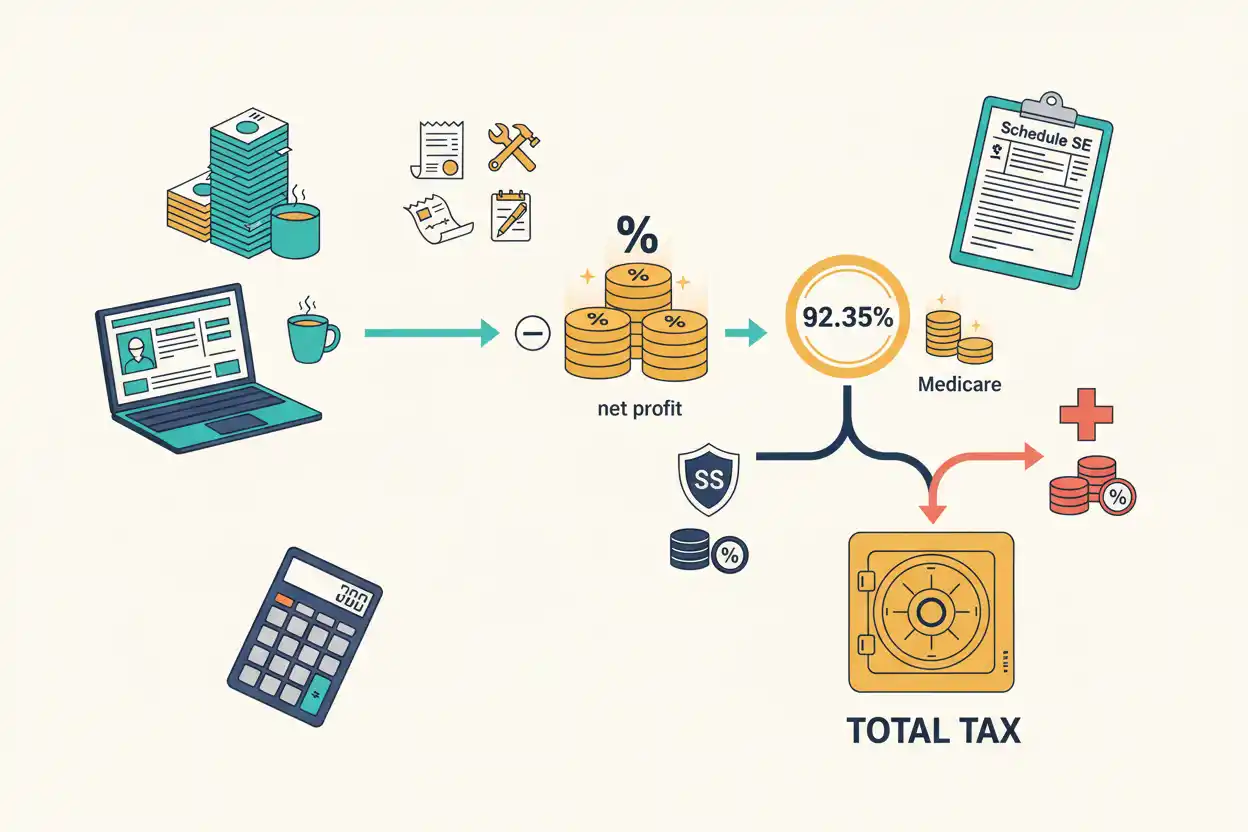

Self-employment tax is the U.S. federal tax used to cover Social Security and Medicare obligations on qualifying net earnings from self-employment.
The standard self-employment tax rate consists of 12.4% for Social Security and 2.9% for Medicare, or 15.3% combined before considering the Social Security earnings limit or Additional Medicare Tax. Generally, 92.35% of net self-employment profit is treated as net earnings subject to the regular self-employment tax calculation.
Suppose a self-employed person has $80,000 of net business profit.
Net Earnings for SE Tax = $80,000 × 92.35%
= $73,880
Because $73,880 is below the 2026 Social Security wage base, the simplified regular tax is:
$73,880 × 15.3%
= $11,303.64
The calculation becomes more complex when the taxpayer also has employee wages, reaches the Social Security wage base, or becomes subject to Additional Medicare Tax.
What Is Self-Employment Tax?
Self-employment tax is separate from ordinary federal income tax.
A self-employed person can owe both:
Income Tax
and:
Self-Employment Tax
on the same year’s earnings because the two taxes serve different purposes and use different calculation rules.
The IRS generally requires self-employment tax when net earnings from self-employment are at least $400, subject to the detailed Schedule SE rules and exceptions.
Start With Net Business Profit
The calculation does not generally begin by multiplying gross business receipts by 15.3%.
Suppose:
Business Revenue = $120,000
and ordinary, necessary business expenses used in the simplified example total:
$40,000
Net business profit:
$120,000 − $40,000
= $80,000
The IRS describes net earnings from self-employment as being based on self-employment income after relevant business expenses, with 92.35% generally entering the regular self-employment tax calculation.
The 92.35% Adjustment
The basic regular-method calculation is:
Net Earnings Subject to SE Tax = Net Self-Employment Profit × 92.35%
For $80,000:
$80,000 × 0.9235
= $73,880
This adjustment is one reason the simplified self-employment tax is not merely:
$80,000 × 15.3%
The tax rate is generally applied after the 92.35% net-earnings calculation.
Self-Employment Tax Rate
The regular rate consists of:
Social Security Portion = 12.4%
Medicare Portion = 2.9%
Combined:
15.3%
The Social Security portion is subject to an annual earnings limit, while the Medicare portion does not use the same cap.
$80,000 Self-Employment Tax Example
Net profit:
$80,000
Net earnings:
$80,000 × 92.35% = $73,880
Social Security portion:
$73,880 × 12.4%
= $9,161.12
Medicare portion:
$73,880 × 2.9%
= $2,142.52
Total regular self-employment tax:
$9,161.12 + $2,142.52
= $11,303.64
The combined 15.3% shortcut gives the same result because all $73,880 remains below the Social Security earnings limit in this example.
2026 Social Security Wage Base
For 2026, the Social Security wage base is $184,500. The employee/employer Social Security rate is 6.2% each, equivalent to a 12.4% Social Security component for the ordinary self-employment tax calculation. Medicare does not have the same wage-base ceiling.
That means the 12.4% component cannot simply be applied without limit to every dollar of net self-employment earnings.
High-Income Example
Suppose net business profit is:
$250,000
First calculate 92.35%:
$250,000 × 92.35%
= $230,875
Ignoring employee wages for the moment, only the amount up to the 2026 Social Security wage base is exposed to the 12.4% Social Security component:
$184,500 × 12.4%
= $22,878
The regular Medicare portion applies to the full $230,875:
$230,875 × 2.9%
= $6,695.38
Regular self-employment tax before considering Additional Medicare Tax:
$22,878 + $6,695.38
= $29,573.38
This is why simply multiplying $230,875 by 15.3% would overstate the regular tax after the Social Security wage base is reached.
Employee Wages Can Use Part of the Social Security Wage Base
Suppose a taxpayer has:
$100,000 of Social Security Wages From Employment
and also has self-employment net earnings subject to the Social Security portion.
The 2026 Social Security wage base is $184,500, so the remaining base available for the self-employment Social Security component is:
$184,500 − $100,000
= $84,500
The IRS coordinates wages and self-employment earnings so the annual Social Security earnings limit is not treated as a separate full limit for each source.
Example With Wages and Self-Employment Income
Suppose:
Employee Social Security Wages = $100,000
and:
Net Self-Employment Profit = $120,000
Self-employment net earnings:
$120,000 × 92.35%
= $110,820
Remaining 2026 Social Security wage base:
$84,500
Therefore, the Social Security portion of self-employment tax is limited to:
$84,500 × 12.4%
= $10,478
Regular Medicare tax still applies to the self-employment net earnings:
$110,820 × 2.9%
= $3,213.78
Regular self-employment tax:
$10,478 + $3,213.78
= $13,691.78
Additional Medicare Tax may also need to be evaluated depending on total wages, self-employment income, and filing status.
Additional Medicare Tax
The Additional Medicare Tax rate is 0.9% above applicable earned-income thresholds. The IRS currently lists thresholds of $250,000 for married filing jointly, $125,000 for married filing separately, and $200,000 for other filing statuses. Self-employment income is included when determining exposure.
This 0.9% component should be calculated separately rather than simply increasing the ordinary self-employment tax rate from 15.3% to 16.2% on all earnings.
Single-Filer Additional Medicare Example
Suppose a single filer has no employee wages and has:
Net Self-Employment Earnings for Medicare Purposes = $230,000
Threshold:
$200,000
Excess:
$30,000
Additional Medicare Tax:
$30,000 × 0.9%
= $270
The $270 is added to the applicable regular Medicare and Social Security tax calculation.
Self-Employment Tax Deduction
When figuring adjusted gross income, the IRS allows a deduction for one-half of the self-employment tax calculated under the applicable Schedule SE rules.
Using the $80,000 example:
Self-Employment Tax = $11,303.64
One-half:
$11,303.64 ÷ 2
= $5,651.82
That $5,651.82 adjustment is not the same as reducing the self-employment tax itself by half.
The tax is still $11,303.64 in the simplified example; the deduction operates in the income-tax calculation.
Why the Deduction Does Not Mean You Pay Only Half
A common mistake is:
SE Tax = $11,303.64
Deduction = $5,651.82
therefore:
Tax Actually Paid = $5,651.82
That is incorrect.
The deduction reduces income used in another part of the federal income-tax calculation. It does not simply erase half of the self-employment tax liability.
Self-Employment Tax vs Income Tax
Suppose a freelancer has $80,000 of net business profit.
The self-employment tax calculation determines Social Security and Medicare tax.
The ordinary income-tax calculation separately determines federal income tax after considering taxable income, deductions, credits, and filing status.
Therefore:
Self-Employment Tax ≠ Total Federal Tax
A taxpayer can owe both.
Self-Employment Tax and Sales Tax Rate
A sales tax rate is applied to qualifying retail transactions.
Self-employment tax is based on qualifying net earnings from self-employment.
If a freelancer collects sales tax from customers, that transaction-tax amount should not automatically be treated as the freelancer’s self-employment profit.
The correct tax base must be identified first.
Self-Employment Tax and Semimonthly Pay
Semimonthly pay describes employee compensation paid 24 times per year.
A self-employed person generally does not calculate self-employment tax by dividing profit into 24 payroll checks.
Instead, business income and expenses determine net self-employment earnings for the annual tax calculation.
Self-Employment Tax and Short-Term Capital Gains
Short-term capital gains can be taxed as ordinary income for federal income-tax purposes, but that does not automatically make an investment gain self-employment earnings.
Income-tax classification and self-employment-tax classification are separate questions.
An asset sale should not be inserted into Schedule SE merely because its gain is short-term.
Self-Employment Tax and Salary Reduction
A salary reduction percentage affects employee compensation.
A freelancer’s business profit can also fall, but the self-employment tax calculation should be rebuilt from actual business revenue and expenses rather than applying an employee salary-cut percentage blindly.
Quarterly Tax Planning
Because self-employed taxpayers often do not have an employer withholding federal income tax and self-employment tax from each customer payment, estimated tax planning can become important.
Suppose expected self-employment and income taxes total:
$24,000
and no withholding or other payments are expected.
A simple cash-flow reserve is:
$24,000 ÷ 12
= $2,000 per Month
The actual required estimated-tax schedule and safe-harbor calculation should follow current IRS rules rather than a simple monthly division.
Reserve Percentage
Suppose net business profit is projected at:
$100,000
and total projected federal tax obligations attributable to the taxpayer’s situation are:
$25,000
A planning reserve ratio is:
$25,000 ÷ $100,000
= 25%
This is a budgeting percentage, not the statutory self-employment tax rate.
$400 Threshold
The IRS generally states that self-employment tax is required when net earnings from self-employment are $400 or more, subject to exceptions and special rules.
A business can therefore have small gross receipts while producing net earnings below that threshold after expenses.
The relevant figure is not simply gross sales.
Loss Year
Suppose:
Business Revenue = $40,000
Business Expenses = $45,000
Simplified net loss:
−$5,000
There is no positive net business profit to multiply by 92.35% under the ordinary simplified calculation.
The wider tax treatment of the loss belongs to the income-tax rules rather than converting the loss into negative self-employment tax.
Multiple Businesses
Suppose Business A produces:
$60,000 Profit
and Business B produces:
$20,000 Profit
Combined simplified self-employment profit:
$80,000
Before special adjustments or exceptions, the combined result can feed into the Schedule SE calculation.
The Social Security wage base is an annual limit across covered Social Security earnings rather than a separate full limit for each business.
Common Self-Employment Tax Mistakes
One common error is multiplying gross revenue by 15.3% instead of beginning with net self-employment profit.
Another is forgetting the 92.35% adjustment.
High earners can also incorrectly apply the 12.4% Social Security component without respecting the annual wage base, while people with employee wages can overlook that those wages consume part or all of the same Social Security limit.
Frequently Asked Questions
What is the regular self-employment tax rate?
The regular rate is 15.3%, consisting of 12.4% Social Security and 2.9% Medicare.
Is 15.3% applied directly to business revenue?
Generally no. The calculation starts from net self-employment earnings, not gross receipts.
Why is profit multiplied by 92.35%?
The regular method generally treats 92.35% of self-employment profit as net earnings for the self-employment tax calculation.
What is the 2026 Social Security wage base?
$184,500.
Does the Medicare portion stop at $184,500?
No. Medicare does not use the Social Security wage-base cap.
Can employee wages reduce the Social Security portion subject to self-employment tax?
Yes, because covered wages and self-employment earnings share the annual Social Security earnings limit.
What is Additional Medicare Tax?
It is an additional 0.9% tax above filing-status-specific earned-income thresholds.
Is half of self-employment tax deductible?
The IRS allows an adjustment for one-half of self-employment tax when calculating adjusted gross income under the applicable rules.
Does that deduction cut the self-employment tax bill in half?
No.
Is self-employment tax the same as federal income tax?
No.
When do I generally start owing self-employment tax?
The IRS generally uses a $400 net-earnings threshold, subject to applicable exceptions.
Why should the tax be calculated by component?
Because the Social Security portion has an annual earnings limit while Medicare and Additional Medicare Tax use different rules.