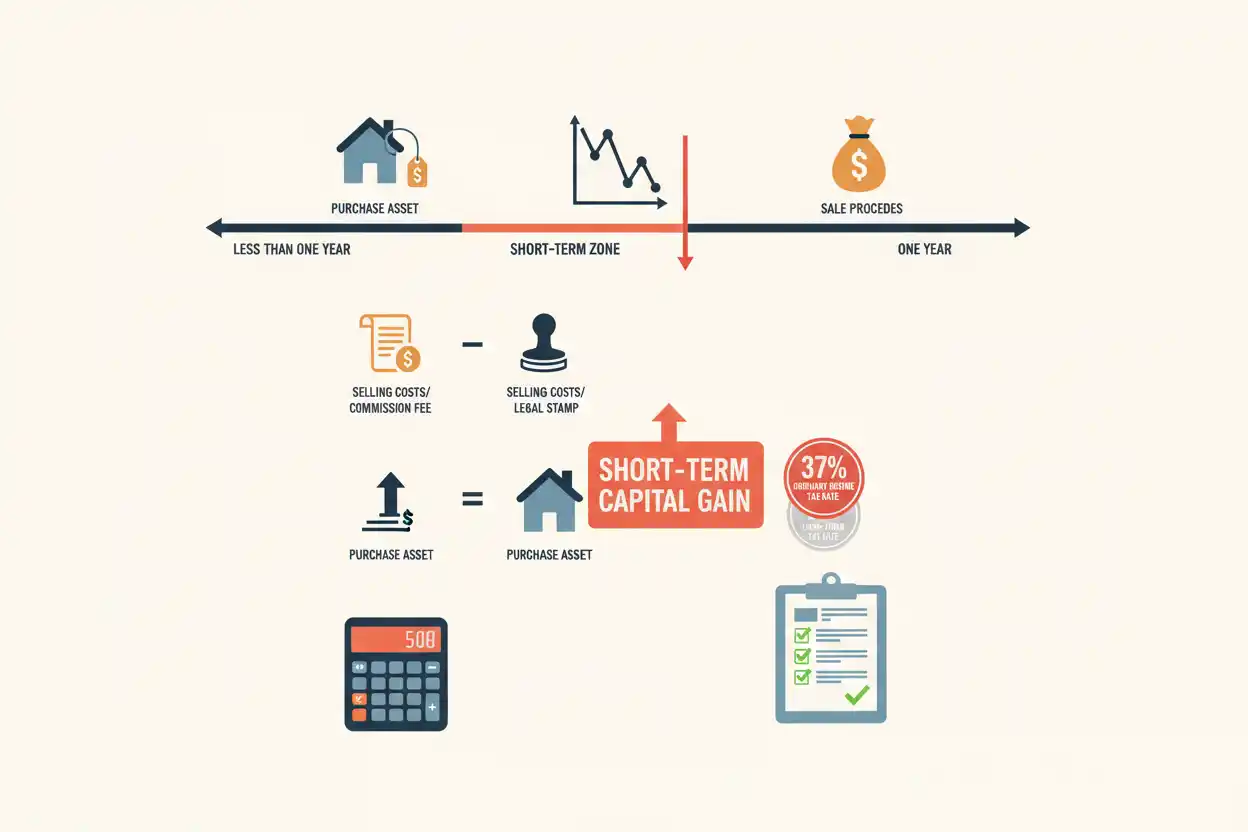

Short-term capital gains generally arise when a capital asset is sold for more than its adjusted basis after being held for one year or less.
For U.S. federal tax purposes, the IRS generally classifies a gain or loss as short-term when the asset is held for one year or less and long-term when it is held for more than one year. Holding period is generally counted from the day after acquisition through the day of disposition.
Suppose an investment has an adjusted basis of $18,500 and is sold eight months later for $24,000 with $500 of selling costs.
Net sale proceeds are:
$24,000 − $500 = $23,500
Short-term gain:
$23,500 − $18,500
= $5,000
That $5,000 gain is short-term under the ordinary holding-period rule.
Short-Term Capital Gain Formula
Capital Gain or Loss = Amount Realized − Adjusted Basis
When selling costs reduce the amount realized:
Net Sale Proceeds = Sale Price − Selling Costs
Then:
Short-Term Capital Gain = Net Sale Proceeds − Adjusted Basis
The arithmetic for long-term and short-term gains is similar. The holding period determines classification.
Basic Short-Term Capital Gains Example
Suppose:
Original Investment Cost = $18,000
Additional basis amount:
$500
Adjusted basis:
$18,500
Sale price after eight months:
$24,000
Selling costs:
$500
Net proceeds:
$23,500
Gain:
$23,500 − $18,500
= $5,000
The $5,000 is a short-term capital gain under the general federal holding-period rule.
Sale Price Is Not the Gain
Suppose an investment sells for:
$50,000
and adjusted basis is:
$42,000
Ignoring other transaction adjustments:
Gain = $50,000 − $42,000
= $8,000
The investor did not earn a $50,000 gain.
Most of the $50,000 represents recovery of the capital already invested.
Holding Period Example
Suppose an asset is acquired on January 10.
Under the general holding-period convention, counting begins the next day. The acquisition and disposition dates determine whether the period is one year or less or more than one year.
This makes dates near the one-year boundary important.
An investor should use the actual acquisition and disposal dates rather than approximating from calendar years.
Short-Term vs Long-Term Capital Gains
The distinction is:
One Year or Less → Generally Short-Term
More Than One Year → Generally Long-Term
subject to exceptions for certain types of property and transactions.
A gain of $10,000 can therefore receive a different federal tax classification depending on how long the asset was held.
Federal Tax Treatment
Net short-term capital gains are generally taxed as ordinary income rather than receiving the preferential rate framework that can apply to net long-term capital gains.
That does not mean every short-term gain has one fixed tax rate.
The actual effect depends on the taxpayer’s wider taxable-income and tax-return situation.
Illustrative Tax Example
Suppose:
Net Short-Term Gain = $5,000
and assume the entire additional amount falls within an illustrative 24% ordinary-income marginal bracket.
Estimated incremental federal income tax:
$5,000 × 24%
= $1,200
After this simplified tax assumption:
$5,000 − $1,200
= $3,800
The 24% figure is illustrative rather than a universal short-term capital gains rate.
Short-Term Capital Loss Example
Suppose:
Adjusted Basis = $25,000
and net sale proceeds are:
$20,000
Result:
$20,000 − $25,000
= −$5,000
The investment generated a $5,000 short-term capital loss if it falls within the short-term holding classification.
Capital gains and losses are netted under the federal capital-gain rules rather than each transaction being analyzed in isolation for final tax liability.
Net Short-Term Gain Example
Suppose the year contains:
Gain A:
+$8,000
Gain B:
+$3,000
Loss C:
−$4,000
Simplified net short-term gain:
$8,000 + $3,000 − $4,000
= $7,000
The complete tax calculation can also involve long-term gains, long-term losses, carryovers, and other capital-gain rules.
Short-Term Losses and Long-Term Gains
Suppose:
Net Short-Term Loss = $6,000
and:
Net Long-Term Gain = $15,000
The federal netting process can require these categories to interact before final net capital gain is determined.
This is why investors should keep short-term and long-term transactions classified separately until the appropriate netting steps are completed.
Losses Beyond Gains
The IRS allows qualifying net capital losses to reduce other income subject to annual limits, with unused losses generally carried forward.
That means a $10,000 net capital loss does not necessarily reduce current-year ordinary taxable income by the full $10,000 at once.
The applicable limitation and carryforward rules determine timing.
Short-Term Gain Percentage
Suppose adjusted basis is:
$18,500
and gain is:
$5,000
Investment return relative to basis:
$5,000 ÷ $18,500 × 100
≈ 27.03%
This is an investment gain percentage.
It is not the tax rate.
Short-Term Capital Gains and Self-Employment Tax
A self-employment tax calculation is based on qualifying self-employment earnings.
A short-term gain from selling an investment is not automatically self-employment income merely because its federal income-tax treatment uses ordinary-income rates.
Tax rate treatment and tax-base classification are separate concepts.
Short-Term Gains and Semimonthly Pay
Semimonthly pay represents employment compensation paid 24 times per year.
Suppose an employee earns:
$3,000 Semimonthly
and realizes a:
$5,000 Short-Term Capital Gain
The gain should not be treated as an extra semimonthly salary check.
Employment pay and investment gains remain distinct income sources.
Short-Term Gains and Sales Tax Rate
A sales tax rate applies to taxable purchases.
Short-term capital gains result from asset dispositions.
Even if both calculations use percentages later, their taxable bases have nothing in common.
Short-Term Gains and Standard Deduction
The standard deduction can affect taxable income, which in turn can affect the ordinary-income tax context surrounding a net short-term capital gain.
The gain itself is calculated from sale proceeds and adjusted basis first.
Tax deductions belong to later stages of the tax calculation.
Short-Term Gains and Social Security Tax
Social Security tax is generally a payroll tax on covered wages and qualifying self-employment earnings.
A short-term investment gain is not automatically Social Security wages.
This is another reason “taxed as ordinary income” should not be misunderstood to mean “subject to every payroll tax.”
Adjusted Basis
Suppose an investor pays:
$20,000
to acquire an asset and has:
$600
of additional amounts properly included in basis.
Adjusted basis:
$20,600
If net sale proceeds are:
$25,000
gain:
$25,000 − $20,600
= $4,400
Ignoring the $600 basis adjustment would overstate the gain.
Selling Costs
Suppose sale price is:
$30,000
Selling costs:
$900
Adjusted basis:
$24,000
Net proceeds:
$29,100
Gain:
$29,100 − $24,000
= $5,100
Transaction costs can therefore affect the gain calculation.
Breakeven Sale Price
Suppose adjusted basis is:
$25,000
and expected selling costs are:
$1,000
The sale price required to break even before tax is:
$25,000 + $1,000
= $26,000
At a $26,000 sale price:
Net Proceeds = $25,000
Gain = $0
After-Tax Break-Even Thinking
Suppose the investor wants an after-tax profit of:
$4,000
and assumes an illustrative 25% tax on the gain.
Pretax gain required:
$4,000 ÷ (1 − 25%)
= $5,333.33
If basis plus transaction costs total $26,000:
Target Sale Price ≈ $31,333.33
This is a planning example rather than a complete tax-return calculation.
Short Holding Period Does Not Guarantee a Gain
Suppose an asset purchased for $20,000 is sold after six months for net proceeds of $16,000.
Capital Loss = −$4,000
The short holding period determines classification, not profitability.
One-Year Boundary
A one-day difference around the holding-period threshold can potentially change whether the general federal classification is short-term or long-term.
For this reason, investors considering tax consequences near the threshold should verify the actual acquisition and disposal dates and any special holding-period rules applicable to the asset.
Common Short-Term Capital Gains Mistakes
A common error is applying an ordinary income tax rate to the entire sale price instead of the gain.
Another is assuming a gain is long-term simply because the sale occurs in a later calendar year.
Investors can also ignore basis adjustments, selling costs, capital losses, or mistakenly treat ordinary-income tax treatment as meaning the gain is subject to ordinary payroll taxes.
Frequently Asked Questions
What is a short-term capital gain?
Generally, it is a gain from a capital asset held for one year or less before disposition under federal tax rules.
What is the formula?
Capital Gain = Amount Realized − Adjusted Basis
Is the full sale price the gain?
No.
How is the holding period generally measured?
The IRS generally counts from the day after acquisition through the day of disposition.
Are short-term gains taxed at one special fixed rate?
No.
How are net short-term gains generally taxed federally?
They are generally taxed as ordinary income.
Is a short-term gain subject to self-employment tax?
Not automatically.
Can short-term losses offset short-term gains?
Capital gains and losses are netted under the applicable federal rules.
Can capital losses reduce other income?
Qualifying net capital losses can do so within applicable annual limits, with additional amounts generally carried forward.
Do selling costs affect the gain?
They can affect the amount realized.
Does holding an asset for one year make the gain long-term?
The general federal rule is more than one year for long-term treatment.
Why classify the gain before estimating tax?
Because holding period affects how the federal tax system treats the resulting capital gain or loss.