
The standard deduction is a fixed deduction that eligible U.S. federal income-tax filers can use to reduce the amount of income subject to tax instead of itemizing deductions.
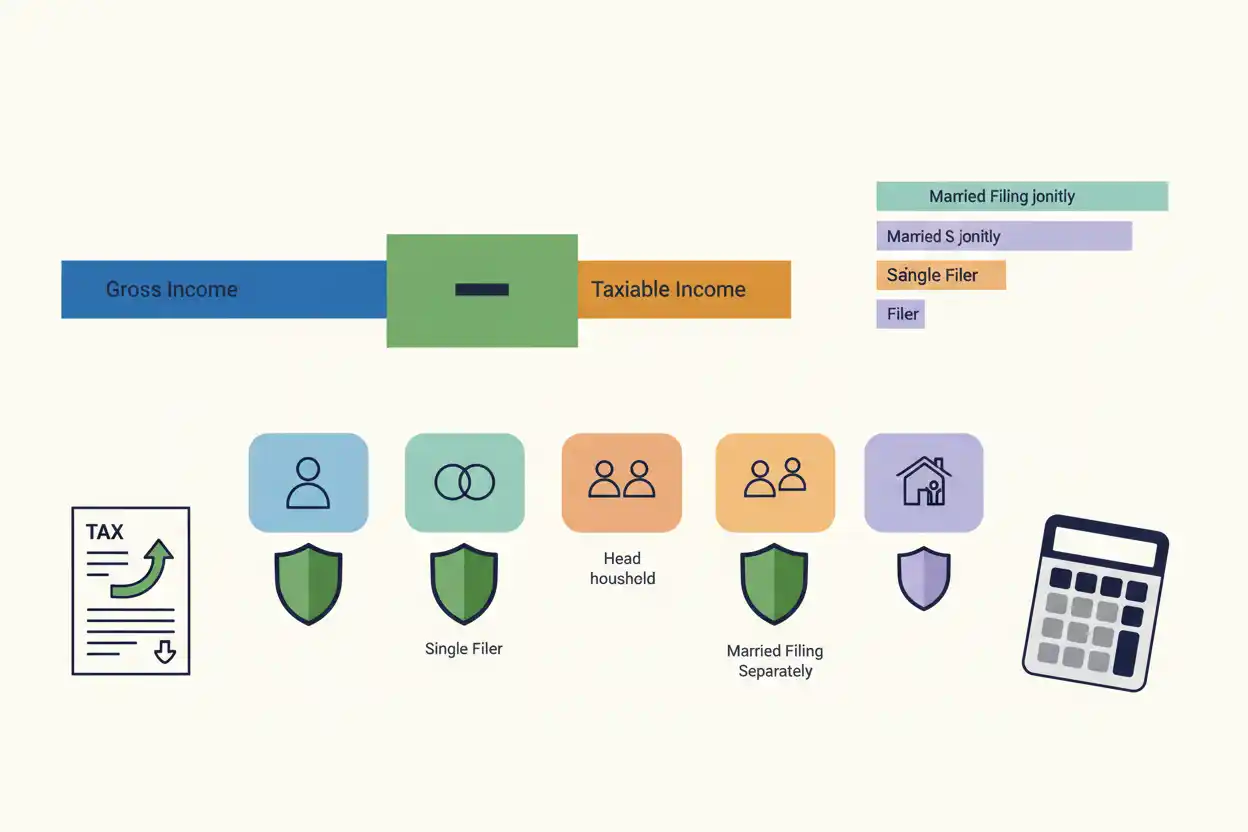
For tax year 2026, the basic federal standard deduction is $16,100 for single filers and married individuals filing separately, $32,200 for married couples filing jointly and qualifying surviving spouses, and $24,150 for heads of household.
If a single taxpayer has $70,000 of income at the stage where the $16,100 standard deduction applies, the simplified calculation is:
Income After Standard Deduction = $70,000 − $16,100
= $53,900
The deduction reduces the income entering later tax calculations. It does not generally mean the taxpayer receives $16,100 in cash or reduces the final tax bill by $16,100.
Standard Deduction Formula
A simplified formula is:
Income After Standard Deduction = Applicable Income Base − Standard Deduction
If the calculation begins with $90,000 and the applicable deduction is $16,100:
$90,000 − $16,100
= $73,900
The exact federal return contains additional steps, so this equation is best understood as the mathematical effect of the deduction rather than a replacement for the full tax return.
2026 Standard Deduction Amounts
For tax year 2026, the IRS lists these basic amounts:
| Filing Status | 2026 Basic Standard Deduction |
|---|---|
| Single | $16,100 |
| Married Filing Separately | $16,100 |
| Married Filing Jointly | $32,200 |
| Qualifying Surviving Spouse | $32,200 |
| Head of Household | $24,150 |
These amounts are year-specific. The IRS adjusts standard deduction amounts over time, so calculations for another tax year should use that year’s figure.
Single Filer Example
Suppose a single filer has:
Relevant Income Before Standard Deduction = $85,000
Using the 2026 basic standard deduction:
$85,000 − $16,100
= $68,900
The simplified post-deduction amount is $68,900.
The $16,100 deduction itself should not be multiplied by 100% and treated as tax savings.
Its tax value depends on the tax rates applying to the income removed.
Married Filing Jointly Example
Suppose a married couple filing jointly has:
Relevant Income Before Standard Deduction = $140,000
2026 basic standard deduction:
$32,200
Then:
$140,000 − $32,200
= $107,800
The standard deduction reduces the modeled income base by $32,200.
Head of Household Example
Suppose:
Relevant Income Before Deduction = $80,000
and the taxpayer qualifies for head-of-household filing status.
Using the 2026 basic amount:
$80,000 − $24,150
= $55,850
Eligibility for a filing status should be established under the applicable tax rules before using its deduction amount.
Standard Deduction vs Tax Deduction
The standard deduction is one particular type of tax deduction.
A tax deduction generally reduces an income amount used in determining tax, while the standard deduction provides a predefined amount to eligible taxpayers rather than requiring them to build the basic deduction from individual Schedule A expenses. The IRS distinguishes deductions from credits because deductions reduce taxable income while credits reduce tax itself.
This distinction is fundamental:
Deduction → Reduces an Income Base
Credit → Reduces Tax
Standard Deduction vs Tax Credit
Suppose an additional $1,000 deduction removes income that would otherwise be taxed at an illustrative 20% rate.
Estimated tax reduction:
$1,000 × 20% = $200
A fully usable $1,000 tax credit can instead reduce the tax itself by $1,000.
The same $1,000 headline amount can therefore produce very different tax effects. The IRS explicitly describes credits as reducing tax due and deductions as reducing taxable income.
Standard Deduction vs Itemizing
Taxpayers generally compare the standard deduction with allowable itemized deductions when determining which deduction method is appropriate, subject to the rules governing their filing situation. The IRS notes that a taxpayer cannot take the standard deduction while also itemizing deductions for the same return.
Suppose:
Standard Deduction = $16,100
and allowable itemized deductions equal:
$13,500
Difference:
$16,100 − $13,500
= $2,600
The standard deduction is $2,600 larger in this comparison.
Now suppose allowable itemized deductions are:
$22,000
Then itemizing exceeds the standard deduction by:
$22,000 − $16,100
= $5,900
The comparison should use allowable amounts rather than merely adding every household expense.
Estimated Tax Value of the Standard Deduction
The standard deduction amount is not equal to its tax savings.
Suppose an additional $16,100 deduction falls entirely within a hypothetical 22% marginal bracket.
Approximate tax effect:
$16,100 × 22%
= $3,542
The deduction is $16,100, while the simplified tax reduction is $3,542.
If the deduction spans multiple tax brackets, each portion can have a different marginal tax value.
Example Across Two Hypothetical Brackets
Suppose a $16,100 deduction removes:
$6,100 of Income From a 22% Bracket
and:
$10,000 From a 12% Bracket
Estimated tax reduction:
$6,100 × 22% + $10,000 × 12%
= $1,342 + $1,200
= $2,542
Applying 22% to the full $16,100 would overstate the modeled effect because not all removed income was in that bracket.
Standard Deduction and Short-Term Capital Gains
Net short-term capital gains are generally taxed as ordinary income federally, so the taxpayer’s broader taxable-income calculation matters when determining their tax effect.
Suppose a taxpayer has a $5,000 short-term capital gain.
The gain should first be incorporated into the appropriate tax-return calculations. The standard deduction then affects taxable income according to the rules applicable to the return.
It would be incorrect to assume the standard deduction is specifically assigned only to salary or only to the investment gain.
Standard Deduction and Social Security Tax
The standard deduction belongs to the federal income-tax calculation. It does not ordinarily reduce covered wages used to determine employee Social Security tax merely because it lowers taxable income for federal income-tax purposes.
For example, an employee can have:
$70,000 of Covered Payroll Wages
while claiming a federal standard deduction on the income-tax return.
The two calculations use different tax bases.
Standard Deduction and Semimonthly Pay
Semimonthly pay determines how annual compensation is divided among 24 regular payroll periods.
Suppose annual salary is:
$72,000
Semimonthly gross pay:
$72,000 ÷ 24 = $3,000
The standard deduction is not divided into 24 pieces and directly subtracted from each gross paycheck to determine annual taxable income.
Payroll withholding and final annual income-tax calculation are related but distinct processes.
Additional Standard Deduction Amounts
The basic standard deduction is not the only possible federal amount. Age, blindness, dependent status, and other rules can affect the deduction available to a particular taxpayer. The IRS provides tools and guidance for determining the appropriate individual amount.
For that reason, the filing-status figures above should be viewed as basic 2026 standard deduction amounts, not a guarantee that every taxpayer with that filing status claims exactly that amount.
A Larger Deduction Does Not Always Mean a Larger Refund
Suppose a taxpayer receives an additional $2,000 deduction.
The effect occurs through the tax calculation.
A refund, however, also depends on withholding, estimated payments, refundable credits, and other amounts already paid or credited.
Therefore:
Larger Deduction ≠ Same-Dollar Larger Refund
Standard Deduction Does Not Reduce Gross Income
Suppose:
Gross Income = $90,000
and:
Standard Deduction = $16,100
Gross income remains:
$90,000
The deduction operates later.
Calling the resulting $73,900 figure “gross income” would mix two different stages of the tax calculation.
Comparing Tax Years
Suppose the standard deduction increases from one year to the next while a taxpayer’s income remains unchanged.
The higher deduction can reduce taxable income, but the final tax difference cannot be calculated from the deduction change alone.
Tax brackets, credits, other deductions, and tax-law changes can also vary between years.
Comparisons should therefore hold all relevant variables constant before attributing the entire tax difference to one deduction.
Common Standard Deduction Mistakes
A common mistake is treating the standard deduction as a tax credit.
Another is subtracting the standard deduction directly from the tax bill.
Taxpayers can also combine the full standard deduction with itemized deductions when the tax rules require choosing between the two methods, or use a standard deduction amount from the wrong tax year.
Frequently Asked Questions
What is the standard deduction?
It is a predefined federal income-tax deduction available to eligible taxpayers instead of itemizing deductions.
What is the 2026 standard deduction for a single filer?
The basic amount is $16,100.
What is the 2026 married-filing-jointly amount?
The basic amount is $32,200.
What is the 2026 head-of-household amount?
The basic amount is $24,150.
Does the standard deduction reduce tax dollar for dollar?
No. It generally reduces taxable income rather than tax itself.
Is the standard deduction the same as a tax credit?
No.
Can I claim the standard deduction and itemize the same deductions?
Generally, you choose the applicable deduction method rather than taking both.
Does everyone receive exactly the basic amount?
Not necessarily. Filing status, age, blindness, dependent status, and other rules can affect the available amount.
Does the standard deduction reduce Social Security wages?
It belongs to the income-tax calculation rather than functioning as a general reduction of covered Social Security wages.
Does the amount change over time?
Yes. The standard deduction is adjusted over time, including inflation-related annual changes.