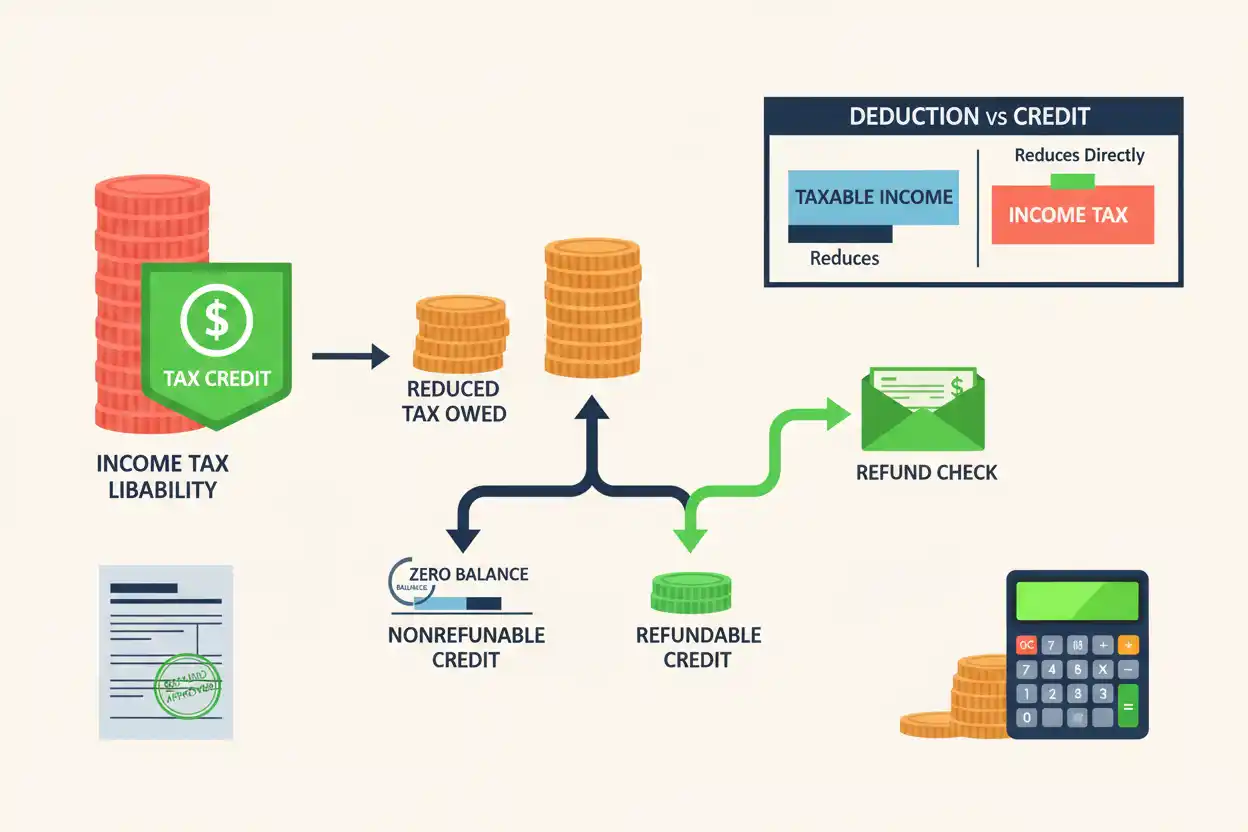

A tax credit reduces the amount of tax owed rather than merely reducing the income used to calculate tax.
The IRS describes a credit as an amount subtracted from tax due. Some credits are refundable, meaning qualifying credit can exceed the tax otherwise owed and potentially contribute to a refund, while many other credits generally reduce tax only to zero.
Suppose calculated tax before a credit is $8,000 and the taxpayer qualifies for a fully usable $2,000 credit.
Tax After Credit = $8,000 − $2,000
= $6,000
The tax credit reduces the modeled liability by $2,000.
Tax Credit Formula
A simplified formula is:
Tax After Credit = Tax Before Credit − Allowable Tax Credit
Suppose:
Tax Before Credit = $12,500
Allowable Credit = $1,500
Then:
Tax After Credit = $12,500 − $1,500
= $11,000
Eligibility rules determine whether the credit is actually available and whether the full amount can be used.
Tax Credit vs Tax Deduction
The difference between a credit and a tax deduction is where each enters the calculation.
The IRS describes deductions as reducing taxable income and credits as reducing tax due.
Suppose a taxpayer has a choice between a hypothetical:
$2,000 Deduction
and:
$2,000 Fully Usable Credit
If the deduction removes income taxed at an illustrative 20% marginal rate:
Tax Effect of Deduction ≈ $2,000 × 20%
= $400
The $2,000 credit reduces tax by:
$2,000
The credit has a much larger immediate tax effect in this simplified comparison.
Credit Example With a $500 Tax Liability
Suppose tax before credits is:
$500
and a taxpayer has an $800 nonrefundable credit.
If the credit can only reduce the relevant tax to zero:
Tax After Credit = $0
Only:
$500
of the $800 credit affects the tax in this simplified example.
The remaining $300 does not automatically become a refund.
Refundable Credit Example
Now suppose the same $800 credit is fully refundable.
Tax before credit:
$500
Credit:
$800
Difference:
$800 − $500
= $300
In a simplified refundable-credit example, the credit can eliminate the $500 tax and leave $300 that contributes to the taxpayer’s refund.
The IRS describes refundable credits as credits that can generate a refund even when no tax remains due.
Partially Refundable Credit
Some tax-credit structures can contain both nonrefundable and refundable features.
Suppose a $2,000 credit allows only $1,200 to be refundable under its specific rules.
If pre-credit tax is only $500, the final result depends on how that particular credit’s nonrefundable and refundable components are defined.
For that reason, “refundable” should not be assumed to mean every tax credit is automatically paid fully in cash.
Tax Credit Percentage of Tax Liability
Suppose:
Tax Before Credit = $10,000
Credit = $2,500
The credit reduces the pre-credit liability by:
$2,500 ÷ $10,000 × 100
= 25%
Tax remaining:
$7,500
The credit amount is 25% of the original modeled tax.
Solve for Tax Before Credit
Suppose tax after a fully usable $2,000 credit is:
$6,000
Then:
Tax Before Credit = Tax After Credit + Credit
$6,000 + $2,000
= $8,000
This reverse calculation works when the credit’s entire amount was actually used against the tax.
Standard Deduction vs Tax Credit
A standard deduction reduces taxable income before tax is calculated.
Suppose an additional $5,000 deduction removes income from a hypothetical 20% tax bracket.
Estimated tax effect:
$5,000 × 20% = $1,000
A fully usable $5,000 credit could instead reduce tax by the full:
$5,000
The deduction and credit amounts look identical but operate at different stages.
Credit Applied After Progressive Tax
Suppose taxable income produces tax of:
$9,400
after the applicable tax brackets have already been calculated.
A $1,500 fully usable credit then gives:
$9,400 − $1,500
= $7,900
The credit does not normally require recalculating every earlier bracket merely because it is applied later in the simplified tax sequence.
Tax Credit and Social Security Tax
A federal income-tax tax credit does not automatically reduce covered wages used to calculate employee Social Security tax.
Suppose an employee has $70,000 of covered Social Security wages and also qualifies for a federal income-tax credit.
The credit may reduce the applicable income-tax liability while the payroll-tax wage calculation remains separate.
Tax Credit and Short-Term Capital Gains
Net short-term capital gains generally feed into the ordinary-income side of the federal tax calculation. A qualifying credit can then reduce tax according to that credit’s own eligibility and limitation rules.
The credit does not change the capital gain itself.
If:
Short-Term Gain = $5,000
the gain remains $5,000 even if a credit later reduces the taxpayer’s final tax liability.
Tax Credit and Tax-Exclusive Prices
A tax-exclusive price is a commercial pricing concept in which transaction tax is added to the displayed pre-tax amount.
A personal income-tax credit does not generally mean a retailer should subtract the credit from an item’s price.
For example:
Pre-Tax Price = $100
Transaction Tax = $8
Checkout Total = $108
A $500 income-tax credit belongs to the taxpayer’s tax return rather than this retail price equation.
Credits Can Have Eligibility Limits
Tax credits are not automatically available to everyone.
Eligibility can depend on the particular credit and may involve factors such as qualifying expenses, income, filing status, dependents, business activity, or other statutory requirements.
The IRS maintains separate eligibility guidance because different credits have different rules.
Credit Phaseout Example
Suppose a hypothetical $2,000 credit is reduced by $100 for each $1,000 of income above a specified threshold.
If the taxpayer is $5,000 above that threshold:
Reduction = 5 × $100
= $500
Remaining credit:
$2,000 − $500
= $1,500
This example illustrates the math of a phaseout. Actual credit phaseout formulas must use the rules for the specific credit.
Credit Limited to an Expense Percentage
Suppose a hypothetical credit equals 20% of a qualifying expense up to an allowed expense amount of $5,000.
Maximum modeled credit:
$5,000 × 20%
= $1,000
If the qualifying expense is only $3,000:
Credit = $3,000 × 20%
= $600
A headline “20% credit” therefore does not necessarily mean 20% of all spending.
Tax Credit vs Refund
A credit and a refund are not the same thing.
A credit is one input into the tax calculation.
A refund generally reflects the relationship between final tax, withholding, estimated payments, refundable credits, and other payments or adjustments.
Someone with a $2,000 credit does not automatically receive a $2,000 refund.
Refund Example With Withholding
Suppose:
Tax Before Credits = $8,000
Credit = $1,500
Tax after credit:
$6,500
Tax already withheld:
$7,200
Simplified overpayment:
$7,200 − $6,500
= $700
The refund in this simplified example is $700, not $1,500.
Credit Can Reduce Balance Due
Suppose:
Tax Before Credit = $10,000
Credit = $1,000
Withholding = $7,000
Tax after credit:
$9,000
Remaining balance:
$9,000 − $7,000
= $2,000
Without the credit, the modeled balance would have been $3,000.
The credit reduced the balance due by $1,000.
Credits and Tax Planning
A credit can affect estimated tax or withholding decisions when the taxpayer reasonably expects to qualify for it.
However, planning should distinguish between:
Expected Credit
and:
Confirmed Allowable Credit
If eligibility changes before filing, the final liability can be higher than originally projected.
Common Tax Credit Mistakes
A common mistake is treating every credit as refundable.
Another is confusing a credit with a deduction or assuming the credit amount directly equals a refund.
Taxpayers can also calculate a credit before confirming eligibility, ignore income-based limits, or subtract a personal income-tax credit from an unrelated transaction price.
Frequently Asked Questions
What is a tax credit?
A tax credit is an amount used to reduce tax owed under the rules governing that credit.
What is the basic formula?
Tax After Credit = Tax Before Credit − Allowable Credit
Is a tax credit the same as a deduction?
No. Credits reduce tax; deductions generally reduce taxable income.
Does a $1,000 credit save $1,000 of tax?
A fully usable $1,000 credit generally reduces the applicable tax by $1,000.
What is a refundable credit?
It is a credit that can potentially result in a refund even after the relevant tax has been reduced to zero.
Are all credits refundable?
No.
Does a credit change gross income?
Not simply because it reduces tax.
Does an income-tax credit reduce Social Security wages?
Not automatically.
Can a tax credit lower a balance due?
Yes.
Does a tax credit always produce a refund?
No.
Can income affect credit eligibility?
Yes, depending on the specific credit.
Why calculate deductions and credits separately?
They enter different stages of the tax calculation and can have very different dollar effects.