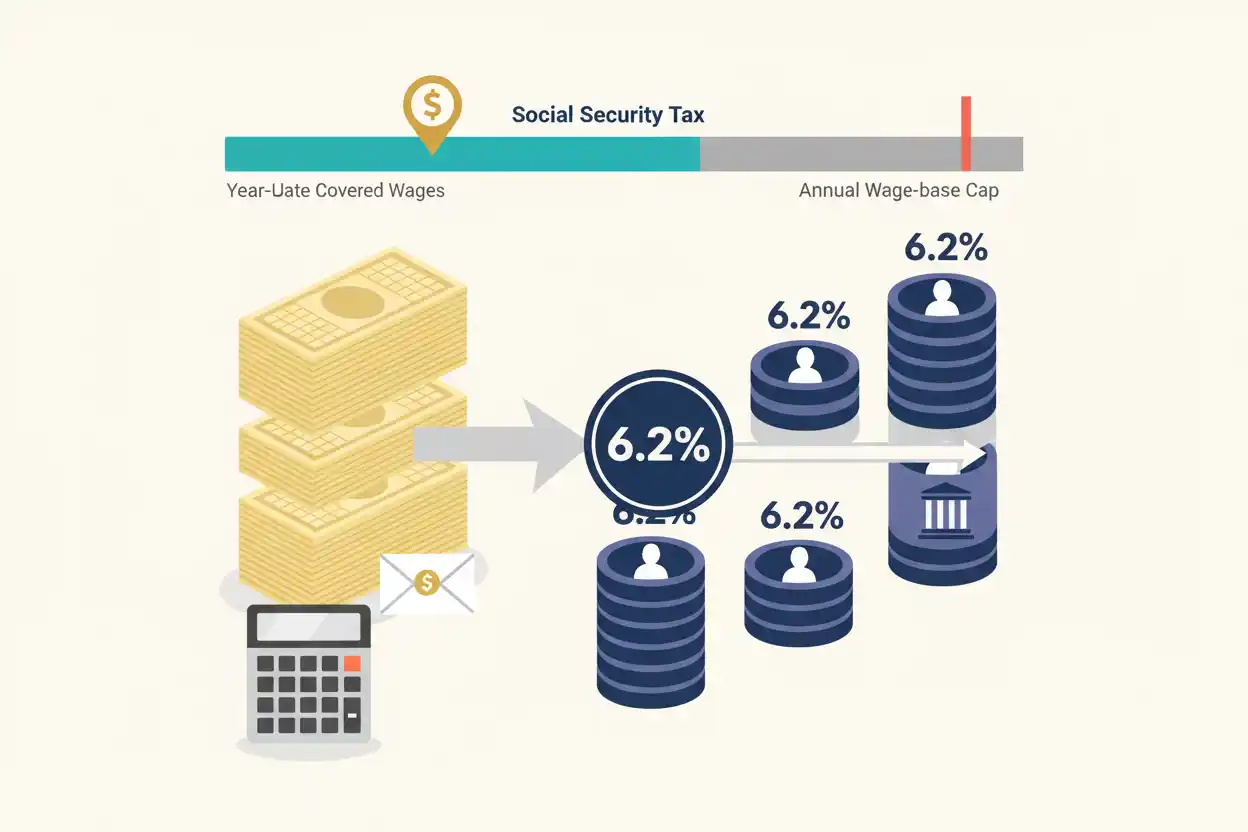

Social Security tax is a U.S. payroll tax applied to covered wages up to an annual wage-base limit.
For 2026, the employee Social Security tax rate is 6.2%, the employer rate is also 6.2%, and the Social Security wage base is $184,500. The combined employer-and-employee rate is 12.4%.
An employee earning $100,000 of covered Social Security wages in 2026 has employee Social Security tax of:
$100,000 × 6.2%
= $6,200
Because $100,000 is below the 2026 wage base, every dollar in the example remains subject to the employee Social Security tax.
Social Security Tax Formula
For an employee whose year-to-date covered wages remain below the annual wage base:
Employee Social Security Tax = Covered Social Security Wages × 6.2%
Employer tax:
Employer Social Security Tax = Covered Social Security Wages × 6.2%
For 2026, covered wages above $184,500 are not subject to additional regular Social Security tax for the same employee after the annual wage base has been reached.
$60,000 Wage Example
Suppose annual covered wages are:
$60,000
Employee Social Security tax:
$60,000 × 6.2%
= $3,720
Employer Social Security tax:
$3,720
Combined:
$7,440
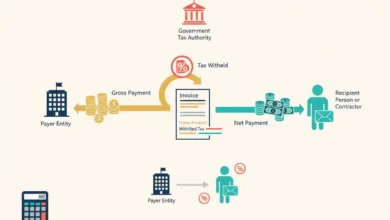
The employee’s paycheck is reduced by the employee portion, not by the full combined $7,440.
$100,000 Wage Example
Covered wages:
$100,000
Employee tax:
$100,000 × 0.062
= $6,200
Employer tax:
$6,200
Combined:
$12,400
The combined 12.4% figure describes both sides together.
2026 Maximum Employee Social Security Tax
The 2026 wage base is:
$184,500
Employee rate:
6.2%
Maximum ordinary employee Social Security tax:
$184,500 × 6.2%
= $11,439
The employer’s corresponding maximum regular Social Security tax for the same wage base is also $11,439, assuming all wages are covered and the ordinary rules apply.
Employee Earning $200,000
Suppose covered annual wages are:
$200,000
Only the first:
$184,500
is subject to regular Social Security tax in 2026.
Employee tax:
$184,500 × 6.2%
= $11,439
The remaining:
$200,000 − $184,500
= $15,500
is above the 2026 Social Security wage base and therefore is not subject to additional regular Social Security tax.
Social Security Tax Stops but Medicare Continues
The Social Security wage base should not be confused with Medicare tax rules.
The IRS confirms that only Social Security tax has the annual wage-base limit; Medicare tax does not use the same cap.
Therefore, when an employee crosses $184,500 of covered Social Security wages in 2026, regular Social Security withholding stops, but Medicare tax can continue on additional covered wages.
Paycheck Example
Suppose a semimonthly employee earns:
$5,000 of Covered Social Security Wages per Paycheck
while year-to-date wages remain below the annual limit.
Employee Social Security tax:
$5,000 × 6.2%
= $310
Employer tax:
$310
This calculation repeats until the employee reaches the applicable annual wage base.
Semimonthly Pay and Social Security Tax
Semimonthly pay generally creates 24 regular pay periods.
Suppose annual salary is:
$120,000
Semimonthly wages:
$120,000 ÷ 24
= $5,000
Social Security tax per ordinary paycheck while below the annual wage base:
$310
Across 24 identical checks:
$310 × 24
= $7,440
The same answer is produced by:
$120,000 × 6.2% = $7,440
Biweekly Pay Example
Suppose annual covered wages are $104,000.
Biweekly wages:
$104,000 ÷ 26
= $4,000
Employee tax per regular check:
$4,000 × 6.2%
= $248
Annual employee tax:
$248 × 26
= $6,448
This matches:
$104,000 × 6.2% = $6,448
Reaching the Wage Base Mid-Paycheck
Suppose an employee has already accumulated:
$182,000
of Social Security wages in 2026.
The next paycheck contains:
$5,000
of otherwise covered wages.
Only:
$184,500 − $182,000
= $2,500
remains under the wage base.
Employee Social Security tax on that paycheck should therefore be based on:
$2,500 × 6.2%
= $155
rather than the entire $5,000.
Social Security Tax After the Wage Base
After the 2026 wage base has been reached with the same employer, ordinary Social Security withholding on additional covered wages should stop for the remainder of the calendar year.
If the employee later receives another $10,000 from that same employer:
Additional Regular Social Security Tax = $0
assuming the wage base had already been fully reached.
Multiple Employers
The multiple-employer situation is different.
The IRS notes that each employer generally withholds Social Security tax up to the annual wage limit based on wages that employer pays. If combined wages from multiple employers exceed the annual limit, excess employee Social Security tax can potentially be claimed as a credit on the individual’s federal income tax return under the applicable rules.
This can cause temporary overwithholding during the year.
Multiple-Employer Example
Suppose in 2026:
Employer A pays:
$120,000
Employer B pays:
$100,000
Combined wages:
$220,000
Each employer may withhold based on its own payroll because neither employer sees the complete combined wage history.
Combined employee Social Security withholding before reconciliation:
Employer A:
$120,000 × 6.2% = $7,440
Employer B:
$100,000 × 6.2% = $6,200
Total:
$13,640
Maximum ordinary employee tax based on the 2026 wage base:
$11,439
Potential excess:
$13,640 − $11,439
= $2,201
The taxpayer’s return can address qualifying excess employee withholding.
Employer Portion Is Different
Even when an employee has excess withholding because of multiple employers, each employer’s Social Security tax obligation is generally determined from the wages that employer paid under the applicable employer rules.
The employee’s personal annual wage-base reconciliation does not simply create an employer refund from one unrelated company.
Employee and employer obligations must remain separate.
Social Security Tax and Self-Employment Tax
Self-employment tax contains a 12.4% Social Security component because a self-employed taxpayer effectively accounts for both sides of the Social Security tax structure in the self-employment system.
However, employee wages and self-employment earnings share the annual Social Security earnings ceiling for the Social Security component.
A taxpayer cannot use a full separate $184,500 Social Security base for wages and another full $184,500 for self-employment earnings in 2026.
Social Security Tax and Short-Term Capital Gains
Short-term capital gains are generally treated as ordinary income for federal income-tax purposes, but they are not automatically Social Security wages.
This distinction is important.
“Taxed as ordinary income” does not mean “subject to every wage-based payroll tax.”
Social Security Tax and Standard Deduction
The standard deduction affects the federal income-tax calculation.
It does not ordinarily reduce Social Security wages simply because it reduces taxable income for federal income-tax purposes.
Payroll-tax and income-tax bases use different rules.
Social Security Tax and Tax Credits
A tax credit can reduce certain tax liabilities on an income tax return.
It does not ordinarily change the Social Security wage amount on an employee’s Form W-2 simply because the taxpayer qualifies for the credit.
Credits and payroll wage calculations occur in different parts of the tax system.
Social Security Tax and Gross Pay
Suppose:
Gross Pay = $4,000
and all $4,000 is covered Social Security wages.
Employee Social Security tax:
$248
If other deductions total:
$752
Net pay:
$3,000
The $248 is one component of the $1,000 difference between gross and net pay.
Social Security Wage vs Gross Pay
Gross pay can differ from Social Security wages when compensation items receive different payroll-tax treatment.
Therefore, payroll calculations should use the amount identified as covered Social Security wages rather than simply assuming every dollar of gross compensation has identical treatment.
Salary Raise Below the Wage Base
Suppose an employee’s salary increases:
$80,000 → $88,000
Additional covered wages:
$8,000
Additional employee Social Security tax:
$8,000 × 6.2%
= $496
because both salaries remain below the 2026 wage base.
Salary Raise Above the Wage Base
Suppose wages rise:
$180,000 → $200,000
Only:
$184,500 − $180,000
= $4,500
of the $20,000 increase remains subject to regular Social Security tax in 2026.
Additional employee Social Security tax:
$4,500 × 6.2%
= $279
The remaining $15,500 increase is above the wage base.
Effective Social Security Tax Percentage at High Wages
An employee earning exactly $184,500 pays:
$11,439
Employee Social Security tax as a percentage of wages:
$11,439 ÷ $184,500
= 6.2%
At $250,000 of wages, ordinary employee Social Security tax remains $11,439:
$11,439 ÷ $250,000
≈ 4.58%
The statutory employee rate is still 6.2% on covered wages up to the cap, but the tax represents a smaller percentage of total earnings once wages exceed the annual base.
New Calendar Year
The Social Security wage base applies by calendar year.
Once a new year begins, payroll begins applying the new year’s wage base and rate rules to that year’s covered wages.
Because the wage base can change annually, payroll projections should use the correct year’s limit rather than carrying forward a prior-year cap.
Common Social Security Tax Mistakes
One mistake is applying 6.2% to unlimited wages.
Another is subtracting both employee and employer shares from employee take-home pay.
People can also assume Medicare stops when Social Security withholding stops or overlook excess employee withholding when working for multiple employers.
Frequently Asked Questions
What is the employee Social Security tax rate in 2026?
6.2% of covered Social Security wages up to the annual wage base.
What is the employer rate?
6.2%.
What is the combined rate?
12.4%.
What is the 2026 Social Security wage base?
$184,500.
What is the maximum ordinary employee Social Security tax for 2026?
$184,500 × 6.2% = $11,439
Does Social Security tax apply above $184,500 in 2026?
Regular employee Social Security tax does not apply to wages above the annual wage base.
Does Medicare tax stop at the same point?
No. Medicare does not use the Social Security wage-base cap.
What happens if I have two employers?
Each employer generally withholds based on the wages it pays, which can result in excess employee Social Security withholding when combined wages exceed the annual limit.
Can excess employee Social Security tax be reconciled?
Qualifying excess withholding from multiple employers can generally be addressed on the individual’s federal income tax return.
Is the employer share deducted from my paycheck?
No. The employee share is the amount ordinarily withheld from employee wages.
Are short-term capital gains Social Security wages?
Not merely because they are generally taxed as ordinary income for federal income-tax purposes.
Why track year-to-date Social Security wages?
Because withholding should stop once covered wages reach the applicable annual wage base.