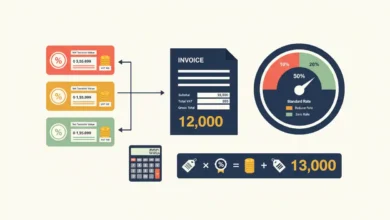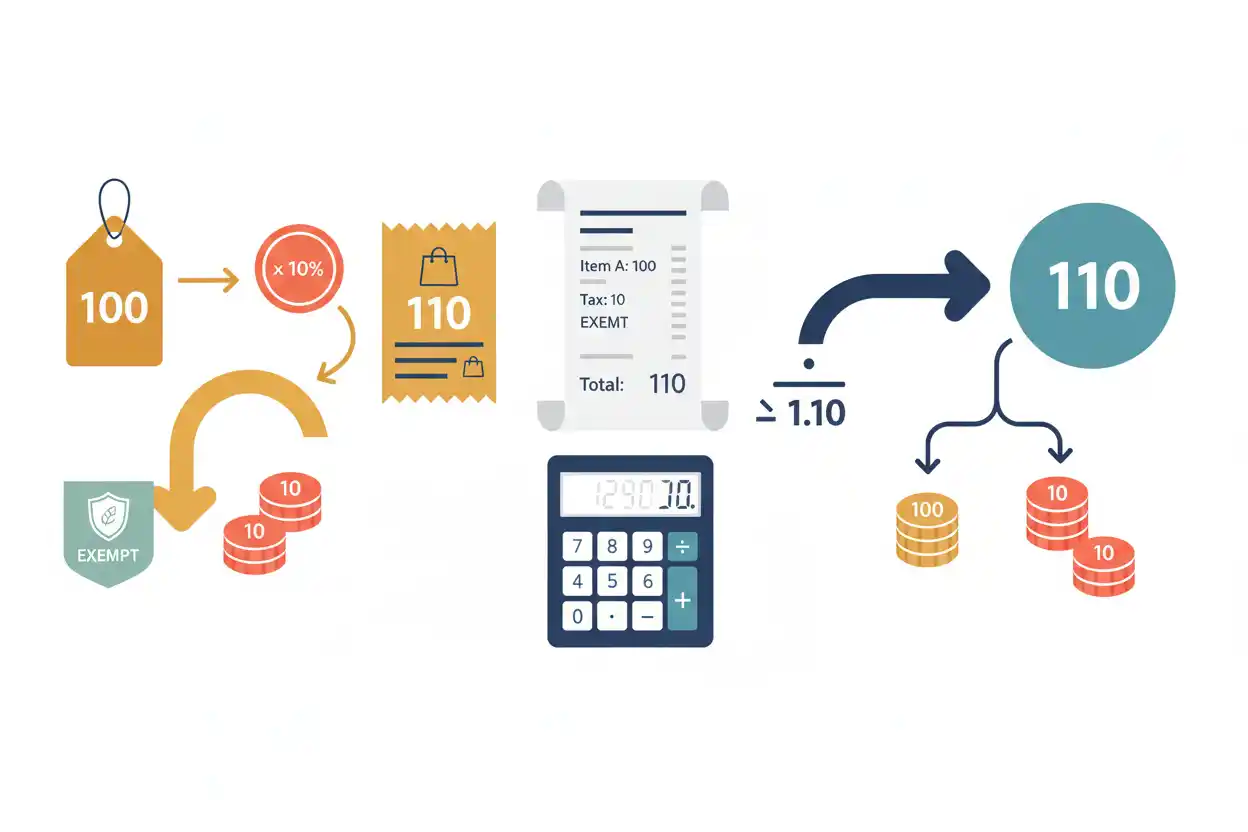

The sales tax rate is the percentage applied to the taxable portion of a purchase to determine the amount of sales tax.
If a $200 taxable purchase produces $16 of sales tax:
Sales Tax Rate = $16 ÷ $200 × 100
= 8%
Once the rate is known, the same relationship can be reversed to calculate tax on another taxable amount or to reconstruct the pre-tax price from a tax-inclusive total.
The most important detail is the denominator. The sales tax rate is based on the taxable price, not necessarily the full receipt total.
Sales Tax Rate Formula
When the sales tax amount and taxable purchase price are known:
Sales Tax Rate = Sales Tax ÷ Taxable Price × 100
Suppose:
Taxable Price = $250
and:
Sales Tax = $18.75
Then:
Sales Tax Rate = $18.75 ÷ $250 × 100
= 7.5%
The sales tax rate is 7.5%.
Sales Tax From a Known Rate
The formula can be rearranged:
Sales Tax = Taxable Price × Sales Tax Rate
For a $250 purchase at 7.5%:
Sales Tax = $250 × 0.075
= $18.75
Final price:
$250 + $18.75
= $268.75
This is the same transaction viewed from the opposite direction.
Total Price Formula
When the entire purchase is taxable:
Total Price = Taxable Price × (1 + Sales Tax Rate)
At 7.5%:
Total Price = $250 × 1.075
= $268.75
The multiplier includes both the original 100% price and the additional 7.5% tax.
Finding the Rate From a Receipt
Suppose a receipt shows:
Taxable Subtotal = $84
Sales Tax = $6.72
Then:
Sales Tax Rate = $6.72 ÷ $84
= 0.08
Convert to a percentage:
0.08 × 100 = 8%
The implied rate is 8%.
This calculation works only when $84 is genuinely the amount to which the $6.72 tax was applied.
Why the Final Total Is the Wrong Denominator
Suppose a $100 taxable purchase carries 8% tax.
Tax:
$8
Final total:
$108
If someone calculates:
$8 ÷ $108 × 100
the result is approximately:
7.41%
That is tax as a percentage of the tax-inclusive total, not the sales tax rate.
The correct rate is:
$8 ÷ $100 = 8%
Reverse a Tax-Inclusive Price
Suppose the total price is $216 and the known sales tax rate is 8%.
To find the pre-tax price:
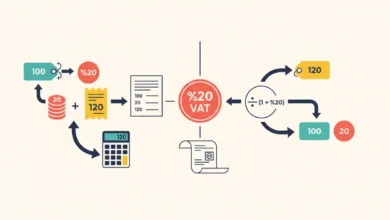
Pre-Tax Price = Tax-Inclusive Total ÷ (1 + Tax Rate)
$216 ÷ 1.08
= $200
Tax:
$216 − $200
= $16
A tax-inclusive total should be divided by the tax factor rather than reduced by simply subtracting 8%.
Why Subtracting 8% Does Not Reverse an 8% Tax
Suppose you calculate:
$216 × 92%
= $198.72
That does not return the original $200 price.
The reason is that the 8% tax was calculated from $200, while subtracting 8% from $216 uses a different base.
Percentage increases and decreases are not direct inverses.
Sales Tax Rate vs Sales Tax
The broader sales tax calculation focuses on the dollar tax and final transaction price.
The sales tax rate calculation focuses on the percentage itself.
For example:
Taxable Price = $500
Rate = 6%
Tax:
$30
The 6% is the sales tax rate.
The $30 is the sales tax.
The $530 is the tax-inclusive total.
Mixed Taxable and Exempt Items
Suppose a receipt contains:
$120 Taxable Goods
and:
$80 Exempt Goods
Total merchandise:
$200
If tax charged is:
$9.60
the implied sales tax rate is:
$9.60 ÷ $120 × 100
= 8%
Dividing by the full $200 would produce only 4.8%, which would incorrectly mix taxable and exempt items in the denominator.
Effective Tax Rate Across the Entire Basket
Although the statutory rate in the previous example is 8%, tax relative to total merchandise is:
$9.60 ÷ $200 × 100
= 4.8%
This can be called an effective transaction-level burden for analytical purposes.
It should not be mislabeled as the statutory sales tax rate.
Multiple Sales Tax Rates
Suppose a purchase contains one $100 item taxed at 5% and another $100 item taxed at 9%.
Tax on the first:
$100 × 5% = $5
Tax on the second:
$100 × 9% = $9
Total tax:
$14
Total merchandise:
$200
Blended effective rate:
$14 ÷ $200
= 7%
Neither item actually carries a 7% rate. It is simply the weighted average across the combined purchase.
Weighted Sales Tax Rate
The general blended-rate formula is:
Blended Tax Rate = Total Sales Tax ÷ Total Relevant Purchase Value × 100
Suppose:
$300 at 5% = $15 Tax
and:
$200 at 8% = $16 Tax
Total tax:
$31
Total value:
$500
Blended rate:
$31 ÷ $500 × 100
= 6.2%
The larger 5%-taxed purchase pulls the blended rate closer to 5%.
State and Local Components
When two sales tax components apply to the same taxable base and are simply additive, the combined rate can be calculated as:
Combined Rate = Component Rate 1 + Component Rate 2
For example:
5% + 2.5% = 7.5%
On $400:
Tax = $400 × 7.5%
= $30
Actual rates and taxable bases depend on the transaction’s jurisdiction, so the applicable rate should be verified before using the formula.
Finding an Unknown Local Component
Suppose the total rate is 8.25% and one known component is 6%.
Unknown Component = 8.25% − 6%
= 2.25%
This arithmetic is useful when a combined rate is known and its components need to be reconciled.
Rate Increase Example
Suppose a sales tax rate changes from:
6% to 7.5%
The increase is:
1.5 Percentage Points
The relative percentage increase in the rate is:
(7.5% − 6%) ÷ 6% × 100
= 25%
The rate rose by 1.5 percentage points, which represents a 25% increase relative to the original rate.
Effect on a Purchase
For a $1,000 taxable purchase:
At 6%:
Tax = $60
At 7.5%:
Tax = $75
Difference:
$15
The tax amount also rose by:
$15 ÷ $60
= 25%
because the taxable base remained unchanged.
Sales Tax Rate and Salary Reduction
A salary reduction percentage and a sales tax rate can both be expressed as percentages, but they use unrelated bases.
A 10% salary reduction is calculated from compensation.
An 8% sales tax is calculated from a taxable purchase.
The percentages cannot be added or compared meaningfully without defining what each one measures.
Sales Tax Rate and Salary Conversions
Salary conversions can help translate earnings into hourly or monthly amounts when evaluating the affordability of a tax-inclusive purchase.
Suppose hourly gross compensation is $25 and an item costs $270 after tax.
The purchase is equivalent to:
$270 ÷ $25
= 10.8 Gross Work Hours
This interpretation does not change the sales tax rate; it simply relates the final purchase price to earnings.
Sales Tax Rate and Self-Employment Tax
Self-employment tax uses net earnings from self-employment under federal tax rules rather than taxable retail purchases.
A 15.3% self-employment tax rate and an 8% sales tax rate therefore describe entirely different calculations.
The denominator is what gives a percentage its financial meaning.
Sales Tax Rate and Semimonthly Pay
Semimonthly pay converts annual compensation into 24 regular pay periods.
A shopper’s pay frequency does not change the statutory sales tax rate on a purchase.
However, it can affect how easily a household absorbs a tax-inclusive transaction within a particular paycheck.
Rate Needed to Produce a Target Tax
Suppose a $500 taxable purchase generates a target tax amount of $35.
Required Rate = $35 ÷ $500
= 7%
If the tax target were $40:
Required Rate = $40 ÷ $500
= 8%
This is simply the rate formula rearranged around a known tax amount.
Taxable Price From Tax and Rate
If tax and rate are known:
Taxable Price = Sales Tax ÷ Sales Tax Rate
Suppose:
Tax = $24
Rate = 8%
Then:
Taxable Price = $24 ÷ 0.08
= $300
Final total:
$324
Rounding
Suppose the taxable subtotal is:
$89.99
and the rate is:
7.25%
Unrounded tax:
$89.99 × 0.0725
= $6.524275
Rounded to cents:
$6.52
Final total:
$96.51
Depending on transaction structure, systems can sometimes produce small rounding differences when tax is calculated per item rather than on the total taxable subtotal.
Common Sales Tax Rate Mistakes
A common mistake is dividing tax by the final tax-inclusive amount instead of the pre-tax taxable price.
Another is calculating the rate from a receipt containing exempt items without isolating the taxable subtotal.
People can also confuse percentage-point changes with percentage changes or assume a blended effective rate is the statutory rate for every item.
Frequently Asked Questions
What is the sales tax rate formula?
Sales Tax Rate = Sales Tax ÷ Taxable Price × 100
What rate produces $16 tax on $200?
8%
How do I calculate sales tax from the rate?
Sales Tax = Taxable Price × Sales Tax Rate
How do I calculate the total after tax?
Total = Taxable Price × (1 + Tax Rate)
when the full purchase is taxable.
How do I reverse a tax-inclusive price?
Pre-Tax Price = Tax-Inclusive Total ÷ (1 + Tax Rate)
Why shouldn’t I divide tax by the final total?
Because the tax was calculated from the taxable pre-tax amount.
How do exemptions affect the rate calculation?
Exclude validly exempt amounts from the statutory-rate denominator.
Can one receipt contain multiple tax rates?
Yes.
What is a blended sales tax rate?
It is total tax divided by the combined purchase value being analyzed.
What is the difference between percentage points and percent change?
A move from 6% to 7.5% is 1.5 percentage points but a 25% relative increase.
Does pay frequency affect a sales tax rate?
No.
Why identify the taxable base first?
Because even a correct percentage formula produces the wrong answer when the denominator is wrong.