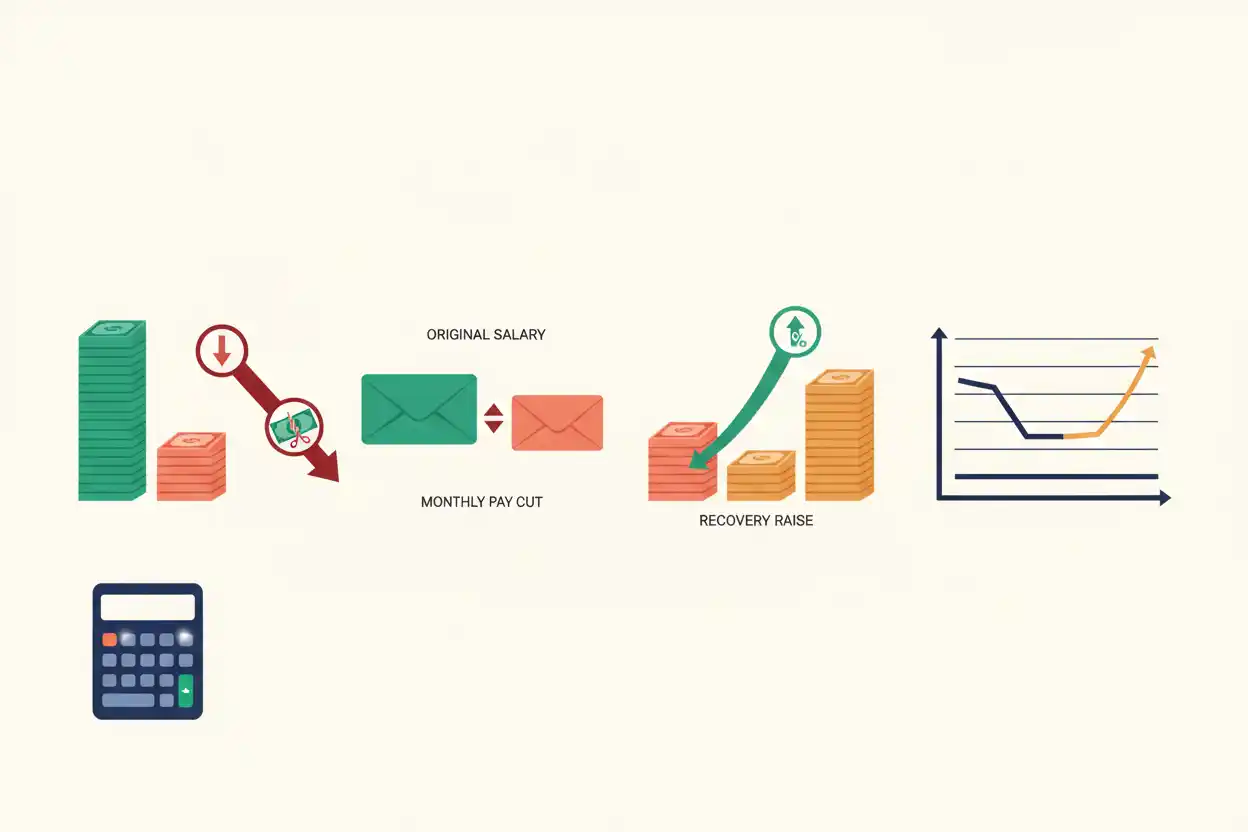

Salary reduction percentage measures how much compensation falls relative to the original salary.
If salary decreases from $80,000 to $72,000:
Salary Reduction = $80,000 − $72,000
= $8,000
Then:
Salary Reduction Percentage = $8,000 ÷ $80,000 × 100
= 10%
The employee’s salary has been reduced by 10%.
The old salary must be used as the denominator because the reduction is measured relative to the amount earned before the cut.
Salary Reduction Percentage Formula
Salary Reduction Percentage = (Old Salary − New Salary) ÷ Old Salary × 100
Using symbols:
Reduction % = (Old − New) ÷ Old × 100
The same formula can be applied to hourly wages, weekly pay, monthly salaries, or other compensation amounts when both values use the same period.
Basic Salary Reduction Example
Suppose:
Old Salary = $90,000
New Salary = $81,000
Reduction:
$90,000 − $81,000 = $9,000
Percentage:
$9,000 ÷ $90,000 × 100
= 10%
The salary reduction is 10%.
Calculate New Salary From a Reduction Percentage
When the old salary and reduction rate are known:
New Salary = Old Salary × (1 − Reduction Rate)
For an $80,000 salary with a 10% reduction:
New Salary = $80,000 × 0.90
= $72,000
Calculate the Dollar Reduction
Dollar Reduction = Old Salary × Reduction Rate
For:
$80,000 × 10%
= $8,000
Then:
$80,000 − $8,000 = $72,000
Reverse a Salary Reduction
Suppose the current salary is:
$72,000
after a 10% reduction.
To recover the original salary mathematically:
Old Salary = New Salary ÷ (1 − Reduction Rate)
$72,000 ÷ 0.90
= $80,000
Adding 10% to $72,000 would produce only $79,200.
Why a 10% Raise Does Not Reverse a 10% Cut
Start:
$80,000
After 10% reduction:
$80,000 × 0.90 = $72,000
Then add a 10% raise:
$72,000 × 1.10 = $79,200
The result is:
$800 Below the Original Salary
Overall change:
$79,200 ÷ $80,000 − 1
= −1%
Equal percentage decreases and increases do not cancel because they apply to different bases.
Raise Needed to Recover From a 10% Reduction
Required recovery rate:
Recovery Raise = Original Salary ÷ Reduced Salary − 1
Using:
$80,000 ÷ $72,000 − 1
≈ 11.11%
A 10% salary cut therefore requires approximately an 11.11% raise from the reduced salary to return to the original amount.
Recovery From a 20% Salary Reduction
Suppose salary falls:
$100,000 → $80,000
Reduction:
20%
Required raise to return from $80,000 to $100,000:
$100,000 ÷ $80,000 − 1
= 25%
The larger the reduction, the larger the required recovery percentage relative to the reduced base.
Monthly Impact
Suppose salary falls:
$80,000 → $72,000
Old monthly gross:
$80,000 ÷ 12
≈ $6,666.67
New monthly gross:
$72,000 ÷ 12
= $6,000
Monthly gross reduction:
≈ $666.67
Annual reduction:
$8,000
The percentage remains 10% across both periods.
Biweekly Impact
Using a 26-pay-period schedule:
Old biweekly gross:
$80,000 ÷ 26
≈ $3,076.92
New:
$72,000 ÷ 26
≈ $2,769.23
Reduction per regular paycheck:
≈ $307.69
Annualized:
$307.69 × 26 ≈ $8,000
subject to rounding.
Hourly Equivalent Impact
Using salary conversions with 2,080 annual hours:
Old hourly equivalent:
$80,000 ÷ 2,080
≈ $38.46
New hourly equivalent:
$72,000 ÷ 2,080
≈ $34.62
Reduction:
≈ $3.85 per Hour
The exact displayed difference can vary slightly because of rounding.
Salary Reduction vs Pay Raise
Pay raises use the opposite growth factor.
Raise:
New Pay = Old Pay × (1 + Rate)
Reduction:
New Pay = Old Pay × (1 − Rate)
Both calculations use the original pay as the starting base.
Temporary Salary Reduction
Suppose an $80,000 salary is reduced by 10% for only six months.
Normal six-month salary:
$80,000 × 6 ÷ 12
= $40,000
Reduced annual rate:
$72,000
Six months at reduced rate:
$36,000
Annual compensation if the other six months remain at the original rate:
$40,000 + $36,000
= $76,000
Although the temporary pay rate is 10% lower, actual full-year compensation falls:
$80,000 − $76,000
= $4,000
or:
5%
because the cut applies for only half of the year.
Three-Month Reduction
Suppose the same 10% reduction applies for three months.
Nine months at original rate:
$80,000 × 9 ÷ 12 = $60,000
Three months at reduced rate:
$72,000 × 3 ÷ 12 = $18,000
Full-year pay:
$78,000
Annual impact:
$2,000
Annual percentage reduction:
$2,000 ÷ $80,000
= 2.5%
The rate reduction and the current-year earnings reduction are different when the change is temporary.
Salary Reduction and Payroll Tax
If taxable wages decline, payroll tax can also decline.
Suppose an illustrative payroll tax rate of 5% applies to the entire salary.
At $80,000:
Tax = $4,000
At $72,000:
Tax = $3,600
Difference:
$400
The employee loses $8,000 of gross salary but may not lose the entire $8,000 in take-home pay because some wage-related taxes can also decline.
Salary Reduction and Sales Tax
A salary reduction does not change a sales tax rate merely because the household has less income.
Suppose take-home income falls by $500 monthly while a local taxable purchase still carries the same sales-tax rate.
The tax percentage on the purchase is unchanged, but the purchase consumes a larger proportion of the household’s available income.
Income changes and transaction-tax rates should therefore be analyzed separately.
Salary Reduction and Sales Tax Rate
The sales tax rate is calculated from transaction tax and taxable purchase price, not from salary.
For example:
$8 Tax ÷ $100 Taxable Price = 8% Sales Tax Rate
That 8% has no direct mathematical relationship with an 8% salary reduction.
Percentages need their bases identified.
Reduction Followed by Another Reduction
Suppose salary is:
$100,000
First reduction:
10%
New salary:
$90,000
Second reduction:
5%
New salary:
$90,000 × 0.95
= $85,500
Cumulative reduction:
$100,000 − $85,500
= $14,500
Percentage:
14.5%
Simply adding 10% and 5% would overstate the reduction as 15%.
General Formula for Successive Reductions
Final Salary = Original Salary × (1 − r₁) × (1 − r₂) × …
The cumulative percentage reduction is:
1 − Product of Remaining-Pay Factors
For reductions of 10% and 5%:
1 − (0.90 × 0.95)
= 14.5%
Reduction Plus Later Raise
Suppose salary falls 15% and later rises 15%.
Start:
$100,000
After cut:
$85,000
After raise:
$85,000 × 1.15
= $97,750
The employee remains 2.25% below the starting salary.
Salary Reduction and Inflation
Suppose nominal salary falls 5% while prices rise 3%.
Real purchasing-power change:
0.95 ÷ 1.03 − 1
≈ −7.77%
The combination of lower salary and higher prices creates a larger real decline than the nominal salary cut alone.
Reduction Needed to Hit a New Payroll Budget
Suppose a company needs to reduce a $500,000 salary budget to:
$450,000
Required dollar reduction:
$50,000
Percentage:
$50,000 ÷ $500,000 × 100
= 10%
If every salary is reduced proportionally, a 10% cut achieves the target before considering other payroll costs.
Common Salary Reduction Mistakes
A common error is dividing the cut by the new salary instead of the original salary.
Another is assuming an equal percentage raise reverses a pay cut.
People can also confuse a temporary 10% salary-rate reduction with a 10% reduction in full-year earnings or simply add successive percentage cuts instead of compounding them.
Frequently Asked Questions
What is salary reduction percentage?
It measures the decrease in salary relative to the original salary.
What is the formula?
(Old Salary − New Salary) ÷ Old Salary × 100
What is the reduction from $80,000 to $72,000?
10%
How do I calculate salary after a cut?
New Salary = Old Salary × (1 − Reduction Rate)
How do I reverse the calculation?
Old Salary = New Salary ÷ (1 − Reduction Rate)
Does a 10% raise reverse a 10% reduction?
No.
What raise is needed after a 10% reduction?
Approximately 11.11%.
What raise is needed after a 20% reduction?
25%.
Does a temporary 10% salary cut reduce full-year pay by 10%?
Only if the cut applies for the full year.
Can payroll taxes fall when salary falls?
They can when applicable taxable wages decline.
Do successive reductions add together?
Not exactly. They compound from progressively smaller salary bases.
Why separate salary-rate reduction from annual earnings reduction?
Effective dates determine how much of the year is actually paid at the reduced rate.