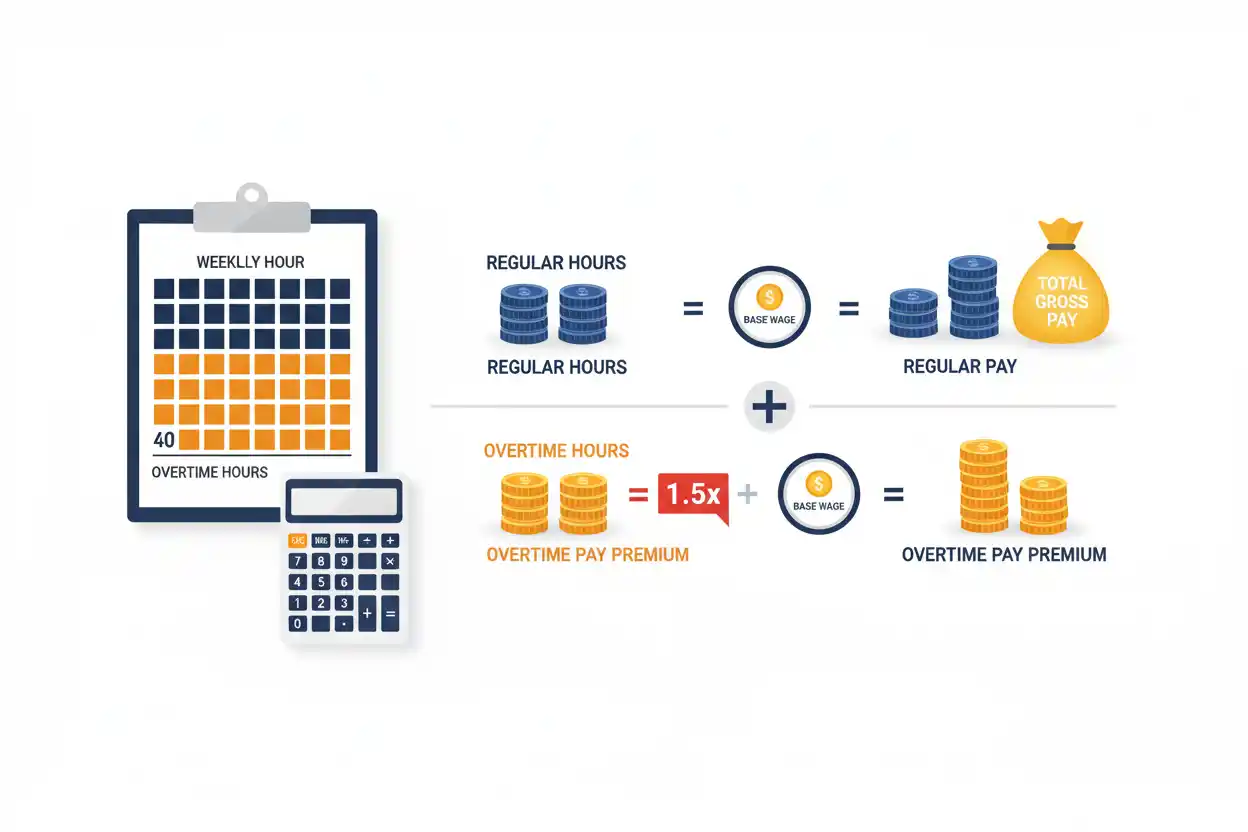

Overtime pay is additional compensation for hours that qualify for an overtime rate under the applicable employment rules, agreement, or employer policy.
If an employee’s base rate is $24 per hour and five hours are paid at a 1.5× multiplier:
Overtime Rate = $24 × 1.5
= $36 per Hour
Overtime compensation for those five hours is:
$36 × 5 = $180
If the employee also has 40 regular hours at $24, total gross pay for the period becomes $1,140.
The arithmetic should begin only after the qualifying hours and correct multiplier have been established.
Overtime Pay Formula
The basic formula is:
Overtime Rate = Regular Hourly Rate × Overtime Multiplier
Then:
Overtime Pay = Overtime Rate × Qualifying Overtime Hours
Combined:
Overtime Pay = Regular Rate × Multiplier × Overtime Hours
If the multiplier is 1.5:
Overtime Pay = Regular Rate × 1.5 × Overtime Hours
Overtime Pay Example
Suppose:
Regular Rate = $24 per Hour
Overtime Multiplier = 1.5
Overtime Hours = 5
Overtime rate:
$24 × 1.5 = $36
Overtime pay:
$36 × 5 = $180
The employee earns $180 for those five qualifying hours.
Total Pay With Regular and Overtime Hours
Suppose the same employee also works:
40 Regular Hours
Regular pay:
$24 × 40 = $960
Overtime pay:
$180
Total net pay is not yet known because taxes and deductions have not been applied, but gross compensation is:
$960 + $180
= $1,140
Overtime Premium vs Overtime Pay
These two amounts are easy to confuse.
Five hours at the ordinary $24 rate have a straight-time value of:
$24 × 5 = $120
The extra 0.5× premium is:
$24 × 0.5 × 5
= $60
Total overtime compensation:
$120 + $60
= $180
Therefore:
Overtime Pay = Straight-Time Value + Overtime Premium
When someone asks only for the additional premium, the correct answer in this example is $60 rather than $180.
Time-and-a-Half
A 1.5× multiplier means:
Overtime Rate = 150% of Regular Rate
At $20 per hour:
$20 × 1.5 = $30
At $30 per hour:
$30 × 1.5 = $45
At $42 per hour:
$42 × 1.5 = $63
The formula remains the same.
Different Overtime Multipliers
Not every premium-pay arrangement uses 1.5×.
If an agreement specifies 2×:
Premium Rate = Regular Rate × 2
If it specifies 1.75×:
Premium Rate = Regular Rate × 1.75
The correct multiplier should be identified before calculating pay.
This page focuses on overtime arithmetic rather than determining which employment rule applies to a specific worker.
Example at a 2× Multiplier
Suppose:
Regular Rate = $25
Qualifying Hours = 4
At a 2× multiplier:
Premium Rate = $25 × 2
= $50
Pay for those hours:
$50 × 4
= $200
A 1.5× calculation would instead produce:
$25 × 1.5 × 4 = $150
The multiplier creates a $50 difference.
Overtime Pay From Total Hours
Suppose a payroll rule or agreement establishes 40 regular hours and 1.5× pay for additional qualifying hours.
If total hours are:
47
then overtime hours are:
47 − 40 = 7
At $22 per hour:
Regular pay:
$22 × 40 = $880
Overtime rate:
$22 × 1.5 = $33
Overtime pay:
$33 × 7 = $231
Total gross:
$1,111
The threshold used here is an example input; the applicable rule must determine which hours actually qualify.
Solve for Overtime Hours
If overtime compensation and the overtime rate are known:
Overtime Hours = Overtime Pay ÷ Overtime Rate
Suppose:
Overtime Pay = $270
Overtime Rate = $45
Then:
Overtime Hours = $270 ÷ $45
= 6 Hours
Solve for Regular Rate
Suppose:
Overtime Rate = $42
and the applicable multiplier is:
1.5
Then:
Regular Rate = $42 ÷ 1.5
= $28 per Hour
Overtime and Pay Frequency
Pay frequency determines how often payroll is issued but does not determine the overtime multiplier.
An employee paid biweekly may have overtime calculated from qualifying hours within each underlying work period rather than simply from whether total hours across a two-week paycheck exceed some arbitrary number.
Pay frequency and overtime eligibility are separate concepts.
Overtime and Monthly Income
Regular monthly income can be estimated from annual or periodic pay.
Overtime should be added carefully.
Suppose base annual compensation is:
$52,000
and expected overtime adds:
$7,800
Total expected annual gross income:
$59,800
Average monthly income:
$59,800 ÷ 12
≈ $4,983.33
If overtime varies substantially, a conservative budget may use base income instead of assuming the full projected amount.
Overtime and Pay Raise Percentage
A higher base rate increases overtime compensation even if the multiplier does not change.
Suppose a pay raise percentage increases the base rate from:
$20 to $22
At 1.5×, the overtime rate changes from:
$30 to $33
Percentage increase in base rate:
($22 − $20) ÷ $20 × 100
= 10%
Overtime rate also increases 10% because the multiplier remains constant.
Overtime and Medicare Tax
Overtime compensation can increase covered payroll wages, which can affect Medicare tax withholding.
Suppose ordinary gross pay is $4,000 and overtime adds $500.
New covered wages in a simplified example:
$4,500
Regular employee Medicare tax at 1.45%:
$4,500 × 1.45%
= $65.25
Without the $500 overtime:
$4,000 × 1.45% = $58
Difference:
$7.25
Overtime Does Not Equal Take-Home Increase
Suppose overtime adds:
$300 Gross
and additional payroll withholding and deductions associated with the larger paycheck total:
$90
Simplified extra take-home cash:
$300 − $90
= $210
The employee earned $300 of overtime pay even though net pay rises by only $210 in this simplified example.
Regular Hours Plus Multiple Premium Categories
Suppose an employee has:
36 Regular Hours at $24
6 Hours at 1.5×
3 Hours at 2×
Regular:
36 × $24 = $864
1.5× rate:
$36
Pay:
6 × $36 = $216
2× rate:
$48
Pay:
3 × $48 = $144
Total gross compensation:
$864 + $216 + $144
= $1,224
Each category should be calculated separately.
Weighted Average Earnings per Hour
Using the previous example:
Total hours:
36 + 6 + 3 = 45
Total gross pay:
$1,224
Average gross earnings per hour:
$1,224 ÷ 45
= $27.20
The average of $27.20 is not the employee’s regular hourly rate.
The underlying base remains $24.
Overtime Percentage of Gross Pay
Using the first example:
Regular Pay = $960
Overtime Pay = $180
Total Gross = $1,140
Overtime share:
$180 ÷ $1,140 × 100
≈ 15.79%
This can help workers understand how dependent a paycheck is on premium hours.
Annualizing Overtime
Suppose an employee earns:
$180 of Overtime Every Two Weeks
If that amount truly occurs in all 26 pay periods:
Annual Overtime = $180 × 26
= $4,680
However, if the $180 came from one unusually busy pay period, multiplying it by 26 would create an unrealistic projection.
Overtime and Salary Comparisons
Suppose Job A pays $25 per hour with regular overtime opportunities, while Job B pays $28 with little overtime.
Annual income cannot be compared reliably from base rates alone.
The analysis should separate:
Base Compensation
from:
Expected Premium Compensation
That prevents uncertain overtime from being mistaken for guaranteed salary.
Common Overtime Pay Mistakes
A common error is multiplying all hours by the overtime rate instead of separating regular and qualifying overtime hours.
Another is calculating only the additional 0.5× premium when the question asks for total pay on the overtime hours.
People can also annualize one unusually large overtime paycheck or assume that pay frequency itself determines which hours qualify.
Frequently Asked Questions
What is overtime pay?
It is compensation for qualifying hours paid at an enhanced rate under the applicable rule, agreement, or policy.
What is the basic formula?
Overtime Pay = Regular Rate × Overtime Multiplier × Overtime Hours
What does time-and-a-half mean?
It means a 1.5× multiplier.
What is time-and-a-half for $24 per hour?
$24 × 1.5 = $36 per Hour
What is five overtime hours at that rate?
$36 × 5 = $180
Is overtime premium the same as total overtime pay?
No. At 1.5×, the additional premium is the extra 0.5× portion.
How do I calculate total gross pay?
Add regular pay and all premium-pay categories.
Does overtime always use 1.5×?
Not necessarily. The applicable employment rule or agreement determines the multiplier.
Does pay frequency determine overtime eligibility?
Not by itself.
Does overtime increase net pay by the full gross overtime amount?
Not necessarily.
Does a pay raise increase the overtime rate?
Yes when overtime is calculated as a fixed multiple of the higher base rate.
Why calculate each pay category separately?
It prevents regular hours, overtime hours, and different premium multipliers from being mixed together.