
Medicare tax is a U.S. payroll tax applied to covered wages and certain other earned income.
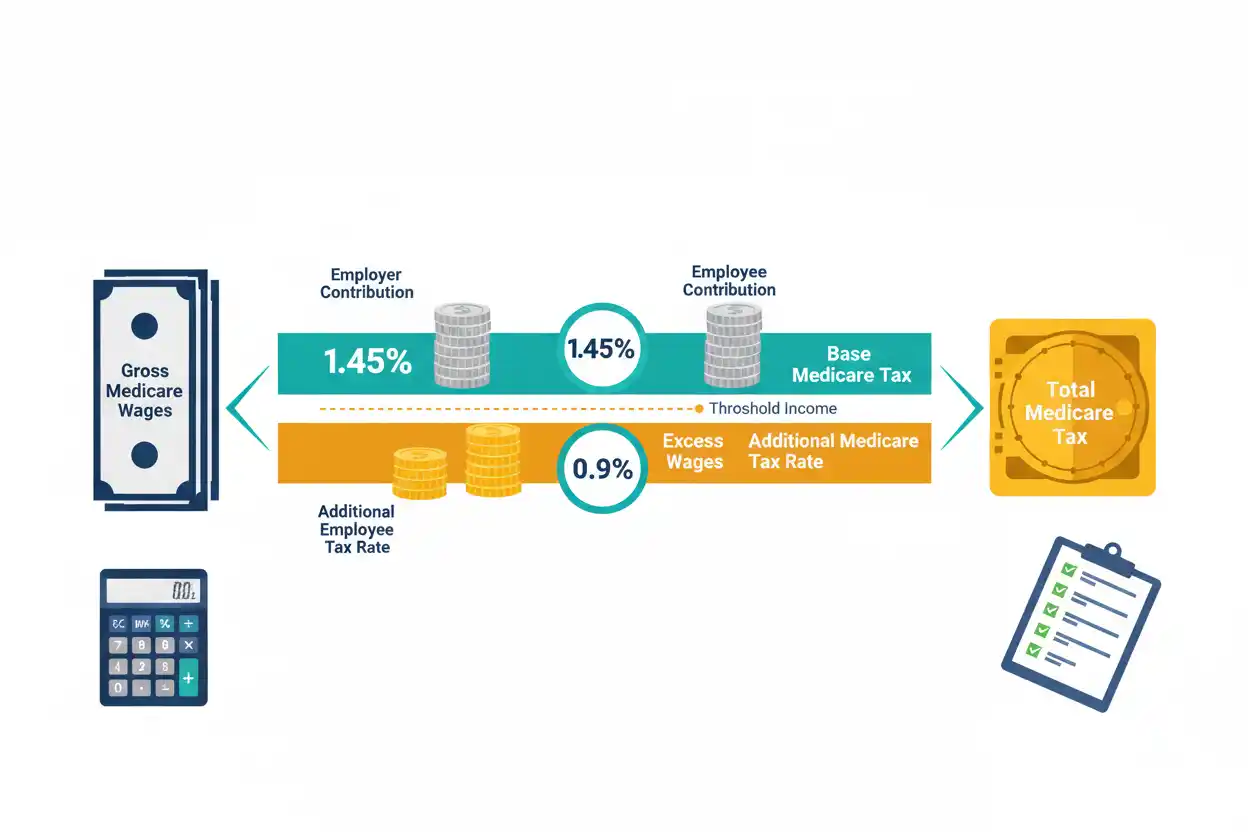
The current regular Medicare tax rate is 1.45% for the employee and 1.45% for the employer, producing a combined 2.9% regular Medicare tax. Unlike Social Security tax, regular Medicare tax has no annual wage-base limit for covered wages.
Higher earners can also owe a 0.9% Additional Medicare Tax on Medicare wages, self-employment income, and certain railroad retirement compensation above thresholds based on filing status.
That means Medicare tax should often be calculated in two layers:
Regular Medicare Tax + Additional Medicare Tax When Applicable
Regular Employee Medicare Tax Formula
For covered employee wages:
Employee Medicare Tax = Medicare Wages × 1.45%
Suppose:
Medicare Wages = $4,000
Then:
Employee Medicare Tax = $4,000 × 0.0145
= $58
The employee’s regular Medicare tax for the paycheck is $58.
Employer Medicare Tax
The employer’s regular matching Medicare tax is also 1.45% of covered Medicare wages.
For the same $4,000:
Employer Medicare Tax = $4,000 × 1.45%
= $58
Combined regular Medicare tax:
$58 + $58
= $116
Only the employee’s $58 is ordinarily withheld from the employee’s wages as the employee portion.
Annual Medicare Tax Example
Suppose an employee earns:
$80,000 of Covered Medicare Wages
Regular employee Medicare tax:
$80,000 × 1.45%
= $1,160
Regular employer Medicare tax:
$1,160
Combined:
$2,320
This calculation remains below the Additional Medicare Tax thresholds, so the example contains only regular Medicare tax.
No Regular Medicare Wage Cap
Social Security tax has an annual wage-base limit, but Medicare tax does not. All covered wages remain subject to the regular Medicare tax.
Suppose covered Medicare wages are:
$500,000
Regular employee Medicare tax:
$500,000 × 1.45%
= $7,250
The regular 1.45% portion does not stop simply because wages become high.
Additional Medicare Tax can then apply separately.
Additional Medicare Tax Formula
The current Additional Medicare Tax rate is:
0.9%
For an individual taxpayer:
Additional Medicare Tax = Amount Above Applicable Filing-Status Threshold × 0.9%
The IRS currently lists thresholds of $250,000 for married filing jointly, $125,000 for married filing separately, and $200,000 for other taxpayers.
Single Taxpayer Example
Suppose a single taxpayer has:
Medicare Wages = $230,000
Applicable Additional Medicare threshold:
$200,000
Excess:
$230,000 − $200,000
= $30,000
Additional Medicare Tax:
$30,000 × 0.9%
= $270
Regular employee Medicare tax:
$230,000 × 1.45%
= $3,335
Total employee Medicare-related tax:
$3,335 + $270
= $3,605
Additional Medicare Tax Has No Employer Match
The employer matches the regular 1.45% Medicare tax but does not match the 0.9% Additional Medicare Tax.
In the $230,000 single-taxpayer example:
Employer regular Medicare amount:
$230,000 × 1.45% = $3,335
Employee regular Medicare:
$3,335
Employee Additional Medicare Tax:
$270
Employer additional match:
$0
Employer Withholding Threshold
Employer withholding for Additional Medicare Tax follows a rule that is different from the employee’s ultimate filing-status-based liability.
An employer must begin withholding the additional 0.9% once wages it pays to an employee exceed $200,000 in the calendar year, regardless of the employee’s filing status.
This creates important differences for married taxpayers.
Married Filing Jointly Example
Suppose a married couple filing jointly has:
Spouse A Medicare wages:
$220,000
Spouse B Medicare wages:
$70,000
Combined Medicare wages:
$290,000
Joint Additional Medicare Tax threshold:
$250,000
Excess:
$290,000 − $250,000
= $40,000
Final Additional Medicare Tax liability:
$40,000 × 0.9%
= $360
Withholding vs Final Liability for the Married Couple
Spouse A’s employer sees $220,000 of wages and begins Additional Medicare Tax withholding after $200,000.
Amount subject to employer withholding:
$20,000
Withheld:
$20,000 × 0.9%
= $180
Spouse B earns only $70,000, so that employer does not cross the $200,000 employer-withholding threshold.
Yet the couple’s actual joint liability is:
$360
Difference:
$360 − $180
= $180
This illustrates why payroll withholding and final tax liability can differ.
Married Filing Jointly With Two $150,000 Earners
Suppose each spouse earns:
$150,000
Combined:
$300,000
Neither employer pays that individual employee more than $200,000, so neither employer would trigger the automatic Additional Medicare Tax withholding rule based solely on those wages.
However, combined wages exceed the $250,000 married-filing-jointly threshold by:
$300,000 − $250,000
= $50,000
Additional Medicare Tax liability:
$50,000 × 0.9%
= $450
This is a clear example of why married households may need to consider withholding or estimated taxes beyond what each employer automatically deducts. The IRS specifically notes that some taxpayers may need additional withholding or estimated payments to cover Additional Medicare Tax liability.
Married Filing Separately Example
The current Additional Medicare Tax threshold for married filing separately is $125,000.
Suppose Medicare wages are:
$160,000
Excess:
$160,000 − $125,000
= $35,000
Additional Medicare Tax:
$35,000 × 0.9%
= $315
The employer may not have withheld Additional Medicare Tax because the employee’s wages never crossed the separate $200,000 employer withholding trigger.
Medicare Tax and Marriage Tax
The difference between filing-status thresholds and employer withholding makes marriage tax analysis particularly relevant for higher-income couples.
Marriage can change the household-level Additional Medicare Tax threshold even though each employer continues processing payroll independently.
The final tax calculation therefore needs household information that one employer may not possess.
Medicare Tax and Marginal Tax Rate
Marginal tax rate usually refers to the income-tax rate applying to the next taxable dollar.
Medicare tax is separate.
Suppose an additional $1,000 of wages is fully subject to:
30% Illustrative Marginal Income Tax
and:
1.45% Regular Employee Medicare Tax
Ignoring all other taxes:
Income tax:
$300
Medicare tax:
$14.50
Combined modeled effect:
$314.50
This is why the income-tax marginal rate alone does not fully describe the tax burden on additional wages.
Medicare Tax and Monthly Income
Monthly income can be used to estimate regular payroll Medicare withholding.
Suppose monthly covered wages are:
$8,000
Regular employee Medicare tax:
$8,000 × 1.45%
= $116
Annualizing 12 identical months:
$116 × 12
= $1,392
which matches:
$96,000 × 1.45% = $1,392
Medicare Tax and Net Pay
Net pay is calculated after employee payroll deductions.
Suppose:
Gross Pay = $5,000
Regular employee Medicare tax:
$72.50
If other taxes and deductions equal:
$1,127.50
Total deductions:
$1,200
Net pay:
$5,000 − $1,200
= $3,800
Medicare tax is only one component of the difference between gross and net pay.
Medicare Tax and Long-Term Capital Gains
Long-term capital gains are investment gains rather than ordinary Medicare wages.
Regular payroll Medicare tax should not simply be applied to a long-term capital gain.
Certain investment income can interact with other federal taxes, but that is separate from the wage-based Medicare tax calculation covered here.
Medicare Tax vs FICA Tax
Medicare tax is one component of FICA for ordinary employees.
Conceptually:
FICA = Social Security Tax + Medicare Tax
The Medicare portion should still be tracked separately because it has no wage cap and can include Additional Medicare Tax at higher income levels.
Medicare Tax vs Social Security Tax
Regular Social Security and Medicare taxes differ in several important ways.
Social Security has a year-specific wage base.
Medicare has no wage-base limit for covered wages.
Additional Medicare Tax can also apply above filing-status-specific thresholds, while Social Security does not use the same additional-tax mechanism.
Payroll Withholding Is Not Always Final Tax
Suppose an employer withholds exactly what payroll rules require.
The employee can still owe Additional Medicare Tax when filing if household income pushes total Medicare wages above the applicable filing-status threshold.
Conversely, employer withholding can exceed final Additional Medicare Tax liability in some situations.
The tax return reconciles the final amount.
Common Medicare Tax Mistakes
A common mistake is assuming Medicare tax stops when Social Security tax reaches its wage cap.
Another is applying the 0.9% additional rate to all wages instead of only the amount above the applicable threshold.
Married taxpayers can also assume employer withholding automatically equals the couple’s final liability or mistakenly add an employer match to the Additional Medicare Tax.
Frequently Asked Questions
What is the regular employee Medicare tax rate?
The current regular employee rate is 1.45% of covered Medicare wages.
What is the employer rate?
The current regular employer rate is also 1.45%.
Is there a Medicare wage cap?
No. Regular Medicare tax applies to all covered wages.
What is Additional Medicare Tax?
It is an additional 0.9% tax on qualifying earned income above filing-status-specific thresholds.
What are the current thresholds?
They are $250,000 for married filing jointly, $125,000 for married filing separately, and $200,000 for other taxpayers.
When does an employer begin withholding Additional Medicare Tax?
When wages paid by that employer to an employee exceed $200,000 during the calendar year, regardless of filing status.
Does the employer match Additional Medicare Tax?
No.
Can a married couple owe Additional Medicare Tax even if neither employer withheld it?
Yes, when combined income exceeds the filing-status threshold even though neither employee individually crossed the employer withholding trigger.
Is Medicare tax the same as income tax?
No.
Is Medicare tax part of FICA?
Yes, for ordinary employee payroll calculations.
Do long-term capital gains receive regular payroll Medicare tax?
They are not ordinary Medicare wages merely because they are investment gains.
Why calculate regular and Additional Medicare Tax separately?
They use different rules, and keeping them separate makes payroll withholding and final tax liability easier to reconcile within the broader Taxes & Pay framework.