
“Marriage tax” is an informal way of describing situations in which a married couple’s combined tax result differs from what the same two people might have paid under another filing or marital-status scenario.
A marriage can create a penalty when combined tax is higher, a bonus when combined tax is lower, or little meaningful difference.
For U.S. federal tax purposes, filing status generally depends on marital status on the last day of the tax year. Married taxpayers can generally use married filing jointly or married filing separately, subject to the rules applicable to their circumstances. Filing status can affect tax, deductions, credits, and filing requirements.
The correct comparison therefore requires actual tax calculations rather than assuming marriage always raises or always lowers taxes.
What Is a Marriage Tax Penalty?
A simplified marriage penalty can be expressed as:
Marriage Penalty = Tax as Married Couple − Combined Comparison Tax Before Marriage
If the result is positive, the modeled married tax is higher.
If the result is negative, the couple experiences a marriage bonus under the comparison.
Marriage Bonus Formula
Marriage Bonus = Combined Comparison Tax Before Marriage − Tax as Married Couple
A positive result indicates the modeled married tax is lower.
These formulas describe the comparison. They do not determine the tax liability themselves.
Why Marriage Can Change Tax
Marriage can change the applicable filing status, which can affect bracket thresholds, standard deduction amounts, eligibility for credits, and other tax-return provisions.
That means two people with exactly the same combined income can have different tax results depending on:
- how income is split;
- filing status;
- deductions;
- credits;
- income type;
- other tax circumstances.
The interaction is more important than marital status by itself.
Hypothetical Single Tax Structure
To demonstrate the math without relying on current-year tax brackets, suppose an imaginary single-filer system taxes:
First $20,000:
10%
Next $30,000:
20%
Income above $50,000:
30%
Now suppose two unmarried individuals each earn $70,000 of taxable income.
Tax for each person:
First $20,000:
$2,000
Next $30,000:
$6,000
Remaining $20,000:
$6,000
Total each:
$14,000
Combined:
$28,000
Hypothetical Married Joint Structure
Now assume an illustrative joint-filer structure of:
First $30,000:
10%
Next $70,000:
20%
Income above $100,000:
30%
Combined taxable income:
$140,000
First $30,000:
$3,000
Next $70,000:
$14,000
Remaining $40,000:
$12,000
Total:
$29,000
Marriage penalty in this purely hypothetical example:
$29,000 − $28,000
= $1,000
The couple pays $1,000 more under the illustrative married structure.
Marriage Bonus Example
Now assume one person earns:
$120,000
and the other:
$20,000
Before marriage, using the hypothetical single structure:
Tax on $120,000:
$2,000 + $6,000 + $21,000
= $29,000
Tax on $20,000:
$2,000
Combined:
$31,000
Under the illustrative married-joint structure, the combined $140,000 produces:
$29,000
Marriage bonus:
$31,000 − $29,000
= $2,000
The same $140,000 combined income produces a bonus rather than a penalty because the income distribution differs.
Why Income Distribution Matters
Equal earners can use more of each person’s lower tax brackets before marriage.
When those incomes are combined, the joint brackets might not always be exactly twice as wide at every level.
Conversely, a household with one high earner and one low earner can sometimes benefit when more of the high earner’s income fits into broader joint lower-rate ranges.
This is the mathematical intuition behind marriage penalties and bonuses.
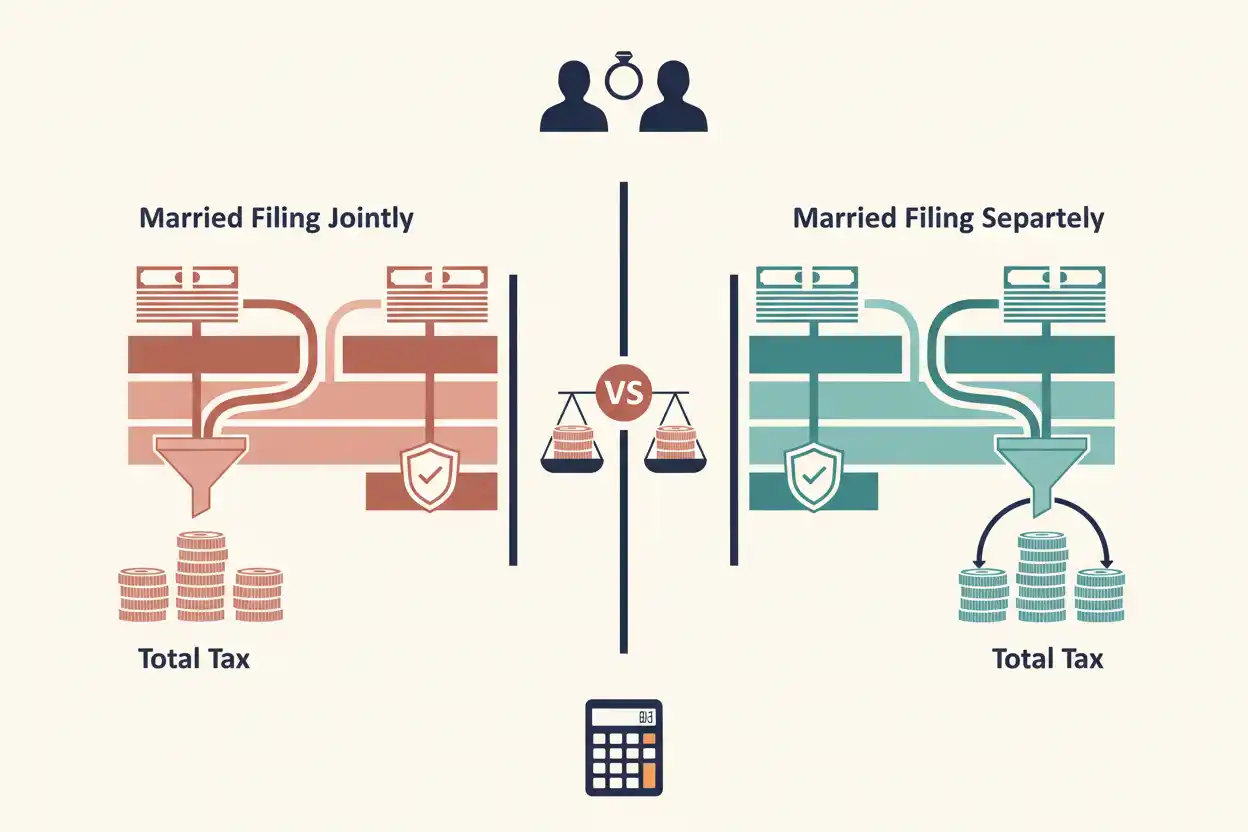
Married Filing Jointly
A joint return combines the spouses’ income and many tax items on one return.
The resulting tax is calculated under the rules for married filing jointly.
It should not be estimated by simply adding the two spouses’ previous single-filer tax bills.
The tax base and applicable thresholds need to be recomputed under the joint status.
Married Filing Separately
Married filing separately means each spouse files a separate federal return under that filing status.
The tax consequences can differ from filing jointly because the applicable brackets, deductions, credits, and eligibility rules may differ.
A separate filing should therefore be calculated directly rather than assumed to equal half of a joint return.
Joint vs Separate Tax Formula
A useful comparison is:
Difference = Total Tax Under Joint Filing − Combined Tax Under Separate Filing
Suppose:
Joint Tax = $32,000
and the two separate returns produce:
$18,000 + $15,000 = $33,000
Then:
Difference = $32,000 − $33,000
= −$1,000
The joint return is $1,000 lower in this simplified comparison.
Marriage Tax and Marginal Tax Rate
The marginal tax rate can change when two incomes are combined.
Suppose one spouse previously had a 20% marginal rate and the other 30%.
After marriage, their joint taxable income could place the household in a different marginal bracket.
The marginal rate affects the next taxable dollar, while marriage-tax analysis compares the complete tax outcomes.
Marriage Tax and Medicare Tax
Medicare tax creates an important example of why filing status can matter beyond ordinary income-tax brackets.
Additional Medicare Tax liability uses filing-status-specific thresholds, even though employer payroll withholding uses its own $200,000 wage threshold regardless of filing status.
A couple therefore cannot determine final Medicare-related tax solely by looking at each paycheck independently.
Marriage Tax and Long-Term Capital Gains
Long-term capital gains can be sensitive to the household’s taxable-income level.
Combining two spouses’ income can change where capital gains fall within the applicable tax calculation.
The gain itself remains the same:
Amount Realized − Adjusted Basis
but the resulting tax can differ.
Marriage Tax and Itemized Deductions
Itemized deductions can also affect the comparison.
Suppose one spouse owns a home and has significant deductible expenses while the other has few deductions.
A filing-status comparison needs to apply the actual rules governing deductions under joint and separate filing rather than simply splitting household deductions 50/50.
Marriage Tax and Monthly Income
Monthly income becomes useful when translating tax differences into household cash flow.
Suppose a filing decision changes annual tax by:
$2,400
Average monthly cash-flow difference:
$2,400 ÷ 12
= $200 per Month
A tax difference that seems modest annually can affect recurring household budgeting.
Filing Status Is Based on Legal Tax Rules
Federal filing status generally depends on marital status on the final day of the year, subject to the rules and exceptions that determine whether someone is treated as married or unmarried for tax purposes.
That means a wedding late in the year can affect the filing status used for that tax year.
Exact circumstances should be checked rather than inferred from how many months the couple lived together.
Marriage Penalty Is Not a Separate Tax Line
A taxpayer will not normally see a line labeled:
Marriage Penalty Tax
The phrase describes the difference between tax outcomes under comparison scenarios.
It is an analytical concept, not a separate percentage automatically charged to married taxpayers.
Withholding After Marriage
When marital status, income, or household circumstances change, payroll withholding can become misaligned with eventual annual tax.
Suppose both spouses work and each payroll system considers only that employee’s wages.
The combined household income can produce a different tax result.
Withholding should therefore be distinguished from final joint or separate tax liability.
Two-Income Household Example
Suppose Spouse A earns:
$80,000
and Spouse B earns:
$60,000
Combined income:
$140,000
A rough calculation that simply treats each paycheck independently can miss:
- joint bracket effects;
- deduction interactions;
- additional household income;
- filing-status-specific provisions.
The proper comparison is built from complete returns under each allowable filing option.
One-Income Household Example
Suppose one spouse earns:
$140,000
and the other earns no taxable income in the simplified scenario.
Compared with a two-earner household each earning $70,000, the combined income is identical.
Yet the marriage-tax result can differ because progressive brackets respond to how income was distributed before combining.
Marriage and Tax Credits
Some credits have filing-status, income, or eligibility rules that can make the joint-versus-separate comparison more complex than applying tax brackets alone.
A filing method that looks better before credits can produce a different result after credits are calculated.
This is why the final tax liability should be compared rather than only taxable income.
Common Marriage Tax Mistakes
A frequent mistake is assuming marriage always creates a tax penalty.
Another is assuming joint filing is automatically best without calculating the permitted alternatives.
Couples can also compare only marginal rates, overlook deductions and credits, or use each spouse’s paycheck withholding as though it represented the final household tax.
Frequently Asked Questions
What does marriage tax mean?
It usually refers informally to a marriage penalty or bonus created when a married couple’s tax differs from a comparison tax before marriage or under another allowable filing arrangement.
Is there a specific federal tax called the marriage tax?
No. It describes an outcome produced by the broader tax system.
Can marriage lower taxes?
Yes, depending on income distribution and other tax circumstances.
Can marriage increase taxes?
Yes.
What filing statuses can married taxpayers generally use?
Married taxpayers can generally file jointly or separately, subject to applicable filing-status rules.
Is filing jointly always cheaper?
No. The actual returns should be compared when both options are available.
Why do equal earners sometimes experience a penalty?
Joint thresholds are not necessarily exactly double equivalent single thresholds across every tax provision.
Why can one-earner couples receive a bonus?
Combining incomes can allow more of a high earner’s income to fall within broader joint ranges in some tax structures.
Does filing status affect deductions and credits?
Yes.
Can marriage affect Medicare-related tax?
Yes, because Additional Medicare Tax liability uses filing-status-specific thresholds.
Does marriage change the dollar amount of a capital gain?
No, although it can change the tax context in which the gain is reported.
Why compare complete tax calculations?
Marriage penalties and bonuses result from interacting brackets, deductions, credits, income types, and filing rules rather than one isolated tax rate.