
Marginal tax rate is the tax rate that applies to the next dollar of taxable income within a progressive tax structure.
It is not necessarily the percentage of total income paid in tax.
Suppose a purely hypothetical system taxes the first $20,000 of taxable income at 10%, the next $30,000 at 20%, and taxable income above $50,000 at 30%.
A person with $70,000 of taxable income has a marginal tax rate of 30%, but total tax under this simplified structure is only $14,000—an effective rate of 20% on the $70,000 taxable-income base.
What Is a Marginal Tax Rate?
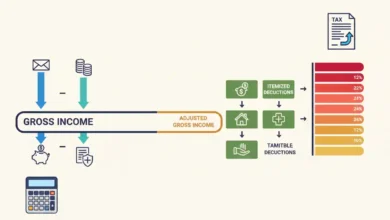
A progressive tax system divides taxable income into ranges.
Each range can carry a different rate.
The marginal rate answers:
What tax rate applies to the next dollar earned, assuming nothing else in the tax calculation changes?
The calculation is fundamentally different from multiplying total income by the highest bracket reached.
Hypothetical Tax Brackets
Assume this simplified structure:
First $20,000:
10%
Next $30,000:
20%
Amount above $50,000:
30%
These are illustrative numbers designed to demonstrate bracket mechanics rather than current tax law.
Marginal Tax Rate Example
Suppose taxable income is:
$70,000
First $20,000:
$20,000 × 10% = $2,000
Next $30,000:
$30,000 × 20% = $6,000
Remaining $20,000:
$20,000 × 30% = $6,000
Total tax:
$2,000 + $6,000 + $6,000
= $14,000
Because the last dollars fall in the 30% bracket:
Marginal Tax Rate = 30%
Why You Do Not Multiply Everything by 30%
A common error is:
$70,000 × 30% = $21,000
That overstates tax by:
$21,000 − $14,000
= $7,000
The first $50,000 remains taxed under the two lower hypothetical brackets.
Only taxable income above $50,000 receives the 30% rate.
Marginal vs Effective Tax Rate
Using the example:
Total Tax = $14,000
Taxable Income = $70,000
Effective tax rate:
$14,000 ÷ $70,000 × 100
= 20%
Therefore:
Marginal Rate = 30%
while:
Effective Rate = 20%
The income tax basics distinction between brackets and average tax burden explains why both numbers can be correct.
Tax on the Next $1,000
Suppose taxable income is already $70,000 and another $1,000 of ordinary taxable income is earned.
If the entire additional amount remains within the same illustrative 30% bracket:
Additional Tax = $1,000 × 30%
= $300
After the simplified income tax:
Additional After-Tax Income = $700
The taxpayer does not lose the entire $1,000 merely because the marginal bracket is higher.
Tax on an Additional $5,000
Using the same bracket:
Additional Tax = $5,000 × 30%
= $1,500
Additional amount after this isolated tax assumption:
$5,000 − $1,500
= $3,500
Other payroll taxes, credits, deductions, or phaseouts can alter the real-world result.
Crossing Into a Higher Bracket
Suppose taxable income is:
$49,000
and another $4,000 is earned.
The first $1,000 of new income fills the remainder of the hypothetical 20% bracket:
$1,000 × 20% = $200
The remaining $3,000 enters the 30% bracket:
$3,000 × 30% = $900
Additional tax:
$1,100
Average tax on this $4,000 increase:
$1,100 ÷ $4,000
= 27.5%
The new income crosses two marginal rates.
Marginal Tax Rate and Itemized Deductions
Itemized deductions can remove taxable income that would otherwise fall in a marginal bracket.
Suppose taxable income before an additional deduction is:
$70,000
A $4,000 deduction reduces it to:
$66,000
All $4,000 would have been taxed at the illustrative 30% rate.
Simplified tax reduction:
$4,000 × 30%
= $1,200
The deduction is $4,000, while the tax effect is $1,200.
Deduction Crossing Two Brackets
Suppose taxable income is:
$52,000
and a $5,000 deduction reduces it to:
$47,000
The deduction removes:
$2,000 from the 30% bracket
and:
$3,000 from the 20% bracket
Tax reduction:
$2,000 × 30% + $3,000 × 20%
= $600 + $600
= $1,200
Using one rate on the entire deduction would miss the bracket crossing.
Marginal Tax Rate and Long-Term Capital Gains
Long-term capital gains should not automatically be taxed at the marginal rate applicable to ordinary income.
Different income categories can use different rate structures.
Therefore, someone whose ordinary marginal tax rate is hypothetically 30% should not simply multiply every long-term investment gain by 30%.
Marginal Tax Rate and Marriage Tax
Filing status can change bracket thresholds, deductions, credits, and other tax calculations, which is central to the marriage tax comparison.
If two incomes are combined on a joint return, the applicable bracket structure can differ from the structures that would have applied separately.
This can create either a marriage penalty or a marriage bonus depending on the circumstances.
Marginal Tax Rate and Medicare Tax
Medicare tax is a payroll-tax calculation and should not be combined with an income-tax bracket to create one unlabeled “marginal tax rate.”
Suppose an additional dollar of wages faces a 30% illustrative income-tax marginal rate plus another applicable payroll tax.
The combined change in take-home pay can differ from the income-tax marginal rate alone.
Marginal Tax Rate and Effective Tax Rate
Suppose taxable income rises from:
$70,000 to $80,000
Tax at $70,000:
$14,000
Additional $10,000 at 30%:
$3,000
New total tax:
$17,000
New effective rate:
$17,000 ÷ $80,000
= 21.25%
The marginal rate remains 30%, while the effective rate rises from 20% to 21.25%.
Marginal Rate on a Pay Raise
Suppose an employee receives a:
$10,000 Taxable Raise
and every additional dollar falls within an illustrative 30% income-tax bracket.
Additional income tax:
$3,000
Simplified income remaining after this tax:
$7,000
A higher marginal rate reduces the portion kept from the raise, but it does not make earning the additional income mathematically disadvantageous under the isolated bracket calculation.
Marginal Rate and Tax Credits
Tax credits can make the effective tax impact of additional income more complicated.
If rising income causes a credit to phase out, the economic marginal tax burden can exceed the statutory bracket rate over that range.
This is why a person’s effective marginal burden can sometimes involve more than the headline bracket.
Marginal Rate and Pretax Contributions
Suppose a qualifying pretax contribution reduces taxable income by:
$5,000
If all $5,000 would otherwise fall within an illustrative 30% bracket:
Current-Year Income-Tax Reduction ≈ $1,500
This does not necessarily mean the contribution creates permanent $1,500 tax savings because future taxation and account rules can matter.
Marginal Rate Can Fall When Income Falls
Suppose taxable income declines:
$70,000 → $45,000
Under the hypothetical brackets, the taxpayer moves from the 30% marginal bracket into the 20% bracket.
The marginal rate falls even though lower portions of income are still taxed under their respective rates.
Why Marginal Rate Is Useful
Marginal rate helps estimate the tax effect of decisions that change taxable income, such as an additional amount of ordinary compensation or an allowable deduction.
For a small change entirely within one bracket:
Approximate Tax Change = Change in Taxable Income × Marginal Rate
For larger changes crossing brackets, calculate each portion separately.
Common Marginal Tax Rate Mistakes
A common error is treating the marginal rate as the percentage paid on all income.
Another is assuming every type of income uses the ordinary marginal bracket structure.
People can also ignore bracket crossings when calculating a large deduction or pay increase.
Frequently Asked Questions
What is marginal tax rate?
It is the tax rate applying to the next dollar of taxable income under a progressive bracket structure.
Is marginal tax rate the same as effective tax rate?
No.
Does reaching a 30% bracket mean all income is taxed at 30%?
No.
How do I calculate tax across brackets?
Apply each rate only to the income falling inside that bracket, then add the results.
How does a deduction interact with marginal rate?
A deduction reduces taxable income, often removing income from the highest bracket first.
What happens if a deduction crosses brackets?
Different portions of the deduction can produce tax savings at different marginal rates.
Do long-term capital gains always use my ordinary marginal rate?
No.
Can filing status change marginal tax rate?
Yes, because the applicable bracket structure can depend on filing status.
Is Medicare tax part of the ordinary income-tax bracket?
No.
Can credits affect my practical marginal tax burden?
Yes, especially when credits phase in or out as income changes.
Does earning more money cause earlier income to be retaxed?
Not simply because a higher bracket is entered.
Why is marginal tax rate useful?
It helps estimate how changes in taxable income can affect tax within the broader Taxes & Pay calculation.