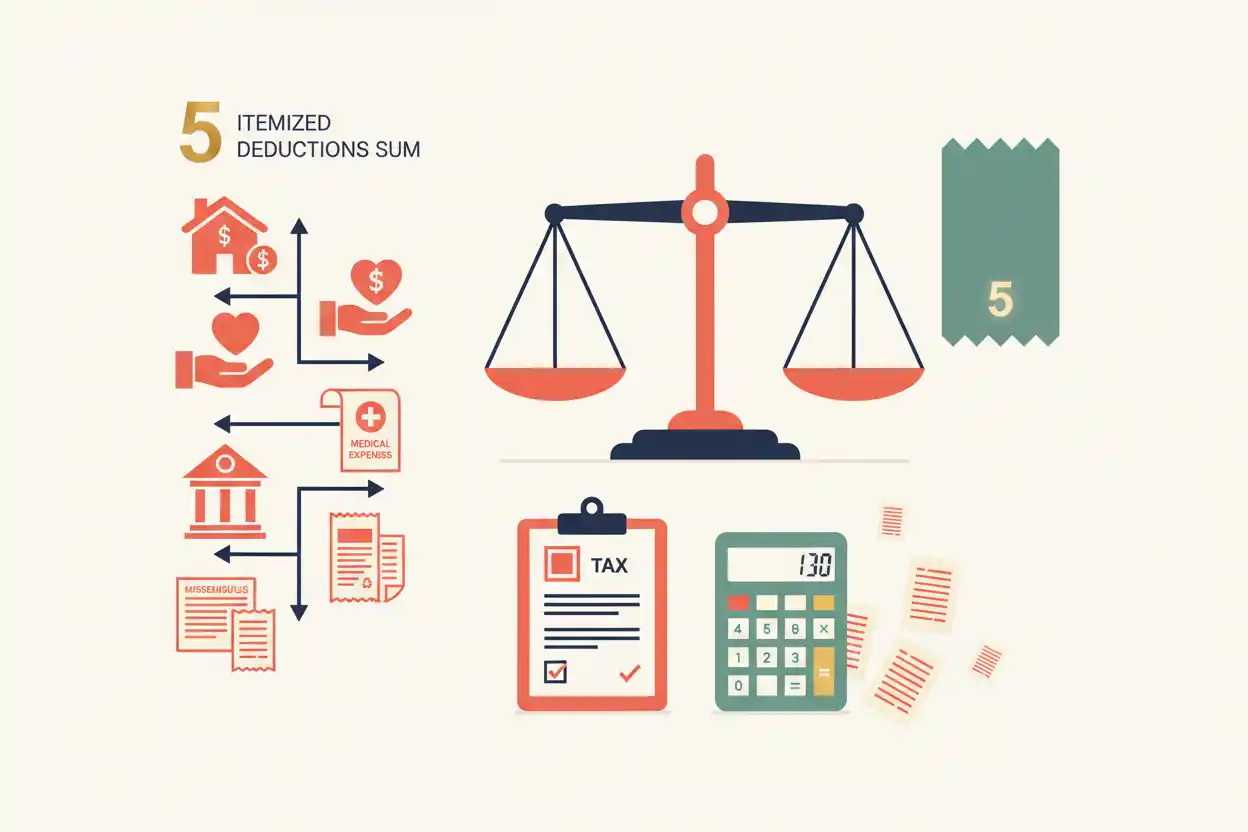

Itemized deductions are qualifying expenses that a taxpayer adds together and claims individually instead of using the standard deduction when the applicable rules make itemizing available.
At the federal level, U.S. taxpayers use Schedule A to calculate itemized deductions. In most cases, the larger of allowable itemized deductions or the standard deduction produces the lower taxable-income starting point, although individual circumstances and limitations still matter.
Suppose qualifying itemized deductions total $22,000 while an illustrative standard deduction is $16,000. Itemizing provides $6,000 more deductions in that simplified comparison.
That does not mean the tax bill falls by $6,000. Deductions reduce the income subject to tax rather than generally reducing tax dollar for dollar.
Itemized Deductions Formula
The basic arithmetic is:
Total Itemized Deductions = Deduction 1 + Deduction 2 + Deduction 3 + …
A comparison can then be made:
Deduction Used = Greater Applicable Amount of Itemized Deductions or Standard Deduction
The actual tax rules determine which expenses qualify, how much can be deducted, and whether limitations apply.
Itemized Deductions Example
Suppose a taxpayer has the following illustrative qualifying amounts after applying any relevant limits:
Medical-related deductible amount:
$3,000
Deductible taxes:
$7,000
Deductible mortgage interest:
$8,000
Qualified charitable contributions:
$4,000
Total:
$3,000 + $7,000 + $8,000 + $4,000
= $22,000
The taxpayer has $22,000 of modeled itemized deductions.
If the applicable standard deduction in this hypothetical example were $16,000:
Additional Deduction From Itemizing = $22,000 − $16,000
= $6,000
The comparison favors itemizing by $6,000 before considering other return-specific effects.
What Expenses Can Appear in Itemized Deductions?
Federal Schedule A can include qualifying amounts related to categories such as certain medical and dental expenses, certain taxes, certain interest, charitable contributions, and certain casualty or theft losses. The amount actually deductible within each category depends on the governing rules rather than simply the amount a household spent.
That distinction is important.
If someone paid $10,000 of a particular expense during the year, it does not automatically follow that:
Itemized Deduction = $10,000
Eligibility thresholds, limitations, documentation, and other requirements can change the deductible amount.
Itemized Deductions vs Standard Deduction
Suppose:
Itemized Deductions = $18,500
and:
Illustrative Standard Deduction = $20,000
Difference:
$20,000 − $18,500
= $1,500
Under a simple comparison, the standard deduction is $1,500 larger.
Now suppose itemized deductions increase to:
$23,000
Then itemizing exceeds the $20,000 standard deduction by:
$3,000
The important comparison is not whether a taxpayer has deductible expenses. It is whether the allowable itemized total produces a better result than the alternative deduction available under the applicable rules.
How Itemized Deductions Affect Taxable Income
Suppose income after earlier adjustments is:
$90,000
If the taxpayer uses a $16,000 hypothetical standard deduction:
Taxable Income = $90,000 − $16,000
= $74,000
If $22,000 of itemized deductions are used instead:
Taxable Income = $90,000 − $22,000
= $68,000
Difference in taxable income:
$74,000 − $68,000
= $6,000
This is the same $6,000 advantage identified earlier.
Deduction Is Not the Same as Tax Savings
Suppose the entire $6,000 additional deduction falls within an illustrative 22% marginal tax bracket.
A simplified estimate of the tax reduction is:
Tax Reduction ≈ Additional Deduction × Marginal Tax Rate
$6,000 × 22%
= $1,320
The taxpayer receives $6,000 more deduction but only an illustrative $1,320 reduction in tax.
The actual effect can differ if the deduction crosses brackets or affects other tax calculations.
Itemized Deductions and Marginal Tax Rate
The value of a deduction is closely connected to the marginal tax rate affecting the income it removes.
Suppose two taxpayers each receive an additional $5,000 deduction.
If one taxpayer’s relevant marginal rate is hypothetically 12%:
Estimated Tax Effect = $5,000 × 12% = $600
If another taxpayer’s relevant marginal rate is 30%:
Estimated Tax Effect = $5,000 × 30% = $1,500
The same deduction can therefore have different tax effects.
Itemized Deductions and Income Tax Basics
The broader income tax basics calculation places deductions before the final application of tax brackets.
A simplified sequence is:
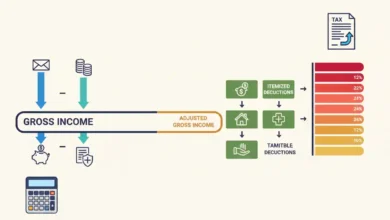
Gross Income → Adjusted Income → Deductions → Taxable Income → Tax Calculation
That sequence explains why deductions and credits should not be treated as interchangeable.
Itemized Deductions and Long-Term Capital Gains
Long-term capital gains can interact with the taxpayer’s broader taxable-income picture.
A deduction that lowers taxable income can sometimes affect where investment income falls within tax-rate calculations.
However, long-term capital gains have their own rate structure and should not simply be multiplied by the taxpayer’s ordinary marginal income-tax rate.
Itemized Deductions and Income Replacement
An income replacement ratio measures how much prior earnings have been replaced after an income interruption.
If household income changes significantly, the tax value of deductions can also change because taxable income and marginal rates may be different.
The replacement ratio itself remains a cash-flow metric rather than a tax deduction.
Itemized Deductions and Import Duty
An import duty is a customs charge rather than a personal Schedule A deduction merely because someone paid it.
Tax classification depends on the nature of the transaction and applicable tax rules.
Not every tax, fee, or business cost belongs among an individual’s itemized deductions.
Medical Expense Example
Suppose a taxpayer spends:
$12,000 on Medical Expenses
but only:
$4,000
meets the applicable deductible calculation after all thresholds and rules are applied.
The amount entering Schedule A would be the allowable $4,000 rather than automatically the full $12,000.
This distinction between expense paid and deduction allowed applies broadly to itemized deductions.
Charitable Contribution Example
Suppose qualifying charitable contributions amount to:
$5,000
If all $5,000 is deductible under the applicable rules, that amount can contribute to total itemized deductions.
However, documentation requirements, qualifying-recipient rules, contribution type, and limitations can affect the allowable amount.
The arithmetic comes after eligibility is established.
Mortgage Interest Example
Suppose an individual pays:
$14,000 of Mortgage Interest
during the year.
The deductible amount should not be assumed to equal $14,000 without considering whether the debt and interest meet the applicable tax requirements and limitations.
If only $11,000 is ultimately deductible:
Itemized Amount = $11,000
rather than the cash payment of $14,000.
Tax Payments Example
A taxpayer might pay several types of taxes during the year.
That does not mean every dollar of every tax belongs on Schedule A.
The applicable federal rules determine which taxes qualify and any limits that apply.
For calculation purposes, always begin with the allowable deductible amount, not merely the cash paid.
Itemizing Can Change From Year to Year
Suppose Year 1 produces:
$14,000 Itemized Deductions
and Year 2 produces:
$25,000
A taxpayer might use the standard deduction in one year and itemize in another, depending on the applicable standard deduction and tax circumstances.
A prior-year decision should not automatically be copied to a new return.
Bunching Expenses
Some taxpayers may have discretion over the timing of certain deductible payments or contributions.
For example, two years of discretionary deductible contributions might be concentrated into one year when legally and practically appropriate.
Mathematically, concentrating deductions can create:
One Year Above the Itemizing Threshold
rather than:
Two Years Below It
Whether such timing is appropriate depends on the tax rules and the taxpayer’s circumstances.
Itemized Deductions Do Not Change Gross Income
Suppose:
Gross Income = $100,000
and:
Itemized Deductions = $20,000
Gross income remains:
$100,000
The deductions operate later in the income-tax calculation.
Reporting:
Gross Income = $80,000
would confuse gross income with income after deductions.
Itemized Deductions vs Business Expenses
A business expense incurred to earn business income is not automatically a personal Schedule A itemized deduction.
Business deductions and personal itemized deductions can appear in different parts of the tax calculation.
Classifying an expense correctly matters before any tax arithmetic begins.
Itemized Deductions vs Tax Credits
Suppose a taxpayer has either a $2,000 deduction or a fully usable $2,000 tax credit.
If the deduction removes income taxed at an illustrative 20%:
Tax Effect of Deduction ≈ $400
The $2,000 credit can instead reduce tax by:
$2,000
The figures look identical before calculation but produce very different results.
Common Itemized Deduction Mistakes
A common error is adding every household expense and labeling the total deductible. Another is itemizing automatically without comparing the result with the standard deduction.
Taxpayers can also confuse deductions with credits, subtract itemized deductions directly from the tax bill, or use gross expenses instead of the allowable amounts after tax-law limits are applied.
Frequently Asked Questions
What are itemized deductions?
They are qualifying deductions calculated individually rather than using the standard deduction.
Where are federal itemized deductions calculated?
For U.S. individual federal income tax, they are generally calculated on Schedule A.
What is the basic formula?
Total Itemized Deductions = Sum of Allowable Itemized Deduction Amounts
Should I itemize whenever I have deductible expenses?
Not necessarily. The allowable itemized total should be compared with the applicable standard deduction.
Does a $10,000 deduction save $10,000 in tax?
No. A deduction generally reduces taxable income.
Can the same deduction produce different tax savings for different people?
Yes, because marginal rates and other tax circumstances can differ.
Do itemized deductions reduce gross income?
No. They occur later in the tax calculation.
Are all medical expenses deductible?
No. Only the amount permitted under the applicable rules enters the itemized deduction calculation.
Are all taxes paid itemized deductions?
No.
Are itemized deductions the same as business expenses?
No.
Can itemizing make sense one year but not the next?
Yes.
Why calculate itemized deductions carefully?
Their value depends on both the allowable total and how that total changes taxable income within the broader Taxes & Pay calculation.