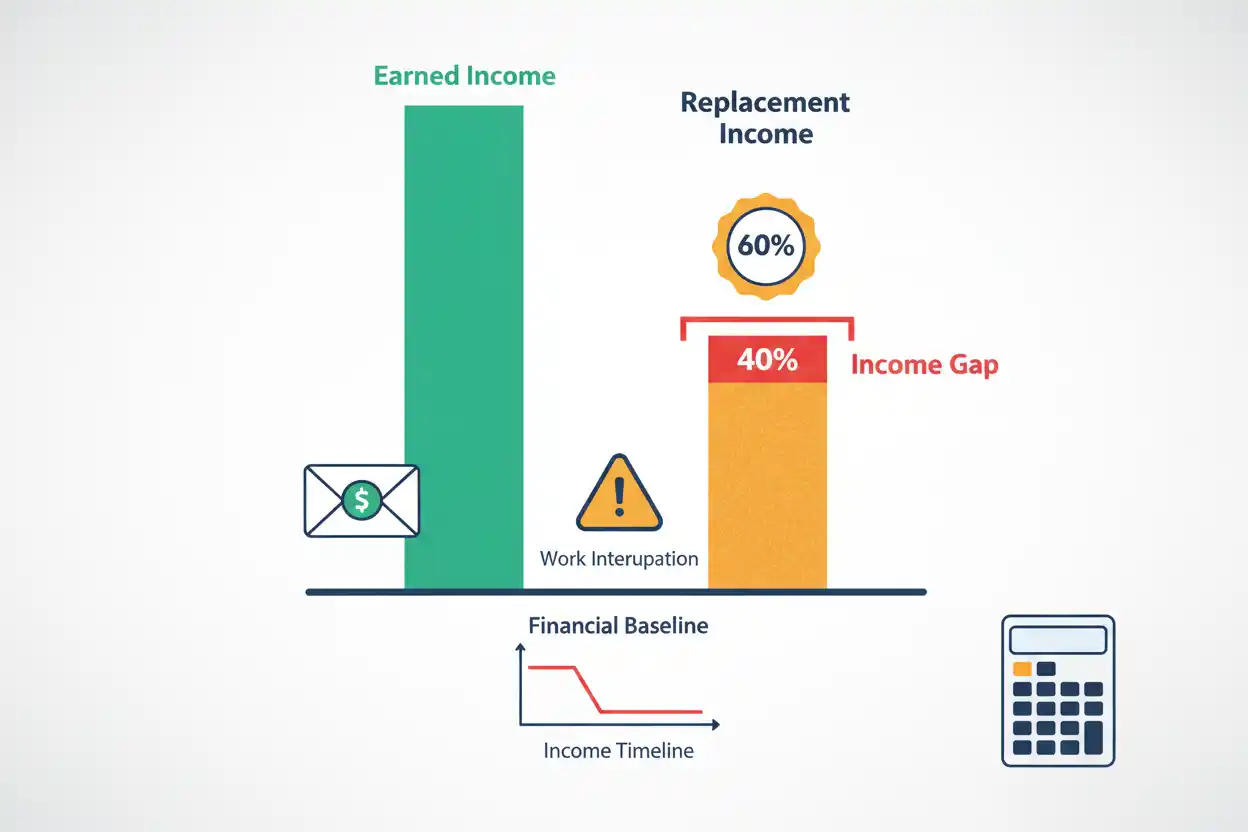

The income replacement ratio measures how much of a person’s previous income is replaced by another source of income.
If normal income is $6,000 per month and replacement income is $3,900:
Income Replacement Ratio = $3,900 ÷ $6,000 × 100
= 65%
The replacement income covers 65% of the previous income, leaving a $2,100 monthly gap.
The ratio can be useful when evaluating disability benefits, insurance coverage, temporary replacement income, career transitions, or other situations in which ordinary earnings are reduced or interrupted.
Income Replacement Ratio Formula
Income Replacement Ratio = Replacement Income ÷ Previous Income × 100
The numerator and denominator must refer to comparable periods.
For monthly income:
Monthly Replacement Income ÷ Monthly Previous Income
For annual income:
Annual Replacement Income ÷ Annual Previous Income
Mixing annual and monthly amounts will produce a meaningless result.
Basic Example
Suppose normal monthly earned income is:
$6,000
and replacement income is:
$3,900
Then:
Replacement Ratio = $3,900 ÷ $6,000
= 0.65
= 65%
The unreplaced portion is:
100% − 65%
= 35%
Dollar gap:
$6,000 − $3,900
= $2,100
Income Gap Formula
Once the ratio is calculated, the dollar shortfall can be found directly:
Income Gap = Previous Income − Replacement Income
Using the same numbers:
Income Gap = $6,000 − $3,900
= $2,100 per Month
Annualized:
$2,100 × 12
= $25,200
A percentage can look manageable until the annual dollar gap is calculated.
Target Replacement Income
Suppose someone wants a 70% income replacement ratio on $6,000 of previous monthly income.
Target Replacement Income = Previous Income × Target Ratio
$6,000 × 70%
= $4,200
If current replacement income is only $3,900:
Shortfall to Target = $4,200 − $3,900
= $300 per Month
Solve for Previous Income
If replacement income and ratio are known:
Previous Income = Replacement Income ÷ Replacement Ratio
Suppose:
Replacement Income = $3,500
Replacement Ratio = 70%
Then:
Previous Income = $3,500 ÷ 0.70
= $5,000
Combining Several Replacement Sources
Replacement income can come from more than one source.
Suppose prior monthly income is $6,000.
A benefit provides:
$2,500
and temporary part-time income provides:
$1,600
Combined replacement income:
$2,500 + $1,600 = $4,100
Replacement ratio:
$4,100 ÷ $6,000 × 100
≈ 68.33%
The monthly income gap is:
$6,000 − $4,100
= $1,900
Gross vs Net Income
A meaningful ratio requires a consistent income definition.
If previous income is gross, replacement income should also be measured on a comparable gross basis where possible.
If previous income is take-home income, compare it with replacement income after the relevant taxes and deductions.
For example:
Previous Gross Income = $6,000
Replacement Net Income = $3,900
Dividing these amounts may produce a percentage, but the result mixes two different bases.
Gross Replacement Ratio
Suppose:
Previous Gross Income = $6,000
Gross Replacement Income = $4,200
Then:
Gross Replacement Ratio = $4,200 ÷ $6,000
= 70%
This tells you how much gross income is replaced.
It does not necessarily indicate how much prior spendable cash is replaced.
Net Replacement Ratio
Suppose previous take-home pay was:
$4,700
and new take-home replacement income is:
$3,600
Then:
Net Replacement Ratio = $3,600 ÷ $4,700
≈ 76.60%
The net ratio is higher than a hypothetical gross ratio if taxes or payroll deductions fall substantially after income decreases.
Income Replacement and Hourly Wage
For an hourly employee, the hourly wage helps establish normal earnings.
Suppose:
Hourly Rate = $30
Normal Hours = 40 per Week
Normal weekly income:
$30 × 40 = $1,200
If replacement income is $780 weekly:
Replacement Ratio = $780 ÷ $1,200
= 65%
Income Replacement and Gross Pay
Gross pay can provide the pre-disruption earnings base.
Suppose average gross monthly pay was $5,500 and replacement compensation is $3,300.
Replacement Ratio = $3,300 ÷ $5,500
= 60%
The missing amount is $2,200 monthly.
Income Replacement and Import Duty
An import duty has no direct role in an individual’s replacement-income percentage.
The presence of both topics in financial planning illustrates why percentages must always be labeled.
A 60% income replacement ratio is not a tax or tariff rate.
Income Replacement and Income Tax
Income tax basics become relevant when the tax treatment of replacement income differs from the tax treatment of previous wages.
If gross income falls from $6,000 to $4,000, the reduction in take-home income might be less than $2,000 because taxes can also change.
That is why gross and net replacement ratios can tell different stories.
Income Replacement and Itemized Deductions
Changes in income can interact with tax deductions and other tax-return calculations. Itemized deductions therefore belong to the tax calculation rather than directly inside the replacement-ratio formula.
The ratio itself remains:
Replacement Income ÷ Previous Income
Tax consequences can then be modeled separately.
Replacement Ratio Greater Than 100%
Suppose prior income was:
$4,000 per Month
and replacement income becomes:
$4,500
Then:
Replacement Ratio = $4,500 ÷ $4,000
= 112.5%
The replacement source exceeds previous income by 12.5%.
A ratio above 100% is mathematically possible.
Zero Replacement Income
If prior income is $5,000 and replacement income is zero:
Replacement Ratio = $0 ÷ $5,000
= 0%
The entire previous income is unreplaced.
Income gap:
$5,000
Income Needed to Close a Gap
Suppose:
Previous Income = $6,000
Current Replacement = $3,900
The gap is:
$2,100
If a second source provides $1,000:
New Replacement Income = $4,900
New ratio:
$4,900 ÷ $6,000
≈ 81.67%
Remaining gap:
$1,100
Expense Replacement vs Income Replacement
A 70% income replacement ratio does not automatically mean 70% of essential expenses are covered.
Suppose:
Previous Income = $6,000
Essential Expenses = $4,500
Replacement income at 70%:
$4,200
The household still has:
$300
of essential expenses not covered.
The ratio should therefore be compared with actual spending needs.
Variable Previous Income
For workers with commissions or irregular hours, one month’s income can be a poor denominator.
Suppose previous monthly income was:
$4,000, $7,000, $5,000, $8,000, $5,500, $6,500
Average:
$36,000 ÷ 6
= $6,000
Using a representative multi-month average can produce a more meaningful denominator than using the highest month of $8,000.
Inflation and Long-Term Replacement
Suppose replacement income remains fixed at $4,000 per month while previous living standards require spending that rises with inflation.
The nominal replacement ratio can stay unchanged if the denominator is also kept fixed, yet real purchasing-power replacement can deteriorate.
Long-duration replacement planning should therefore distinguish nominal income from purchasing power.
Common Income Replacement Ratio Mistakes
A frequent error is comparing gross previous income with net replacement income.
Another is ignoring supplementary income sources or using one unusually strong earnings month as the normal baseline.
People can also focus on the percentage without calculating whether essential dollar expenses are actually covered.
Frequently Asked Questions
What is an income replacement ratio?
It measures replacement income as a percentage of previous income.
What is the formula?
Income Replacement Ratio = Replacement Income ÷ Previous Income × 100
What does a 65% replacement ratio mean?
Replacement income equals 65% of the previous income base.
How do I calculate the income gap?
Income Gap = Previous Income − Replacement Income
How do I calculate target replacement income?
Target Income = Previous Income × Target Replacement Ratio
Can several income sources be combined?
Yes, when they are genuinely available replacement sources and are measured consistently.
Should I use gross or net income?
Either can be useful, but both sides of the ratio should use the same basis.
Can the ratio exceed 100%?
Yes.
What if previous income was variable?
A representative historical average can be more useful than one unusual month.
Is income replacement ratio a tax rate?
No.
Does 70% income replacement guarantee expenses are covered?
No. Compare the dollar amount with actual spending requirements.
Why calculate the ratio and the gap?
The percentage provides comparability, while the dollar gap shows the actual cash-flow shortfall.