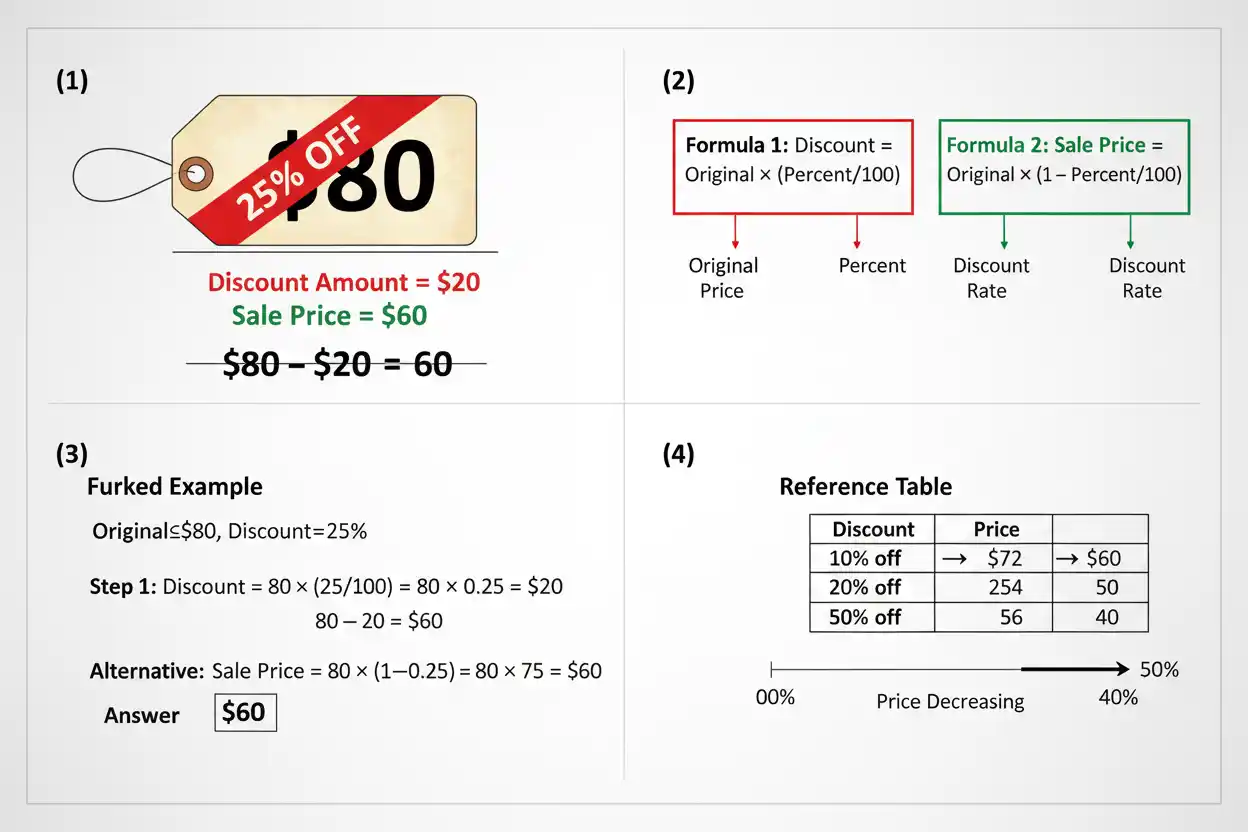
Percent off tells you how much an original price or quantity is reduced as a percentage of that original amount.
If an item costs:
$80
and is:
25% off
the discount is:
$80 × 25/100
= $20
Subtract the discount:
$80 – $20 = $60
Therefore:
25% off $80 gives a sale price of $60
The two main formulas are:
Discount = Original Price × (Percent Off / 100)
and:
Sale Price = Original Price × (1 – Percent Off / 100)
Percent off is a specific application of percentage calculations.
What Does Percent Off Mean?
A statement such as:
30% off
means the price is reduced by:
30%
of its original value.
It does not mean you pay 30% of the original price.
Instead, you pay:
100% – 30% = 70%
of the original price.
Therefore:
30% off means you pay 70%
Likewise:
20% off → pay 80%
50% off → pay 50%
75% off → pay 25%
The reduction percentage and remaining percentage always add to 100%.
Percent Off Formula
Let:
O = original price
p = percent off
D = discount amount
S = sale price
Then:
D = O × p/100
and:
S = O – D
Substituting the first equation into the second gives:
S = O(1 – p/100)
This direct sale-price formula is usually the fastest calculation.
Example: 20% Off $50
Original price:
$50
Percent off:
20%
Find the discount:
Discount = 50 × 20/100
= 50 × 0.20
= 10
Therefore:
Discount = $10
Sale price:
50 – 10 = 40
So:
20% off $50 = $40
Direct Multiplier Method
Instead of calculating the discount first, determine the percentage remaining.
For:
20% off
the remaining percentage is:
80%
Convert:
80% = 0.80
Then:
Sale Price = $50 × 0.80
= $40
Therefore:
$40
This produces the same answer in one multiplication.
Example: 25% Off $120
Calculate the discount:
120 × 0.25 = 30
Then:
120 – 30 = 90
Therefore:
25% off $120 = $90
Using the multiplier method:
100% – 25% = 75%
75% = 0.75
Then:
120 × 0.75 = 90
Again:
Sale Price = $90
Example: 15% Off $80
Find the discount:
80 × 0.15
= 12
Subtract:
80 – 12 = 68
Therefore:
15% off $80 = $68
Example: 35% Off $200
Discount:
200 × 0.35 = 70
Sale price:
200 – 70 = 130
Therefore:
35% off $200 = $130
Example: 40% Off $75
Discount:
75 × 0.40 = 30
Sale price:
75 – 30 = 45
Therefore:
40% off $75 = $45
50% Off
Fifty percent means one-half.
Therefore:
50% off = half price
For example:
50% off $96
gives:
96 × 0.50 = 48
Therefore:
Sale Price = $48
This can often be calculated mentally without writing the full formula.
10% Off
Ten percent is:
10/100 = 0.1
So:
10% off = subtract one-tenth of the original price
For:
$70
10% is:
$7
Therefore:
$70 – $7 = $63
So:
10% off $70 = $63
5% Off
Five percent is half of 10%.
For:
$240
10% is:
$24
Therefore 5% is:
$12
Subtract:
240 – 12 = 228
Therefore:
5% off $240 = $228
15% Off Mentally
To find 15%, combine 10% and 5%.
For:
$160
10%:
$16
5%:
$8
Therefore 15%:
$24
Sale price:
160 – 24 = 136
So:
15% off $160 = $136
25% Off Mentally
Twenty-five percent is:
1/4
Therefore, 25% off means subtract one-quarter.
For:
$200
one-quarter is:
$50
Therefore:
Sale Price = $150
You could also multiply directly:
200 × 0.75 = 150
75% Off
If something is 75% off, only 25% remains.
For:
$120
calculate:
120 × 0.25 = 30
Therefore:
75% off $120 = $30
This remaining-percentage method is often easier than calculating and subtracting a 75% discount.
Percent Off as a Fraction
A percentage can be written as a fraction over 100.
For example:
30% = 30/100
Simplify:
30/100 = 3/10
Therefore:
30% off $90
has discount:
90 × 3/10
= 27
Sale price:
90 – 27 = 63
Therefore:
30% off $90 = $63
The conversion follows the same principles used when working with fractions to percent, only in the reverse direction.
Percent Off With Decimal Prices
Suppose an item costs:
$47.50
and is:
20% off
Discount:
47.50 × 0.20
= 9.50
Sale price:
47.50 – 9.50
= 38.00
Therefore:
20% off $47.50 = $38.00
Accurate decimal arithmetic is useful when prices contain cents.
Percent Off With a Non-Whole Percentage
Suppose:
Original Price = $80
Percent Off = 12.5%
Convert:
12.5% = 0.125
Discount:
80 × 0.125 = 10
Therefore:
Sale Price = 80 – 10
= 70
So:
12.5% off $80 = $70
Since:
12.5% = 1/8
the discount could also be calculated as one-eighth of $80.
Finding the Discount Amount
If you need only the amount saved:
Discount = Original × p/100
For example:
Original = $350
Percent Off = 18%
Then:
Discount = 350 × 0.18
= 63
Therefore:
You save $63
The sale price would then be:
350 – 63 = $287
Finding the Sale Price
The direct formula is:
Sale Price = Original × (1 – p/100)
For:
Original = $350
p = 18
calculate:
1 – 18/100 = 0.82
Then:
350 × 0.82 = 287
Therefore:
Sale Price = $287
This gives the same answer without separately calculating the discount amount.
Finding Percent Off From Original and Sale Prices
Sometimes the original price and sale price are known, and the missing value is the discount percentage.
The reduction is:
Original – Sale
Then:
Percent Off = (Original – Sale) / Original × 100%
For example:
Original = $80
Sale = $60
Reduction:
80 – 60 = 20
Divide by the original:
20/80 = 0.25
Convert:
0.25 × 100% = 25%
Therefore:
The item is 25% off
Example: Original $150, Sale $105
Reduction:
150 – 105 = 45
Then:
45/150 = 0.30
Convert:
0.30 × 100% = 30%
Therefore:
The discount is 30%
Finding the Original Price
Suppose a sale price is known after a stated percent off.
From:
S = O(1-p/100)
solve:
O = S / (1-p/100)
For example, suppose:
Sale Price = $72
after:
20% off
The remaining multiplier is:
0.80
Therefore:
Original = 72/0.80
= 90
So:
Original Price = $90
Check:
20% of 90 = 18
90 – 18 = 72
Example: $105 After 30% Off
Thirty percent off leaves:
70%
or:
0.70
Therefore:
Original = 105/0.70
= 150
So:
The original price was $150
Finding the Original Price Is Not an Increase by the Same Percentage
Suppose an item is reduced:
20%
from:
$100
The sale price is:
$80
Increasing $80 by 20% gives:
80 × 1.20 = 96
not $100.
To reverse a 20% discount, divide by:
0.80
Therefore:
80/0.80 = 100
This asymmetry is important whenever percentages use different reference amounts.
Percent Off vs. Percentage Change
Percentage change gives the broader formula:
(New – Original)/|Original| × 100%
A price reduction produces a negative percentage change if direction is retained.
Percent off usually reports the magnitude of that reduction as a positive promotional percentage.
For example:
$100 → $75
Percentage change:
(75-100)/100 × 100%
= -25%
Percent off:
25%
The magnitude is the same, but the conventions differ.
Percent Off vs. Percent Error
Percent error compares a measured value with an accepted reference:
|Measured-Accepted|/|Accepted| × 100%
Percent off compares an original amount with a deliberately reduced amount:
(Original-Sale)/Original × 100%
Although both use percentage ratios, their interpretations are completely different.
A sale price is not an experimental error.
Percent Off vs. Percentage
The percentage page covers the general part-whole relationship.
Percent off uses that general concept in a specific way:
Discount / Original = Percent Off / 100
For example:
Discount = 24
Original = 120
Then:
24/120 = 0.20
Therefore:
20% off
Multiple Discounts
Two successive discounts should normally be applied one after another.
Suppose an item costs:
$100
with:
20% off
followed by:
another 10% off
First discount:
100 × 0.80 = 80
Second:
80 × 0.90 = 72
Therefore:
Final Price = $72
The total reduction is:
$28
which is:
28% off the original price
not 30%.
Why 20% Off Then 10% Off Is Not 30%
The first discount is based on:
$100
The second is based on:
$80
The reductions are:
$20
and:
$8
Total:
$28
Therefore:
28/100 × 100% = 28%
The changing reference amount prevents simple addition of the discount percentages.
Combined Discount Formula
For successive discounts p₁ and p₂ written as decimals:
Final Multiplier = (1-p₁)(1-p₂)
Therefore the effective total discount is:
Effective Discount = 1 – (1-p₁)(1-p₂)
For:
p₁ = 0.20
p₂ = 0.10
we get:
Final Multiplier = 0.80 × 0.90
= 0.72
So:
Effective Discount = 1 – 0.72
= 0.28
Therefore:
Effective percent off = 28%
Example: 25% Off Then 20% Off
Start with a multiplier:
0.75
Then apply:
0.80
Combined:
0.75 × 0.80 = 0.60
Therefore 60% of the original price remains.
The total percent off is:
100% – 60% = 40%
So:
25% off followed by 20% off equals 40% off overall
not 45%.
Three Successive Discounts
Suppose discounts are:
10%, 20%, and 25%
The remaining multipliers are:
0.90
0.80
0.75
Multiply:
0.90 × 0.80 × 0.75
= 0.54
Therefore:
54%
of the original price remains.
Effective discount:
100% – 54%
= 46%
So:
The combined discount is 46%
Discount Followed by Tax
A discount and a tax are separate percentage operations.
Suppose:
Original Price = $100
Discount = 20%
First:
100 × 0.80 = 80
If a hypothetical 10% tax is then applied to the discounted amount:
80 × 1.10 = 88
Therefore:
Final amount = $88
The tax is calculated from the post-discount price in this example, not from the original price.
Actual tax treatment depends on applicable rules, but the arithmetic illustrates sequential percentage multipliers.
Markdown Then Markup
Suppose an original amount is:
$200
It is reduced by 25%:
200 × 0.75 = 150
Then the reduced amount increases by 25%:
150 × 1.25 = 187.50
The result is not $200.
A decrease and an equal percentage increase do not cancel because the second percentage uses a smaller reference amount.
How Much Increase Reverses a Discount?
If a price is reduced by fraction d, the sale price is:
S = O(1-d)
To return to the original:
O/S = 1/(1-d)
The required increase rate is:
Increase = d/(1-d)
For a 20% discount:
d = 0.20
Required increase:
0.20/0.80
= 0.25
Therefore:
A 25% increase is required to reverse a 20% discount
Percent Off With Fractions
Suppose a price is:
$48
and the discount is:
1/4
Since:
1/4 = 25%
the discount is:
48 × 1/4
= 12
Sale price:
48 – 12
= 36
Therefore:
25% off $48 = $36
Fraction equivalents can make certain percentage calculations faster.
Percent Off With Mixed Numbers
Suppose a quantity is:
12 1/2
and it is reduced by:
20%
Convert:
12 1/2 = 12.5
Then:
12.5 × 0.80
= 10
Therefore the reduced quantity is:
10
The rules for mixed numbers determine the initial conversion; percent off then applies the discount multiplier.
Order of Operations in Percent Off
The order of operations matters in formulas such as:
S = O(1-p/100)
Suppose:
O = 160
p = 35
First:
35/100 = 0.35
Then:
1 – 0.35 = 0.65
Finally:
160 × 0.65 = 104
Therefore:
35% off $160 = $104
Sale-Price Relationship as a Line
For a fixed discount rate, sale price depends linearly on original price.
Suppose the discount is:
20%
Then:
S = 0.80O
If the original price changes through:
10, 20, 30, 40, …
the corresponding sale prices are:
8, 16, 24, 32, …
Graphing S against O gives a straight line through the origin with slope:
0.80
Different fixed discount percentages create different slopes. The slope-based concepts used for parallel and perpendicular lines describe geometric relationships among lines, while the discount multiplier here describes how sale price scales with original price.
Percent Off Across a Price Sequence
Suppose original prices form:
$20, $40, $60, $80
Apply:
25% off
The remaining multiplier is:
0.75
Sale prices become:
$15, $30, $45, $60
Because every term was multiplied by the same constant, the relative structure of the sequence is preserved.
Rounding Sale Prices
Suppose:
Original Price = $39.99
Discount = 17%
The remaining multiplier is:
0.83
Calculate:
39.99 × 0.83
= 33.1917
When prices are expressed to the nearest cent:
Sale Price ≈ $33.19
If the discount amount itself is required:
39.99 – 33.19 ≈ $6.80
Specific commercial systems may have their own rounding conventions, so the exact transaction can occasionally differ by a cent depending on when rounding occurs.
Discount Table
For an original price of:
$100
common discounts produce:
| Percent Off | Discount | Sale Price |
|---|---|---|
| 5% | $5 | $95 |
| 10% | $10 | $90 |
| 20% | $20 | $80 |
| 25% | $25 | $75 |
| 30% | $30 | $70 |
| 40% | $40 | $60 |
| 50% | $50 | $50 |
| 75% | $75 | $25 |
Using $100 makes the relationship especially easy to see because the numerical dollar reduction matches the percentage.
Common Mistake: Paying the Percent Off
If an item is:
30% off
you do not normally pay:
30%
of the original price.
You pay:
70%
because:
100% – 30% = 70%
For a $200 item:
Incorrect interpretation:
200 × 0.30 = $60
That is the discount amount.
Correct sale price:
200 × 0.70 = $140
Therefore:
30% off $200 = $140
Common Mistake: Adding Successive Discounts
For:
20% off
then:
20% off again
the combined discount is not 40%.
Calculate remaining percentage:
0.80 × 0.80 = 0.64
So:
64%
remains.
Therefore:
Effective Discount = 36%
Common Mistake: Using the Sale Price as the Denominator
Suppose:
Original = $100
Sale = $80
The percent off is:
(100-80)/100 × 100%
= 20%
Using:
20/80 × 100% = 25%
answers a different question: the reduction is 25% of the sale price.
Percent off uses the original price as its reference.
Common Mistake: Subtracting the Percentage Number Directly
For:
$80 at 25% off
do not calculate:
80 – 25 = 55
The number 25 represents 25 percent, not $25.
Calculate:
25% of 80 = 20
Then:
80 – 20 = 60
Therefore:
Sale Price = $60
Common Mistake: Converting Percent Incorrectly
To convert:
15%
to decimal form:
15/100 = 0.15
not:
15
and not:
1.5
Therefore:
15% off $200
uses:
200 × 0.15 = 30
as the discount.
How to Check a Percent Off Calculation
Suppose:
$150 at 30% off = $105
Check the amount saved:
150 – 105 = 45
Now calculate the discount as a fraction of the original:
45/150 = 0.30
Convert:
0.30 × 100% = 30%
Therefore the sale price is correct.
Frequently Asked Questions
What does percent off mean?
Percent off is the percentage of an original price or amount that is removed.
What is the percent off formula?
Percent Off = (Original – Sale) / Original × 100%
How do you calculate a discount amount?
Discount = Original × Percent Off / 100
How do you calculate the sale price?
Sale Price = Original × (1 – Percent Off/100)
What is 20% off $50?
Discount:
$10
Sale price:
$40
What is 25% off $80?
Discount:
$20
Sale price:
$60
What is 30% off $100?
$70
What is 40% off $200?
Discount:
$80
Sale price:
$120
What is 50% off?
It means half the original amount remains.
How do you find percent off from two prices?
Subtract the sale price from the original price, divide by the original, then multiply by 100%.
Are two 20% discounts equal to 40% off?
No.
0.80 × 0.80 = 0.64
so 64% remains and the effective discount is:
36%
Is percent off the same as percentage change?
They are closely related, but percent off reports the magnitude of an intentional reduction, while percentage change can preserve the direction of either an increase or decrease.
Can percent off exceed 100%?
For an ordinary price reduction without credits or unusual adjustments, 100% off already reduces the price to zero. A percentage beyond 100% would imply a negative resulting amount under the simple formula and is outside the usual discount interpretation.
Final Example
An item originally costs:
$240
and is marked:
35% off
First calculate the remaining percentage:
100% – 35% = 65%
Convert to decimal:
65% = 0.65
Multiply:
Sale Price = 240 × 0.65
= 156
Therefore:
35% off $240 gives a sale price of $156
Check the discount:
240 – 156 = 84
Then:
84/240 × 100%
= 35%
So the discount is confirmed.
The essential percent off relationships are:
Discount = Original × Percent Off / 100
Sale Price = Original × (1 – Percent Off/100)
Percent Off = (Original – Sale) / Original × 100%
Once the original amount, discount percentage, and remaining percentage are kept distinct, percent-off calculations become straightforward.