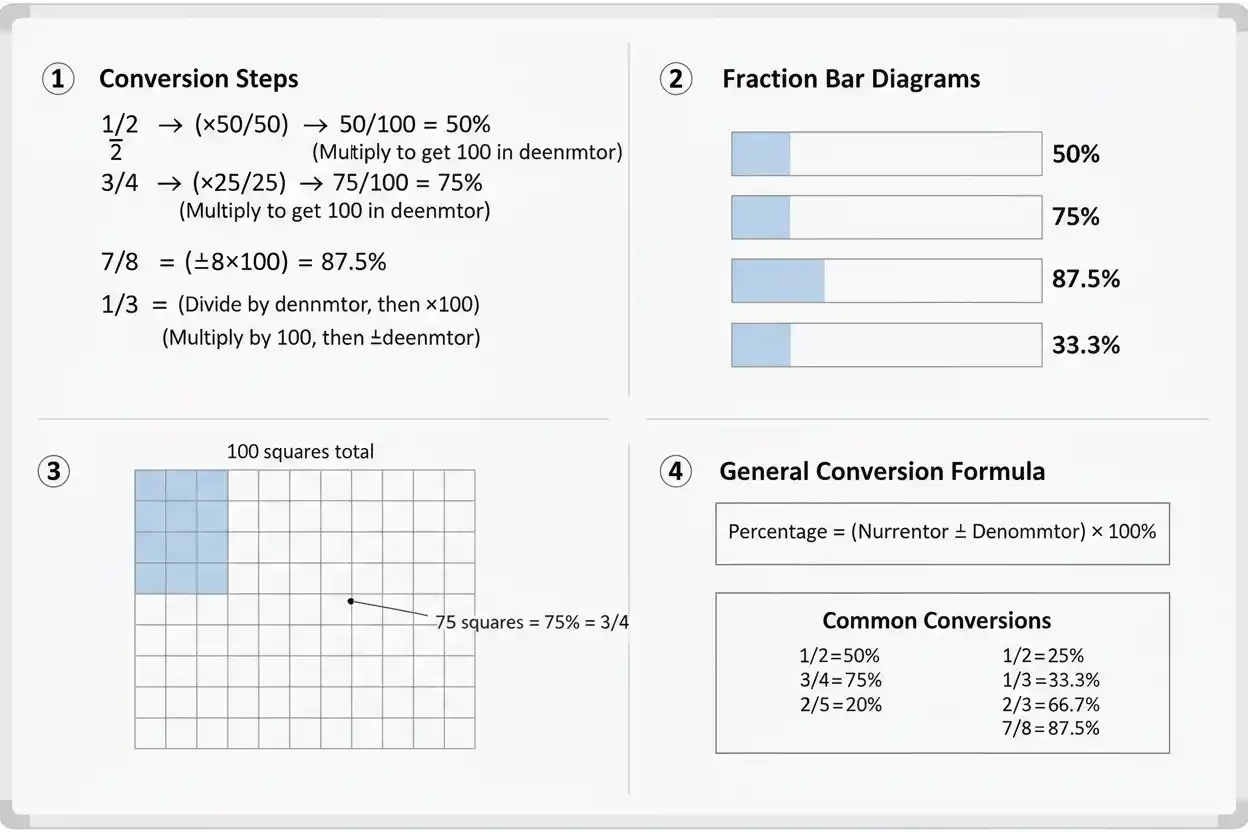

Converting fractions to percent means expressing a fractional value as a number of parts per hundred. The basic method is to divide the numerator by the denominator and multiply the result by 100%.
For a fraction:
a / b
where:
b ≠ 0
the formula is:
Percentage = (a / b) × 100%
For example:
3 / 4 × 100% = 75%
Therefore:
3/4 = 75%
The fractional and percentage forms represent exactly the same proportion.
Fractions to percent conversions are useful in mathematics, probability, statistics, finance, test scores, discounts, ratios, measurements, and comparisons throughout arithmetic and number theory.
What Does Percent Mean?
The word percent means:
per hundred
Therefore:
25% = 25 / 100
and:
80% = 80 / 100
A fraction does not need to have denominator 100 initially. Converting it to percent determines the equivalent number of parts out of 100.
For example:
1 / 2
is equivalent to:
50 / 100
so:
1/2 = 50%
Fractions to Percent Formula
For:
Fraction = numerator / denominator
use:
Percent = (numerator / denominator) × 100%
Symbolically:
Percent = (a / b) × 100%
with:
b ≠ 0
For example:
7 / 20 × 100%
Calculate:
700 / 20 %
= 35%
Therefore:
7/20 = 35%
Method 1: Divide Then Multiply by 100
Consider:
3 / 5
First divide:
3 ÷ 5 = 0.6
Then multiply by 100:
0.6 × 100% = 60%
Therefore:
3/5 = 60%
This method works for any valid fraction.
Example: Convert 7/8 to Percent
Divide:
7 ÷ 8 = 0.875
Multiply:
0.875 × 100% = 87.5%
Therefore:
7/8 = 87.5%
The result is exact because 7/8 has a terminating decimal representation.
Method 2: Create a Denominator of 100
When the denominator can easily be scaled to 100, the conversion may be even faster.
Consider:
3 / 4
Multiply numerator and denominator by 25:
3/4 = 75/100
Since percent means per hundred:
3/4 = 75%
No decimal calculation is required.
Example: Convert 9/20 to Percent
Multiply numerator and denominator by 5:
9/20 = 45/100
Therefore:
9/20 = 45%
This method is particularly convenient for denominators such as:
2, 4, 5, 10, 20, 25, 50, 100
because they can be scaled to 100 easily.
Method 3: Multiply the Fraction by 100 Directly
Instead of finding a decimal first, calculate:
a/b × 100
For example:
5/8 × 100%
Multiply:
500 / 8 %
Then:
500 ÷ 8 = 62.5
Therefore:
5/8 = 62.5%
This is mathematically identical to the divide-then-multiply method.
Why the Formula Works
Suppose a fraction is:
3/5
To express it per hundred, ask:
3/5 = x/100
Cross-multiply:
5x = 300
Divide:
x = 60
Therefore:
3/5 = 60/100
and:
3/5 = 60%
Multiplying by 100 is simply a compact way to solve this equivalent proportion.
Common Fraction-to-Percent Values
Some conversions are useful to recognize.
| Fraction | Percent |
|---|---|
| 1/2 | 50% |
| 1/3 | 33.333…% |
| 2/3 | 66.666…% |
| 1/4 | 25% |
| 3/4 | 75% |
| 1/5 | 20% |
| 2/5 | 40% |
| 3/5 | 60% |
| 4/5 | 80% |
| 1/8 | 12.5% |
| 3/8 | 37.5% |
| 5/8 | 62.5% |
| 7/8 | 87.5% |
| 1/10 | 10% |
Recognizing these values can make many calculations immediate.
Convert 1/4 to Percent
Use:
1/4 × 100%
= 100/4 %
= 25%
Therefore:
1/4 = 25%
Convert 2/5 to Percent
Calculate:
2/5 × 100%
= 200/5 %
= 40%
Therefore:
2/5 = 40%
Convert 11/20 to Percent
Calculate:
11/20 × 100%
= 1100/20 %
= 55%
Therefore:
11/20 = 55%
Convert 13/25 to Percent
Because:
25 × 4 = 100
multiply numerator and denominator by 4:
13/25 = 52/100
Therefore:
13/25 = 52%
Fractions That Produce Repeating Percentages
Some fractions do not convert to terminating decimals.
Consider:
1 / 3
Divide:
1 ÷ 3 = 0.333333…
Multiply by 100:
33.333333…%
Therefore:
1/3 = 33.333…%
If a rounded value is required:
1/3 ≈ 33.33%
to two decimal places.
The exact repeating percentage and the rounded percentage should be distinguished.
Convert 2/3 to Percent
Use:
2/3 × 100%
= 200/3 %
= 66.6666…%
Therefore:
2/3 = 66.666…%
Rounded to two decimal places:
2/3 ≈ 66.67%
The rounded value is approximate.
Convert 5/6 to Percent
Calculate:
5/6 × 100%
= 500/6 %
= 83.333…%
Therefore:
5/6 = 83.333…%
or approximately:
83.33%
when two decimal places are requested.
Exact Percent vs. Approximate Percent
If a fraction converts to a terminating decimal, its percentage can often be written exactly.
For example:
7/8 = 87.5%
This is exact.
But:
1/7 × 100% = 14.2857142857…%
If written:
14.29%
the result is approximate.
A clear notation is:
1/7 ≈ 14.29%
The symbol ≈ indicates rounding rather than exact equality.
Simplify the Fraction First When Helpful
Suppose:
18 / 24
You may convert directly:
18/24 × 100% = 75%
Or use fraction simplification first:
18/24 = 3/4
Then:
3/4 = 75%
Both routes are correct.
Simplifying first often makes the percentage easier to recognize.
Example: Simplify 45/60 Before Converting
Find the common factor:
45/60 = 3/4
Then:
3/4 × 100% = 75%
Therefore:
45/60 = 75%
The percentage is based on the fraction’s value, not on whether the original fraction was already in lowest terms.
Using the GCF Before Conversion
The GCF can reduce larger fractions efficiently.
Consider:
126 / 168
The greatest common factor is:
42
Simplify:
126/168 = 3/4
Then:
3/4 = 75%
Therefore:
126/168 = 75%
The conversion would be identical without simplification, but the reduced form makes the relationship clearer.
Fraction Operations Before Converting to Percent
Sometimes the fraction to be converted is itself the result of a calculation.
Consider:
1/4 + 3/8
Using fraction operations:
1/4 = 2/8
Then:
2/8 + 3/8 = 5/8
Now convert:
5/8 × 100% = 62.5%
Therefore:
1/4 + 3/8 = 62.5%
The fraction arithmetic should be completed before the final percentage conversion unless the problem structure provides a simpler route.
Convert an Improper Fraction to Percent
Fractions greater than 1 produce percentages greater than 100%.
Consider:
5 / 4
Calculate:
5/4 × 100%
= 125%
Therefore:
5/4 = 125%
A percentage above 100% simply represents a quantity larger than the reference whole.
Example: Convert 7/5 to Percent
Calculate:
7/5 = 1.4
Then:
1.4 × 100% = 140%
Therefore:
7/5 = 140%
There is no rule requiring a valid percentage representation to remain below 100%.
Convert a Mixed Number to Percent
Consider:
1 1/2
Convert to an improper fraction:
1 1/2 = 3/2
Now:
3/2 × 100%
= 150%
Therefore:
1 1/2 = 150%
A mixed number greater than 1 naturally converts to a percentage greater than 100%.
Another Mixed-Number Example
Convert:
2 1/4
to percent.
First:
2 1/4 = 9/4
Then:
9/4 × 100%
= 225%
Therefore:
2 1/4 = 225%
Convert a Negative Fraction to Percent
Negative fractions produce negative percentages.
Consider:
-3/5
Calculate:
-3/5 × 100%
= -60%
Therefore:
-3/5 = -60%
The sign is preserved because multiplying by positive 100 does not change it.
Negative Percentage Interpretation
A negative percentage may represent a signed change, deficit, position, or other context-dependent quantity.
For example:
-1/4 = -25%
Mathematically, the conversion is straightforward.
Its practical meaning depends on the original problem.
Fraction Equal to Zero
For any nonzero denominator b:
0/b = 0
Therefore:
0/b × 100% = 0%
So:
0/7 = 0%
Denominator Zero Is Invalid
A fraction such as:
4/0
is undefined.
Therefore it cannot be converted into an ordinary percentage.
The formula:
(a/b) × 100%
requires:
b ≠ 0
Fractions Already Written Over 100
If the denominator is 100, the conversion is immediate.
For example:
37/100 = 37%
Likewise:
6/100 = 6%
and:
125/100 = 125%
This direct relationship is the basis of percent notation.
Fractions With Denominator 10
A denominator of 10 is also easy to convert.
Consider:
7/10
Multiply numerator and denominator by 10:
7/10 = 70/100
Therefore:
7/10 = 70%
Similarly:
3/10 = 30%
Fractions With Denominator 1000
Consider:
375 / 1000
Divide:
375 ÷ 1000 = 0.375
Multiply by 100:
37.5%
Therefore:
375/1000 = 37.5%
Alternatively, simplify:
375/1000 = 3/8
and recognize:
3/8 = 37.5%
Converting a Fraction to Percent Without a Calculator
Look first for a familiar denominator or an easy equivalent fraction.
For:
17/20
multiply numerator and denominator by 5:
17/20 = 85/100
Therefore:
17/20 = 85%
For:
9/25
multiply by 4:
9/25 = 36/100
Therefore:
9/25 = 36%
This is often faster than performing long division.
Example With an Unfriendly Denominator
Convert:
7/13
to percent.
Use the formula:
7/13 × 100%
= 700/13 %
Calculate:
700 ÷ 13 ≈ 53.8461538
Therefore:
7/13 ≈ 53.85%
to two decimal places.
Because the decimal repeats, the two-decimal result is approximate.
Fraction to Percent and Decimal Arithmetic
A common route is:
Fraction → Decimal → Percent
For example:
11/16 = 0.6875
Then:
0.6875 × 100% = 68.75%
The division and multiplication are ordinary decimal arithmetic.
The intermediate decimal may be omitted if multiplying the fraction by 100 directly is easier.
Fraction to Percent and Rational Numbers
Every ordinary fraction:
a/b
with integers a, b and:
b ≠ 0
is a rational number.
Its decimal form either terminates or repeats.
Therefore, its percentage representation likewise either terminates or repeats.
For example:
1/8 = 12.5%
while:
1/9 = 11.111…%
Fractions to Percent in Probability
Suppose an event occurs in:
7 out of 20
equally weighted cases.
The fraction is:
7/20
Convert:
7/20 × 100% = 35%
Therefore:
7 out of 20 = 35%
The percentage makes the proportion easier to compare with situations based on different totals.
Fractions to Percent in Test Scores
Suppose a student answers:
42 out of 50
questions correctly.
Represent the score as:
42/50
Convert:
42/50 × 100%
= 84%
Therefore:
Score = 84%
Simplifying first also works:
42/50 = 21/25 = 84/100
Fractions to Percent in Surveys
Suppose:
27 of 40
respondents choose an option.
The fraction is:
27/40
Convert:
27/40 × 100%
= 67.5%
Therefore:
67.5% of respondents selected the option
Fractions to Percent in Ratios
Suppose a quantity is:
3/8
of a total.
Its percentage is:
3/8 × 100%
= 37.5%
So the fraction of the total can equivalently be described as:
37.5%
The denominator defines the whole, while the numerator indicates the selected portion.
Geometric Sequence Ratios and Percent
A geometric sequence uses a constant ratio between consecutive terms.
Suppose the common ratio is:
r = 3/2
Convert the ratio itself to percent:
3/2 × 100% = 150%
So each term is:
150% of the preceding term
However, the percentage increase is only:
150% – 100% = 50%
This distinction is important.
A multiplier of 3/2 corresponds to 150% of the original value, which represents a 50% increase.
Another Geometric-Ratio Example
If:
r = 4/5
then:
4/5 = 80%
Each term is 80% of the preceding term.
The corresponding decrease is:
100% – 80% = 20%
So a ratio and a percentage change should not be confused.
Floor and Ceiling Are Not Ordinary Percent Rounding
Suppose an exact conversion gives:
7/13 × 100% ≈ 53.846%
Ordinary rounding to the nearest whole percent gives:
54%
Using floor and ceiling functions would answer different questions:
floor(53.846) = 53
ceiling(53.846) = 54
Floor deliberately chooses the integer below, while ceiling chooses the integer above. Neither should replace ordinary rounding unless the problem specifically requires a lower or upper integer bound.
Choosing Percentage Precision
Suppose:
5/7 × 100% = 71.428571…%
Possible reported forms include:
71.4%
to one decimal place,
or:
71.43%
to two decimal places.
The required precision should come from the problem’s context.
When no instruction is given, preserve enough digits to communicate the value accurately without suggesting unnecessary precision.
Why You Should Avoid Early Rounding
Suppose a fraction is used in another calculation after conversion.
If:
1/3 = 33.333…%
rounding immediately to:
33%
loses information.
If that rounded value is later multiplied or compared, the error can propagate.
Whenever practical, retain the exact fraction:
1/3
or sufficient decimal precision until the final reporting stage.
Converting Percent Back to a Fraction
A useful check is to reverse the conversion.
Suppose:
62.5%
Write it over 100:
62.5 / 100
Multiply numerator and denominator by 10:
625 / 1000
Simplify:
625/1000 = 5/8
Therefore:
62.5% = 5/8
This confirms:
5/8 = 62.5%
Checking a Fraction-to-Percent Conversion
Suppose:
7/20 = 35%
Reverse the percentage:
35% = 35/100
Simplify:
35/100 = 7/20
The original fraction is recovered.
This reverse check is particularly useful when the percentage terminates exactly.
Fractions to Percent vs. Fraction Simplification
The two procedures answer different questions.
Fraction simplification changes:
18/24
into:
3/4
Both are fractional forms.
Converting fractions to percent changes:
3/4
into:
75%
The numerical value remains the same through both transformations:
18/24 = 3/4 = 0.75 = 75%
Fractions to Percent vs. Fraction Operations
Fraction operations calculate with fractions:
addition
subtraction
multiplication
division
A fractions-to-percent problem instead changes the representation of an already determined fraction.
For example:
1/3 + 1/6 = 1/2
is fraction arithmetic.
Then:
1/2 = 50%
is the conversion step.
Keeping those tasks separate reduces procedural mistakes.
Common Mistake: Forgetting to Multiply by 100
Suppose:
3/4 = 0.75
The decimal:
0.75
is not written as:
0.75%
The correct percentage is:
0.75 × 100% = 75%
Therefore:
3/4 = 75%
not:
0.75%
Common Mistake: Multiplying Only the Numerator by 100 and Keeping the Old Denominator
Consider:
3/4
Writing:
300/4 %
is acceptable as an intermediate calculation because:
300/4 = 75
But writing a new fraction such as:
300/4
and claiming it remains equivalent to 3/4 without the percent conversion context would be false.
The percent formula is:
(3/4) × 100%
The multiplication by 100 is part of the conversion.
Common Mistake: Assuming Percent Must Be Below 100
Consider:
9/4
The fraction is:
2.25
So:
2.25 × 100% = 225%
Therefore:
9/4 = 225%
Percentages above 100% are mathematically valid.
They indicate a value greater than one whole reference amount.
Common Mistake: Treating Repeating Percentages as Exact Terminating Values
For:
2/3
the exact percentage is:
66.666…%
Writing:
66.67%
is an approximation.
Therefore:
2/3 ≈ 66.67%
rather than strict equality if the repeating decimal has been rounded.
Common Mistake: Using the Wrong Denominator
To convert:
7/12
you must calculate:
7 ÷ 12
not:
12 ÷ 7
Correct:
7/12 ≈ 0.583333…
Then:
≈ 58.333…%
Reversing numerator and denominator would calculate the reciprocal and produce a completely different percentage.
How to Estimate a Percentage Before Calculating
Benchmarks make useful checks.
If a fraction is close to:
1/2
its percentage should be near:
50%
If it is close to:
3/4
the result should be near:
75%
For example:
8/11 ≈ 0.727
so a percentage near 73% is reasonable.
An answer such as 7.3% or 730% would signal a likely scale error.
Frequently Asked Questions
How do you convert fractions to percent?
Use:
Percent = (numerator / denominator) × 100%
What is 1/2 as a percent?
1/2 × 100% = 50%
What is 1/4 as a percent?
1/4 × 100% = 25%
What is 3/4 as a percent?
3/4 × 100% = 75%
What is 1/5 as a percent?
1/5 × 100% = 20%
What is 3/5 as a percent?
3/5 × 100% = 60%
What is 7/8 as a percent?
7/8 × 100% = 87.5%
What is 1/3 as a percent?
1/3 = 33.333…%
or approximately:
33.33%
to two decimal places.
Can a fraction convert to more than 100%?
Yes. Any fraction greater than 1 converts to a percentage greater than 100%.
For example:
5/4 = 125%
Can a fraction convert to a negative percent?
Yes.
For example:
-1/4 = -25%
Should I simplify a fraction before converting it to percent?
It is not required, but it often makes the conversion easier.
For example:
18/24 = 3/4 = 75%
What happens if the denominator is zero?
The fraction is undefined, so no ordinary percentage conversion exists.
Final Example
Convert:
17 / 24
to percent.
Use:
Percent = (17 / 24) × 100%
First divide:
17 ÷ 24 = 0.708333…
Then multiply by 100:
0.708333… × 100% = 70.8333…%
Therefore, the exact repeating percentage is:
17/24 = 70.8333…%
Rounded to two decimal places:
17/24 ≈ 70.83%
A reverse estimate confirms the result: 17/24 is greater than 2/3 ≈ 66.67% but less than 3/4 = 75%, so a value near 71% is reasonable.
The central fractions-to-percent rule is:
Percent = (numerator / denominator) × 100%
Simplify first when it makes the arithmetic easier, preserve repeating values when exactness matters, and round only to the precision the problem requires.