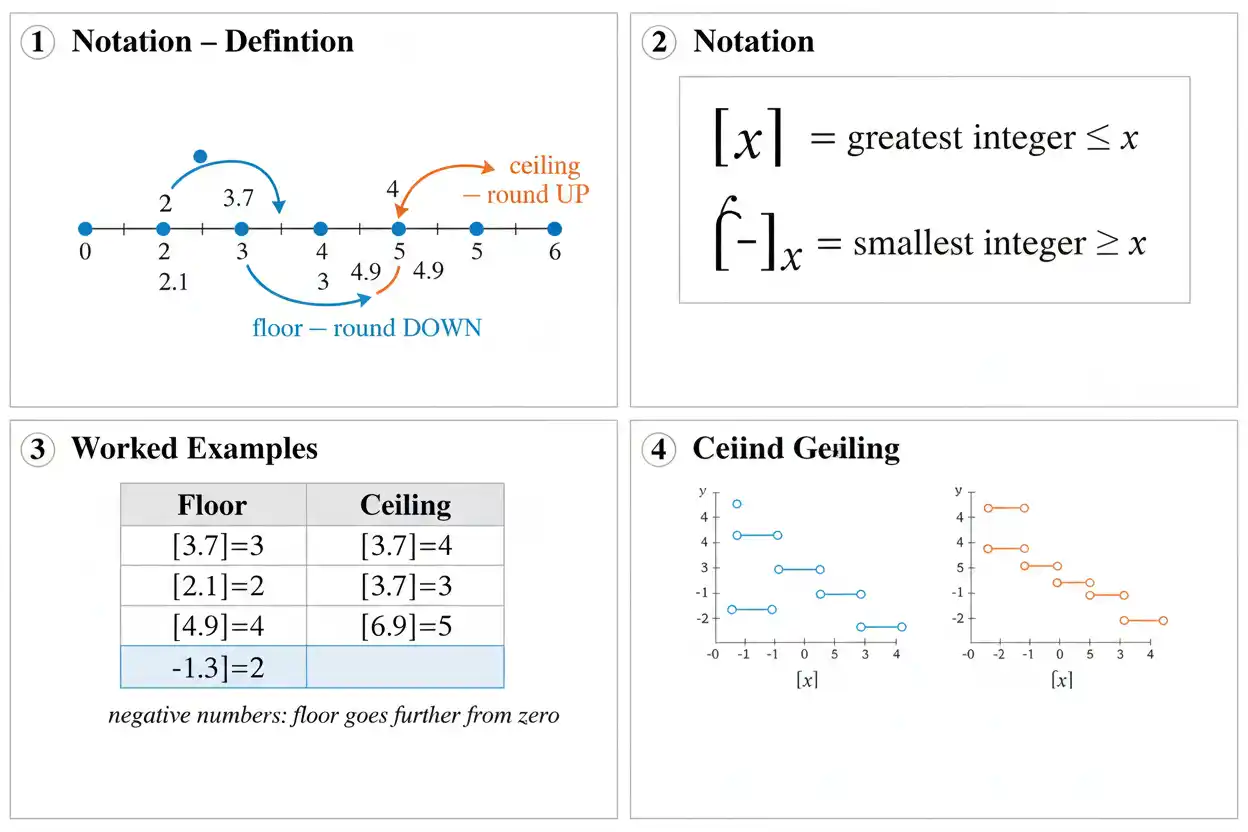

Floor and ceiling functions map real numbers to nearby integers. The floor function returns the greatest integer less than or equal to a number, while the ceiling function returns the smallest integer greater than or equal to it.
For example, if:
x = 4.7
then:
floor(4.7) = 4
and:
ceiling(4.7) = 5
For a negative value such as:
x = -4.7
the results are:
floor(-4.7) = -5
ceiling(-4.7) = -4
The negative case is important because floor does not simply remove the decimal portion. Floor always moves toward the next integer at or below the original value, while ceiling moves toward the next integer at or above it.
Floor and ceiling functions appear throughout arithmetic and number theory, discrete mathematics, computer science, counting, scheduling, indexing, and integer-based calculations.
What Are Floor and Ceiling Functions?
The floor function of a real number x is the greatest integer that is less than or equal to x.
In symbolic terms:
floor(x) = greatest integer n such that n ≤ x
The ceiling function is the smallest integer greater than or equal to x:
ceiling(x) = smallest integer n such that n ≥ x
For:
x = 6.25
the integers around the value are:
6 < 6.25 < 7
Therefore:
floor(6.25) = 6
ceiling(6.25) = 7
The two functions take a value from the real numbers and return an integer.
Floor Function Formula
The floor function can be described as:
floor(x) = max{n ∈ integers : n ≤ x}
In ordinary words, choose the largest integer that does not exceed x.
For example:
floor(9.999) = 9
because 9 is the largest integer satisfying:
9 ≤ 9.999
The integer 10 does not qualify because:
10 > 9.999
Ceiling Function Formula
The ceiling function can be described as:
ceiling(x) = min{n ∈ integers : n ≥ x}
Choose the smallest integer that is not below x.
For:
ceiling(9.001)
the answer is:
10
because:
10 ≥ 9.001
and no smaller integer satisfies that condition.
Floor and Ceiling of Positive Decimals
For a positive non-integer decimal, floor takes the integer immediately below it and ceiling takes the integer immediately above it.
For example:
floor(2.4) = 2
ceiling(2.4) = 3
Similarly:
floor(18.999) = 18
ceiling(18.999) = 19
The size of the decimal portion does not change the rule.
Even though 18.999 is very close to 19, its floor remains 18.
Floor and Ceiling of Integers
When x is already an integer:
floor(x) = x
and:
ceiling(x) = x
For example:
floor(7) = 7
ceiling(7) = 7
There is no need to move to another integer because 7 itself satisfies both definitions.
This produces the useful equivalence:
floor(x) = ceiling(x) if and only if x is an integer
Negative Numbers Require Care
Consider:
x = -3.2
On a number line:
-4 < -3.2 < -3
The greatest integer less than or equal to -3.2 is:
-4
Therefore:
floor(-3.2) = -4
The smallest integer greater than or equal to -3.2 is:
-3
Therefore:
ceiling(-3.2) = -3
This is why simply deleting decimal digits produces the wrong floor for negative non-integers.
Floor of Negative Numbers
Consider:
floor(-7.01)
The surrounding integers are:
-8 < -7.01 < -7
The floor must be at or below -7.01.
Therefore:
floor(-7.01) = -8
Even though the decimal portion is only 0.01, the result moves to -8.
Ceiling of Negative Numbers
For:
ceiling(-7.01)
the smallest integer greater than or equal to the value is:
-7
Therefore:
ceiling(-7.01) = -7
The number line is the safest way to understand negative floor and ceiling calculations.
Floor and Ceiling on a Number Line
Suppose:
5 < x < 6
Then:
floor(x) = 5
and:
ceiling(x) = 6
If instead:
-6 < x < -5
then:
floor(x) = -6
and:
ceiling(x) = -5
The definitions remain identical on both sides of zero.
Core Inequalities
Floor satisfies:
floor(x) ≤ x < floor(x) + 1
For example, if:
x = 8.37
then:
floor(x) = 8
and:
8 ≤ 8.37 < 9
Ceiling satisfies:
ceiling(x) – 1 < x ≤ ceiling(x)
For:
x = 8.37
we have:
ceiling(x) = 9
and:
8 < 8.37 ≤ 9
These inequalities are useful when solving problems involving unknown values inside floor or ceiling expressions.
Floor and Ceiling Are Not Ordinary Rounding
Floor and ceiling functions differ from ordinary rounding rules.
For:
x = 6.8
ordinary rounding to the nearest integer gives:
7
Floor gives:
6
Ceiling gives:
7
Now consider:
x = 6.2
ordinary rounding gives:
6
Floor also gives:
6
but ceiling gives:
7
The functions are directional, whereas conventional nearest-integer rounding chooses whichever integer is closer.
Negative Example: Floor vs. Rounding
Consider:
-2.7
Rounded to the nearest integer:
-3
Floor:
floor(-2.7) = -3
Ceiling:
ceiling(-2.7) = -2
Now consider:
-2.2
Ordinary rounding gives:
-2
but floor still gives:
-3
This demonstrates why the three operations should not be treated as interchangeable.
Relationship Between Floor and Ceiling
One important identity is:
ceiling(x) = -floor(-x)
Similarly:
floor(x) = -ceiling(-x)
For example, take:
x = 3.7
Then:
-x = -3.7
and:
floor(-3.7) = -4
Therefore:
-floor(-3.7) = 4
which equals:
ceiling(3.7) = 4
The identity works for integer and non-integer values.
Difference Between Floor and Ceiling
If x is an integer:
ceiling(x) – floor(x) = 0
If x is not an integer:
ceiling(x) – floor(x) = 1
For example:
x = 5
gives:
5 – 5 = 0
But:
x = 5.3
gives:
6 – 5 = 1
So the difference immediately reveals whether the original value was an integer.
Floor of a Sum With an Integer
If n is an integer:
floor(x + n) = floor(x) + n
For example:
floor(3.7 + 5)
= floor(8.7)
= 8
Using the property:
floor(3.7) + 5 = 3 + 5
= 8
Both methods agree.
The same relationship holds for ceiling:
ceiling(x + n) = ceiling(x) + n
Example With a Negative Integer Shift
Let:
x = 4.6
and:
n = -3
Then:
floor(4.6 – 3) = floor(1.6) = 1
Using the identity:
floor(4.6) – 3 = 4 – 3 = 1
Similarly:
ceiling(4.6 – 3) = ceiling(1.6) = 2
and:
ceiling(4.6) – 3 = 5 – 3 = 2
Floor Does Not Generally Distribute Over Addition
It is not generally true that:
floor(x + y) = floor(x) + floor(y)
For example:
x = 1.6
y = 2.6
Then:
floor(x + y) = floor(4.2) = 4
But:
floor(1.6) + floor(2.6)
= 1 + 2
= 3
Therefore:
4 ≠ 3
Care is required when simplifying expressions containing several floor functions.
Ceiling Also Does Not Generally Distribute Over Addition
Take:
x = 1.2
y = 2.2
Then:
ceiling(x + y) = ceiling(3.4) = 4
But:
ceiling(1.2) + ceiling(2.2)
= 2 + 3
= 5
So:
4 ≠ 5
The function should usually be applied to the complete expression specified inside it.
Fractional Part and the Floor Function
For a real number x, its fractional part can be expressed as:
fractional part = x – floor(x)
For:
x = 7.36
we have:
floor(7.36) = 7
Therefore:
fractional part = 7.36 – 7
= 0.36
The result always satisfies:
0 ≤ fractional part < 1
This remains true for negative values under the mathematical definition of fractional part.
Fractional Part of a Negative Number
Take:
x = -2.3
Then:
floor(-2.3) = -3
Therefore:
x – floor(x)
= -2.3 – (-3)
= 0.7
So the mathematical fractional part is:
0.7
rather than -0.3.
This differs from simply treating the digits after a decimal point as a signed decimal tail.
Floor and Fractions
Consider:
floor(17 / 5)
First perform the fraction operations or division:
17 / 5 = 3.4
Then:
floor(3.4) = 3
Therefore:
floor(17/5) = 3
If:
ceiling(17 / 5)
then:
ceiling(3.4) = 4
So:
ceiling(17/5) = 4
Floor of a Proper Fraction
For a positive proper fraction:
0 < a/b < 1
its floor is:
0
and its ceiling is:
1
For example:
3/8 = 0.375
Therefore:
floor(3/8) = 0
ceiling(3/8) = 1
The fraction need not be converted to a decimal if its position relative to neighboring integers is already clear.
Floor and Fraction Simplification
A fraction can often be reduced before evaluating the floor or ceiling.
For example:
floor(18/12)
Using fraction simplification:
18/12 = 3/2
and:
3/2 = 1.5
Therefore:
floor(18/12) = 1
and:
ceiling(18/12) = 2
Simplification may make the integer boundaries easier to identify.
Floor and Ceiling With Negative Fractions
Consider:
-7/3
Since:
-7/3 ≈ -2.333…
we know:
-3 < -7/3 < -2
Therefore:
floor(-7/3) = -3
and:
ceiling(-7/3) = -2
Again, the floor moves toward the smaller integer on the number line, not toward zero.
Floor and Ceiling With Decimal Arithmetic
Suppose an expression is:
floor(2.75 × 3.2)
First use decimal arithmetic:
2.75 × 3.2 = 8.8
Then:
floor(8.8) = 8
Therefore:
floor(2.75 × 3.2) = 8
For the ceiling:
ceiling(8.8) = 9
The arithmetic inside the function must be completed before the floor or ceiling is applied.
Order of Operations Matters
Consider:
floor(3.4 + 2²)
Apply the order of operations.
First:
2² = 4
Then:
3.4 + 4 = 7.4
Finally:
floor(7.4) = 7
Therefore:
floor(3.4 + 2²) = 7
The floor brackets do not justify ignoring ordinary arithmetic precedence inside the expression.
Floor and Ceiling of Powers
Suppose:
ceiling(2^(3/2))
Using exponents:
2^(3/2) = √8
and:
√8 ≈ 2.828
Therefore:
ceiling(2^(3/2)) = 3
For floor:
floor(2^(3/2)) = 2
Exact comparison is often preferable to unnecessary decimal rounding.
Floor and Ceiling in Integer Division
Floor naturally appears when asking how many complete groups fit into a quantity.
Suppose 53 items are packed into boxes holding 8 each.
Calculate:
53 / 8 = 6.625
The number of complete boxes is:
floor(53/8) = 6
This corresponds to integer division:
53 = 8 × 6 + 5
There are six complete boxes and five items left.
Ceiling in Capacity Problems
Now suppose every one of the 53 items must be packed and each box holds at most 8.
The required number of boxes is:
ceiling(53/8)
Since:
53/8 = 6.625
we get:
ceiling(6.625) = 7
Therefore:
7 boxes are required
This is one of the most common practical uses of the ceiling function.
Practical Example: Pages
Suppose a report contains:
2,350 words
and each page holds approximately:
400 words
The estimated page count is:
2350 / 400 = 5.875
If the entire report must fit on whole pages:
ceiling(5.875) = 6
So at least:
6 pages
are required under the stated capacity assumption.
Practical Example: Complete Production Batches
A machine processes 25 parts per full batch.
If 138 parts are available, the number of complete batches is:
floor(138 / 25)
Since:
138 / 25 = 5.52
we get:
floor(5.52) = 5
So the machine can run:
5 complete batches
with parts left over.
Practical Example: Scheduling
Suppose a task takes:
17 hours
and work is scheduled in full 8-hour days.
The number of calendar workdays needed is:
ceiling(17 / 8)
Since:
17 / 8 = 2.125
we get:
ceiling(2.125) = 3
Therefore:
3 workdays are needed
even though the third day is only partially occupied.
Floor and Ceiling in Grouping
Suppose:
n = 100
items are assigned in groups of:
k = 12
The number of complete groups is:
floor(n/k)
= floor(100/12)
= 8
The number of groups needed to include all items is:
ceiling(n/k)
= ceiling(100/12)
= 9
The two functions answer different practical questions from the same fraction.
Floor and Ceiling in Fibonacci Computation
Certain formulas related to the Fibonacci sequence may be evaluated numerically and produce a value extremely close to an integer.
For example, a closed-form computation may return something resembling:
54.999999999
because of finite numerical precision even though the exact Fibonacci term is 55.
A suitable integer conversion or rounding policy may then be necessary computationally. The Fibonacci recurrence itself, however, generates exact integer values and does not require floor or ceiling.
Floor and Ceiling in Factor Counting
The factors of an integer can be searched efficiently only up to its square root.
For example, if:
n = 70
then:
√70 ≈ 8.366
The largest integer candidate that needs to be tested as the smaller member of a factor pair is:
floor(√70) = 8
So candidate divisors only need to be checked from 1 through 8.
Floor Functions in Factorial Calculations
The factorials topic uses floor functions in certain prime-factor counts.
For example, the number of factors of 5 contained in n! can be counted with:
floor(n/5) + floor(n/25) + floor(n/125) + …
For:
n = 30
we get:
floor(30/5) = 6
floor(30/25) = 1
Higher terms are zero.
So 30! contains:
7 factors of 5
This produces seven trailing zeros because factorials contain more than enough factors of 2.
Floor and Ceiling With Rational Numbers
Every rational number lies either exactly on an integer or between two consecutive integers.
For example:
11/4 = 2.75
Therefore:
floor(11/4) = 2
ceiling(11/4) = 3
A terminating decimal representation is not required; the fraction’s size can often be determined exactly.
Floor and Ceiling With Irrational Values
The functions also apply to irrational real numbers.
For example:
3 < √10 < 4
Therefore:
floor(√10) = 3
ceiling(√10) = 4
The decimal expansion does not need to terminate or repeat. All that matters is the pair of consecutive integers surrounding the value.
Piecewise Behavior of the Floor Function
The floor function remains constant across each interval:
[n, n + 1)
For example:
floor(x) = 3
for:
3 ≤ x < 4
Then at exactly:
x = 4
the function jumps to:
floor(4) = 4
This produces a step-shaped graph.
Piecewise Behavior of the Ceiling Function
The ceiling function satisfies:
ceiling(x) = n
when:
n – 1 < x ≤ n
For example:
ceiling(x) = 4
for:
3 < x ≤ 4
At exactly 3:
ceiling(3) = 3
but immediately above 3:
ceiling(3.001) = 4
This produces a step graph with endpoint inclusion opposite to the floor function.
Solving a Floor Equation
Suppose:
floor(x) = 5
Using the definition:
5 ≤ x < 6
Therefore the solution is not one number but an interval:
5 ≤ x < 6
Every real number in that interval has floor 5.
Solving a Ceiling Equation
Suppose:
ceiling(x) = 5
Then:
4 < x ≤ 5
Therefore the solution set is:
4 < x ≤ 5
The inclusion of endpoints is essential.
Solving floor(x) = -2
Use:
n ≤ x < n + 1
with:
n = -2
Therefore:
-2 ≤ x < -1
Any value in that interval has floor -2.
For example:
floor(-1.3) = -2
and:
floor(-2) = -2
but:
floor(-2.1) = -3
Solving ceiling(x) = -2
Use:
n – 1 < x ≤ n
with:
n = -2
Therefore:
-3 < x ≤ -2
For instance:
ceiling(-2.8) = -2
and:
ceiling(-2) = -2
but:
ceiling(-3) = -3
Common Floor and Ceiling Mistakes
The most common mistake is truncating negative numbers.
For:
-4.8
truncation toward zero gives:
-4
but:
floor(-4.8) = -5
Another mistake is assuming ceiling always means “add 1.” If the number is already an integer:
ceiling(6) = 6
not 7.
Similarly:
floor(6) = 6
not 5.
A third mistake is treating floor or ceiling as ordinary rounding. The size of the fractional portion does not decide the direction.
A fourth error is applying the function before finishing the expression inside it.
Floor vs. Ceiling vs. Truncation
For positive numbers such as:
3.8
floor and truncation both give:
3
But for:
-3.8
truncation toward zero gives:
-3
while:
floor(-3.8) = -4
Ceiling gives:
ceiling(-3.8) = -3
The distinction becomes especially important in programming and algorithms where different integer-conversion operations may follow different rules.
How to Check a Floor Answer
Suppose:
floor(7.9) = 7
Check the defining inequality:
7 ≤ 7.9 < 8
It holds.
Suppose someone proposes:
floor(-2.4) = -2
Check:
-2 ≤ -2.4
This is false.
Therefore the proposed answer cannot be correct.
The correct inequality is:
-3 ≤ -2.4 < -2
so:
floor(-2.4) = -3
How to Check a Ceiling Answer
Suppose:
ceiling(4.2) = 5
Check:
4 < 4.2 ≤ 5
The condition holds.
For:
ceiling(-5.8) = -5
check:
-6 < -5.8 ≤ -5
Again, the condition holds.
These inequalities provide a precise verification method without relying on intuition.
Frequently Asked Questions
What are floor and ceiling functions?
The floor function gives the greatest integer less than or equal to a number. The ceiling function gives the smallest integer greater than or equal to it.
What is floor(3.7)?
floor(3.7) = 3
What is ceiling(3.7)?
ceiling(3.7) = 4
What is floor(-3.7)?
floor(-3.7) = -4
because -4 is the greatest integer less than or equal to -3.7.
What is ceiling(-3.7)?
ceiling(-3.7) = -3
What happens when the input is already an integer?
Both functions return the same integer:
floor(n) = ceiling(n) = n
Is floor the same as rounding down?
If “down” means toward negative infinity, yes. It should not be interpreted as always moving toward zero.
Is ceiling the same as rounding up?
If “up” means toward positive infinity, yes. For negative numbers, ceiling therefore moves toward zero.
What is the relationship between floor and ceiling?
A useful identity is:
ceiling(x) = -floor(-x)
When is ceiling(x) – floor(x) equal to 1?
Whenever x is not an integer.
If x is an integer, the difference is 0.
Why is ceiling useful in practical calculations?
It is useful when a fractional quantity requires one additional whole unit, such as the number of boxes, pages, vehicles, servers, or days required to cover an entire demand.
Why is floor useful in practical calculations?
It is useful when only complete groups count, such as complete batches, full packages, or whole intervals that fit inside a quantity.
Final Example
Suppose 187 items must be packed into containers that each hold 24 items.
First calculate:
187 / 24 ≈ 7.7917
The number of completely filled containers is:
floor(187/24) = 7
Seven containers hold:
7 × 24 = 168
items.
The remaining quantity is:
187 – 168 = 19
If every item must be packed, the number of containers required is:
ceiling(187/24) = 8
Therefore:
Complete full containers = 7
Containers required for all items = 8
The difference captures the practical meaning of floor and ceiling functions: floor counts complete units that fit, while ceiling counts whole units required to cover the entire quantity.