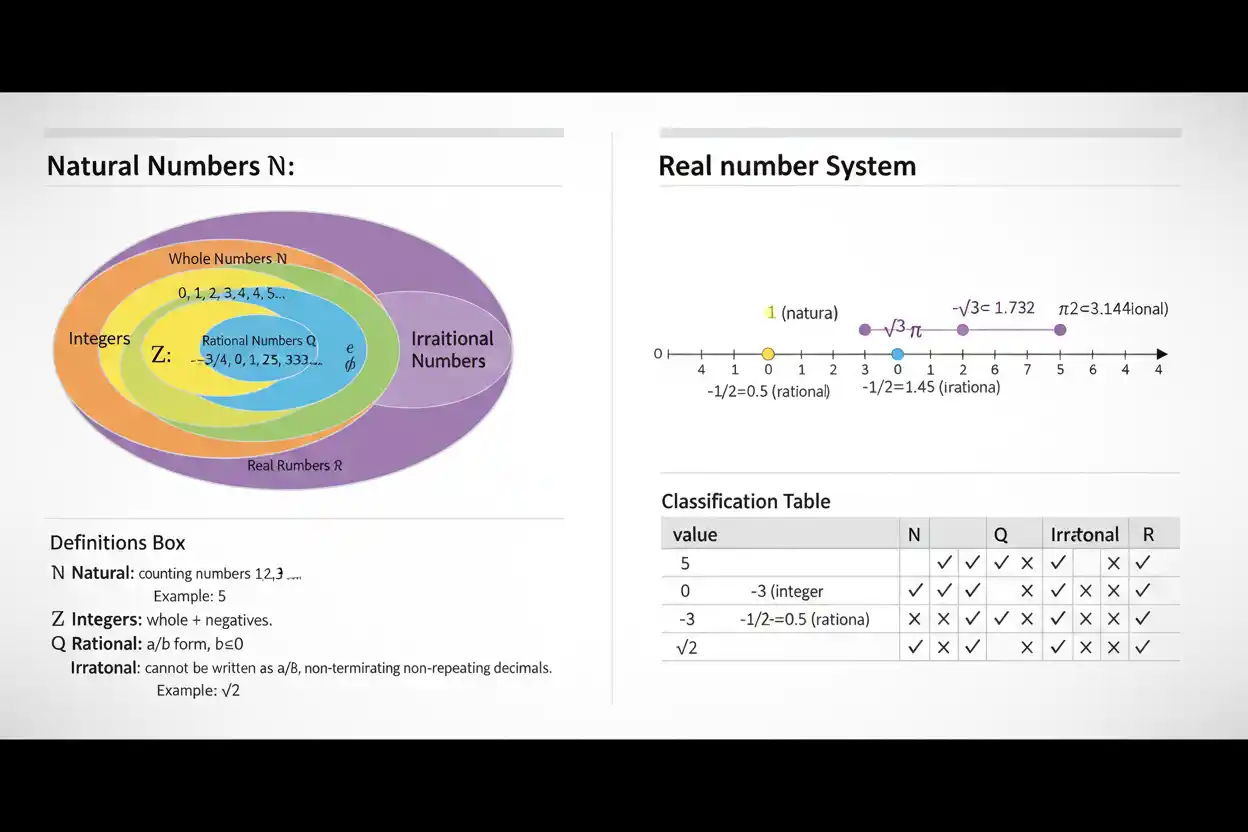

Real numbers are all numbers that can be represented as points on the ordinary number line. They include positive and negative integers, zero, fractions, terminating and repeating decimals, and irrational values such as √2 and π.
The real-number system can be divided into two main groups:
Real Numbers = Rational Numbers + Irrational Numbers
In set notation:
R = Q ∪ Irrational Numbers
Examples of real numbers include:
-7
0
3/4
2.5
√2
π
Numbers such as:
√(-1)
are not real numbers because no real number squared equals -1.
What Are Real Numbers?
A real number is any value that corresponds to a position on a continuous number line.
For example:
-3
lies three units to the left of zero.
1/2
lies halfway between 0 and 1.
√2 ≈ 1.4142
lies between 1 and 2.
π ≈ 3.14159
lies between 3 and 4.
All of these values belong to the real-number system.
The rational numbers and irrational numbers together account for every point on the real line.
Real Number Classification
The real-number system contains several important subsets:
Natural Numbers
Whole Numbers
Integers
Rational Numbers
Irrational Numbers
A typical containment structure is:
Natural ⊂ Whole ⊂ Integers ⊂ Rational ⊂ Real
Irrational numbers are also real but do not belong to the rational-number subset.
Natural Numbers
Natural numbers are counting numbers such as:
1, 2, 3, 4, 5, …
Some conventions also include:
0
among the natural numbers.
Every natural number is real because each has a location on the number line.
Whole Numbers
Whole numbers are:
0, 1, 2, 3, 4, …
They contain the nonnegative integers.
Every whole number is also:
an integer,
a rational number,
and:
a real number.
For example:
8 = 8/1
so 8 satisfies the definition of a rational number.
Integers
Integers include:
…, -3, -2, -1, 0, 1, 2, 3, …
Every integer is rational because:
n = n/1
For example:
-12 = -12/1
Therefore all integers are also real numbers.
Arithmetic with positive and negative integers follows the usual integer operations.
Rational Real Numbers
A rational number can be written:
a/b
where:
a and b are integers
and:
b ≠ 0
Examples include:
2/3
-9/5
7
0.125
0.333…
All are real numbers.
Irrational Real Numbers
An irrational number cannot be written as a ratio of two integers.
Examples include:
√2
√3
π
e
Their decimal expansions continue indefinitely without becoming permanently repeating.
Irrational numbers are still real because each corresponds to an exact point on the number line.
Rational vs. Irrational Numbers
The distinction is:
Rational → expressible as a/b
Irrational → not expressible as a/b
For example:
0.75 = 3/4
so it is rational.
But:
√2
cannot be written as a fraction of integers, so it is irrational.
Both:
0.75
and:
√2
are real.
Terminating Decimals Are Real
A terminating decimal such as:
2.375
is rational because:
2.375 = 2375/1000
which can be simplified to:
19/8
Therefore:
2.375 is a rational real number
Repeating Decimals Are Real
Consider:
0.666…
This equals:
2/3
Therefore it is rational and hence real.
Likewise:
0.121212…
is a repeating decimal and can be expressed as a fraction.
So it is also real.
Nonrepeating Infinite Decimals
A decimal can continue forever and still be real.
For example:
π = 3.14159265…
does not terminate or repeat periodically.
It is irrational but remains part of the real-number system.
The decimal behavior determines whether a real number is rational or irrational, not whether it is real.
Is Zero a Real Number?
Yes.
Zero belongs to several number sets:
whole numbers
integers
rational numbers
real numbers
It is rational because:
0 = 0/1
Therefore:
0 is a real number
Are Negative Numbers Real?
Yes, provided they belong to the ordinary real-number line.
Examples:
-1
-2.5
-7/8
-√3
are all real.
A negative sign does not make a number non-real.
Are Fractions Real Numbers?
Ordinary fractions with real numerator and nonzero real denominator can represent real values.
For integer fractions:
a/b
with:
b ≠ 0
the result is rational and therefore real.
For example:
-5/9
is real.
The same division-based idea underlies mathematical ratios.
Ratios and Real Numbers
A ratio such as:
3:4
has numerical value:
3/4
which is a rational real number.
Ratios may also involve irrational real quantities.
For example:
√2 : 1
has quotient:
√2
which is irrational but real.
Therefore the result of a valid ratio need not be rational merely because it is expressed through division.
Real Numbers on a Number Line
A real-number line extends indefinitely in both directions:
… < -3 < -2 < -1 < 0 < 1 < 2 < 3 < …
Fractions and irrational numbers fill the spaces between integers.
For example:
1 < √2 < 3/2 < 2
because:
√2 ≈ 1.4142
and:
3/2 = 1.5
The real line contains no gaps between these values.
Ordering Real Numbers
Any two real numbers can be compared.
For real numbers a and b, exactly one of these relationships holds:
a < b
a = b
a > b
For example:
-5 < -2
and:
1.4 < √2
because:
√2 ≈ 1.4142
This ordering property makes the real-number system suitable for measurements and continuous quantities.
Absolute Value of a Real Number
The absolute value of a real number represents its distance from zero.
For:
x ≥ 0
we have:
|x| = x
For:
x < 0
we have:
|x| = -x
Examples:
|7| = 7
|-7| = 7
Both 7 and -7 are seven units from zero.
Addition of Real Numbers
Real numbers are closed under addition.
If:
a and b
are real, then:
a + b
is also real.
Examples:
3 + 5 = 8
1/2 + 1/3 = 5/6
√2 + 3
is also real.
Subtraction of Real Numbers
Real numbers are closed under subtraction.
If:
a,b ∈ R
then:
a – b ∈ R
For example:
3 – 8 = -5
and:
√5 – 2
is real.
Multiplication of Real Numbers
Real numbers are closed under multiplication.
For example:
4 × (-3) = -12
and:
√2 × √8
can be simplified:
√16 = 4
The result remains real.
Division of Real Numbers
If:
a and b
are real and:
b ≠ 0
then:
a/b
is real.
For example:
7/4 = 1.75
and:
√2/3
is also real.
The restriction:
b ≠ 0
is essential because division by zero is undefined.
Real Numbers Are Not Closed Under Every Root Operation
The roots of positive real numbers can often be evaluated within the real-number system.
For example:
√25 = 5
and:
∛27 = 3
But:
√(-9)
is not a real number.
No real number x satisfies:
x² = -9
because every real square is nonnegative.
Even and Odd Roots
For real numbers, an odd root can accept a negative radicand.
For example:
∛(-8) = -2
because:
(-2)³ = -8
But an even root of a negative number is not real.
For example:
√(-4)
and:
⁴√(-16)
do not have real values.
This domain distinction is central when using nth roots.
Perfect Squares and Real Roots
For a nonnegative perfect square:
n²
the principal square root is:
|n|
For example:
√81 = 9
The equation:
x² = 81
has two real solutions:
x = ±9
while the radical expression itself gives the principal nonnegative value:
9
Real Powers
Many exponent expressions remain real.
For example:
2³ = 8
5^-2 = 1/25
16^(1/2) = 4
However, fractional powers involving negative bases require attention to the denominator of the exponent when interpreted in the real-number system.
For example:
(-8)^(1/3) = -2
is real.
But:
(-8)^(1/2)
is not real.
Real Numbers and Remainders
Ordinary remainders are typically defined in integer division.
For example:
17 = 5(3) + 2
The remainder:
2
is an integer and therefore also a real number.
The broader real-number system contains many values that are not normally treated through integer quotient-and-remainder division.
Thus:
remainders belong to real numbers,
but:
not every real-number division problem is a remainder problem.
Repeating Decimals and Remainders
Repeated remainders during long division create repeating decimal patterns.
For example:
1/3 = 0.333…
When dividing 1 by 3, the same remainder returns repeatedly.
This illustrates a direct connection between integer remainders and rational real numbers.
Every Integer Is Real, but Not Every Real Number Is an Integer
For example:
5
is both integer and real.
But:
1/2
is real without being an integer.
Likewise:
√2
is real but neither rational nor integer.
The real-number set is therefore much broader than the integer set.
Every Rational Number Is Real
By definition:
Q ⊂ R
For example:
3/7
is rational.
Therefore it is automatically real.
But the reverse is false because irrational real numbers exist.
For example:
π
is real but not rational.
Every Irrational Number Is Real?
In ordinary elementary classification, the term irrational number means a real number that is not rational.
Therefore:
Irrational Numbers ⊂ Real Numbers
Values outside the real-number system are not described merely as irrational.
For example:
√(-1)
is not irrational; it is non-real.
Rational Plus Irrational
If:
r
is rational and:
x
is irrational, then:
r + x
is irrational.
For example:
3 + √2
is irrational.
If it were rational, subtracting rational 3 would make √2 rational, which is impossible.
Rational Times Irrational
If:
r ≠ 0
is rational and x is irrational, then:
rx
is irrational.
For example:
2√3
is irrational.
The zero exception is:
0 × √3 = 0
which is rational.
Irrational Plus Irrational
Two irrational numbers can produce either a rational or irrational result.
For example:
√2 + (-√2) = 0
which is rational.
But:
√2 + √3
is irrational.
Therefore irrational numbers do not have the same simple closure behavior as rational or real numbers.
Irrational Times Irrational
Again, the result can vary.
For example:
√2 × √2 = 2
which is rational.
But:
√2 × √3 = √6
which is irrational.
Both results remain real.
Density of Real Numbers
Between any two distinct real numbers lies another real number.
For example, if:
a < b
their average:
(a+b)/2
lies strictly between them.
This means the real number line is densely populated.
There is no “next real number” after an arbitrary real value.
Rational and Irrational Numbers Are Both Dense
Between two distinct real numbers, rational numbers can be found.
Irrational numbers can also be found.
For example, between:
1 and 2
we have rational:
3/2 = 1.5
and irrational:
√2 ≈ 1.4142
The intervals of the real line contain infinitely many values of both types.
Scientific Notation Represents Real Numbers
Large and small real values may be written in scientific notation.
For example:
6.02 × 10²³
is a positive real number.
And:
-3.5 × 10^-7
is a negative real number.
Changing notation does not change the number’s classification.
Rounding Real Numbers
Many real numbers have decimal expansions longer than needed for a practical calculation.
For example:
√2 ≈ 1.41421356…
Using rounding rules, this might be represented to three decimal places as:
1.414
The rounded value is an approximation to the exact real number.
Exact vs. Approximate Real Numbers
The expression:
√2
is exact.
The decimal:
1.414
is approximate.
Likewise:
π
is exact as a mathematical constant, while:
3.14
is an approximation.
Keeping exact forms until a final numerical approximation is often useful in calculations.
Common Mistake: Thinking Fractions Are Not Real
Fractions such as:
3/5
are rational and therefore real.
The real-number line includes much more than integers.
Common Mistake: Calling Every Root Irrational
Some roots are rational.
For example:
√64 = 8
which is an integer.
But:
√7
is irrational.
The expression must be evaluated or classified based on the radicand.
Common Mistake: Calling √(-4) Irrational
The number:
√(-4)
is not an irrational real number.
It is outside the real-number system.
“Irrational” describes real numbers that cannot be expressed as integer fractions.
Common Mistake: Assuming Every Infinite Decimal Is Irrational
Repeating infinite decimals are rational.
For example:
0.777…
equals:
7/9
A decimal must be nonterminating and nonrepeating to represent an irrational number.
Common Mistake: Dividing by Zero
Even though 0 is real:
a/0
is undefined.
Closure under division requires:
divisor ≠ 0
How to Classify a Number
A useful sequence is:
First ask:
Is it a valid real value?
Then ask:
Can it be written as a/b with integers a,b and b ≠ 0?
If yes:
rational.
If no, but it is still real:
irrational.
Then identify narrower subsets such as:
integer,
whole,
or:
natural
when appropriate.
Frequently Asked Questions
What are real numbers?
Real numbers are all values that correspond to points on the ordinary number line.
What is the real-number formula?
The main classification relationship is:
Real Numbers = Rational Numbers ∪ Irrational Numbers
Is 0 a real number?
Yes.
Are negative numbers real?
Yes, ordinary negative integers, fractions, decimals, and irrational values are real.
Are fractions real numbers?
Yes, ordinary fractions with nonzero denominators are rational real numbers.
Is π a real number?
Yes. It is an irrational real number.
Is √2 a real number?
Yes. It is irrational.
Is √4 a real number?
Yes.
√4 = 2
Is √(-4) a real number?
No.
Are all integers real numbers?
Yes.
Are all rational numbers real?
Yes.
Are all real numbers rational?
No. Irrational numbers are real but not rational.
Are repeating decimals real?
Yes. They are rational real numbers.
Is division of two real numbers always real?
Only when the divisor is nonzero.
Final Example
Classify:
-6
3/5
0.125
√16
√3
π
√(-9)
First:
-6 = -6/1
So it is:
integer, rational, real
Next:
3/5
is:
rational and real
Next:
0.125 = 1/8
so it is:
rational and real
Next:
√16 = 4
so it is:
natural, whole, integer, rational, real
Next:
√3
cannot be written as an integer fraction.
Therefore it is:
irrational and real
Next:
π
is:
irrational and real
Finally:
√(-9)
has no real value.
Therefore:
√(-9) is not a real number
The central classification is:
Real Numbers = Rational Numbers ∪ Irrational Numbers
Every ordinary point on the number line belongs to one of those two categories.