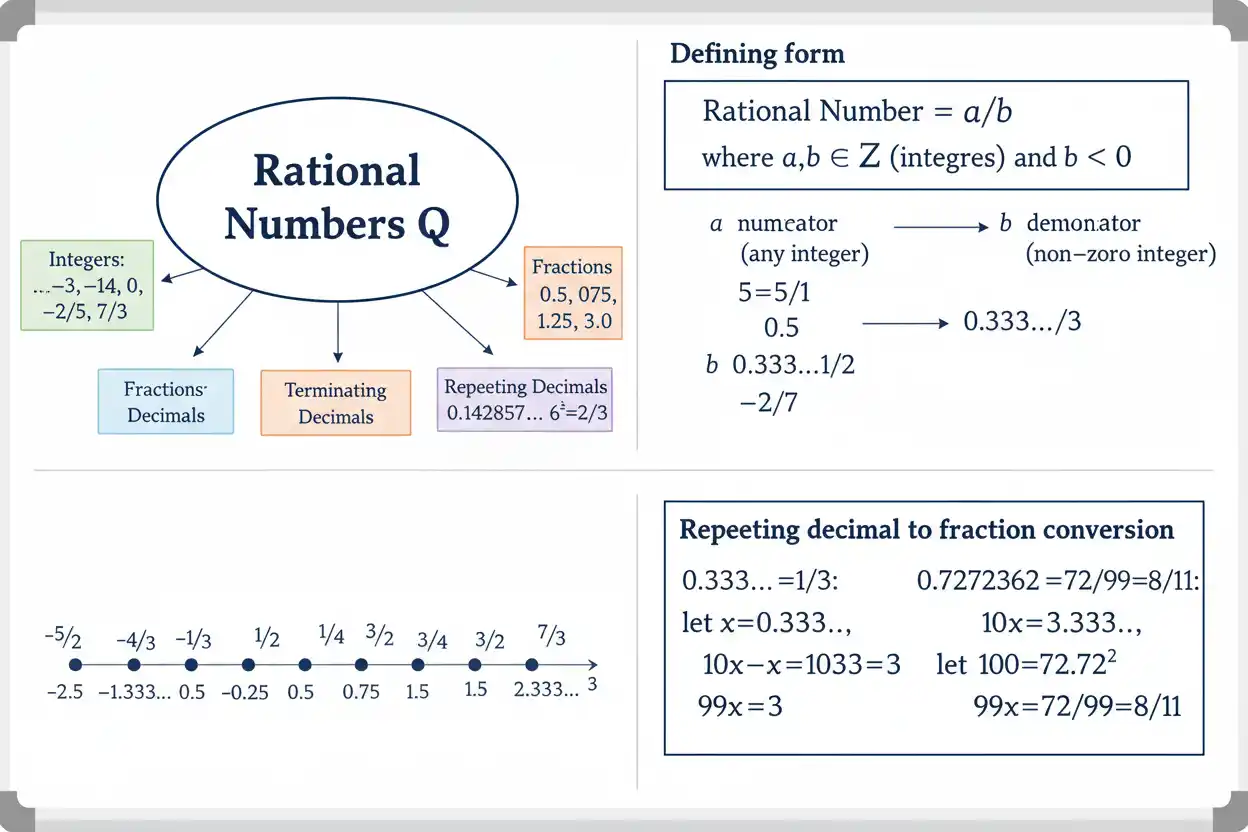

Rational numbers are numbers that can be written as a fraction of two integers:
x = a/b
where:
a and b are integers
and:
b ≠ 0
For example:
3/4
is rational because it already has the required form.
The integer:
7
is also rational because:
7 = 7/1
A terminating decimal such as:
0.25
is rational because:
0.25 = 25/100 = 1/4
A repeating decimal such as:
0.333…
is rational because:
0.333… = 1/3
Therefore rational numbers include integers, ordinary fractions, terminating decimals, and repeating decimals.
Rational Number Definition
A real number x is rational when there exist integers a and b such that:
x = a/b
with:
b ≠ 0
The set of rational numbers is commonly denoted:
Q
So:
x ∈ Q
means:
xis rational.
The ratio form is fundamental because every rational number can be represented as one integer divided by another.
This connects rational numbers directly with the general idea of a ratio.
Rational Number Formula
The defining form is:
Rational Number = Integer / Nonzero Integer
or:
x = a/b, where a,b ∈ Z and b ≠ 0
Examples:
5/8
-7/3
12/1
0/9
are all rational.
The denominator cannot equal zero because division by zero is undefined.
Examples of Rational Numbers
Examples include:
1/2
-4/9
0
5
-13
0.75
2.125
0.666…
12.121212…
Each can be expressed as a fraction of integers.
Is Zero Rational?
Yes.
Zero can be written:
0 = 0/1
or:
0 = 0/7
or more generally:
0 = 0/b
for any nonzero integer b.
Therefore:
0 is a rational number
Are Integers Rational Numbers?
Yes.
Every integer n can be written:
n = n/1
For example:
-8 = -8/1
25 = 25/1
Therefore every integer is rational.
The containment relationship is:
Integers ⊂ Rational Numbers
Are Fractions Rational Numbers?
Any fraction:
a/b
with integer numerator a, integer denominator b, and:
b ≠ 0
is rational.
Examples:
2/7
-11/5
18/3
0/4
are rational.
A fraction may simplify to an integer and still remain rational.
For example:
18/3 = 6
and:
6 = 6/1
Proper and Improper Fractions
Both proper and improper fractions can represent rational numbers.
Proper:
3/5
Improper:
11/4
Both satisfy the form:
a/b
with integer numerator and denominator.
A mixed number also represents a rational number because it can be converted to an improper fraction.
Are Mixed Numbers Rational?
Yes.
For example:
2 3/5
convert using the mixed numbers rule:
2 3/5 = (2×5+3)/5
= 13/5
Since:
13 and 5
are integers and:
5 ≠ 0
the number is rational.
Terminating Decimals Are Rational
A terminating decimal has finitely many decimal digits.
For example:
0.375
can be written:
375/1000
Simplify:
375/1000 = 3/8
Therefore:
0.375 is rational
Any terminating decimal can be converted into a fraction with a denominator that is a power of 10.
Example: Convert 2.45 to a Rational Fraction
Write:
2.45 = 245/100
Simplify by 5:
245/100 = 49/20
Therefore:
2.45 = 49/20
and 2.45 is rational.
The general conversion process is covered further under decimal to fraction.
Repeating Decimals Are Rational
A decimal that repeats forever is also rational.
For example:
x = 0.333…
Multiply by 10:
10x = 3.333…
Subtract:
10x – x = 3.333… – 0.333…
So:
9x = 3
Therefore:
x = 1/3
Hence:
0.333… = 1/3
Example: Convert 0.272727… to a Fraction
Let:
x = 0.272727…
The repeating block has two digits, so multiply by:
100
Then:
100x = 27.272727…
Subtract the original:
100x – x = 27
So:
99x = 27
Therefore:
x = 27/99
Simplify:
x = 3/11
Thus:
0.272727… = 3/11
and the repeating decimal is rational.
Decimal Test for Rational Numbers
A real number is rational if its decimal expansion:
terminates
or:
eventually repeats
Examples:
0.5 → terminates
1.875 → terminates
0.121212… → repeats
2.166666… → eventually repeats
All are rational.
A nonterminating decimal that never becomes periodic is irrational.
Rational vs. Irrational Numbers
An irrational number cannot be expressed as:
a/b
for integers a and nonzero b.
Examples include:
√2
π
e
Their decimal expansions are nonterminating and nonrepeating.
Thus:
Rational → terminating or repeating decimal
Irrational → nonterminating, nonrepeating decimal
Both belong to the broader set of real numbers.
Rational Numbers Within the Real Numbers
The real-number system contains:
rational numbers
and:
irrational numbers
So:
Real Numbers = Rational Numbers ∪ Irrational Numbers
and these two sets do not overlap.
Every point on the ordinary real number line represents either a rational or irrational number.
Natural Numbers Are Rational
If natural numbers are taken as:
1,2,3,4,…
each can be expressed over 1:
1 = 1/1
2 = 2/1
3 = 3/1
Therefore every natural number is rational.
If a convention includes zero among the natural numbers, zero is rational as well.
Whole Numbers Are Rational
Whole numbers such as:
0,1,2,3,…
are rational because each can be expressed as:
n/1
The hierarchy can be summarized:
Natural Numbers ⊂ Whole Numbers ⊂ Integers ⊂ Rational Numbers ⊂ Real Numbers
depending on the convention used for whether 0 belongs to the natural numbers.
Negative Rational Numbers
Rational numbers can be negative.
For example:
-3/7
is rational.
The negative sign can be placed:
-3/7
3/-7
or:
-(3/7)
These expressions represent the same value.
Usually the denominator is kept positive for standard form.
Positive Rational Numbers
A rational number is positive when numerator and denominator have the same sign.
For example:
4/7 > 0
and:
(-4)/(-7) = 4/7 > 0
Two negative signs cancel.
Rational Number Simplification
A rational number can have many fraction representations.
For example:
1/2 = 2/4 = 3/6 = 50/100
These are equivalent because numerator and denominator have been multiplied by the same nonzero factor.
A fraction in simplest form has numerator and denominator with:
GCF = 1
For:
18/24
divide by:
GCF(18,24) = 6
giving:
3/4
The process is developed in fraction simplification.
Equivalent Rational Representations
The rational number:
2/3
can be represented as:
4/6
20/30
0.666…
66.666…%
These forms look different but represent the same mathematical value.
The relationship between equivalent ratios naturally leads to proportions.
Rational Numbers and Ratios
The broader ratios framework compares quantities using division.
A ratio:
3:5
can be represented numerically as:
3/5
which is a rational number.
However, a ratio may retain contextual meaning about two quantities, while the rational number 3/5 is the numerical value of that comparison.
Rational Numbers and Proportion
A proportion states that two ratios represent the same rational number.
For example:
4/6 = 10/15
Both simplify:
2/3
Therefore the proportion is true.
Cross multiplication confirms:
4 × 15 = 60
6 × 10 = 60
Equal fractions are different representations of the same rational number.
Addition of Rational Numbers
Rational numbers are closed under addition.
If:
a/b
and:
c/d
are rational, then:
a/b + c/d = (ad + bc)/bd
The numerator:
ad + bc
is an integer.
The denominator:
bd
is a nonzero integer if b and d are nonzero.
Therefore the result is rational.
Example
2/3 + 5/7
Use a common denominator:
(2×7 + 5×3)/21
= (14+15)/21
= 29/21
Therefore:
2/3 + 5/7 = 29/21
which is rational.
Subtraction of Rational Numbers
Rational numbers are closed under subtraction:
a/b – c/d = (ad – bc)/bd
For example:
3/4 – 1/6
Use denominator:
24
Then:
18/24 – 4/24
= 14/24
= 7/12
Therefore:
3/4 – 1/6 = 7/12
which is rational.
Multiplication of Rational Numbers
Multiply numerators and denominators:
a/b × c/d = ac/bd
For example:
4/9 × 3/5
= 12/45
Simplify:
4/15
Therefore:
4/9 × 3/5 = 4/15
The result remains rational.
Division of Rational Numbers
For nonzero divisor:
c/d ≠ 0
division is:
a/b ÷ c/d = a/b × d/c
For example:
5/8 ÷ 15/4
= 5/8 × 4/15
Simplify:
= 1/6
Therefore:
5/8 ÷ 15/4 = 1/6
Rational numbers are closed under division except when dividing by zero.
The computational details belong to fraction operations.
Closure Rules for Rational Numbers
If r and s are rational:
r + s is rational
r – s is rational
r × s is rational
and, if:
s ≠ 0
then:
r/s is rational
These are called closure properties.
Rational Plus Irrational
A rational number plus an irrational number is irrational.
Suppose:
r
is rational and:
x
is irrational.
If:
r + x
were rational, then subtracting rational r would imply:
x = (r+x)-r
is rational.
That contradicts the assumption.
Therefore:
rational + irrational = irrational
Rational Times Irrational
If r is a nonzero rational number and x is irrational:
rx is irrational
If rx were rational, dividing by nonzero rational r would imply that x is rational.
The exception is:
r = 0
because:
0 × x = 0
which is rational.
Irrational Plus Irrational Is Not Predictable
Two irrational numbers may sum to either rational or irrational.
For example:
√2 + (-√2) = 0
which is rational.
But:
√2 + √3
is irrational.
Therefore closure rules involving two irrational numbers are not as simple as those for rational numbers.
Rational Numbers on a Number Line
Rational numbers can be positive, negative, or zero.
For example:
-3/2 = -1.5
lies between:
-2 and -1
while:
7/4 = 1.75
lies between:
1 and 2
Their order can be determined by decimal conversion, common denominators, or cross multiplication.
Comparing Rational Numbers
Compare:
3/5
and:
5/8
Cross multiply:
3 × 8 = 24
5 × 5 = 25
Since:
24 < 25
we have:
3/5 < 5/8
No decimal approximation is necessary.
Comparing a Negative and Positive Rational Number
Any negative rational number is less than any positive rational number.
For example:
-7/8 < 1/100
even though:
7/8
has greater magnitude.
Sign determines the ordering across zero.
Comparing Two Negative Rational Numbers
Compare:
-2/3
and:
-3/5
Their positive magnitudes are:
2/3 ≈ 0.667
3/5 = 0.6
The number with the larger positive magnitude becomes more negative.
Therefore:
-2/3 < -3/5
Density of Rational Numbers
Between any two distinct rational numbers there is another rational number.
If:
a < b
then their average:
(a+b)/2
lies between them.
If a and b are rational, their average is rational because rational numbers are closed under addition and division by nonzero rational numbers.
Therefore rational numbers are dense on the real number line.
Example of Density
Between:
1/3
and:
1/2
take the average:
(1/3 + 1/2)/2
First:
1/3 + 1/2 = 5/6
Then:
(5/6)/2
= 5/12
Thus:
1/3 < 5/12 < 1/2
and:
5/12
is rational.
This process can be repeated indefinitely.
There Are Infinitely Many Rational Numbers Between Two Rational Numbers
Once one rational midpoint is found, another can be inserted between either endpoint and that midpoint.
For example, between:
1/3
and:
5/12
take their average.
The process never ends.
Therefore every interval containing more than one point contains infinitely many rational numbers.
Repeating Decimal From a Fraction
Every rational number has a decimal expansion that terminates or repeats.
For example:
1/7 = 0.142857142857…
The repeating block is:
142857
Although the expansion never terminates, its periodic repetition shows that the number is rational.
Why Fractions Eventually Repeat in Decimal Form
When performing long division of integer a by positive integer b, possible nonzero remainders are limited to:
1,2,…,b-1
If a remainder becomes zero, the decimal terminates.
If not, eventually a remainder must repeat.
Once a remainder repeats, the subsequent decimal digits repeat in the same cycle.
This is the structural reason every rational decimal terminates or eventually repeats.
The underlying division behavior is related to remainders.
Which Fractions Have Terminating Decimals?
When a fraction is in simplest form:
a/b
its decimal terminates exactly when the prime factorization of positive denominator b contains no primes except:
2 and 5
For example:
3/8
has denominator:
8 = 2³
so it terminates:
0.375
Similarly:
7/20
has:
20 = 2² × 5
so:
7/20 = 0.35
Example of a Repeating Fraction
Consider:
5/12
The denominator:
12 = 2² × 3
contains prime factor:
3
after simplification.
Therefore the decimal does not terminate.
Indeed:
5/12 = 0.416666…
The digit 6 repeats.
Standard Form of a Rational Fraction
A rational number may be written in reduced form:
a/b
with:
b > 0
and:
GCF(|a|,b) = 1
For example:
-18/-24
first simplify the signs:
18/24
Then reduce:
3/4
So the standard reduced form is:
3/4
Rational Numbers and Percentages
Percentages are rational whenever their numerical percentage is rational.
For example:
35% = 35/100
= 7/20
Therefore:
35% is rational
Similarly:
12.5% = 1/8
Percentage notation is simply another representation of a numerical ratio.
Common Mistake: Thinking Rational Means Positive
The word “rational” does not mean positive.
Examples of negative rational numbers include:
-1/2
-8
-0.75
All can be expressed as ratios of integers.
Common Mistake: Thinking Rational Means Integer
Integers are rational, but many rational numbers are not integers.
For example:
2/3
is rational but not an integer.
Therefore:
Integers are a subset of rational numbers
rather than the two sets being identical.
Common Mistake: Thinking Every Decimal Is Rational
A terminating or repeating decimal is rational.
But a nonterminating, nonrepeating decimal can be irrational.
For example:
3.14159265…
as the decimal expansion of π does not become periodic.
Therefore π is irrational.
Common Mistake: Calling √4 Irrational Because It Contains a Root
The notation used does not determine rationality.
For example:
√4 = 2
which is rational.
Likewise:
∛27 = 3
is rational.
But:
√2
is irrational.
Evaluate or classify the value rather than the symbol alone.
Common Mistake: Allowing Zero in the Denominator
The expression:
5/0
does not define a rational number.
The rational-number definition requires:
b ≠ 0
Zero can appear in the numerator:
0/5 = 0
but not as the denominator.
How to Check Whether a Number Is Rational
Ask whether the value can be written:
a/b
with integer a, integer b, and:
b ≠ 0
For decimals:
- terminating → rational;
- repeating or eventually repeating → rational;
- nonterminating and nonrepeating → irrational.
For roots, simplify the value if possible.
Frequently Asked Questions
What is a rational number?
A rational number is any number expressible as:
a/b
where a and b are integers and b ≠ 0.
Is 0 rational?
Yes.
0 = 0/1
Is 5 rational?
Yes.
5 = 5/1
Is -3 rational?
Yes.
-3 = -3/1
Is 0.25 rational?
Yes.
0.25 = 1/4
Is 0.333… rational?
Yes.
0.333… = 1/3
Are repeating decimals rational?
Yes. Every eventually repeating decimal represents a rational number.
Are terminating decimals rational?
Yes.
Is √2 rational?
No. It is irrational.
Is √9 rational?
Yes.
√9 = 3
Is π rational?
No.
Can a rational number have a zero denominator?
No. Division by zero is undefined.
Are all integers rational?
Yes.
Are all rational numbers integers?
No.
For example:
3/5
is rational but not an integer.
Final Example
Classify each value:
-7
3/8
0.125
0.272727…
√49
√5
First:
-7 = -7/1
so:
rational
Next:
3/8
already has integer numerator and denominator:
rational
Next:
0.125 = 125/1000
= 1/8
so:
rational
Next:
0.272727… = 3/11
so:
rational
Next:
√49 = 7
so:
rational
Finally:
√5
cannot be expressed as a fraction of integers and has a nonterminating, nonrepeating decimal expansion.
Therefore:
√5 is irrational
The defining rational-number rule is:
x is rational ⇔ x = a/b for integers a and b with b ≠ 0
In decimal form, this is equivalent to saying that the expansion either terminates or eventually repeats.