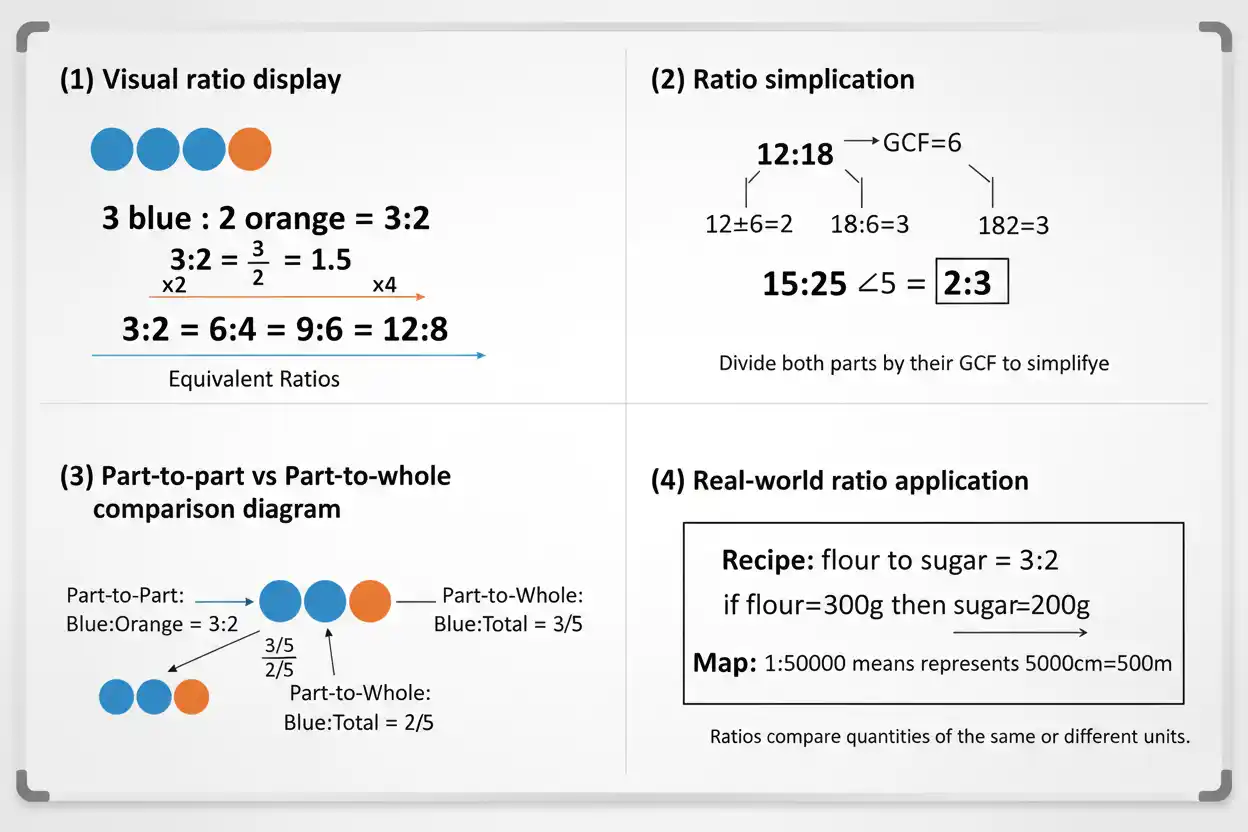

A ratio compares one quantity with another by division.
If quantity a is compared with quantity b, the ratio can be written:
a:b
or:
a/b
provided:
b ≠ 0
For example, if a group contains:
12 red objects
and:
8 blue objects
the ratio of red to blue is:
12:8
Divide both terms by their greatest common factor:
GCF(12,8) = 4
So:
12:8 = 3:2
Therefore:
The simplified ratio of red to blue is 3:2
A ratio is an ordered comparison. The ratio 3:2 does not mean the same thing as 2:3 because reversing the terms changes which quantity is being compared with which.
What Is a Ratio?
A ratio tells how much of one quantity there is relative to another quantity.
For:
a:b
the first term is:
a
and the second term is:
b
The division interpretation is:
a:b = a/b
For example:
5:4
means:
5/4
or:
1.25
So the first quantity is:
1.25 times
the second quantity.
Ratio Formula
The basic ratio relationship is:
Ratio = Quantity A / Quantity B
or:
A:B
For example, if:
A = 18
B = 24
then:
Ratio = 18:24
Simplify:
18:24 = 3:4
Therefore:
A:B = 3:4
Order Matters in a Ratio
Suppose there are:
3 cats
and:
5 dogs
Cats to dogs:
3:5
Dogs to cats:
5:3
These ratios are not interchangeable.
Numerically:
3/5 = 0.6
while:
5/3 ≈ 1.667
Always identify the requested order before constructing the ratio.
Ratio Notation
A ratio may be written in three common ways:
3 to 4
3:4
3/4
All can represent the same comparison, although fraction notation can also carry other meanings depending on context.
The colon form:
3:4
is particularly useful when comparing more than two quantities.
Simplifying a Ratio
A ratio is simplified by dividing every term by the same common factor.
For:
24:36
find:
GCF(24,36) = 12
Divide:
24 ÷ 12 = 2
36 ÷ 12 = 3
Therefore:
24:36 = 2:3
The simplified ratio contains whole-number terms with no common factor greater than 1.
Ratio Simplification Formula
If:
g = GCF(a,b)
then:
a:b = (a/g):(b/g)
For:
42:56
we have:
g = 14
Therefore:
42:56
= 3:4
So:
42:56 = 3:4
Greatest Common Factor and Ratios
The greatest common factor gives the largest integer by which both ratio terms can be divided.
Consider:
84:126
The GCF is:
42
Therefore:
84 ÷ 42 = 2
126 ÷ 42 = 3
So:
84:126 = 2:3
Using the GCF simplifies the ratio in one step.
Prime Factorization Method
Prime factorization can reveal common factors.
For:
72:120
factor:
72 = 2³ × 3²
120 = 2³ × 3 × 5
The shared prime product is:
2³ × 3
= 24
Divide:
72/24 = 3
120/24 = 5
Therefore:
72:120 = 3:5
Equivalent Ratios
Ratios are equivalent when each term is multiplied or divided by the same nonzero factor.
Starting with:
2:5
multiply both terms by 3:
6:15
Multiply by 10:
20:50
Therefore:
2:5 = 6:15 = 20:50
These equivalent ratios can form proportions when written as equal fractions.
Ratio and Proportion
A ratio is one comparison:
a:b
A proportion states that two ratios are equal:
a/b = c/d
For example:
3:4
is a ratio.
The statement:
3/4 = 9/12
is a proportion.
Therefore:
ratio → comparison
proportion → equality of comparisons
Part-to-Part Ratio
A part-to-part ratio compares two categories within the same whole.
Suppose a class has:
12 boys
and:
18 girls
Boys to girls:
12:18
Simplify:
2:3
Therefore:
Boys:girls = 2:3
This compares one part of the class with another part.
Part-to-Whole Ratio
Using the same class:
12 boys
18 girls
Total:
30 students
Boys to total:
12:30
Simplify:
2:5
Therefore:
Boys:total = 2:5
This is different from the boys-to-girls ratio:
2:3
because the second quantity being compared has changed.
Whole From a Ratio
Suppose the ratio of red to blue objects is:
2:3
There are:
2 + 3 = 5
total ratio parts.
Therefore red objects represent:
2/5
of the total.
Blue objects represent:
3/5
of the total.
This connection allows a part-to-part ratio to be converted into part-to-whole fractions.
Find Quantities From a Ratio and Total
Suppose the ratio is:
3:5
and the total is:
64
Total ratio parts:
3 + 5 = 8
Value of one part:
64/8 = 8
First quantity:
3 × 8 = 24
Second quantity:
5 × 8 = 40
Therefore:
The quantities are 24 and 40
Check:
24 + 40 = 64
and:
24:40 = 3:5
Three-Part Ratios
Ratios can compare more than two quantities.
For example:
2:3:5
Suppose the total is:
200
Total ratio parts:
2 + 3 + 5 = 10
One part:
200/10 = 20
Quantities:
2 × 20 = 40
3 × 20 = 60
5 × 20 = 100
Therefore:
40:60:100
simplifies back to:
2:3:5
The broader ratios topic can extend these comparisons across multi-part and applied settings.
Ratio as a Fraction
A two-term ratio:
a:b
can be written:
a/b
For example:
7:10 = 7/10
This also means the first quantity is:
70%
of the second quantity because:
7/10 = 0.7 = 70%
However, the percentage describes a relative to b, not necessarily a as a fraction of a larger total.
Ratio to Percentage
To express:
a:b
as the first quantity relative to the second in percentage form:
Percentage = a/b × 100%
For:
3:4
calculate:
3/4 × 100%
= 75%
Therefore:
The first quantity is 75% of the second quantity
This follows the general percentage relationship.
Part-to-Whole Percentage From a Ratio
Suppose the part-to-part ratio is:
3:2
The total number of ratio parts is:
3 + 2 = 5
The first part as a fraction of the whole is:
3/5
Therefore:
3/5 × 100%
= 60%
The second part is:
2/5 × 100%
= 40%
So a:
3:2
part-to-part ratio corresponds to a:
60% : 40%
split of the whole.
Ratio to Decimal
For:
5:8
write:
5/8
Calculate:
5 ÷ 8 = 0.625
Therefore:
5:8 = 0.625
This means the first quantity is:
0.625 times
the second.
The decimal arithmetic does not change the underlying ratio.
Ratios With Decimal Terms
Suppose:
1.5:2.5
To remove decimals, multiply both terms by 10:
15:25
Simplify by 5:
3:5
Therefore:
1.5:2.5 = 3:5
Multiplying every term by the same nonzero value preserves the ratio.
Another Decimal Ratio
Simplify:
0.4:1.2
Multiply by 10:
4:12
Divide by 4:
1:3
Therefore:
0.4:1.2 = 1:3
Ratios With Fractions
Consider:
1/2 : 3/4
Multiply both terms by the least common denominator:
4
Then:
1/2 × 4 = 2
3/4 × 4 = 3
Therefore:
1/2 : 3/4 = 2:3
The same idea can be applied using ordinary fraction operations.
Ratio With Mixed Numbers
Simplify:
1 1/2 : 2 1/4
Convert the mixed numbers:
1 1/2 = 3/2
2 1/4 = 9/4
So:
3/2 : 9/4
Multiply both by 4:
6:9
Simplify:
2:3
Therefore:
1 1/2 : 2 1/4 = 2:3
Unit Ratio
A unit ratio has a second term equal to 1.
For example:
240 km : 4 hours
divide both terms by 4:
60 km : 1 hour
Therefore:
60:1
in the stated units.
This is usually described as a unit rate:
60 km/h
Ratio vs. Rate
A ratio compares two quantities generally.
A rate is a ratio comparing quantities with different units.
For example:
3 red balls : 5 blue balls
is a ratio involving the same type of object.
But:
180 km : 3 hours
compares distance with time and is therefore a rate.
Both use division, but units affect interpretation.
Ratios and Rational Numbers
A two-term integer ratio:
a:b
with:
b ≠ 0
corresponds to:
a/b
which is a rational number.
For example:
7:4
corresponds to:
7/4
= 1.75
Therefore ratios often provide a practical interpretation of rational numbers as comparisons.
Prime Numbers in Ratios
Prime numbers can make a ratio already simplified.
For example:
7:11
contains two different primes.
Since:
GCF(7,11) = 1
the ratio cannot be reduced further.
However, not every simplified ratio must contain prime terms.
For example:
8:15
is simplified even though both numbers are composite because:
GCF(8,15) = 1
Coprime Terms in a Simplified Ratio
A whole-number ratio is in simplest form when its terms are coprime:
GCF(a,b) = 1
For:
14:25
we have:
GCF(14,25) = 1
Therefore:
14:25 is already simplified
The individual terms need not be prime.
Comparing Ratios
Suppose you want to compare:
3:5
and:
5:8
Convert to fractions:
3/5 = 0.6
5/8 = 0.625
Therefore:
5:8
has the larger first-to-second ratio.
Cross multiplication gives the same result:
3 × 8 = 24
5 × 5 = 25
Since:
24 < 25
we have:
3/5 < 5/8
Comparing Ratios With a Common Second Term
Compare:
3:7
and:
5:7
Since both have the same second term, compare first terms:
3 < 5
Therefore:
3:7 < 5:7
The second ratio represents the larger first quantity relative to the same reference quantity.
Finding a Missing Ratio Term
Suppose:
3:5 = 12:x
Write as a proportion:
3/5 = 12/x
Cross multiply:
3x = 60
Therefore:
x = 20
So:
3:5 = 12:20
This is where ratios naturally connect with proportional equations.
Find the Scale Factor
Suppose:
4:7 = 20:35
First term:
4 → 20
Scale factor:
5
Check second:
7 × 5 = 35
Therefore:
scale factor = 5
Equivalent ratios always use the same multiplicative scale factor for corresponding terms.
Scaling a Ratio Down
Simplify:
90:150
Find GCF:
30
Then:
90 ÷ 30 = 3
150 ÷ 30 = 5
Therefore:
90:150 = 3:5
The scale factor from the larger ratio to the smaller is:
1/30
Sharing in a Ratio
Divide:
420
in the ratio:
2:5
Total parts:
7
One part:
420/7 = 60
Shares:
2 × 60 = 120
5 × 60 = 300
Therefore:
120 and 300
Check:
120:300
divide by 60:
2:5
Ratio in a Recipe
Suppose a mixture uses:
2 cups of ingredient A
for every:
3 cups of ingredient B
The ratio is:
2:3
If ingredient A is increased to:
8 cups
the scale factor is:
8/2 = 4
Therefore ingredient B must become:
3 × 4 = 12 cups
So:
8:12 = 2:3
Ratio in Scale Drawings
Suppose a drawing uses:
1 cm : 5 m
A line measuring:
7 cm
represents:
7 × 5
= 35 m
The ratio remains:
1:5
when the corresponding units are kept consistent.
Ratio and Number Sequences
A fixed ratio between consecutive nonzero terms characterizes a geometric sequence.
For:
3, 6, 12, 24, …
the consecutive ratios are:
6/3 = 2
12/6 = 2
24/12 = 2
Therefore the common ratio is:
2
This is a different use of the word ratio, but it relies on the same division-based comparison.
Ratio and Percentage Growth
Suppose a quantity grows from:
80
to:
100
The new-to-original ratio is:
100:80
Simplify:
5:4
or:
1.25
Therefore the new value is:
125%
of the original.
The percentage growth is the amount above the original:
25%
A growth multiplier is therefore itself a ratio of new value to original value.
Ratio and Percentage Change
The ratio:
New/Original
can also express a percentage change.
If:
New/Original = 0.8
then the new value is:
80%
of the original.
Therefore the signed percentage change is:
80% – 100%
= -20%
So the quantity decreased by 20%.
Ratio and Percent Error
In percent error, the central ratio is:
Absolute Error / Accepted Value
For example:
Error = 3
Accepted = 60
Then:
3:60
simplifies:
1:20
which equals:
0.05
or:
5%
The percentage form is produced by multiplying the ratio by 100%.
Part-to-Part vs. Part-to-Whole Mistake
Suppose there are:
4 red
and:
6 blue
Red to blue:
4:6 = 2:3
Red to total:
4:10 = 2:5
These are different ratios.
A common error is to use:
2:3
when the question asks what fraction of the entire group is red.
Common Mistake: Reversing the Ratio
If a question asks:
cats to dogs
and there are:
4 cats
7 dogs
the answer is:
4:7
not:
7:4
The words establish the order.
Common Mistake: Adding or Subtracting the Same Number
Equivalent ratios are produced by multiplication or division, not by adding the same quantity.
For example:
2:3
is not equivalent to:
4:5
even though 2 was added to each term.
Check:
2/3 ≈ 0.667
4/5 = 0.8
The values differ.
Common Mistake: Dividing Terms by Different Numbers
To simplify:
12:18
you cannot divide 12 by 4 and 18 by 3:
3:6
because the ratio changes.
Both terms must be multiplied or divided by the same nonzero factor.
Correct:
divide both by 6
giving:
2:3
Common Mistake: Forgetting Units
Consider:
2 meters : 50 centimeters
Before simplifying numerically, use common units.
Convert:
2 m = 200 cm
Then:
200:50
= 4:1
Therefore:
2 m : 50 cm = 4:1
Using:
2:50
without reconciling units would be incorrect.
Common Mistake: Assuming Ratio Terms Must Be Prime
A simplified ratio only requires:
GCF = 1
For:
8:9
both values are composite or power-derived, yet:
GCF(8,9) = 1
Therefore:
8:9 is already in simplest form
How to Check a Simplified Ratio
Suppose:
42:63
is simplified to:
2:3
Check the scale factor:
42/2 = 21
63/3 = 21
Both terms use the same factor.
Alternatively:
42/63 = 2/3
Therefore the simplification is correct.
Frequently Asked Questions
What is a ratio?
A ratio compares one quantity with another using division.
What is the ratio formula?
Ratio = Quantity A / Quantity B
or:
A:B
What does 3:4 mean?
It means:
3/4
so the first quantity is three-fourths of the second.
How do you simplify a ratio?
Divide every term by their greatest common factor.
Simplify 12:18.
GCF = 6
so:
12:18 = 2:3
Are 2:3 and 4:6 equivalent?
Yes. Both represent:
2/3
Is 3:2 the same as 2:3?
No. Ratio order matters.
What is a part-to-part ratio?
It compares one category within a whole with another category.
What is a part-to-whole ratio?
It compares one part with the total quantity.
Can ratios contain decimals?
Yes. They can often be converted to equivalent whole-number ratios.
Can ratios contain fractions?
Yes. Multiply all terms by a common denominator to simplify them.
What is the difference between a ratio and a proportion?
A ratio is one comparison. A proportion is an equation stating that two ratios are equal.
What is a unit ratio?
A ratio simplified so the second quantity equals 1.
How do you divide a total in a given ratio?
Add the ratio terms, divide the total by that sum to find one ratio part, then multiply by each term.
Final Example
A container holds red, blue, and green objects in the ratio:
3:4:5
There are:
144
objects in total.
First find total ratio parts:
3 + 4 + 5 = 12
Value of one part:
144/12 = 12
Red:
3 × 12 = 36
Blue:
4 × 12 = 48
Green:
5 × 12 = 60
Therefore:
Red = 36
Blue = 48
Green = 60
Check:
36 + 48 + 60 = 144
and simplify:
36:48:60
divide every term by 12:
3:4:5
The original ratio is recovered.
The core ratio rules are:
a:b = a/b
Equivalent ratio: a:b = ka:kb
Simplified ratio: divide all terms by their GCF
A ratio is fundamentally an ordered multiplicative comparison. Keeping the quantities in the correct order, using consistent units, and applying the same scale factor to every term makes ratio calculations reliable.