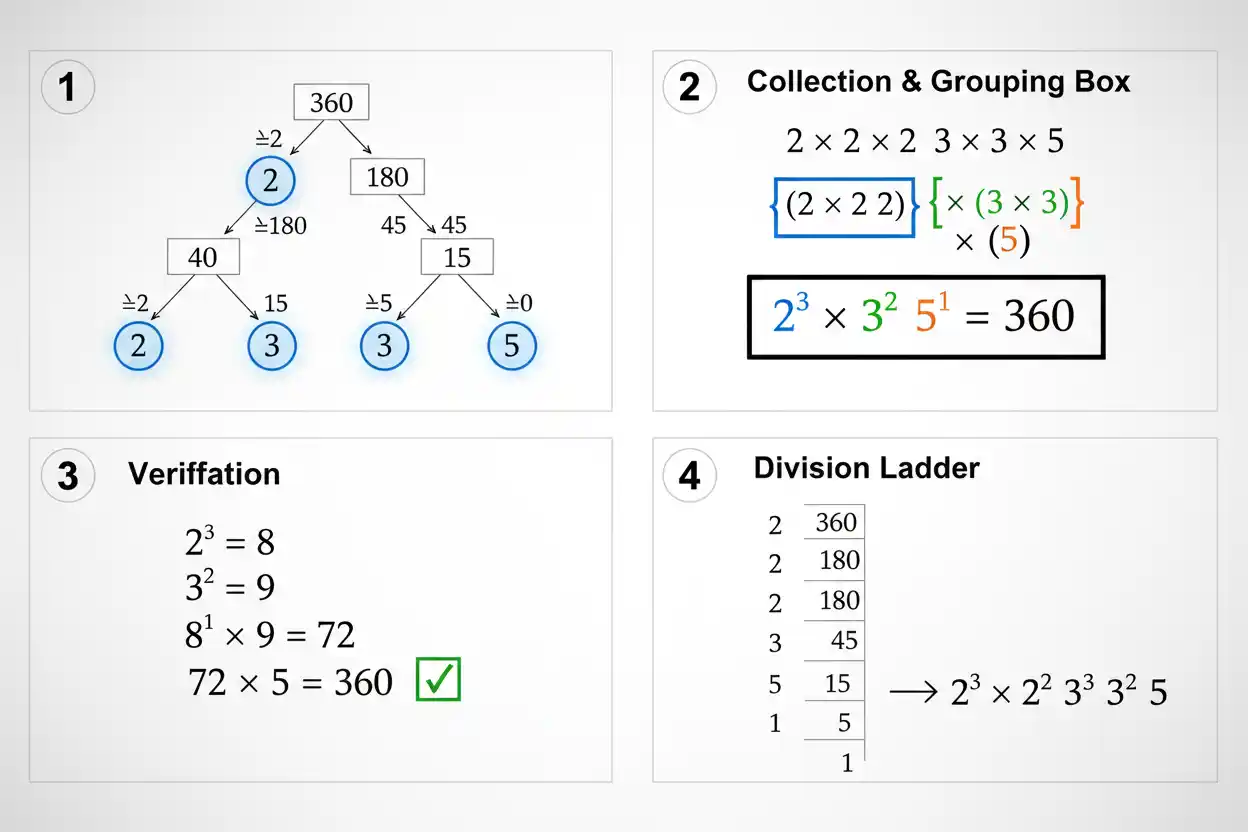

Prime factorization expresses a positive integer greater than 1 as a product of prime numbers.
For example:
60 = 2 × 2 × 3 × 5
Using exponents:
60 = 2² × 3 × 5
Because 2, 3, and 5 are all prime, this is the prime factorization of 60.
In general, every integer:
n > 1
can be represented as:
n = p₁^a₁ × p₂^a₂ × … × pₖ^aₖ
where each p is a distinct prime number and each exponent is a positive integer.
Apart from the order of the prime factors, this representation is unique. This property makes prime factorization one of the central tools in arithmetic and number theory.
What Is Prime Factorization?
A factor of a number divides it exactly.
A prime factor is a factor that is also prime.
Prime factorization repeatedly breaks a composite integer into smaller factors until every remaining factor is prime.
For:
84
one factorization is:
84 = 12 × 7
But 12 is composite.
Continue:
12 = 3 × 4
and:
4 = 2 × 2
Therefore:
84 = 2 × 2 × 3 × 7
or:
84 = 2² × 3 × 7
That final expression contains only primes.
Prime Factorization Formula
A positive integer greater than 1 can be written:
n = p₁^a₁p₂^a₂…pₖ^aₖ
where:
p₁, p₂, ..., pₖ are distinct primes
a₁, a₂, ..., aₖ are positive integer exponents
For example:
360 = 2³ × 3² × 5
because:
2³ = 8
3² = 9
and:
8 × 9 × 5 = 360
What Is a Prime Number?
A prime number is a positive integer greater than 1 with exactly two positive factors:
1
and:
itself
Examples include:
2, 3, 5, 7, 11, 13, 17, 19, …
Prime numbers are the indivisible building blocks used in prime factorization.
Composite Numbers
A composite number has more than two positive factors.
For example:
12
is composite because:
12 = 2 × 6
and:
12 = 3 × 4
Its prime factorization is:
12 = 2² × 3
The composite numbers page focuses on identifying and classifying such integers.
Is 1 Prime?
No.
The number:
1
has only one positive factor:
1
Therefore it is neither prime nor composite.
It also does not have an ordinary prime factorization consisting of positive prime factors.
This convention is essential for the uniqueness of prime factorization.
Is 0 Prime?
No.
Zero is divisible by every nonzero integer and does not satisfy the definition of a prime number.
Therefore the standard prime-factorization process on this page applies to:
positive integers greater than 1
Prime Factorization of a Prime Number
If p is itself prime, its prime factorization is simply:
p
For example:
13
cannot be broken into smaller positive prime factors.
Therefore:
Prime factorization of 13 = 13
Likewise:
97 = 97
if 97 has been verified to be prime.
Method 1: Factor Tree
A factor tree repeatedly splits composite numbers.
Find the prime factorization of:
72
Start:
72 = 8 × 9
Break 8:
8 = 2 × 4
and:
4 = 2 × 2
Break 9:
9 = 3 × 3
So:
72 = 2 × 2 × 2 × 3 × 3
Combine repeated factors:
72 = 2³ × 3²
Different Factor Trees Give the Same Prime Factors
Instead of:
72 = 8 × 9
you could begin:
72 = 6 × 12
Then:
6 = 2 × 3
12 = 3 × 4
4 = 2 × 2
Again:
72 = 2 × 2 × 2 × 3 × 3
Therefore:
72 = 2³ × 3²
The intermediate tree may differ, but the final prime factorization does not.
Method 2: Repeated Division
Prime factorization can also be found by repeatedly dividing by the smallest prime factor.
Factor:
180
Divide by 2:
180 ÷ 2 = 90
Again:
90 ÷ 2 = 45
45 is not divisible by 2, so try 3:
45 ÷ 3 = 15
Again:
15 ÷ 3 = 5
Finally:
5 ÷ 5 = 1
The prime divisors used were:
2, 2, 3, 3, 5
Therefore:
180 = 2² × 3² × 5
Why Start With Small Primes?
Trying primes in increasing order makes the process systematic.
The first primes are:
2, 3, 5, 7, 11, …
If the current number is divisible by 2, remove factors of 2.
Then test 3.
Continue until the remaining quotient is 1 or is itself prime.
Divisibility rules can make many of these tests quicker.
Divisibility by 2
A decimal integer is divisible by 2 if its final digit is even:
0, 2, 4, 6, or 8
For example:
1,344
is even.
Repeatedly divide:
1,344 ÷ 2 = 672
672 ÷ 2 = 336
336 ÷ 2 = 168
168 ÷ 2 = 84
84 ÷ 2 = 42
42 ÷ 2 = 21
Thus:
1,344 = 2⁶ × 21
and:
21 = 3 × 7
Therefore:
1,344 = 2⁶ × 3 × 7
Divisibility by 3
A decimal integer is divisible by 3 if its digit sum is divisible by 3.
For:
567
digit sum:
5 + 6 + 7 = 18
Since 18 is divisible by 3, so is 567.
Divide:
567 ÷ 3 = 189
189 ÷ 3 = 63
63 ÷ 3 = 21
21 ÷ 3 = 7
Therefore:
567 = 3⁴ × 7
Example: Prime Factorization of 1,000
Start:
1,000 = 10 × 100
Use:
10 = 2 × 5
and:
100 = 2² × 5²
Therefore:
1,000 = 2³ × 5³
So:
1,000 = 2³ × 5³
Check:
8 × 125 = 1,000
Example: Prime Factorization of 756
Divide by 2:
756 ÷ 2 = 378
Again:
378 ÷ 2 = 189
Now divide by 3:
189 ÷ 3 = 63
63 ÷ 3 = 21
21 ÷ 3 = 7
7 is prime.
Therefore:
756 = 2² × 3³ × 7
So:
756 = 2² × 3³ × 7
Exponent Notation
Repeated prime factors are usually condensed with exponents.
Instead of:
2 × 2 × 2 × 3 × 3 × 5
write:
2³ × 3² × 5
The exponent tells how many copies of the prime occur.
For example:
2⁴
means:
2 × 2 × 2 × 2
The ordinary rules are explained under exponents.
Fundamental Theorem of Arithmetic
Every integer greater than 1 can be expressed as a product of prime numbers in exactly one way, apart from the order of those prime factors.
For example:
180 = 2² × 3² × 5
You can rearrange the factors:
5 × 3 × 2 × 3 × 2
but you cannot produce a genuinely different set of prime factors whose product is also 180.
This uniqueness is why prime factorization can serve as a canonical representation of integer multiplicative structure.
Prime Factorization and Factors
Once the prime factorization is known, factors can be generated systematically.
Suppose:
N = 2³ × 3²
Any positive divisor has the form:
2^a × 3^b
where:
0 ≤ a ≤ 3
and:
0 ≤ b ≤ 2
Choosing different allowable exponents produces every positive factor exactly once.
Number of Positive Factors
If:
N = p₁^a₁p₂^a₂…pₖ^aₖ
then the number of positive factors is:
(a₁+1)(a₂+1)…(aₖ+1)
For example:
72 = 2³ × 3²
Number of positive factors:
(3+1)(2+1)
= 4 × 3
= 12
Therefore:
72 has 12 positive factors
Why the Factor-Count Formula Works
For factor:
2³
a divisor can use:
2⁰, 2¹, 2², or 2³
giving:
4 choices
For:
3²
a divisor can use:
3⁰, 3¹, or 3²
giving:
3 choices
Every choice for the power of 2 can be paired with every choice for the power of 3.
Therefore:
4 × 3 = 12
positive divisors.
Common Factors From Prime Factorization
Suppose:
72 = 2³ × 3²
and:
120 = 2³ × 3 × 5
A common factor can use only prime powers available in both numbers.
The shared primes are:
2 and 3
The maximum common exponents available simultaneously are:
2³
and:
3¹
This leads directly to the greatest common factor.
GCF Using Prime Factorization
To find the greatest common factor, use common primes with the smallest exponent appearing in either factorization.
For:
72 = 2³ × 3²
120 = 2³ × 3 × 5
take:
2³
and:
3¹
Therefore:
GCF = 2³ × 3
= 8 × 3
= 24
So:
GCF(72,120) = 24
LCM Using Prime Factorization
To find the least common multiple, use every prime appearing in either factorization with the largest required exponent.
For:
72 = 2³ × 3²
120 = 2³ × 3 × 5
take:
2³ × 3² × 5
Calculate:
8 × 9 × 5
= 360
Therefore:
LCM(72,120) = 360
GCF and LCM Comparison
Prime factorization makes the difference easy to remember:
GCF → minimum exponents
LCM → maximum exponents
For the same pair:
72 = 2³ × 3²
120 = 2³ × 3¹ × 5¹
GCF:
2³ × 3¹ = 24
LCM:
2³ × 3² × 5¹ = 360
Fraction Simplification
Prime factorization can reveal common factors in fractions.
Consider:
84/126
Factor:
84 = 2² × 3 × 7
126 = 2 × 3² × 7
Cancel common factors:
2 × 3 × 7
leaving:
2/3
Therefore:
84/126 = 2/3
This is the structural basis of fraction simplification.
Perfect Square Test
Prime factorization provides a complete test for perfect squares.
A positive integer is a perfect square exactly when every prime exponent is even.
For example:
900 = 2² × 3² × 5²
Every exponent is even.
Therefore:
900 is a perfect square
and:
√900 = 2 × 3 × 5
= 30
Perfect Cube Test
A positive integer is a perfect cube exactly when every prime exponent is divisible by 3.
For:
1,728 = 2⁶ × 3³
both:
6 and 3
are divisible by 3.
Therefore:
1,728 is a perfect cube
and:
∛1,728 = 2² × 3
= 12
Simplifying Square Roots
Suppose:
√72
Factor:
72 = 2³ × 3²
Separate complete square factors:
72 = 2² × 3² × 2
Therefore:
√72 = 2 × 3 × √2
= 6√2
Prime factorization identifies exactly which pairs can leave the square root.
Simplifying Cube Roots
Consider:
∛432
Factor:
432 = 2⁴ × 3³
Separate complete groups of three:
= 2³ × 3³ × 2
Therefore:
∛432 = 2 × 3 × ∛2
= 6∛2
The same principle extends to general nth roots: groups of n equal prime factors can leave an nth root.
Prime Factorization and Proportion
A proportion compares equivalent ratios.
Prime factorization can help simplify the ratios before testing equivalence.
Suppose:
84/126 = 20/30
Simplify the first using common prime factors:
84/126 = 2/3
Simplify the second:
20/30 = 2/3
Therefore the ratios are equal and form a valid proportion.
Prime factorization is not required for every proportion, but it can expose common multiplicative structure.
Prime Factorization in Permutations and Combinations
Factorials appearing in permutations and combinations can become very large.
Prime factorization can help analyze or simplify expressions such as:
n!/[r!(n-r)!]
For example:
10C5 = 252
and:
252 = 2² × 3² × 7
The factorization can be useful for divisibility questions about the combinatorial result without expanding more complicated products unnecessarily.
Prime Factorization in Permutations
The permutations formula:
nPr = n!/(n-r)!
reduces to a product of consecutive integers.
Those integers can themselves be prime-factorized when divisibility or exact factor structure matters.
For example:
8P3 = 8 × 7 × 6
Factor:
8 = 2³
6 = 2 × 3
Therefore:
8P3 = 2⁴ × 3 × 7
The numerical value is:
336
Prime Factorization and Permutation Rank
A permutation rank uses factorial weights such as:
4!, 3!, 2!, 1!
Prime factorization can analyze those factorial values, but it does not determine the rank directly.
Ranking depends on how many smaller unused elements are skipped at each position.
Thus prime factorization concerns the multiplicative structure of the factorial weights, while permutation ranking concerns their combinatorial use.
Is Prime Factorization Unique?
Yes, for every integer greater than 1, except for reordering the same prime factors.
For example:
90 = 2 × 3² × 5
You could write:
5 × 3 × 2 × 3
but this contains exactly the same prime factors and exponents.
There is no second genuinely different prime decomposition of 90.
Negative Integers
For a negative integer, separate the sign first.
For example:
-60
can be written:
-1 × 2² × 3 × 5
The positive magnitude:
60
has the ordinary prime factorization.
Because -1 is not prime, it is treated as a unit/sign factor rather than one of the positive prime factors.
Prime Factorization of Powers
Suppose:
n = 12
with:
12 = 2² × 3
Then:
12³ = (2² × 3)³
Apply exponent rules:
= 2⁶ × 3³
Therefore:
12³ = 2⁶ × 3³
Raising an integer to a power multiplies every exponent in its prime factorization by that power.
Product of Two Factorized Numbers
Suppose:
a = 2³ × 3
and:
b = 2 × 5²
Then:
ab = 2⁴ × 3 × 5²
Exponents on common primes add.
This follows from:
2³ × 2¹ = 2⁴
Prime-factor notation therefore makes multiplication particularly transparent.
Quotient of Factorized Integers
If division is exact, subtract prime exponents.
For example:
2⁷ × 3⁴
divided by:
2³ × 3
gives:
2^(7-3) × 3^(4-1)
= 2⁴ × 3³
This method can simplify large exact quotients without expanding the numbers first.
How Far Do You Need to Test for Prime Factors?
If an integer N has a composite factorization:
N = ab
and both:
a > √N
and:
b > √N
then their product would exceed N.
Therefore any composite integer must have at least one factor not exceeding:
√N
When testing whether a remaining quotient is prime, it is sufficient to test prime divisors up to its square root.
This principle is also central to practical prime-number testing.
Example: Factor 221
Test small primes.
Not divisible by 2.
Digit sum:
2 + 2 + 1 = 5
so not divisible by 3.
It does not end in 0 or 5.
Try 7:
221 ÷ 7
is not an integer.
Try 11:
221 ÷ 11
is not an integer.
Try 13:
221 ÷ 13 = 17
Both:
13 and 17
are prime.
Therefore:
221 = 13 × 17
Example: Factor 323
Check primes.
323 is odd.
Digit sum:
3 + 2 + 3 = 8
so not divisible by 3.
Not divisible by 5.
Try 7, 11, 13.
Then:
323 ÷ 17 = 19
Therefore:
323 = 17 × 19
Both factors are prime.
Factor Tree Verification
Suppose a factor tree gives:
504 = 2³ × 3² × 7
Check by multiplication:
2³ = 8
3² = 9
Then:
8 × 9 × 7
= 72 × 7
= 504
The original number is recovered.
Multiplying the final prime factors is the simplest verification.
Common Mistake: Stopping at Composite Factors
Suppose:
60 = 6 × 10
This is a factorization, but not a prime factorization because:
6 and 10
are composite.
Continue:
6 = 2 × 3
10 = 2 × 5
Therefore:
60 = 2² × 3 × 5
Every final factor must be prime.
Common Mistake: Treating 1 as Prime
Writing:
12 = 1 × 2² × 3
does not add useful prime structure.
The number:
1
is not prime.
Prime factorization uses primes greater than 1.
Common Mistake: Forgetting Repeated Prime Factors
For:
72
writing:
2 × 3
is incomplete.
The complete factorization is:
2³ × 3²
because:
2 × 3 = 6
not 72.
Every repeated prime factor must be represented, usually through exponents.
Common Mistake: Assuming a Factor Tree’s First Split Must Be Prime
You may begin:
72 = 8 × 9
even though both factors are composite.
The important requirement is that splitting continues until every terminal factor is prime.
Different valid starting splits lead to the same final prime decomposition.
Common Mistake: Confusing Factors and Prime Factors
For:
60
some factors include:
1,2,3,4,5,6,10,12,15,20,30,60
But its prime factors are only:
2,3,5
with multiplicities represented as:
2² × 3 × 5
A factor need not be prime.
Common Mistake: Thinking Prime Factorization Applies Only to Even Numbers
Odd composite numbers also have prime factorizations.
For example:
315
is odd.
Factor:
315 = 3² × 5 × 7
Every integer greater than 1 has a prime factorization regardless of parity.
How to Check Prime Factorization
Suppose:
840 = 2³ × 3 × 5 × 7
First verify every listed factor is prime.
Then multiply:
2³ = 8
8 × 3 = 24
24 × 5 = 120
120 × 7 = 840
The original number is recovered.
Therefore the factorization is correct.
Frequently Asked Questions
What is prime factorization?
Prime factorization expresses an integer greater than 1 as a product of prime numbers.
What is the general prime-factorization form?
n = p₁^a₁ × p₂^a₂ × … × pₖ^aₖ
What is the prime factorization of 12?
12 = 2² × 3
What is the prime factorization of 24?
24 = 2³ × 3
What is the prime factorization of 36?
36 = 2² × 3²
What is the prime factorization of 60?
60 = 2² × 3 × 5
What is the prime factorization of 100?
100 = 2² × 5²
Does a prime number have a prime factorization?
Yes. Its factorization is the prime number itself.
For example:
13 = 13
Does 1 have a prime factorization?
Not in the ordinary positive-prime sense. One is neither prime nor composite.
Is prime factorization unique?
Yes, apart from the order in which the prime factors are written.
How does prime factorization help find GCF?
Use shared primes with the smallest exponents.
How does prime factorization help find LCM?
Use every required prime with the largest exponent.
How do you know if a number is a perfect square from its prime factorization?
Every prime exponent must be even.
How do you know if a number is a perfect cube?
Every prime exponent must be divisible by 3.
Final Example
Find the prime factorization of:
9,240
Start with 2:
9,240 ÷ 2 = 4,620
Again:
4,620 ÷ 2 = 2,310
Again:
2,310 ÷ 2 = 1,155
So far:
9,240 = 2³ × 1,155
Now divide 1,155 by 3:
Digit sum:
1 + 1 + 5 + 5 = 12
so it is divisible by 3.
1,155 ÷ 3 = 385
Now:
385 ÷ 5 = 77
and:
77 = 7 × 11
Therefore:
9,240 = 2³ × 3 × 5 × 7 × 11
Check:
8 × 3 × 5 × 7 × 11
= 24 × 5 × 7 × 11
= 120 × 77
= 9,240
The original number is recovered.
The defining idea of prime factorization is straightforward:
break a composite integer into factors until every remaining factor is prime
and then write repeated primes compactly with exponents.
Because the resulting prime decomposition is unique for every integer greater than 1, it provides a reliable foundation for studying factors, divisibility, GCF, LCM, roots, perfect powers, and many other number-theory relationships.