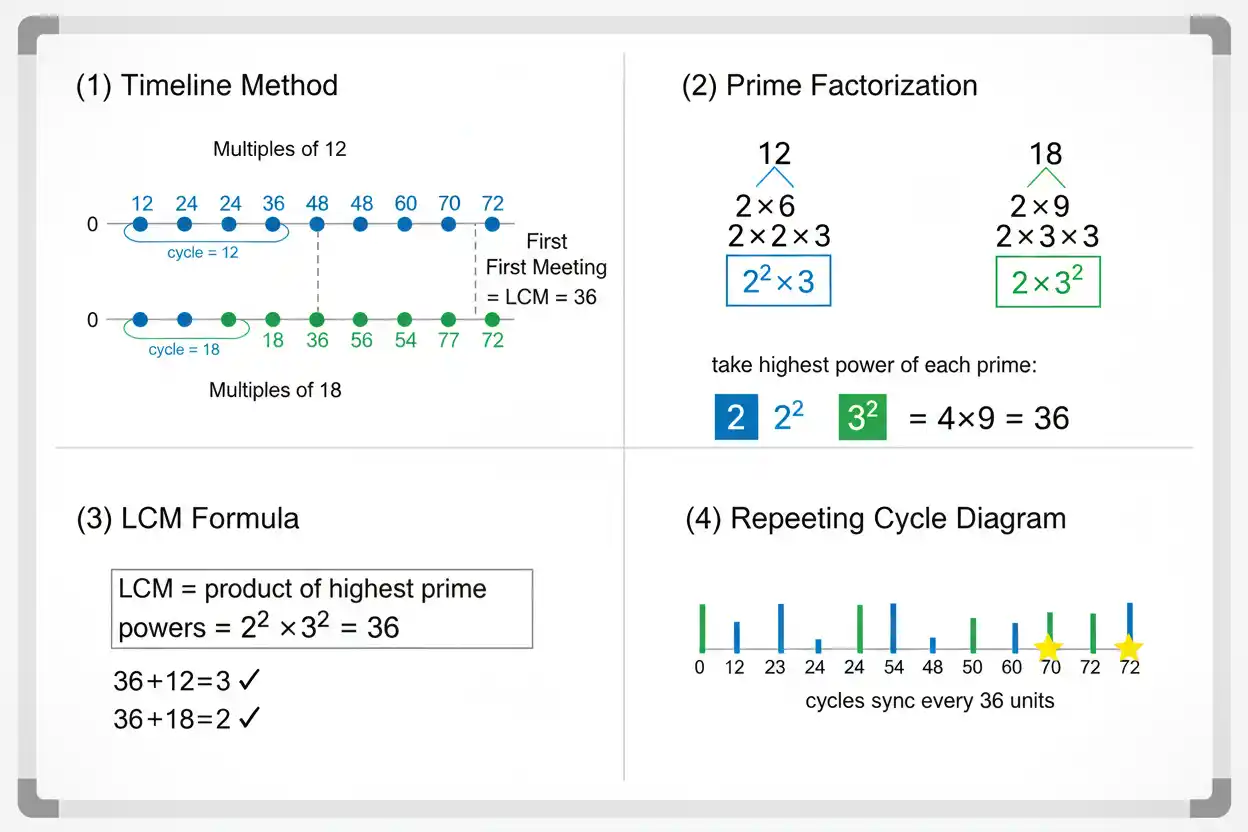

The least common multiple of two or more integers is the smallest positive integer that is divisible by every number in the group.
For example, consider:
6 and 8
Multiples of 6 include:
6, 12, 18, 24, 30, …
Multiples of 8 include:
8, 16, 24, 32, …
The smallest positive value appearing in both lists is:
24
Therefore:
LCM(6,8) = 24
The least common multiple is used to find common denominators, synchronize repeating cycles, solve divisibility problems, and identify the smallest quantity that can be divided exactly into several specified group sizes.
The shorter LCM page focuses on the abbreviation and core meaning, while this page develops the calculation methods, formulas, rules, and examples.
What Is the Least Common Multiple?
For positive integers a and b, their least common multiple is the smallest positive integer m such that:
a divides m
and:
b divides m
Equivalently:
m mod a = 0
and:
m mod b = 0
For example, take:
12 and 15
Multiples of 12:
12, 24, 36, 48, 60, …
Multiples of 15:
15, 30, 45, 60, …
The first shared positive multiple is:
60
Therefore:
LCM(12,15) = 60
This belongs to the broader study of arithmetic and number theory.
Least Common Multiple Formula Using GCF
For positive integers a and b:
LCM(a,b) × GCF(a,b) = a × b
Therefore:
LCM(a,b) = (a × b) / GCF(a,b)
For example, find:
LCM(18,24)
First determine:
GCF(18,24) = 6
Then:
LCM(18,24) = (18 × 24) / 6
= 432 / 6
= 72
Therefore:
LCM(18,24) = 72
The greatest common factor removes the duplicated common-factor structure from the product.
Why the GCF Formula Works
Suppose two integers share prime factors.
Multiplying them directly counts those shared factors twice.
The GCF contains exactly the prime-factor overlap that has been duplicated.
Dividing:
a × b
by:
GCF(a,b)
removes one copy of the overlap and leaves the minimum integer containing enough factors to be divisible by both numbers.
For example:
12 = 2² × 3
18 = 2 × 3²
The raw product contains:
2³ × 3³
But the GCF is:
2 × 3 = 6
Divide away one shared copy:
(2³ × 3³)/(2 × 3)
= 2² × 3²
= 36
Therefore:
LCM(12,18) = 36
Method 1: Find the LCM by Listing Multiples
For small integers, listing multiples can be the simplest method.
Find:
LCM(4,10)
Multiples of 4:
4, 8, 12, 16, 20, 24, …
Multiples of 10:
10, 20, 30, 40, …
The first shared value is:
20
Therefore:
LCM(4,10) = 20
This method is intuitive, but it becomes inefficient when the numbers or their LCM are large.
Example: LCM of 8 and 12 by Listing Multiples
Multiples of 8:
8, 16, 24, 32, 40, …
Multiples of 12:
12, 24, 36, 48, …
The first common multiple is:
24
Therefore:
LCM(8,12) = 24
Method 2: Use Prime Factorization
A systematic way to find the least common multiple is through prime factorization.
For example:
24 = 2³ × 3
36 = 2² × 3²
To form the LCM, take every prime appearing in either factorization using the largest exponent required.
For 2:
max(3,2) = 3
For 3:
max(1,2) = 2
Therefore:
LCM = 2³ × 3²
= 8 × 9
= 72
So:
LCM(24,36) = 72
Prime Factorization Formula
Suppose:
a = p₁^α₁ × p₂^α₂ × … × pₖ^αₖ
and:
b = p₁^β₁ × p₂^β₂ × … × pₖ^βₖ
where an exponent may be zero if a prime does not occur in one number.
Then:
LCM(a,b) = p₁^max(α₁,β₁) × p₂^max(α₂,β₂) × … × pₖ^max(αₖ,βₖ)
The largest exponent is necessary because the LCM must contain enough copies of every prime to include each original number as a factor.
Example: LCM of 72 and 120
Prime-factorize:
72 = 2³ × 3²
120 = 2³ × 3 × 5
Use the greatest exponent of each prime:
For 2:
2³
For 3:
3²
For 5:
5
Therefore:
LCM = 2³ × 3² × 5
= 8 × 9 × 5
= 360
So:
LCM(72,120) = 360
Check:
360 ÷ 72 = 5
360 ÷ 120 = 3
Both divisions are exact.
Method 3: Use the GCF
If the GCF is easy to determine, the formula:
LCM(a,b) = |ab| / GCF(a,b)
is often faster than listing multiples.
Find:
LCM(84,126)
From the GCF calculation:
GCF(84,126) = 42
Then:
LCM = (84 × 126)/42
Simplify before multiplying:
126/42 = 3
So:
LCM = 84 × 3
= 252
Therefore:
LCM(84,126) = 252
Checking simplification before multiplying can keep the arithmetic smaller.
LCM of Coprime Numbers
If:
GCF(a,b) = 1
then:
LCM(a,b) = a × b
For example:
8 and 15
have no positive common factors greater than 1.
Therefore:
LCM(8,15) = 8 × 15
= 120
So:
LCM(8,15) = 120
This product rule works automatically only when the numbers are coprime.
LCM of Two Prime Numbers
If p and q are distinct prime numbers:
LCM(p,q) = pq
For example:
LCM(7,11) = 77
because the two distinct primes share no factor greater than 1.
If the same prime is repeated:
LCM(7,7) = 7
not 49.
When One Number Divides the Other
Suppose:
8 and 40
Since:
40 ÷ 8 = 5
40 is already a multiple of both values.
Therefore:
LCM(8,40) = 40
In general, if:
a divides b
then:
LCM(a,b) = |b|
when b has the larger magnitude.
LCM of Equal Numbers
For any positive integer a:
LCM(a,a) = a
For example:
LCM(27,27) = 27
The original number is already the smallest positive quantity divisible by both copies.
LCM of Three Numbers
The least common multiple extends naturally to three or more integers.
Find:
LCM(6,8,15)
Prime factorizations:
6 = 2 × 3
8 = 2³
15 = 3 × 5
Take the highest required powers:
2³
3¹
5¹
Therefore:
LCM = 8 × 3 × 5
= 120
So:
LCM(6,8,15) = 120
Check:
120 ÷ 6 = 20
120 ÷ 8 = 15
120 ÷ 15 = 8
LCM of Four Numbers
Find:
LCM(4,6,10,15)
Prime factorizations:
4 = 2²
6 = 2 × 3
10 = 2 × 5
15 = 3 × 5
Use:
2² × 3 × 5
Therefore:
LCM = 4 × 3 × 5
= 60
So:
LCM(4,6,10,15) = 60
Pairwise LCM Method
Another way to handle several numbers is to find the LCM progressively.
For:
8,12,18
First:
LCM(8,12) = 24
Then:
LCM(24,18) = 72
Therefore:
LCM(8,12,18) = 72
The grouping does not alter the final LCM.
LCM and Factors
A number m is a multiple of a exactly when a is one of its factors.
For example:
60
is a multiple of 12 because:
12 is a factor of 60
and:
60 ÷ 12 = 5
Therefore an LCM must contain every input integer in its divisor structure.
LCM and Divisibility Rules
Divisibility rules can help verify whether a proposed LCM is actually divisible by its inputs.
Suppose:
LCM(9,12) = 36
Check 9:
3 + 6 = 9
so 36 is divisible by 9.
Check 12:
36 is divisible by 3, and its final two digits:
36
are divisible by 4.
Therefore 36 is divisible by 12.
A verification step establishes that a value is a common multiple, although additional reasoning is needed to confirm that it is the least one.
LCM and Fraction Addition
One of the most common applications is finding a common denominator in fraction operations.
Calculate:
5/12 + 7/18
Find:
LCM(12,18) = 36
Rewrite:
5/12 = 15/36
7/18 = 14/36
Then:
15/36 + 14/36 = 29/36
Therefore:
5/12 + 7/18 = 29/36
Using the LCM gives the least common denominator.
Why the Least Common Denominator Helps
Any common multiple of denominators can be used for addition or subtraction.
For 12 and 18:
216
is a common multiple because:
216 = 12 × 18
But:
36
is their least common multiple.
Using 36 keeps the converted numerators and denominator much smaller.
This reduces arithmetic and often lowers the chance of errors.
LCM and Fraction Simplification
The LCM is generally used to build common denominators, while fraction simplification typically uses a GCF.
For example:
1/8 + 1/12
LCM:
LCM(8,12) = 24
So:
1/8 = 3/24
1/12 = 2/24
Add:
5/24
Now:
GCF(5,24) = 1
so no simplification is required.
LCM and GCF therefore often appear in different stages of the same fraction problem.
LCM and Repeating Schedules
Suppose one event repeats every:
6 days
and another every:
8 days
If both happen today, the number of days until they occur together again is:
LCM(6,8)
= 24
Therefore:
They coincide again after 24 days
This assumes both continue at fixed integer intervals.
Example: Traffic Lights
Suppose one signal completes a cycle every:
45 seconds
and another every:
60 seconds
Find:
LCM(45,60)
Prime factorizations:
45 = 3² × 5
60 = 2² × 3 × 5
Use maximum exponents:
2² × 3² × 5
= 4 × 9 × 5
= 180
Therefore:
The cycles realign after 180 seconds
or:
3 minutes
Example: Maintenance Cycles
Machine A requires maintenance every:
12 days
Machine B every:
18 days
Machine C every:
30 days
Find:
LCM(12,18,30)
Prime factorizations:
12 = 2² × 3
18 = 2 × 3²
30 = 2 × 3 × 5
Use:
2² × 3² × 5
= 180
Therefore all three maintenance intervals align every:
180 days
assuming the cycles start together.
LCM and Lattice Patterns
Lattice points use integer-coordinate structure, and LCM can describe when independent periodic patterns on a grid line up.
Suppose vertical markers repeat every:
6 units
and another set every:
10 units
The first positive location shared by both periodic patterns is:
LCM(6,10)
= 30
So their positions align every:
30 grid units
This differs from counting lattice points along a segment, where the greatest common divisor is usually the relevant quantity.
LCM and Long Division
long division can verify that an LCM candidate divides exactly by each input.
For example, if:
LCM(28,45) = 1260
then checking:
1260 ÷ 28 = 45
and:
1260 ÷ 45 = 28
confirms exact divisibility.
Long division is not normally the primary method for finding an LCM, but it can support verification when the quotients are not immediately obvious.
Least Common Multiple and Integer Operations
LCM operates on integer multiples, so integer operations underlie its arithmetic.
For positive a:
a, 2a, 3a, 4a, …
are positive multiples generated by integer multiplication.
For example:
Multiples of 14 = 14,28,42,56,…
Each value has the form:
14k
for a positive integer k.
Negative Inputs
LCM is conventionally reported as nonnegative.
For example:
LCM(-6,8) = 24
because the divisibility structure depends on magnitudes:
|-6| = 6
|8| = 8
A practical calculation therefore uses:
LCM(|a|,|b|)
for nonzero integer inputs.
LCM and Zero
A common convention is:
LCM(a,0) = 0
for nonzero integer a.
This differs from the usual “smallest positive common multiple” wording because there is no positive multiple of zero.
In elementary exercises, LCM problems are therefore often restricted to positive integers.
When zero is included, follow the convention stated in the problem or system being used.
LCM Is Not Usually an Irrational-Number Operation
The ordinary least common multiple is defined in integer divisibility.
An irrational number such as:
√2
does not fit the usual integer-factor and integer-multiple framework.
So while:
LCM(6,8) = 24
is a standard number-theory question, an expression such as:
LCM(√2,π)
is outside the ordinary elementary definition used here.
LCM Does Not Require Logarithms
The mapped concept of logarithms belongs to exponential relationships rather than integer common multiples.
For ordinary LCM calculations, prime factorization, the GCF identity, or multiple lists are appropriate.
For example:
LCM(16,24)
requires integer factor structure:
16 = 2⁴
24 = 2³ × 3
so:
LCM = 2⁴ × 3 = 48
No logarithmic transformation is needed.
Common Mistake: Multiplying the Numbers Automatically
Consider:
12 and 18
Their product is:
216
But:
LCM(12,18) = 36
The raw product counts common factors multiple times.
The product equals the LCM automatically only when the numbers are coprime.
Common Mistake: Using the Smallest Prime Exponents
For an LCM, use the largest exponent of every prime appearing.
For:
24 = 2³ × 3
36 = 2² × 3²
using smaller exponents would give:
2² × 3 = 12
That is the GCF, not the LCM.
The correct LCM is:
2³ × 3² = 72
Common Mistake: Choosing a Common Multiple That Is Not the Least
For:
6 and 9
the value:
36
is a common multiple.
But:
18
is also divisible by both and is smaller.
Therefore:
LCM(6,9) = 18
Finding a common multiple does not necessarily find the least common multiple.
Common Mistake: Confusing Factors and Multiples
For:
8 and 12
the value:
4
is a common factor.
The value:
24
is a common multiple.
Factors divide the starting numbers.
Multiples are divisible by the starting numbers.
The least common multiple points upward through the multiple lists, while the greatest common factor points downward through divisor lists.
How to Check an LCM Answer
Suppose the proposed result is:
LCM(20,30) = 60
First verify:
60 ÷ 20 = 3
60 ÷ 30 = 2
So 60 is a common multiple.
Now check the prime structure:
20 = 2² × 5
30 = 2 × 3 × 5
The minimum structure capable of containing both is:
2² × 3 × 5
= 60
Therefore no smaller positive common multiple can satisfy all requirements.
Frequently Asked Questions
What is the least common multiple?
The least common multiple is the smallest positive integer divisible by every integer in a given group.
What is the formula for LCM?
For positive integers:
LCM(a,b) = (a × b)/GCF(a,b)
What is the LCM of 6 and 8?
24
What is the LCM of 12 and 18?
36
What is the LCM of 8 and 12?
24
How do you find the LCM with prime factorization?
Prime-factorize each number and use every prime that appears with its largest required exponent.
How do you find the LCM by listing multiples?
Write positive multiples of each number until the first shared value appears.
What happens when the numbers are coprime?
Their LCM equals their product.
For example:
LCM(8,15) = 120
What happens if one number divides the other?
The larger magnitude is the LCM.
For example:
LCM(6,24) = 24
What is the difference between LCM and GCF?
LCM is the smallest shared positive multiple. GCF is the largest shared positive divisor.
Why is LCM useful with fractions?
It provides the least common denominator for adding or subtracting fractions with different denominators.
Can you find the LCM of more than two numbers?
Yes. Use prime factorization or combine the numbers progressively.
Final Example
Find:
LCM(84,120,150)
Prime-factorize each number:
84 = 2² × 3 × 7
120 = 2³ × 3 × 5
150 = 2 × 3 × 5²
Take the largest exponent of every prime appearing.
For 2:
2³
For 3:
3¹
For 5:
5²
For 7:
7¹
Therefore:
LCM = 2³ × 3 × 5² × 7
Calculate:
8 × 3 × 25 × 7
= 24 × 175
= 4,200
Check:
4,200 ÷ 84 = 50
4,200 ÷ 120 = 35
4,200 ÷ 150 = 28
Every quotient is an integer.
Therefore:
LCM(84,120,150) = 4,200
The defining principle is consistent: construct the smallest positive integer containing enough prime-factor structure to be divisible by every number in the problem.