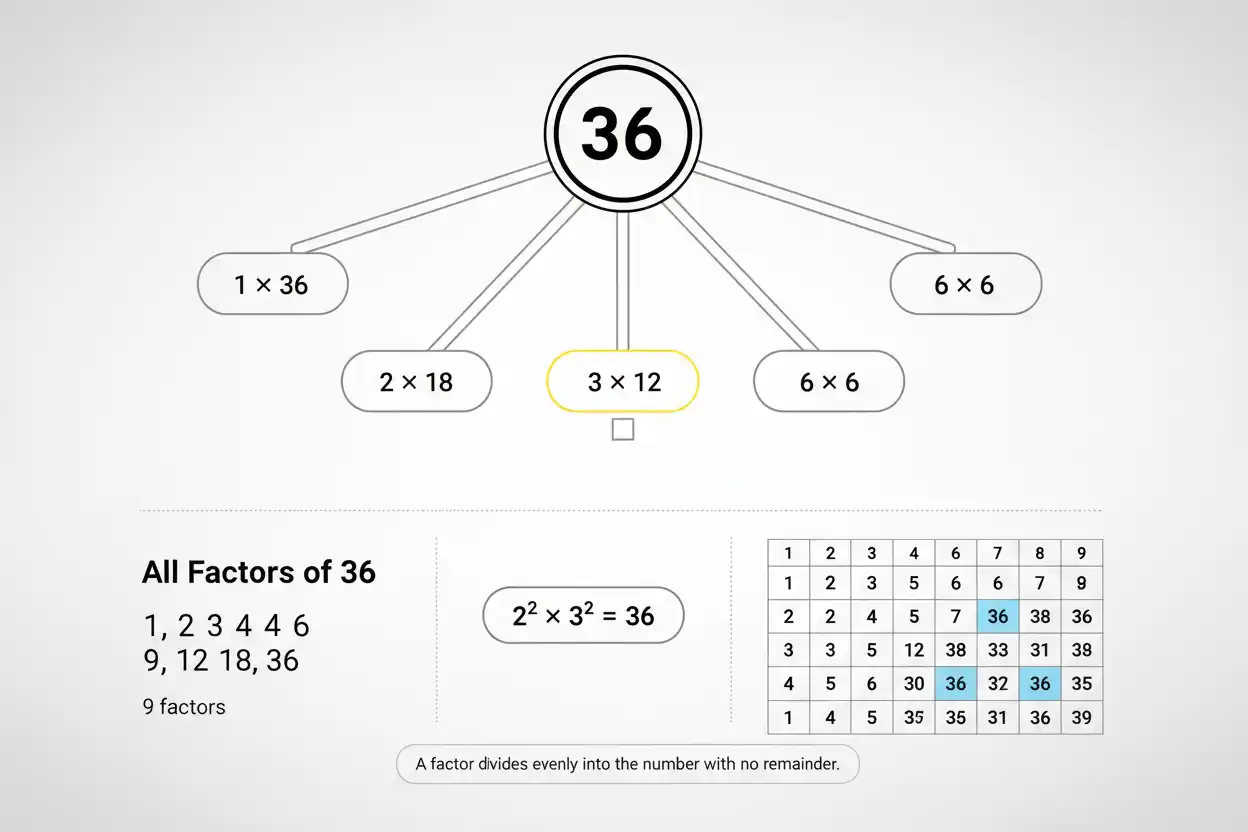

Factors are integers that divide another integer exactly without leaving a remainder. They can be written individually as a factor list or grouped into factor pairs whose products equal the original number.
For example, the positive factors of 12 are:
1, 2, 3, 4, 6, 12
They form the factor pairs:
1 × 12 = 12
2 × 6 = 12
3 × 4 = 12
So 12 has six positive factors and three positive factor pairs.
Factors are fundamental to arithmetic and number theory because they support divisibility, fraction reduction, prime factorization, greatest-common-factor calculations, and many other integer relationships.
What Is a Factor?
An integer d is a factor of an integer n when dividing n by d produces an integer with no remainder.
The condition can be written:
n mod d = 0
or:
n = d × q
where q is also an integer.
For example:
30 ÷ 5 = 6
Since the quotient is an integer:
5 is a factor of 30.
Likewise:
30 = 5 × 6
so both 5 and 6 belong to the factor list of 30.
Factor Pairs
A factor pair consists of two integers whose product equals the target number.
For 24:
1 × 24 = 24
2 × 12 = 24
3 × 8 = 24
4 × 6 = 24
Therefore, the positive factor pairs are:
(1, 24)
(2, 12)
(3, 8)
(4, 6)
Combining the entries from all pairs gives the complete positive factor list:
1, 2, 3, 4, 6, 8, 12, 24
How to Find Factors by Listing Pairs
For a relatively small positive integer, start with 1 and test possible divisors in increasing order.
Suppose we want the factors of:
40
Start with:
1 × 40 = 40
Then test 2:
2 × 20 = 40
Test 3:
40 ÷ 3
does not produce an integer.
Test 4:
4 × 10 = 40
Test 5:
5 × 8 = 40
Once the smaller member of a factor pair passes the square root of the target number, no new pairs remain.
Therefore:
Factors of 40 = 1, 2, 4, 5, 8, 10, 20, 40
Why You Only Need to Check Up to the Square Root
Suppose:
n = a × b
If both a and b were greater than √n, their product would be greater than n.
Therefore, every factor pair contains at least one member satisfying:
factor ≤ √n
For example:
√100 = 10
To find all factor pairs of 100, you only need to test possible smaller factors through 10.
The pairs are:
1 × 100
2 × 50
4 × 25
5 × 20
10 × 10
No new pair can begin with a number greater than 10.
Example: Factors of 36
Find the positive factors of 36.
Check possible divisors up to:
√36 = 6
The factor pairs are:
1 × 36
2 × 18
3 × 12
4 × 9
6 × 6
Therefore:
Factors of 36 = 1, 2, 3, 4, 6, 9, 12, 18, 36
Notice that 6 × 6 contributes only one distinct factor value, 6.
Factors of a Perfect Square
A perfect square has an odd number of positive factors.
Consider:
36 = 6²
Its factor pairs are:
1 × 36
2 × 18
3 × 12
4 × 9
6 × 6
Every pair normally contributes two distinct factors except the middle pair:
6 × 6
Because the two members are identical, the total number of positive factors is odd:
9 factors
This property applies to every positive perfect square.
Example: Factors of 48
Factor pairs of 48 are:
1 × 48
2 × 24
3 × 16
4 × 12
6 × 8
Therefore:
Factors of 48 = 1, 2, 3, 4, 6, 8, 12, 16, 24, 48
There are:
10 positive factors
Because 48 is not a perfect square, its factors pair into distinct partners.
Prime Numbers and Factors
A prime number has exactly two positive factors:
1 and itself
For example:
Factors of 13 = 1, 13
There are no additional positive integer divisors.
By contrast, composite numbers have more than two positive factors.
For 15:
Factors of 15 = 1, 3, 5, 15
so 15 is composite.
The factor list therefore provides a direct way to distinguish prime and composite integers.
The Factors of 1
The number 1 has only one positive factor:
1
Therefore:
Factors of 1 = {1}
This is why 1 is neither prime nor composite. A prime number requires exactly two positive factors, and a composite number requires more than two.
Factors of Zero
Zero behaves differently.
Every nonzero integer divides zero exactly because:
0 = d × 0
for any nonzero integer d.
Therefore zero has infinitely many nonzero integer factors.
However, zero itself cannot be used as a divisor because division by zero is undefined.
This is one reason ordinary factor-list exercises usually focus on positive integers.
Negative Factors
Integers also have negative factors.
For example:
12 = (-1)(-12)
12 = (-2)(-6)
12 = (-3)(-4)
So the integer factors of 12 include:
±1, ±2, ±3, ±4, ±6, ±12
In elementary factor-list problems, the word factors usually means positive factors unless negative factors are explicitly requested.
Factors vs. Multiples
Factors and multiples describe opposite relationships.
For 6, the positive factors are:
1, 2, 3, 6
Multiples of 6 begin:
6, 12, 18, 24, 30, 36, …
Factors divide a number exactly.
Multiples are created by multiplying the number by integers.
A fixed positive integer has finitely many positive factors but infinitely many positive multiples.
Factors and Divisibility Rules
Divisibility rules can make factor testing faster.
Suppose we want to know whether 3 is a factor of:
5,427
Add the digits:
5 + 4 + 2 + 7 = 18
Because 18 is divisible by 3:
5,427 is divisible by 3
Therefore:
3 is a factor of 5,427
Similarly, an even number greater than 2 automatically has 2 as a factor.
Factors and Prime Factorization
A complete factor list and a prime factorization represent different information about the same integer.
Consider:
60
Its prime factorization is:
60 = 2² × 3 × 5
Its positive factor list is:
1, 2, 3, 4, 5, 6, 10, 12, 15, 20, 30, 60
Prime factorization identifies the prime building blocks. The factor list identifies every positive integer divisor.
Finding the Number of Factors From Prime Factorization
Prime factorization provides an efficient formula for counting positive factors.
Suppose:
n = p^a × q^b × r^c
where p, q, and r are distinct primes.
Then:
Number of positive factors = (a + 1)(b + 1)(c + 1)
The same idea extends to any number of distinct prime factors.
Example: Number of Factors of 72
Prime-factorize:
72 = 2³ × 3²
A factor may use a power of 2 from:
2⁰, 2¹, 2², 2³
That gives:
4 choices
It may use a power of 3 from:
3⁰, 3¹, 3²
That gives:
3 choices
Therefore:
Number of factors = 4 × 3
= 12
So:
72 has 12 positive factors
Its factor list is:
1, 2, 3, 4, 6, 8, 9, 12, 18, 24, 36, 72
Why the Factor-Count Formula Works
For:
n = p^a × q^b
every factor must choose some allowable exponent for each prime.
For p, the exponent can be:
0 through a
giving:
a + 1 choices
For q, there are:
b + 1 choices
Each choice for p can be combined with each choice for q.
Therefore:
Total factors = (a + 1)(b + 1)
This is an application of the same multiplication principle used in combinatorics.
Factor Pairs From a Factor List
Once a factor list is known, pair the smallest and largest values.
For 60:
1 and 60
2 and 30
3 and 20
4 and 15
5 and 12
6 and 10
Each pair multiplies to:
60
Therefore, 60 has:
6 positive factor pairs
and:
12 positive factors
Because 60 is not a perfect square, every pair contains two distinct values.
Factors and Common Factors
A common factor divides two or more integers exactly.
For 18:
Factors = 1, 2, 3, 6, 9, 18
For 30:
Factors = 1, 2, 3, 5, 6, 10, 15, 30
The values appearing in both lists are:
1, 2, 3, 6
Therefore:
Common factors of 18 and 30 = 1, 2, 3, 6
The current page focuses on the factor list of an individual integer; common-factor problems compare multiple lists.
Factors and the Greatest Common Factor
From the previous example:
Common factors of 18 and 30 = 1, 2, 3, 6
The largest shared value is:
6
Therefore:
GCF(18, 30) = 6
The dedicated greatest common factor calculation focuses specifically on finding the largest shared factor rather than listing every divisor of each number.
The shorter GCF topic covers the named concept in its own assigned context.
Factors and the Euclidean Algorithm
For large integers, producing complete factor lists may be unnecessary when the goal is only to find a greatest common divisor.
The Euclidean algorithm uses repeated division and remainders instead.
For example:
84 = 30 × 2 + 24
30 = 24 × 1 + 6
24 = 6 × 4 + 0
Therefore:
GCD(84, 30) = 6
This finds the greatest common factor without listing every factor of 84 and 30.
Factors and Fraction Simplification
Factors are central to fraction simplification.
Consider:
18 / 24
Both numerator and denominator have 6 as a factor:
18 = 6 × 3
24 = 6 × 4
Divide both by 6:
18 / 24 = 3 / 4
The value of the fraction does not change because the numerator and denominator were divided by the same nonzero factor.
Factors and Fraction Operations
Factors also matter when performing fraction operations, particularly when simplifying intermediate or final results.
For example:
2/3 × 9/10
Multiply:
18/30
Since 6 is a common factor of 18 and 30:
18/30 = 3/5
Recognizing factors can often reduce the amount of arithmetic required.
Factors and Factorials
The terms factor and factorial should not be confused.
For the number 5:
Factors of 5 = 1, 5
But:
5! = 5 × 4 × 3 × 2 × 1 = 120
The dedicated factorial page explains the individual n! calculation, while factorials covers the wider sequence and structure of factorial values.
A factorial contains many factors, but a factorial is not itself a factor list.
Factors and Exponents
Exponents make repeated prime factors easier to write.
For example:
144 = 2⁴ × 3²
This exponent form immediately shows how possible divisors can be constructed.
A factor of 144 may contain:
2⁰ through 2⁴
and:
3⁰ through 3²
So the number of positive factors is:
(4 + 1)(2 + 1)
= 15
Exponent notation therefore helps organize factor structure efficiently.
Factors and the Fibonacci Sequence
Integers in the Fibonacci sequence have ordinary factor relationships like any other integers.
For example:
F₁₀ = 55
and:
55 = 5 × 11
Therefore the positive factors of 55 are:
1, 5, 11, 55
The sequence rule determines which number appears at a given Fibonacci position. Factor analysis then examines the divisors of that resulting integer.
Factors and Floor or Ceiling Functions
The floor and ceiling functions sometimes appear in efficient algorithms that count divisors or restrict search ranges.
For example, when testing potential factors, it can be useful to consider integers only through:
floor(√n)
because every factor pair has at least one member no greater than √n.
For:
n = 50
we have:
√50 ≈ 7.071
so:
floor(√50) = 7
Testing candidate divisors through 7 is enough to locate every positive factor pair.
Practical Example: Equal Rows
Suppose 36 chairs must be arranged in equal rows with no chairs left over.
The possible numbers of rows must be factors of 36:
1, 2, 3, 4, 6, 9, 12, 18, 36
For example:
4 rows × 9 chairs = 36
or:
6 rows × 6 chairs = 36
Every factor pair describes one possible rectangular arrangement.
Practical Example: Packaging
Suppose 48 items must be packed into equal-size boxes with no leftovers.
Possible numbers of boxes are the factors of 48:
1, 2, 3, 4, 6, 8, 12, 16, 24, 48
If there are 8 boxes:
48 ÷ 8 = 6
so each box contains 6 items.
If there are 12 boxes:
48 ÷ 12 = 4
so each contains 4 items.
The factor relationship ensures exact grouping.
Practical Example: Rectangular Dimensions
Suppose a rectangle must have an integer area of:
72 square units
Possible whole-number side-length pairs correspond to factor pairs of 72:
1 × 72
2 × 36
3 × 24
4 × 18
6 × 12
8 × 9
Each pair gives a possible pair of integer dimensions.
How to Find All Factors Efficiently
For a positive integer n, begin with 1 and test integers no larger than √n.
Whenever a candidate d divides n exactly:
n ÷ d = q
record both:
d and q
For example, with 84:
√84 ≈ 9.17
So test only:
1 through 9
Successful divisors are:
1, 2, 3, 4, 6, 7
Their partners are:
84, 42, 28, 21, 14, 12
Sort them:
1, 2, 3, 4, 6, 7, 12, 14, 21, 28, 42, 84
These are all positive factors of 84.
Common Factor-List Mistakes
A frequent mistake is listing only the smaller member of each factor pair.
For 24, stopping at:
1, 2, 3, 4
misses:
6, 8, 12, 24
Each successful divisor below the square root normally supplies a partner above the square root.
Another mistake is including a number that does not divide exactly.
For example:
5 is not a factor of 24
because:
24 ÷ 5 = 4.8
A third error is confusing factors with multiples.
Finally, when a number is a perfect square, the square-root factor should be listed only once.
For 49:
7 × 7 = 49
so 7 is one factor, not two separate entries.
How to Check a Factor
To verify that d is a factor of n, calculate:
n ÷ d
If the answer is an integer, d is a factor.
For example, test whether 14 is a factor of 98:
98 ÷ 14 = 7
Since 7 is an integer:
14 is a factor of 98
Now test 15:
98 ÷ 15 ≈ 6.533…
The result is not an integer:
15 is not a factor of 98
How to Check a Complete Factor List
Suppose the proposed factors of 20 are:
1, 2, 4, 5, 10, 20
Pair the outer entries:
1 × 20 = 20
2 × 10 = 20
4 × 5 = 20
Every entry belongs to a valid pair, and the smaller members cover all possible divisors through:
√20 ≈ 4.47
So the list is complete.
Frequently Asked Questions
What are factors?
Factors are integers that divide another integer exactly without leaving a remainder.
What is a factor pair?
A factor pair consists of two integers whose product equals the target number.
For 20:
1 × 20
2 × 10
4 × 5
are its positive factor pairs.
What are the factors of 12?
1, 2, 3, 4, 6, 12
What are the factors of 24?
1, 2, 3, 4, 6, 8, 12, 24
What are the factors of 36?
1, 2, 3, 4, 6, 9, 12, 18, 36
Does every positive integer have 1 as a factor?
Yes:
n ÷ 1 = n
so 1 is a factor of every positive integer.
Is every number a factor of itself?
Every nonzero integer divides itself:
n ÷ n = 1
so a positive integer is always one of its own positive factors.
Why do prime numbers have only two factors?
A prime number greater than 1 is defined as an integer whose only positive divisors are 1 and itself.
How many factors does a perfect square have?
A perfect square has an odd number of positive factors because its square-root factor pairs with itself.
How can I find factors of a large number?
Test divisors only through the square root, recording both members of each successful factor pair. Prime factorization can also determine the divisor structure systematically.
Are factors and multiples the same?
No. Factors divide a number exactly; multiples are values produced by multiplying the number by integers.
Final Example
Find every positive factor of:
90
First determine the search limit:
√90 ≈ 9.49
So test integers from 1 through 9.
Successful factor pairs are:
1 × 90
2 × 45
3 × 30
5 × 18
6 × 15
9 × 10
Combine and sort the values:
Factors of 90 = 1, 2, 3, 5, 6, 9, 10, 15, 18, 30, 45, 90
There are:
12 positive factors
and:
6 positive factor pairs
The central idea is straightforward: a number belongs in a factor list exactly when it divides the target integer with remainder zero.