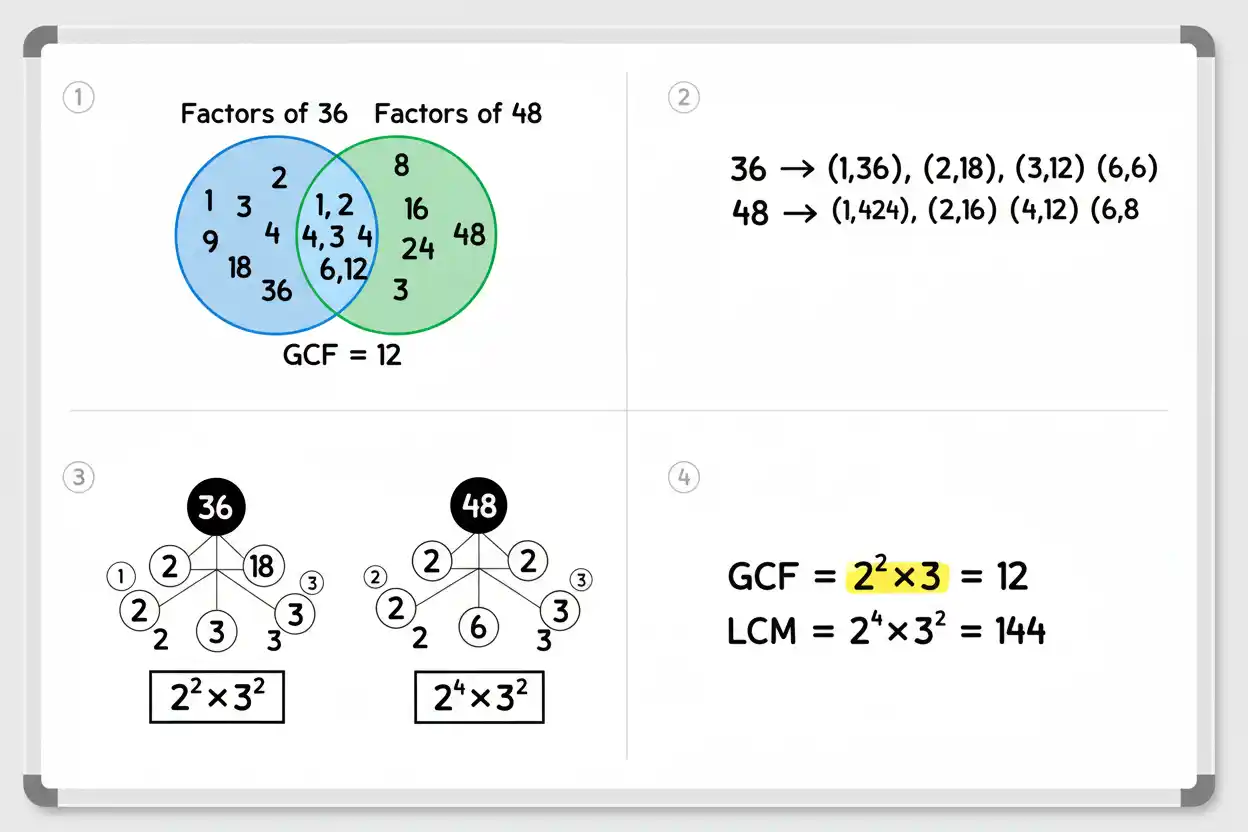

Common factors are numbers that divide two or more integers exactly, leaving no remainder. For example, 12 and 18 share the factors 1, 2, 3, and 6, so those four numbers are their common factors.
Finding common factors is useful when simplifying fractions, dividing quantities into equal groups, comparing integer structures, and identifying the greatest factor shared by several numbers.
The topic belongs to arithmetic and number theory within mathematics.
What Are Common Factors?
A factor of an integer divides that integer exactly.
For example, the positive factors of 12 are:
Factors of 12 = 1, 2, 3, 4, 6, 12
The positive factors of 18 are:
Factors of 18 = 1, 2, 3, 6, 9, 18
The numbers appearing in both lists are:
Common factors of 12 and 18 = 1, 2, 3, 6
The general factors topic covers how factor pairs and factor lists are constructed. Common factors narrow the question to values shared by two or more integers.
Common Factor Rule
A positive integer d is a common factor of integers a and b when both divisions have zero remainder:
a mod d = 0
and
b mod d = 0
Equivalently:
d divides a and d divides b
For three integers a, b, and c, a number is a common factor only if it divides all three exactly.
Example: Common Factors of 16 and 24
List the factors of 16:
1, 2, 4, 8, 16
List the factors of 24:
1, 2, 3, 4, 6, 8, 12, 24
Compare the lists.
The shared values are:
Common factors = 1, 2, 4, 8
Therefore, 1, 2, 4, and 8 are the common factors of 16 and 24.
How to Find Common Factors by Listing
For relatively small integers, factor listing is usually the most direct method.
Suppose we want the common factors of 20 and 30.
The factors of 20 are:
1, 2, 4, 5, 10, 20
The factors of 30 are:
1, 2, 3, 5, 6, 10, 15, 30
Compare the two lists:
Common factors = 1, 2, 5, 10
This method works well because every possible factor is visible.
For larger numbers, however, constructing complete factor lists can become cumbersome.
Finding Common Factors With Prime Factorization
Another method begins by expressing each integer as a product of primes.
Suppose we want the common factors of 36 and 48.
The prime factorization of 36 is:
36 = 2² × 3²
The prime factorization of 48 is:
48 = 2⁴ × 3
The prime powers shared by both numbers are limited by the smaller exponent of each common prime:
Shared prime structure = 2² × 3
2² × 3 = 12
This tells us that every positive divisor of 12 is a common factor of 36 and 48.
The factors of 12 are:
1, 2, 3, 4, 6, 12
Therefore:
Common factors of 36 and 48 = 1, 2, 3, 4, 6, 12
This method becomes more useful as the original integers grow.
Why the Smaller Exponent Is Used
Consider:
72 = 2³ × 3²
and:
120 = 2³ × 3 × 5
A factor shared by both numbers may contain no more copies of a prime than either number possesses.
Both numbers contain at least three factors of 2, so 2³ can appear in their shared prime structure.
However, 120 contains only one factor of 3, so a common factor cannot contain 3².
Thus:
Shared prime structure = 2³ × 3
Shared prime structure = 24
Every divisor of 24 is therefore a common factor of 72 and 120.
Those divisors are:
1, 2, 3, 4, 6, 8, 12, 24
Common Factors of Three Numbers
The same idea applies to more than two integers.
Find the common factors of 18, 24, and 30.
Factors of 18:
1, 2, 3, 6, 9, 18
Factors of 24:
1, 2, 3, 4, 6, 8, 12, 24
Factors of 30:
1, 2, 3, 5, 6, 10, 15, 30
The values found in all three lists are:
1, 2, 3, 6
Therefore:
Common factors of 18, 24, and 30 = 1, 2, 3, 6
A number that divides only two of the three values is not a common factor of the entire group.
Common Factors and the Greatest Common Factor
The largest common factor has a special name: the greatest common factor.
For 18 and 24:
Common factors = 1, 2, 3, 6
The largest is 6.
Therefore:
Greatest common factor = 6
The dedicated greatest common factor calculation focuses specifically on finding that maximum shared factor. The related GCF page addresses the same named concept in its own assigned context.
The current question is broader: it asks for all common factors, not merely the largest one.
Relationship Between the GCF and All Common Factors
Once the greatest common factor is known, there is a useful property:
Every positive common factor of a group of integers is a positive factor of their GCF.
For example, suppose:
GCF(48, 60) = 12
The positive factors of 12 are:
1, 2, 3, 4, 6, 12
Those are exactly the common factors of 48 and 60.
Check the original numbers:
Factors shared by 48 and 60 are:
1, 2, 3, 4, 6, 12
So finding the GCF can provide a fast route to the complete set of common factors.
Common Factors and Divisibility
Common-factor problems fundamentally depend on divisibility.
A number d can be a factor of n only when:
n ÷ d
produces an integer with no remainder.
For example:
42 ÷ 7 = 6
So 7 is a factor of 42.
But:
42 ÷ 8 = 5 remainder 2
So 8 is not a factor of 42.
Knowing divisibility rules can make factor identification faster, especially for divisors such as 2, 3, 5, 9, and 10.
The underlying division operation provides the basic test.
Example Using Divisibility
Find the common factors of 45 and 60.
First consider likely small divisors.
Both numbers are divisible by 1.
Both are divisible by 3:
45 ÷ 3 = 15
60 ÷ 3 = 20
Both are divisible by 5:
45 ÷ 5 = 9
60 ÷ 5 = 12
Both are divisible by 15:
45 ÷ 15 = 3
60 ÷ 15 = 4
The complete factor lists confirm:
Factors of 45 = 1, 3, 5, 9, 15, 45
Factors of 60 = 1, 2, 3, 4, 5, 6, 10, 12, 15, 20, 30, 60
Therefore:
Common factors = 1, 3, 5, 15
Common Factors and Composite Numbers
A composite number has positive factors other than 1 and itself.
Because composite numbers contain multiple factor relationships, two composite numbers may share several factors.
For example:
24 = 2³ × 3
36 = 2² × 3²
Their shared factor structure produces several common factors:
1, 2, 3, 4, 6, 12
However, being composite does not guarantee that two numbers share a factor greater than 1.
Consider 8 and 9.
Factors of 8:
1, 2, 4, 8
Factors of 9:
1, 3, 9
Their only positive common factor is:
1
Even though both numbers are composite.
Numbers With Only 1 as a Common Factor
Two positive integers whose only positive common factor is 1 are called relatively prime or coprime.
For example:
Factors of 14 = 1, 2, 7, 14
Factors of 25 = 1, 5, 25
Therefore:
Common factors of 14 and 25 = 1
The numbers themselves do not need to be prime. They simply cannot share any prime factor.
Is 1 Always a Common Factor?
For positive integers, yes.
Every positive integer is divisible by 1:
n ÷ 1 = n
Therefore, any collection of positive integers always has at least one positive common factor:
1
This is why two positive integers never have an empty set of positive common factors.
Common Factors in Fraction Simplification
Common factors are especially useful when reducing fractions.
Consider:
18 / 24
The numerator and denominator have common factors:
1, 2, 3, 6
Dividing both by 6 gives:
18 ÷ 6 = 3
24 ÷ 6 = 4
So:
18 / 24 = 3 / 4
The broader process is covered under fraction simplification, while the common-factor idea explains why dividing the numerator and denominator by the same shared factor preserves the fraction’s value.
Practical Example: Equal Groups
Suppose 24 red items and 36 blue items must be divided into identical groups with no items left over.
The number of groups must divide both 24 and 36 exactly.
Factors of 24:
1, 2, 3, 4, 6, 8, 12, 24
Factors of 36:
1, 2, 3, 4, 6, 9, 12, 18, 36
Therefore:
Possible numbers of equal groups = 1, 2, 3, 4, 6, 12
If 6 groups are chosen, each group receives:
24 ÷ 6 = 4 red items
and:
36 ÷ 6 = 6 blue items
The shared factor ensures that both quantities divide evenly.
Another Example: Packaging Quantities
A warehouse has 40 units of one product and 56 units of another. The products must be packed into the same number of equal batches without leftovers.
Factors of 40:
1, 2, 4, 5, 8, 10, 20, 40
Factors of 56:
1, 2, 4, 7, 8, 14, 28, 56
Their common factors are:
1, 2, 4, 8
Therefore, the products could be divided into 1, 2, 4, or 8 equal batches.
If the goal were specifically to find the maximum number of identical batches, the problem would shift to the greatest common factor.
Common Factors of Consecutive Integers
Consecutive positive integers always have exactly one positive common factor:
1
For example:
Factors of 8 = 1, 2, 4, 8
Factors of 9 = 1, 3, 9
The only shared value is 1.
Why?
If a number greater than 1 divided two consecutive integers, it would also divide their difference.
The difference between consecutive integers is 1, and no integer greater than 1 divides 1.
Therefore, consecutive integers are always coprime.
Common Factors of a Number and Its Multiple
If one number is a multiple of another, every factor of the smaller number is automatically a common factor.
Consider 12 and 36.
Because:
36 = 3 × 12
every factor of 12 also divides 36.
Factors of 12:
1, 2, 3, 4, 6, 12
Therefore:
Common factors of 12 and 36 = 1, 2, 3, 4, 6, 12
This observation can eliminate unnecessary calculation.
What About Negative Factors?
In many elementary arithmetic problems, “factors” means positive factors.
For example, the positive factors of 12 are normally listed as:
1, 2, 3, 4, 6, 12
In integer mathematics, negative divisors also exist:
-1, -2, -3, -4, -6, -12
If negative factors are permitted, every positive common factor has a corresponding negative common factor.
Unless a problem explicitly includes negative divisors, positive factors are usually intended.
What Happens When One Number Is Zero?
Zero requires special care.
Every nonzero integer divides 0 because:
0 = d × 0
for any nonzero integer d.
Therefore, if the problem asks for common factors of 0 and a positive integer such as 12, the finite positive common factors are simply the factors of 12:
1, 2, 3, 4, 6, 12
Division by zero itself remains undefined, so zero is not treated as a divisor.
A Faster Strategy for Large Numbers
For small values, listing factors is straightforward.
For larger values, this approach is usually more efficient:
- Find the prime structure of each number.
- Keep only primes present in every number.
- Use the smallest exponent available for each shared prime.
- Form the greatest shared factor from those prime powers.
- List the factors of that result.
Suppose:
360 = 2³ × 3² × 5
and:
504 = 2³ × 3² × 7
Their shared prime structure is:
2³ × 3²
= 8 × 9
= 72
The complete set of common factors is therefore the set of positive factors of 72.
Those are:
1, 2, 3, 4, 6, 8, 9, 12, 18, 24, 36, 72
Common Mistakes When Finding Common Factors
One common mistake is listing factors of only one number. A common factor must divide every number in the problem.
Another mistake is confusing factors with multiples. Factors divide a number; multiples are produced by multiplying it.
For 6:
Factors = 1, 2, 3, 6
while:
Multiples = 6, 12, 18, 24, 30, …
Another error is stopping after finding the largest common factor when the question asks for all common factors.
It is also easy to omit factor pairs. If 4 divides 36, then its paired factor 9 should also appear because:
4 × 9 = 36
Systematic factor listing prevents omissions.
Common Factors vs. Other Mathematical Problems
Common factors answer a very specific arithmetic question: which integers divide all the given integers exactly?
They do not determine how many arrangements or selections are possible. Those questions belong to combinatorics and specialized counting methods such as combinations.
They also do not solve quadratic equations. Algebraic methods such as completing the square address a fundamentally different type of mathematical structure.
Similarly, a measurement problem such as calculating board feet may involve multiplication and division, but its primary purpose is measuring lumber volume rather than identifying shared integer divisors.
Recognizing the type of problem prevents an arithmetic method from being applied where it does not belong.
How to Check Your Common Factors
Every proposed common factor should pass a simple test.
Suppose you claim that 6 is a common factor of 42 and 54.
Check:
42 ÷ 6 = 7
54 ÷ 6 = 9
Both results are integers, so 6 is a common factor.
Now test 8:
42 ÷ 8 = 5.25
Since the result is not an integer, 8 cannot be a common factor regardless of whether it divides the other number.
This direct divisibility check is an effective way to verify an answer.
Frequently Asked Questions
What is a common factor?
A common factor is an integer that divides each of two or more given integers exactly, without leaving a remainder.
What are the common factors of 12 and 18?
The factors of 12 are 1, 2, 3, 4, 6, and 12. The factors of 18 are 1, 2, 3, 6, 9, and 18. Therefore, their common factors are:
1, 2, 3, 6
What is the difference between a factor and a common factor?
A factor only needs to divide one specified number. A common factor must divide every number being compared.
Is the greatest common factor the same as common factors?
No. Common factors include every factor shared by the numbers. The greatest common factor is only the largest member of that set.
For 20 and 30:
Common factors = 1, 2, 5, 10
Greatest common factor = 10
Can two numbers have only one common factor?
Yes. If their only positive common factor is 1, they are relatively prime or coprime. For example, 8 and 15 have only 1 as a common positive factor.
Is 1 a common factor of every positive integer?
Yes. Every positive integer is divisible by 1, so 1 is always a positive common factor of any group of positive integers.
How do I find common factors of large numbers?
Prime factorization or a GCF-based method is usually faster. Determine the shared prime structure, find its product, and then list the positive factors of that result.
Can three or more numbers have common factors?
Yes. A common factor of several integers must divide all of them exactly. For 12, 18, and 30, the common positive factors are 1, 2, 3, and 6.
Final Example
Find the common factors of 42 and 70.
Factors of 42:
1, 2, 3, 6, 7, 14, 21, 42
Factors of 70:
1, 2, 5, 7, 10, 14, 35, 70
The numbers appearing in both lists are:
1, 2, 7, 14
Therefore:
Common factors of 42 and 70 = 1, 2, 7, 14
The largest common factor is 14, but the complete answer contains all four shared divisors.
That distinction—between finding every factor shared by the numbers and finding only the largest one—is the central idea behind common factors.