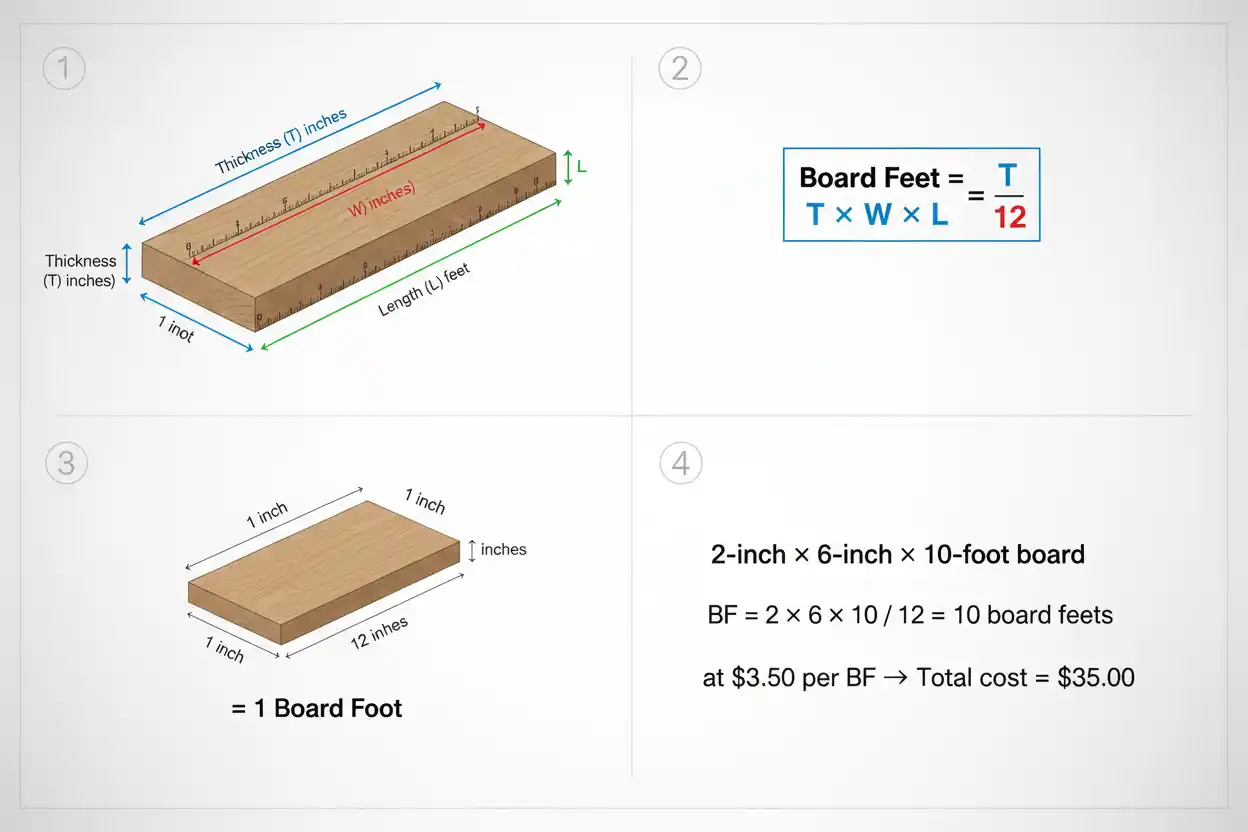

Board feet measure lumber volume. One board foot represents a piece of wood with a volume of 144 cubic inches, conventionally visualized as a board measuring 1 inch thick, 12 inches wide, and 12 inches long.
1 board foot = 144 in³
When thickness and width are measured in inches and length is measured in feet, use:
Board Feet = Thickness × Width × Length / 12
For example, a board measuring 1 inch thick, 8 inches wide, and 10 feet long contains:
Board Feet = 1 × 8 × 10 / 12
= 80/12
≈ 6.67 board feet
Board feet are especially useful when hardwood lumber is sold by volume rather than strictly by piece, linear foot, or surface area.
What Is a Board Foot?
A board foot is a unit of lumber volume equal to:
1 in × 12 in × 12 in
Multiplying those dimensions gives:
144 cubic inches
So:
1 BF = 144 in³
The board does not literally need to have dimensions of 1 × 12 × 12 inches. Any dimensions producing the same volume equal one board foot.
For example:
2 in × 6 in × 12 in = 144 in³
so that piece also contains:
1 board foot
Likewise:
1 in × 6 in × 24 in = 144 in³
also equals one board foot.
The unit measures volume, not one specific board shape.
Board Feet Formula
When:
- thickness is in inches,
- width is in inches,
- length is in feet,
the formula is:
BF = T × W × L / 12
where:
BF = board feet
T = thickness in inches
W = width in inches
L = length in feet
The division by 12 converts the mixed inch-and-foot dimensions into the 144-cubic-inch board-foot standard.
The calculation relies on ordinary multiplication and division within the broader numerical framework of Arithmetic & Number Theory.
Board Feet Formula When All Dimensions Are in Inches
If thickness, width, and length are all measured in inches, use:
BF = T × W × L / 144
For example, a board measures:
1.5 in × 8 in × 96 in
Then:
BF = 1.5 × 8 × 96 / 144
= 1152/144
= 8
Therefore the board contains:
8 board feet
Both formulas describe the same volume. The denominator changes only because the length unit changes.
Why Divide by 12?
Suppose length is measured in feet.
A board measuring:
T inches × W inches × L feet
has a length of:
12L inches
Its volume in cubic inches is therefore:
T × W × 12L
Since one board foot is 144 cubic inches:
BF = T × W × 12L / 144
Simplify:
BF = T × W × L / 12
That is the standard board-foot formula.
Example 1: 1-Inch-Thick Board
Find the board feet in a piece measuring:
1 in thick
10 in wide
8 ft long
Use:
BF = T × W × L / 12
Substitute:
BF = 1 × 10 × 8 / 12
= 80/12
≈ 6.67
Therefore:
Board feet ≈ 6.67 BF
Example 2: 2-Inch-Thick Lumber
A board measures:
2 in × 9 in × 8 ft
Calculate:
BF = 2 × 9 × 8 / 12
= 144/12
= 12
Therefore:
Board feet = 12 BF
Doubling the thickness doubles the volume when width and length remain unchanged.
Example 3: Fractional Thickness
Suppose a board measures:
1.25 in thick
7 in wide
10 ft long
Then:
BF = 1.25 × 7 × 10 / 12
= 87.5/12
≈ 7.292
Therefore:
Board feet ≈ 7.29 BF
Fractional dimensions can be kept as exact fractions or converted to decimals before multiplication.
Quarter Thickness and Board Feet
Hardwood thickness is often described in quarters of an inch.
Common examples include:
4/4 = 1 in
5/4 = 1.25 in
6/4 = 1.5 in
8/4 = 2 in
12/4 = 3 in
If lumber is listed as 8/4, convert that thickness before using the board-foot formula:
8/4 = 2 inches
Then a board measuring 8/4 × 9 inches × 8 feet has:
BF = 2 × 9 × 8 / 12
= 12 BF
Formula Using Quarter Thickness
If Q represents thickness in quarter-inch units:
Thickness in inches = Q/4
Therefore:
BF = (Q/4) × W × L / 12
which can be written:
BF = Q × W × L / 48
For example, 6/4 lumber has:
Q = 6
For a piece 8 inches wide and 10 feet long:
BF = 6 × 8 × 10 / 48
= 480/48
= 10 BF
This formula is useful when the thickness is already expressed in quarters.
Nominal vs Actual Dimensions
One of the most important board-foot distinctions is whether the dimensions being entered are nominal or actual.
A board sold as a nominal:
2 × 8
may not physically measure exactly 2 inches by 8 inches after surfacing and drying.
If the goal is to calculate the physical volume of the finished board, use its actual measured dimensions.
Suppose an actual board measures:
1.5 in × 7.25 in × 10 ft
Then:
BF = 1.5 × 7.25 × 10 / 12
= 108.75/12
= 9.0625
Therefore its physical volume is:
≈ 9.06 BF
Using nominal 2 × 8 dimensions would instead give:
2 × 8 × 10 / 12
≈ 13.33 BF
Those are substantially different results.
When calculating a purchase tally, use the dimensional convention specified by the lumber seller rather than assuming that nominal construction-lumber dimensions and hardwood tally dimensions are interchangeable.
Board Feet and Rough Lumber
Board-foot measurement is especially common with rough hardwood.
A rough board may be described by thickness class, width, and length. For example:
4/4 × 10 in × 9 ft
Using 4/4 as 1 inch:
BF = 1 × 10 × 9 / 12
= 7.5 BF
If several rough boards vary in width and length, calculate each board separately and add the results.
Multiple Boards
For boards with identical dimensions:
Total BF = BF per board × Number of boards
Suppose each board contains:
6.5 BF
and there are:
12 boards
Then:
Total BF = 6.5 × 12
= 78 BF
For mixed dimensions, calculate each piece independently before summing.
Example: Mixed Lumber Order
Suppose an order contains:
- one 1 × 8 × 10 ft board;
- two 1 × 10 × 8 ft boards;
- one 2 × 9 × 6 ft board.
First board:
1 × 8 × 10 / 12 = 6.67 BF
Each 1 × 10 × 8 board:
1 × 10 × 8 / 12 = 6.67 BF
Two contain:
13.33 BF
The 2 × 9 × 6 board contains:
2 × 9 × 6 / 12 = 9 BF
Total:
6.67 + 13.33 + 9
= 29 BF
Therefore the order contains approximately:
29 board feet
Board Feet to Cubic Inches
Since:
1 BF = 144 in³
convert board feet to cubic inches with:
Cubic Inches = BF × 144
For example:
8 BF = 8 × 144
= 1152 in³
Conversely:
BF = Cubic Inches / 144
Board Feet to Cubic Feet
One cubic foot contains:
12 in × 12 in × 12 in
= 1728 in³
Since one board foot is:
144 in³
then:
1728/144 = 12
Therefore:
1 ft³ = 12 BF
and:
1 BF = 1/12 ft³
To convert board feet to cubic feet:
Cubic Feet = BF / 12
For example:
96 BF / 12 = 8 ft³
Cubic Feet to Board Feet
Use:
BF = Cubic Feet × 12
For example:
5 ft³ × 12 = 60 BF
Therefore:
5 cubic feet = 60 board feet
This conversion is exact because both units measure volume.
Board Feet vs Square Feet
Board feet and square feet measure different things.
Square feet measure area.
Board feet measure volume.
A surface measuring:
4 ft × 8 ft
has:
32 ft²
of area.
Its board-foot volume cannot be determined unless thickness is also known.
If that surface is 1 inch thick, the board-foot volume is:
32 BF
because a one-inch-thick square foot corresponds to one board foot.
If it is 2 inches thick:
64 BF
Thickness is therefore essential.
Board Feet vs Linear Feet
A linear foot measures only length:
1 linear foot = 12 inches of length
It does not include width or thickness.
A 10-foot-long board can have very different board-foot volumes depending on its cross-sectional dimensions.
For example:
1 × 4 × 10 ft
contains:
1 × 4 × 10 / 12 ≈ 3.33 BF
while:
2 × 12 × 10 ft
contains:
2 × 12 × 10 / 12 = 20 BF
Both pieces are 10 linear feet long, but their volumes differ greatly.
Board Feet and Lumber Price
If lumber is priced per board foot:
Cost = Board Feet × Price per BF
Suppose a board contains:
7.5 BF
and lumber costs:
$9.20 per BF
Then:
Cost = 7.5 × 9.20
= $69.00
For several boards, calculate the total board feet and multiply by the applicable rate.
Example: Lumber Order Cost
Suppose a project requires:
85 BF
of lumber priced at:
$6.75 per BF
Then:
Cost = 85 × 6.75
= $573.75
If tax, delivery, milling, or other charges apply, those amounts are additional to the basic board-foot material calculation.
Adding a Waste Allowance
Projects often require more lumber than the exact finished-part volume because of defects, trimming, grain selection, cutting loss, and mistakes.
If the net requirement is N board feet and the allowance rate is r:
Purchase BF = N × (1 + r)
where r is written as a decimal.
For a 15% allowance:
r = 0.15
If the net requirement is:
120 BF
then:
Purchase BF = 120 × 1.15
= 138 BF
Therefore a 15% allowance increases the planned purchase to:
138 board feet
Finding Waste Percentage From Purchased and Used Lumber
Suppose:
Purchased = 150 BF
and:
Finished requirement = 125 BF
The difference is:
150 – 125 = 25 BF
Relative to the finished requirement:
Allowance rate = 25/125
= 0.20
= 20%
The appropriate denominator depends on whether you are describing waste relative to material purchased or extra material relative to the net requirement, so state the convention clearly.
Solving for Length
Starting with:
BF = T × W × L / 12
solve for L:
12BF = T × W × L
Therefore:
L = 12BF / (T × W)
Suppose you need 10 BF from a board that is:
1.5 inches thick
and:
8 inches wide
Then:
L = 12 × 10 / (1.5 × 8)
= 120/12
= 10 ft
So a 1.5 × 8-inch board must be 10 feet long to contain 10 BF.
Solving for Width
Rearrange:
BF = T × W × L / 12
to get:
W = 12BF / (T × L)
Suppose:
BF = 8
T = 1 in
L = 12 ft
Then:
W = 12 × 8 / (1 × 12)
= 8 in
Therefore the board must be 8 inches wide.
Solving for Thickness
Rearrange again:
T = 12BF / (W × L)
Suppose a 6-foot-long, 8-inch-wide board contains 8 BF:
T = 12 × 8 / (8 × 6)
= 96/48
= 2 in
Therefore the thickness is:
2 inches
Decimal Measurements
Actual lumber measurements may involve decimals such as:
1.75 inches
or:
7.625 inches
The board-foot formula works without modification.
For example:
T = 1.75
W = 7.625
L = 9
Then:
BF = 1.75 × 7.625 × 9 / 12
≈ 10.01 BF
When working through several measured values, ordinary decimal arithmetic rules apply.
Avoid rounding intermediate values too aggressively when the result will later be multiplied by a price.
Fractions in Lumber Dimensions
Measurements such as:
1 1/4 in
or:
7 1/2 in
can be entered as decimal equivalents:
1.25
7.5
or retained as fractions.
For example:
1.25 × 7.5 × 8 / 12
= 75/12
= 6.25 BF
Both fractional and decimal notation describe the same dimensions.
Board Foot as a Volume Ratio
The board-foot formula can be understood as:
Board Feet = Lumber Volume / 144 in³
If a rectangular board has volume:
V = T × W × L
with every dimension in inches, then:
BF = V/144
This definition is more fundamental than any particular shortcut formula.
The shortcut:
T × W × L(ft) / 12
simply incorporates the feet-to-inches conversion.
Very Large Lumber Tallies
A warehouse or mill may track thousands of board feet.
For example:
125,000 BF
corresponds to:
125,000/12
≈ 10,416.67 ft³
of lumber volume.
Large quantities can be written with separators or scientific notation when useful. The principles of numerical scale and digit length are covered under big numbers.
The board-foot definition remains unchanged regardless of order size.
Rounding Board Feet
A calculated volume may produce a repeating or long decimal:
6.666666… BF
A practical display might be:
6.67 BF
However, purchase tallies can follow supplier-specific rounding conventions for board width, length, thickness, or final board footage.
For estimating physical volume, retain adequate precision through the calculation and round only the final result.
For purchasing, use the seller’s stated tally method.
Board Feet for Tapered or Irregular Boards
The basic rectangular formula assumes uniform thickness and width.
If a board has significant taper, live edges, or irregular shape, one single width may not represent its volume accurately.
A practical estimate may use an agreed average width or a supplier’s specific measuring rule.
For example, if width changes from:
8 in
to:
10 in
an approximate average width is:
(8 + 10)/2 = 9 in
If the board is 1 inch thick and 8 feet long:
BF ≈ 1 × 9 × 8 / 12
= 6 BF
This is an approximation unless the measuring convention specifically defines that averaging method.
Common Board Feet Mistakes
Dividing by 144 When Length Is Already in Feet
If length is in feet, use:
BF = T × W × L / 12
The divisor 144 is for dimensions all measured in inches.
Mixing Nominal and Actual Dimensions
Use one consistent dimensional basis appropriate to the calculation.
Physical-volume calculations should use actual dimensions.
Forgetting Thickness
Board feet measure volume, so length and width alone are insufficient.
Treating Board Feet as Square Feet
Square feet measure area. Board feet include thickness.
Treating Board Feet as Linear Feet
Linear feet measure length only.
Ignoring Units
Entering a 96-inch length as though it were 96 feet produces a result twelve times too large.
Rounding Too Early
Rounding each individual dimension or board before totaling can create unnecessary error in a large order.
Assuming Every Seller Tallies Lumber Identically
Commercial tally conventions can differ. A mathematical volume calculation and a seller’s invoice tally should be compared using the same measurement assumptions.
Worked Board Feet Example
A hardwood board measures:
6/4 thick
10.5 inches wide
9 feet long
First convert the thickness:
6/4 in = 1.5 in
Use:
BF = T × W × L / 12
Substitute:
BF = 1.5 × 10.5 × 9 / 12
Multiply:
1.5 × 10.5 = 15.75
Then:
15.75 × 9 = 141.75
Divide:
141.75/12 = 11.8125
Therefore:
Board Feet = 11.8125 BF
Rounded to two decimals:
≈ 11.81 BF
If the price is:
$8.40 per BF
then:
Cost = 11.8125 × 8.40
= $99.225
Rounded to cents:
≈ $99.23
Frequently Asked Questions
What is a board foot?
A board foot is a lumber-volume unit equal to:
144 cubic inches
What is the board feet formula?
When thickness and width are in inches and length is in feet:
BF = T × W × L / 12
What if all dimensions are in inches?
Use:
BF = T × W × L / 144
How many cubic inches are in one board foot?
1 BF = 144 in³
How many board feet are in one cubic foot?
1 ft³ = 12 BF
How many cubic feet are in one board foot?
1 BF = 1/12 ft³
How do you calculate the cost of lumber sold by board foot?
Use:
Cost = BF × Price per BF
Is a board foot the same as a square foot?
No. A square foot measures area, while a board foot measures volume.
Is a board foot the same as a linear foot?
No. A linear foot measures length only. Board footage also depends on width and thickness.
How do you calculate 8/4 lumber?
Convert:
8/4 = 2 inches
then use 2 as the thickness in the board-foot formula.
Should nominal or actual dimensions be used?
Use dimensions consistent with the purpose of the calculation. For physical volume, actual measured dimensions are appropriate. For a purchase tally, follow the seller’s stated measurement convention.
How do you calculate board feet for several boards?
Calculate the board footage of each size and add the results. If all boards have identical dimensions, multiply board feet per board by the number of boards.