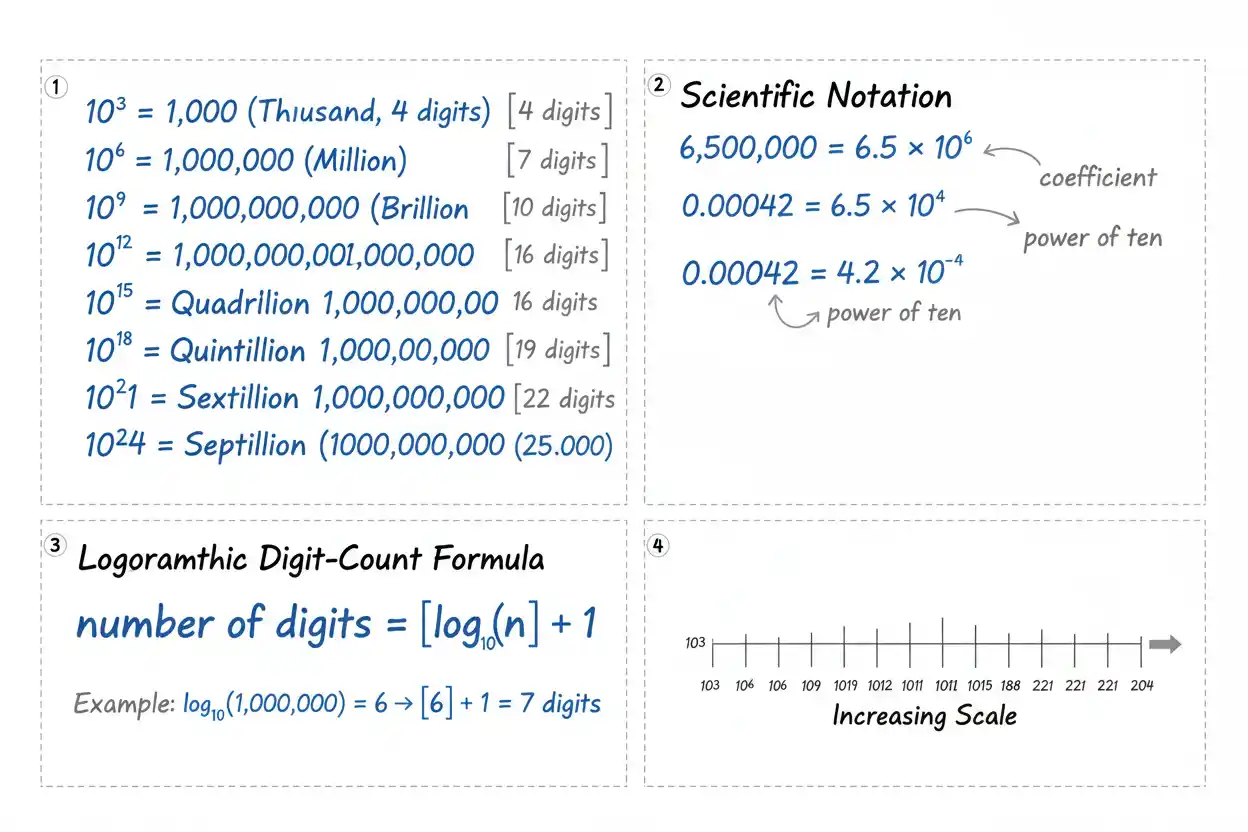

Big numbers become easier to understand when you measure their digit length and express their scale using powers of ten or scientific notation.
For a positive integer N, the number of decimal digits is:
Digits = floor(log₁₀(N)) + 1
For example:
N = 123456789
Since:
8 < log₁₀(123456789) < 9
the floor is 8, giving:
Digits = 8 + 1 = 9
So 123,456,789 is a 9-digit number.
Powers of ten provide an even simpler rule:
10^k has k + 1 digits
For example:
10⁶ = 1,000,000
has:
7 digits
Understanding digit length, powers of ten, and scientific notation makes extremely large values easier to compare without writing every zero.
What Are Big Numbers?
There is no single mathematical threshold at which a number becomes “big.” The term usually describes values whose magnitude makes ordinary written notation cumbersome.
For example:
1,000
is manageable.
So is:
1,000,000
But a number such as:
1,000,000,000,000,000,000,000,000
is easier to interpret as:
10²⁴
or by an appropriate large-number name.
The underlying number does not change. Only the representation becomes more compact.
This topic sits within Arithmetic & Number Theory because magnitude, powers, digit counts, and numerical representation all build on place value.
What Is Digit Length?
The digit length of a positive integer is the number of decimal digits required to write it without leading zeros.
Examples:
7 has 1 digit
42 has 2 digits
999 has 3 digits
1000 has 4 digits
Commas and other digit-group separators are not digits.
The minus sign of a negative integer is also not counted as a numerical digit.
Therefore:
-52,800
has:
5 digits
because its magnitude 52,800 contains five decimal digits.
Digit Length Formula
For every positive integer N:
Digits(N) = floor(log₁₀(N)) + 1
The floor function means take the greatest integer less than or equal to the logarithm.
For example:
N = 7500
Because:
10³ ≤ 7500 < 10⁴
we know:
3 ≤ log₁₀(7500) < 4
Therefore:
floor(log₁₀(7500)) = 3
and:
Digits = 4
Indeed:
7500
contains four digits.
Special Case: Zero
The logarithmic formula does not apply directly to zero because:
log₁₀(0)
is undefined.
But zero is written as:
0
so:
Digits(0) = 1
This case should be handled separately.
Negative Integers
For a negative integer N, count the digits of its absolute value:
Digits(N) = Digits(|N|)
For example:
N = -123456
Then:
|N| = 123456
which has:
6 digits
The negative sign indicates direction or sign, not an additional numerical digit.
The concept of magnitude independent of sign is formalized by absolute value.
Powers of Ten and Digit Length
A power of ten has a particularly simple digit count.
For nonnegative integer k:
10^k
is written as 1 followed by k zeros.
Therefore:
Digits(10^k) = k + 1
Examples:
10⁰ = 1 → 1 digit
10¹ = 10 → 2 digits
10² = 100 → 3 digits
10³ = 1000 → 4 digits
10⁶ = 1,000,000 → 7 digits
The exponent measures the number of zeros, not the total number of digits.
Smallest Number With n Digits
For:
n ≥ 1
the smallest positive n-digit decimal integer is:
10^(n-1)
For example, the smallest 5-digit number is:
10⁴ = 10,000
The smallest 8-digit number is:
10⁷ = 10,000,000
This provides a useful boundary for digit-length questions.
Largest Number With n Digits
The largest n-digit positive decimal integer is:
10^n – 1
For example, the largest 3-digit number is:
10³ – 1
= 999
The largest 6-digit number is:
10⁶ – 1
= 999,999
Therefore an n-digit positive integer N satisfies:
10^(n-1) ≤ N ≤ 10^n – 1
Digit-Length Interval
A positive integer has exactly n decimal digits if:
10^(n-1) ≤ N < 10^n
For example, a number has exactly 7 digits if:
10⁶ ≤ N < 10⁷
or:
1,000,000 ≤ N < 10,000,000
This interval rule often avoids the need to calculate a logarithm explicitly.
Example 1: How Many Digits Does 87,425 Have?
Compare with powers of 10:
10⁴ = 10,000
and:
10⁵ = 100,000
Since:
10,000 ≤ 87,425 < 100,000
the number has:
5 digits
Example 2: How Many Digits Does 10¹² Have?
Use:
Digits(10^k) = k + 1
Therefore:
Digits(10¹²) = 13
Indeed:
10¹² = 1,000,000,000,000
which is a 1 followed by 12 zeros.
Example 3: How Many Digits Does 999,999,999 Have?
The number is:
10⁹ – 1
Therefore it is the largest 9-digit number.
So:
Digits = 9
Adding 1 gives:
1,000,000,000 = 10⁹
which has:
10 digits
Crossing an exact power of 10 increases the digit count by one.
Number Scale Using Powers of Ten
Powers of ten provide a compact measure of numerical scale.
Some common values in the modern English short scale are:
| Power | Value | Name |
|---|---|---|
| 10³ | 1,000 | thousand |
| 10⁶ | 1,000,000 | million |
| 10⁹ | 1,000,000,000 | billion |
| 10¹² | 1,000,000,000,000 | trillion |
| 10¹⁵ | 1,000,000,000,000,000 | quadrillion |
| 10¹⁸ | 1,000,000,000,000,000,000 | quintillion |
| 10²¹ | 1,000,000,000,000,000,000,000 | sextillion |
| 10²⁴ | 1 followed by 24 zeros | septillion |
Large-number naming conventions can differ historically and regionally, so powers of ten provide the more universal mathematical representation.
Why Powers Increase So Quickly
Each increase of 1 in a base-10 exponent multiplies the value by 10:
10⁶ = 1,000,000
10⁷ = 10,000,000
10⁸ = 100,000,000
A difference of 3 in the exponent means a factor of:
10³ = 1000
Therefore:
10¹² / 10⁹ = 10³ = 1000
A trillion is one thousand times a billion in the short-scale convention.
Scientific Notation
Scientific notation writes a nonzero number as:
N = a × 10^k
where:
1 ≤ |a| < 10
and k is an integer.
For example:
45,000,000 = 4.5 × 10⁷
The coefficient 4.5 shows the leading significant digits, while 10⁷ communicates the scale.
For a small value:
0.00032 = 3.2 × 10^-4
Scientific notation therefore handles both extremely large and extremely small magnitudes.
Digit Length From Scientific Notation
Suppose a positive integer is expressed as:
N = a × 10^k
with:
1 ≤ a < 10
and k ≥ 0.
If N is an integer at that scale, its decimal digit length is:
k + 1
For example:
6.02 × 10²³
has a magnitude in the interval:
10²³ ≤ N < 10²⁴
so its integer-scale representation has:
24 digits
The coefficient changes the leading digits but not the order-of-magnitude interval.
Order of Magnitude
A rough numerical scale is often expressed through the exponent in scientific notation.
For:
3.4 × 10⁸
the value lies between:
10⁸
and:
10⁹
The exponent 8 immediately tells you that the number has nine decimal digits.
Compare:
7 × 10⁵
and:
7 × 10⁸
The second is:
10³ = 1000
times larger.
This comparison can be made without expanding either number.
Comparing Big Numbers by Exponents
Suppose:
A = 4.2 × 10¹⁷
and:
B = 9.8 × 10¹⁵
Because:
10¹⁷
is 100 times:
10¹⁵
A is larger even though 4.2 is smaller than 9.8.
To compare scientific-notation values, compare the exponents first. If the exponents match, compare the leading coefficients.
Example: Same Exponent
Compare:
3.7 × 10¹²
and:
8.1 × 10¹²
The powers of ten are identical, so compare:
3.7
and:
8.1
Therefore:
8.1 × 10¹² > 3.7 × 10¹²
Multiplying Big Numbers in Scientific Notation
Multiply coefficients and add exponents:
(a × 10^m)(b × 10^n) = ab × 10^(m+n)
For example:
(3 × 10⁸)(2 × 10⁵)
= 6 × 10¹³
The result is already normalized because 6 lies between 1 and 10.
Dividing Big Numbers in Scientific Notation
Divide coefficients and subtract exponents:
(a × 10^m)/(b × 10^n) = (a/b) × 10^(m-n)
For example:
(8 × 10¹⁵)/(2 × 10⁶)
= 4 × 10⁹
This is much easier than writing all the zeros first.
Adding Big Numbers
Exponents must represent the same power before coefficients can be added directly.
For example:
3 × 10⁸ + 5 × 10⁷
Rewrite:
5 × 10⁷ = 0.5 × 10⁸
Then:
3 × 10⁸ + 0.5 × 10⁸
= 3.5 × 10⁸
You cannot simply add the exponents.
Logarithms and Digit Count
Why does:
floor(log₁₀ N) + 1
count digits?
If N has n digits:
10^(n-1) ≤ N < 10^n
Taking log base 10 gives:
n – 1 ≤ log₁₀N < n
Therefore:
floor(log₁₀N) = n – 1
and:
n = floor(log₁₀N) + 1
The formula is therefore a direct consequence of decimal place-value boundaries.
Digit Count Without Writing the Number
Suppose:
N = 2^100
How many decimal digits does it have?
Use:
Digits = floor(log₁₀(2^100)) + 1
Apply the logarithm power rule:
log₁₀(2^100) = 100 log₁₀2
Using:
log₁₀2 ≈ 0.30103
gives:
100 × 0.30103 = 30.103
Therefore:
Digits = floor(30.103) + 1
= 30 + 1
= 31
So:
2^100
has:
31 decimal digits
This is far more efficient than expanding all 100 powers manually.
Factorial Digit Length
Very large factorials can also be measured without fully writing them.
For positive n:
n! = 1 × 2 × 3 × … × n
Taking logarithms gives:
log₁₀(n!) = log₁₀1 + log₁₀2 + … + log₁₀n
Therefore:
Digits(n!) = floor(log₁₀(n!)) + 1
This illustrates a broader principle: logarithms convert very large multiplicative structures into manageable additive calculations.
Digit Length Depends on the Base
The same number can require different numbers of digits in different numeral systems.
For example:
255₁₀ = FF₁₆ = 11111111₂
The representations require:
3 decimal digits
2 hexadecimal digits
8 binary digits
The base conversions guide covers changing between those representations.
For base b, the general positive-integer digit-count formula is:
Digits base b = floor(log_b N) + 1
for:
N ≥ 1
Binary Digit Length
For a positive integer N, the number of binary digits is:
floor(log₂N) + 1
For example:
N = 255
Since:
2⁷ = 128
and:
2⁸ = 256
we have:
128 ≤ 255 < 256
Therefore 255 requires:
8 binary digits
Indeed:
255₁₀ = 11111111₂
The binary numbers page focuses on the base-2 representation itself.
Bits and Representable Values
With n binary digits, or bits, there are:
2^n
possible bit patterns.
For example, 8 bits provide:
2⁸ = 256
patterns.
If those patterns represent unsigned integers starting at zero, the range is:
0 through 255
because:
2⁸ – 1 = 255
This shows how digit length controls representational capacity.
Decimal Digits and Possible Strings
With exactly n unrestricted decimal digit positions, there are:
10^n
possible digit strings from all zeros through all nines.
For ordinary positive n-digit integers, the first digit cannot be zero.
Therefore the number of positive n-digit decimal integers is:
9 × 10^(n-1)
For example, the number of 3-digit positive integers is:
9 × 10²
= 900
corresponding to:
100 through 999
Why Leading Zeros Do Not Increase Numerical Digit Length
Consider:
00042
As an ordinary integer representation:
00042 = 42
The leading zeros do not change the value.
Therefore the mathematical digit length of 42 remains:
2
However, in fixed-width data formats, identifiers, or computer fields, leading zeros may be intentionally preserved as part of a string length or field width.
That is a formatting issue rather than the mathematical digit count of the integer.
Arithmetic Sequences and Big Values
An arithmetic sequence can produce large terms when n is large:
aₙ = a₁ + (n – 1)d
Suppose:
a₁ = 5
d = 1000
and:
n = 1,000,000
Then:
aₙ = 5 + 999,999 × 1000
= 999,999,005
This is a 9-digit number.
The sequence formula generates the value; digit-length rules describe its scale.
Algebra With Big Numbers
Scientific notation keeps algebra involving huge values manageable.
Suppose:
x = 3 × 10¹²
and you need:
5x
Then:
5x = 5(3 × 10¹²)
= 15 × 10¹²
Normalize:
= 1.5 × 10¹³
The symbolic manipulation uses the same distributive and multiplication principles introduced in algebra basics.
Big Numbers in Counting Problems
Large values appear naturally in counting and probability because the number of possible combinations can grow extremely quickly.
The birthday paradox is a familiar example: rather than counting only one pair of people, a group creates many possible pairs.
For n people, the number of distinct pairs is:
n(n – 1)/2
For 23 people:
23 × 22 / 2
= 253
possible pairs exist.
This rapid growth helps explain why match probabilities can become substantial even when the underlying number of possible birthdays seems large.
Growth Can Outpace Intuition
Humans often reason comfortably about additive change but underestimate multiplicative growth.
Compare:
1,000 + 1,000 = 2,000
with:
1,000 × 1,000 = 1,000,000
Repeated multiplication can move through orders of magnitude far faster than repeated addition.
Powers, factorials, and combinatorial counts therefore produce big numbers surprisingly quickly.
Example: Doubling
Start with:
1
and double repeatedly:
1, 2, 4, 8, 16, 32, …
After n doublings from 1:
Value = 2^n
At n = 10:
2¹⁰ = 1024
At n = 20:
2²⁰ = 1,048,576
At n = 30:
2³⁰ = 1,073,741,824
The number crosses from four digits to seven digits to ten digits in only 20 additional doublings.
Approximate Scale vs Exact Value
Scientific notation can communicate scale without displaying every exact digit.
For example:
7.3 × 10¹⁸
immediately tells you that the number is between:
10¹⁸
and:
10¹⁹
Therefore it contains:
19 digits
if interpreted as an integer-sized quantity.
The coefficient 7.3 gives additional precision, while the exponent gives the dominant scale.
Comparing Numbers by Digit Length
A positive decimal integer with more digits is always larger than a positive integer with fewer digits.
For example, every 8-digit positive integer is larger than every 7-digit positive integer because:
smallest 8-digit number = 10,000,000
while:
largest 7-digit number = 9,999,999
If two numbers have the same digit length, compare their leading digits from left to right.
Estimating Products by Scale
Suppose:
A ≈ 4 × 10⁷
and:
B ≈ 3 × 10⁵
Then:
AB ≈ 12 × 10¹²
Normalize:
AB ≈ 1.2 × 10¹³
Even before an exact multiplication, you know the result is roughly on the order of:
10¹³
This kind of scale estimate is useful for checking whether an exact calculation is plausible.
Big Numbers and Unit Prefixes
Large measured quantities are often compressed with metric prefixes.
For example:
kilo = 10³
mega = 10⁶
giga = 10⁹
tera = 10¹²
A value of:
5 × 10⁹ bytes
is therefore approximately:
5 gigabytes
under decimal SI prefix usage.
These prefixes are convenient because they encode powers of 1000 rather than requiring long strings of zeros.
Common Big Numbers Mistakes
Counting Commas Instead of Digits
Commas are separators, not digits.
For:
1,234,567
the digit count is:
7
not 9.
Counting the Negative Sign as a Digit
The number:
-82,000
has five numerical digits.
Saying 10⁶ Has Six Digits
10⁶ = 1,000,000
which contains seven digits.
The exponent counts the zeros after the leading 1.
Applying the Logarithm Formula to Zero
log₁₀(0)
is undefined.
Handle zero separately:
Digits(0) = 1
Forgetting to Normalize Scientific Notation
35 × 10⁸
is valid algebraically but conventional scientific notation is:
3.5 × 10⁹
Adding Exponents During Addition
The rule:
10^a × 10^b = 10^(a+b)
applies to multiplication, not addition.
Assuming Number Names Are Always Universal
Large-number naming conventions can vary. Powers of ten and scientific notation are less ambiguous.
Worked Digit-Length Example
How many decimal digits does:
7^50
have?
Use:
Digits = floor(log₁₀(7^50)) + 1
Apply the power rule:
log₁₀(7^50) = 50 log₁₀7
Using:
log₁₀7 ≈ 0.845098
gives:
50 × 0.845098 ≈ 42.2549
Take the floor:
floor(42.2549) = 42
Then:
Digits = 42 + 1
= 43
Therefore:
7^50 has 43 decimal digits
No 43-digit expansion was required.
Worked Scale Example
Compare:
A = 6.4 × 10¹⁸
and:
B = 8.2 × 10¹⁶
Rewrite B using 10¹⁸:
B = 0.082 × 10¹⁸
Now compare:
6.4 × 10¹⁸
with:
0.082 × 10¹⁸
Clearly:
A > B
Find the approximate ratio:
A/B = (6.4/8.2) × 10²
≈ 0.7805 × 100
≈ 78.05
So A is about:
78 times larger than B
The exponents reveal most of this scale difference immediately.
Frequently Asked Questions
What are big numbers?
Big numbers are values whose magnitude is large enough that compact representations such as powers of ten or scientific notation become useful.
How do you find the number of digits in a positive integer?
Use:
Digits = floor(log₁₀N) + 1
for N ≥ 1.
How many digits does zero have?
Zero is written as 0, so it has:
1 digit
How many digits does 10^n have?
For nonnegative integer n:
10^n has n + 1 digits
What is the smallest n-digit positive integer?
10^(n-1)
What is the largest n-digit positive integer?
10^n – 1
How do you count digits in a negative number?
Count the digits of its absolute value. The minus sign is not a digit.
What is scientific notation?
Scientific notation writes a nonzero number as:
a × 10^k
where:
1 ≤ |a| < 10
How do you compare numbers in scientific notation?
Compare their exponents first. If the exponents are equal, compare the coefficients.
Does changing the number base change the number’s magnitude?
No. It changes only the representation, although the number of written digits may change.
What is the digit-count formula in another base?
For positive integer N written in base b:
Digits = floor(log_bN) + 1
Why are logarithms useful for big numbers?
They convert multiplicative scale into additive quantities and can determine digit counts without expanding enormous powers or products.