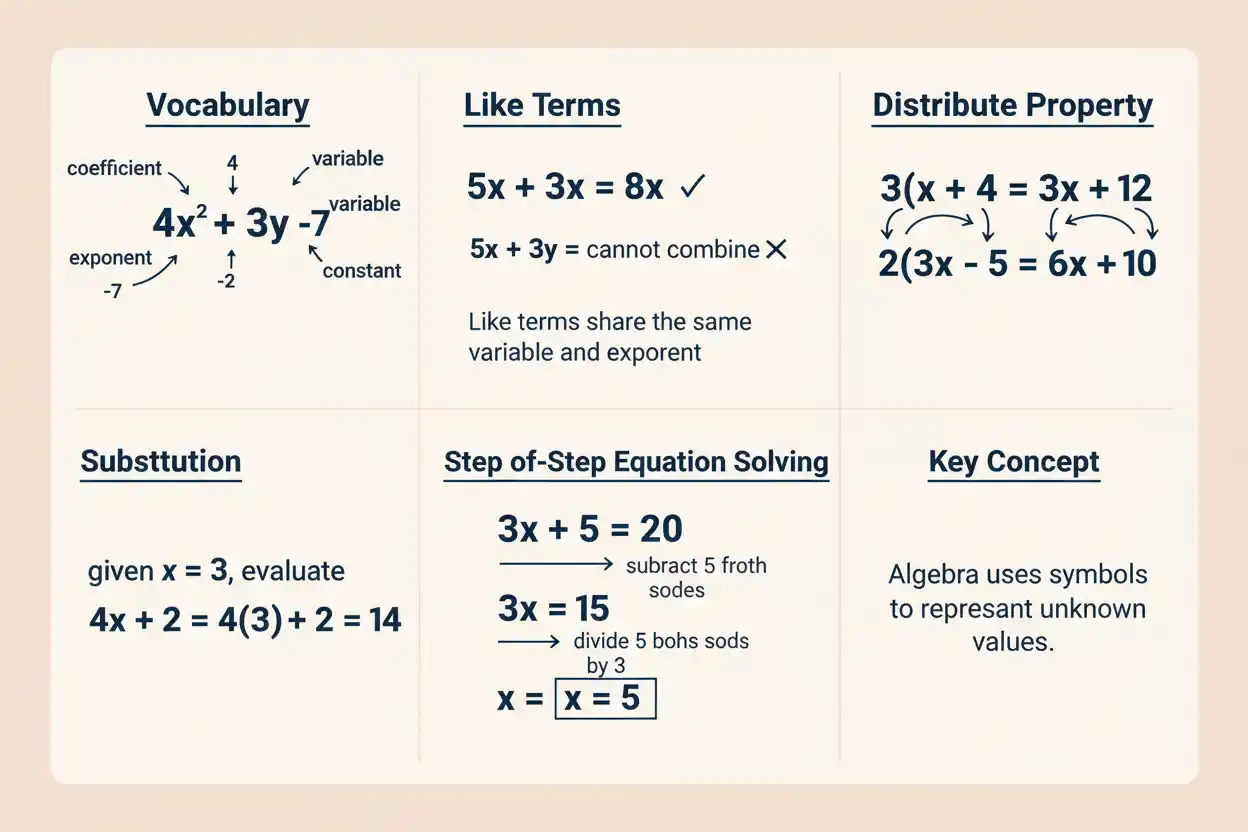

Algebra basics are the foundational rules for working with variables, constants, expressions, equations, and mathematical relationships. Instead of calculating only with known numbers, algebra uses symbols such as x and y to represent unknown or changing values.
For example:
3x + 5 = 20
To find x, subtract 5 from both sides:
3x = 15
Then divide by 3:
x = 5
Check:
3(5) + 5 = 20
20 = 20
The core idea is simple: algebra extends ordinary arithmetic so the same numerical rules can be applied to unknown quantities.
What Is Algebra?
Algebra is a branch of mathematics that represents numbers and relationships with symbols.
An arithmetic statement might be:
8 + 4 = 12
An algebraic statement might be:
x + 4 = 12
The second statement asks which value of x makes the equality true.
Subtract 4:
x = 8
The calculation still uses arithmetic, but algebra allows the unknown quantity to be represented before its value is known.
These ideas build directly on the numerical foundations summarized in Arithmetic & Number Theory.
What Is a Variable?
A variable is a symbol representing a number whose value may be unknown or may change.
Common variables include:
x
y
a
n
For example:
x + 7
contains the variable x.
If:
x = 5
then:
x + 7 = 5 + 7 = 12
A variable does not have to be x. Any suitable symbol can represent an unknown or changing quantity.
What Is a Constant?
A constant is a fixed value.
In:
4x + 9
the number:
9
is a constant.
The number 4 is also fixed, but because it multiplies x, it is specifically called a coefficient.
In:
3x² – 5x + 7
the constant term is:
7
because it contains no variable.
What Is a Coefficient?
A coefficient is a numerical factor multiplying a variable or variable expression.
For:
6x
the coefficient is:
6
For:
-3x²
the coefficient is:
-3
For:
x
the coefficient is understood to be:
1
because:
x = 1x
For:
-x
the coefficient is:
-1
because:
-x = -1x
What Is a Term?
A term is one part of an expression separated by addition or subtraction.
Consider:
4x² – 3x + 8
The terms are:
4x²
-3x
8
The sign immediately before a term belongs to that term.
This is why the second term is -3x rather than simply 3x.
What Is an Algebraic Expression?
An algebraic expression combines numbers, variables, and operations but does not state an equality.
Examples include:
2x + 7
3a² – 4a + 1
(x + 5)/2
√(x + 3)
An expression can be evaluated, simplified, expanded, or factored.
It does not have a solution by itself because there is no equals sign requiring two quantities to match.
For instance:
2x + 7
is an expression.
But:
2x + 7 = 19
is an equation.
What Is an Equation?
An equation states that two expressions have equal values.
For example:
4x – 3 = 17
The equals sign means both sides must have the same value.
Add 3 to both sides:
4x = 20
Divide by 4:
x = 5
A complete guide to isolating variables and handling more involved forms is available under solving equations.
A Basic Algebra Formula
A common introductory equation has the form:
ax + b = c
where:
a ≠ 0
To solve for x:
ax = c – b
and:
x = (c – b)/a
For example:
5x + 4 = 29
Here:
a = 5
b = 4
c = 29
Therefore:
x = (29 – 4)/5
x = 25/5
x = 5
This pattern is a basic form of a linear equation.
Like Terms
Like terms have the same variable part with the same exponents.
For example:
3x
and:
7x
are like terms.
Therefore:
3x + 7x = 10x
Similarly:
4x² – x² = 3x²
But:
3x + 4x²
cannot be combined because x and x² are different variable parts.
Likewise:
5x + 2y
cannot become 7xy or 7x because x and y are different variables.
Combining Like Terms
Simplify:
4x + 7 + 3x – 2
Group like terms:
4x + 3x
and:
7 – 2
Then:
7x + 5
Therefore:
4x + 7 + 3x – 2 = 7x + 5
The value of the expression has not changed. It has only been rewritten in a simpler equivalent form.
The Distributive Property
The distributive property is:
a(b + c) = ab + ac
For example:
3(x + 4)
becomes:
3x + 12
because:
3 × x = 3x
and:
3 × 4 = 12
Likewise:
5(2x – 3)
becomes:
10x – 15
The multiplier outside the parentheses applies to every term inside.
Distributing a Negative Number
Simplify:
-2(x – 5)
Multiply -2 by both terms:
-2x + 10
The second term becomes positive because:
(-2)(-5) = 10
Sign errors during distribution are one of the most common early algebra mistakes.
Factoring as Reverse Distribution
Factoring reverses the distributive property.
For example:
6x + 12
has a common factor of 6:
6x + 12 = 6(x + 2)
Similarly:
8x² – 4x
has a common factor of 4x:
8x² – 4x = 4x(2x – 1)
More specialized factorization patterns belong to their own topics, but recognizing a greatest common factor is a basic algebra skill.
Commutative Property
Addition and multiplication are commutative:
a + b = b + a
and:
ab = ba
For example:
4 + 9 = 9 + 4
and:
3 × 7 = 7 × 3
Subtraction and division are not commutative in general:
8 – 3 ≠ 3 – 8
and:
12/4 ≠ 4/12
Associative Property
Addition and multiplication are associative:
(a + b) + c = a + (b + c)
and:
(ab)c = a(bc)
For example:
(2 + 3) + 4 = 2 + (3 + 4)
Both sides equal 9.
The property changes grouping without changing the order of the quantities.
Identity Properties
Zero is the additive identity:
a + 0 = a
One is the multiplicative identity:
a × 1 = a
For example:
x + 0 = x
and:
7x × 1 = 7x
These values leave a quantity unchanged under their corresponding operations.
Inverse Properties
The additive inverse of a is -a:
a + (-a) = 0
For example:
8 + (-8) = 0
The multiplicative inverse of nonzero a is:
1/a
because:
a × 1/a = 1
For example:
5 × 1/5 = 1
Inverse operations are central to equation solving.
Order of Operations in Algebra
Algebra follows the same order-of-operations principles as arithmetic.
For:
3 + 2x²
with:
x = 4
substitute first:
3 + 2(4²)
Evaluate the exponent:
4² = 16
Multiply:
2 × 16 = 32
Add:
3 + 32 = 35
Parentheses and exponents must be handled correctly before addition and subtraction.
Substitution
Substitution replaces a variable with a known value or another equivalent expression.
Evaluate:
2x² – 3x + 1
when:
x = 4
Substitute:
2(4²) – 3(4) + 1
Calculate:
2(16) – 12 + 1
32 – 12 + 1
21
Therefore the expression has value:
21
at x = 4.
Parentheses When Substituting Negative Values
Suppose:
f(x) = x² + 3x
and:
x = -2
Write:
(-2)² + 3(-2)
Then:
4 – 6
= -2
Writing parentheses around a substituted negative number helps preserve the intended signs and exponents.
Exponents in Basic Algebra
An exponent indicates repeated multiplication.
For example:
x³ = x × x × x
Some basic exponent rules are:
x^a × x^b = x^(a+b)
x^a / x^b = x^(a-b), x ≠ 0
(x^a)^b = x^(ab)
For example:
x³ × x² = x⁵
because:
3 + 2 = 5
Exponent rules become increasingly important as algebraic expressions become more complex.
Equations and the Balance Principle
If:
a = b
adding the same value c to both sides gives:
a + c = b + c
Subtracting the same value preserves equality:
a – c = b – c
Multiplying by the same value preserves equality:
ac = bc
and division by the same nonzero value gives:
a/c = b/c
The idea is analogous to keeping a balance scale level.
Example: Solve a Two-Step Equation
Solve:
4x – 7 = 21
Add 7:
4x = 28
Divide by 4:
x = 7
Check:
4(7) – 7
= 28 – 7
= 21
The check confirms the solution.
Variables on Both Sides
Solve:
5x + 3 = 2x + 18
Subtract 2x:
3x + 3 = 18
Subtract 3:
3x = 15
Divide by 3:
x = 5
Check:
5(5) + 3 = 28
and:
2(5) + 18 = 28
Both sides agree.
Algebraic Fractions
Fractions can appear as coefficients:
(2/3)x + 4
This remains an ordinary linear algebraic expression because 2/3 is a constant.
If an unknown occurs in a denominator, such as:
1/(x – 2)
the expression has additional domain restrictions and belongs to the more specialized rational-expression framework.
At the introductory level, the important rule is that division by zero is never allowed.
Absolute Value in Algebra
Absolute value measures distance from zero:
|x| = x, if x ≥ 0
|x| = -x, if x < 0
For example:
|-6| = 6
Absolute-value notation is an early example of an algebraic rule whose output depends on a condition.
It also reinforces the distinction between the signed value of a number and its magnitude.
Algebra and Number Representation
A numerical value can be represented in different numeral systems without changing the underlying algebraic relationships.
For example, decimal 10 can be written in binary as:
1010₂
The specialist binary numbers guide explains base-2 notation, while base conversions covers changing numerical representations between bases.
An equation such as:
x + 2 = 10
depends on the represented numerical values, not on whether those values are written in decimal, binary, or another valid base.
Algebra With Large Numbers
Variables are useful when numerical quantities become too large or cumbersome to repeat.
For example, instead of repeatedly writing a very large population value, you can define:
P = population
and write a relationship such as:
2P
or:
P + 1,000,000
Topics involving digit length and numerical scale are treated under big numbers, while algebra focuses on the symbolic relationship between the quantities.
Algebra and Arithmetic Sequences
An arithmetic sequence illustrates how algebra converts a repeated numerical pattern into one formula.
For a sequence with first term a₁ and common difference d:
aₙ = a₁ + (n – 1)d
Instead of generating every preceding term, the algebraic formula can calculate a specified term directly.
This is a practical example of variables representing changing numerical quantities.
Function Notation
A function may be written:
f(x) = 2x + 3
Here x is the input and f(x) is the corresponding output.
For x = 4:
f(4) = 2(4) + 3
= 11
The notation is developed more fully under function notation, but the substitution principle is the same one used throughout introductory algebra.
Inequalities
An inequality compares quantities using symbols such as:
<
>
≤
≥
For example:
x + 3 < 10
Subtract 3:
x < 7
Many equation-solving principles carry over, although multiplying or dividing an inequality by a negative number requires reversing the inequality sign.
That specialist rule distinguishes inequalities from ordinary equations.
Algebraic Expressions vs Equations
Compare:
3x + 5
and:
3x + 5 = 20
The first is an expression. It can be simplified or evaluated if x is known.
The second is an equation. It asks for values of x that make both sides equal.
This distinction determines whether the goal is simplification or solution.
Example: Simplify an Expression
Simplify:
3(x + 4) + 2x – 5
Distribute:
3x + 12 + 2x – 5
Combine like terms:
5x + 7
Therefore:
3(x + 4) + 2x – 5 = 5x + 7
There is no value of x to solve for because there is no equation.
Example: Solve an Equation
Now consider:
3(x + 4) + 2x – 5 = 27
Simplify the left side:
5x + 7 = 27
Subtract 7:
5x = 20
Divide by 5:
x = 4
The addition of the equality condition turns the simplification problem into an equation-solving problem.
Common Algebra Basics Mistakes
Combining Unlike Terms
Incorrect:
3x + 2 = 5x
The terms 3x and 2 are not alike.
Forgetting to Distribute to Every Term
Correct:
4(x – 3) = 4x – 12
not:
4x – 3
Losing Negative Signs
For:
-2(x + 5)
the result is:
-2x – 10
Treating an Expression Like an Equation
An expression such as:
x + 7
does not have a unique “answer” until additional information about x is provided.
Dividing by Zero
Expressions such as:
5/0
are undefined.
Forgetting Parentheses Around Negative Substitutions
For x = -3:
x² = (-3)² = 9
not -9.
Changing Only One Side of an Equation
If 5 is subtracted from one side, it must also be subtracted from the other side to preserve equality.
Worked Algebra Basics Example
Simplify and solve:
2(3x – 4) + 5 = 3x + 12
First distribute:
6x – 8 + 5 = 3x + 12
Combine constants:
6x – 3 = 3x + 12
Subtract 3x from both sides:
3x – 3 = 12
Add 3:
3x = 15
Divide by 3:
x = 5
Check the original equation.
Left side:
2(3(5) – 4) + 5
= 2(15 – 4) + 5
= 22 + 5
= 27
Right side:
3(5) + 12
= 15 + 12
= 27
Therefore:
x = 5
Frequently Asked Questions
What are algebra basics?
Algebra basics include variables, constants, coefficients, terms, expressions, equations, substitution, properties of operations, and simple equation solving.
What is a variable?
A variable is a symbol such as x or y that represents an unknown or changing value.
What is a coefficient?
A coefficient is a number multiplying a variable. In 7x, the coefficient is 7.
What is a constant?
A constant is a fixed value. In 3x + 8, the constant term is 8.
What is an algebraic expression?
An algebraic expression combines variables, numbers, and operations without an equals sign.
What is the difference between an expression and an equation?
An expression represents a quantity. An equation states that two expressions are equal and can therefore have solutions.
What are like terms?
Like terms have identical variable parts and exponents. For example, 3x and 8x are like terms.
What is the distributive property?
The distributive property is:
a(b + c) = ab + ac
How do you solve ax + b = c?
For a ≠ 0:
x = (c – b)/a
Why must you perform the same operation on both sides?
Doing so preserves equality and keeps the transformed equation equivalent to the original one.
What does substitution mean in algebra?
Substitution means replacing a variable with a known value or an equivalent expression.
Why are algebra basics important?
They provide the symbolic rules used throughout equations, functions, sequences, geometry, statistics, finance, science, and higher mathematics.