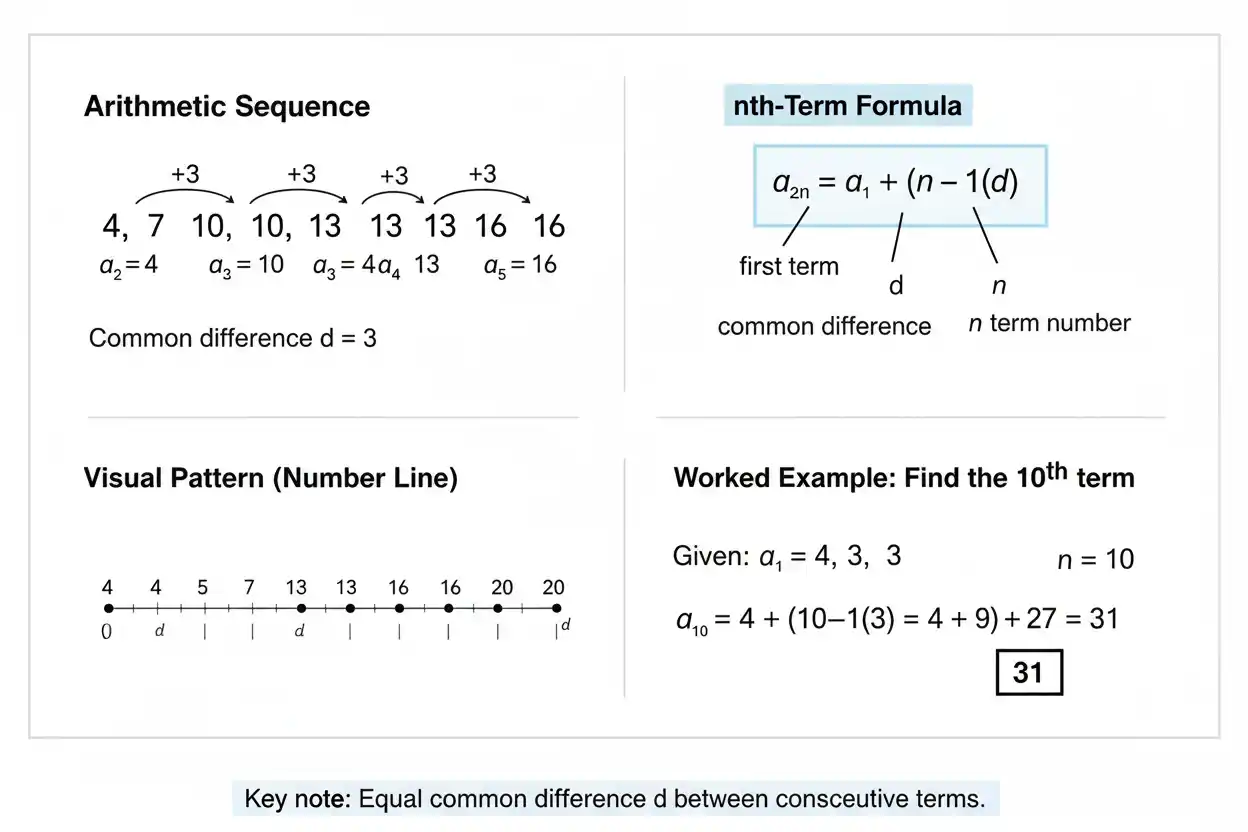

An arithmetic sequence is an ordered sequence in which the difference between consecutive terms is constant.
For example:
5, 9, 13, 17, 21, …
is an arithmetic sequence because each term increases by:
4
The constant amount added or subtracted is called the common difference, written d.
The main arithmetic sequence formula is:
aₙ = a₁ + (n – 1)d
where:
- aₙ = nth term
- a₁ = first term
- n = term position
- d = common difference
For the sequence above:
a₁ = 5
d = 4
The tenth term is:
a₁₀ = 5 + (10 – 1)(4)
= 5 + 36
= 41
The formula lets you find any specified term without calculating every term before it.
What Is an Arithmetic Sequence?
An arithmetic sequence has the general pattern:
a₁, a₁ + d, a₁ + 2d, a₁ + 3d, …
The change from one term to the next is always the same.
For example:
2, 7, 12, 17, 22, …
has:
d = 5
because:
7 – 2 = 5
12 – 7 = 5
17 – 12 = 5
The constant difference is what defines the sequence.
Arithmetic sequences are a natural bridge between repeated numerical patterns and the formulas introduced in algebra basics.
Arithmetic Sequence Formula
The explicit formula is:
aₙ = a₁ + (n – 1)d
This can also be called the nth-term formula.
The expression:
n – 1
appears because the first term requires zero applications of the common difference.
At n = 1:
a₁ = a₁ + (1 – 1)d
a₁ = a₁ + 0
which is correct.
At n = 2:
a₂ = a₁ + d
At n = 3:
a₃ = a₁ + 2d
and so on.
Common Difference Formula
The common difference can be found by subtracting a term from the following term:
d = aₙ – aₙ₋₁
For example:
14, 20, 26, 32, …
gives:
d = 20 – 14
d = 6
Check again:
26 – 20 = 6
Because the difference remains constant, the sequence is arithmetic.
Why the Sign of d Matters
The common difference can be positive, negative, or zero.
If:
d > 0
the sequence increases.
If:
d < 0
the sequence decreases.
If:
d = 0
the sequence is constant.
For example:
20, 15, 10, 5, 0, …
has:
d = -5
The magnitude of the change is 5, but the actual common difference is -5.
This is an important distinction from absolute value, which would report:
|-5| = 5
and remove the directional sign.
Example 1: Find the Common Difference
Consider:
8, 13, 18, 23, …
Subtract consecutive terms:
13 – 8 = 5
18 – 13 = 5
23 – 18 = 5
Therefore:
d = 5
The sequence is arithmetic.
Example 2: Negative Common Difference
Consider:
30, 24, 18, 12, 6, …
Calculate:
24 – 30 = -6
and:
18 – 24 = -6
Therefore:
d = -6
The negative sign indicates that each new term is 6 less than the previous one.
How to Find the nth Term
Suppose:
a₁ = 7
and:
d = 3
Find:
a₂₀
Use:
aₙ = a₁ + (n – 1)d
Substitute:
a₂₀ = 7 + (20 – 1)(3)
= 7 + 19(3)
= 7 + 57
= 64
Therefore:
a₂₀ = 64
No intermediate terms are required.
Example 3: Find the 50th Term
For:
4, 11, 18, 25, …
we have:
a₁ = 4
and:
d = 7
Find:
a₅₀
Use:
a₅₀ = 4 + (50 – 1)(7)
= 4 + 49(7)
= 4 + 343
= 347
Therefore:
a₅₀ = 347
Writing an Arithmetic Sequence Formula
Suppose the sequence is:
9, 14, 19, 24, …
The first term is:
a₁ = 9
The common difference is:
d = 5
Substitute into the general formula:
aₙ = 9 + (n – 1)(5)
Simplify:
aₙ = 9 + 5n – 5
aₙ = 5n + 4
Both formulas describe the same sequence:
aₙ = 9 + 5(n – 1)
and:
aₙ = 5n + 4
Checking an nth-Term Formula
Suppose:
aₙ = 5n + 4
Check n = 1:
a₁ = 5(1) + 4 = 9
Check n = 2:
a₂ = 5(2) + 4 = 14
Check n = 3:
a₃ = 5(3) + 4 = 19
The formula reproduces:
9, 14, 19, …
so it is consistent with the sequence.
Recursive Arithmetic Sequence Formula
An arithmetic sequence can also be defined recursively.
The recursive rule is:
a₁ = starting value
aₙ = aₙ₋₁ + d
for n > 1.
For:
5, 8, 11, 14, …
the recursive definition is:
a₁ = 5
aₙ = aₙ₋₁ + 3
This tells you how to find a term from the preceding term.
Explicit vs Recursive Form
The explicit formula:
aₙ = a₁ + (n – 1)d
finds a term directly from its position.
The recursive formula:
aₙ = aₙ₋₁ + d
requires the previous term.
For example, to find the 100th term, explicit form is usually more efficient because it avoids generating the first 99 terms.
Recursive form is useful when the sequence’s step-by-step construction is important.
Finding a Missing Term
Suppose:
7, ?, 17
are consecutive terms of an arithmetic sequence.
Because the difference must be equal on both sides, the missing number lies halfway between 7 and 17.
Calculate:
(7 + 17)/2
= 24/2
= 12
So the sequence is:
7, 12, 17
with:
d = 5
The middle value is called an arithmetic mean of the two surrounding values.
Example 4: Two Missing Terms
Suppose four consecutive arithmetic-sequence terms begin at 4 and end at 19:
4, ?, ?, 19
There are three equal jumps from 4 to 19.
The total change is:
19 – 4 = 15
Therefore:
d = 15/3
d = 5
The sequence is:
4, 9, 14, 19
Finding the First Term
Rearrange:
aₙ = a₁ + (n – 1)d
to solve for a₁:
a₁ = aₙ – (n – 1)d
For example, suppose:
a₁₀ = 38
and:
d = 4
Then:
a₁ = 38 – (10 – 1)(4)
= 38 – 36
= 2
The sequence begins:
2, 6, 10, 14, …
Finding the Common Difference From Two Known Terms
If aᵢ and aⱼ are known, then:
aⱼ – aᵢ = (j – i)d
Therefore:
d = (aⱼ – aᵢ)/(j – i)
for j ≠ i.
Suppose:
a₄ = 17
and:
a₁₀ = 41
Then:
d = (41 – 17)/(10 – 4)
= 24/6
= 4
Once d is known, use either term to find the first term.
Example 5: Find the Formula From Two Terms
Given:
a₃ = 11
and:
a₈ = 31
Find d:
d = (31 – 11)/(8 – 3)
= 20/5
= 4
Now use:
a₃ = a₁ + (3 – 1)d
Substitute:
11 = a₁ + 2(4)
11 = a₁ + 8
a₁ = 3
Therefore:
aₙ = 3 + (n – 1)(4)
Simplify:
aₙ = 4n – 1
Check n = 8:
a₈ = 4(8) – 1
= 31
Correct.
Finding the Term Number
Sometimes the term value is known and the position n is unknown.
Start with:
aₙ = a₁ + (n – 1)d
If d ≠ 0:
aₙ – a₁ = (n – 1)d
Divide by d:
(aₙ – a₁)/d = n – 1
Therefore:
n = (aₙ – a₁)/d + 1
For example, in:
5, 9, 13, 17, …
which term equals 81?
Here:
a₁ = 5
d = 4
Use:
n = (81 – 5)/4 + 1
= 76/4 + 1
= 19 + 1
= 20
Therefore:
81 is the 20th term
The rearrangement itself uses ordinary solving equations principles.
What if n Is Not an Integer?
Suppose the formula produces:
n = 12.5
for a question asking whether a value appears as a term.
Sequence positions are normally positive integers:
1, 2, 3, …
Therefore n = 12.5 does not correspond to a term position.
The value is not a member of that arithmetic sequence.
Constant Arithmetic Sequence
Consider:
7, 7, 7, 7, …
The common difference is:
d = 0
The formula is:
aₙ = 7 + (n – 1)(0)
so:
aₙ = 7
Every term is identical.
The formula for solving n by division through d should not be used here because d = 0.
Arithmetic Sequences With Fractions
The common difference can be fractional.
Consider:
1/2, 3/4, 1, 5/4, …
Calculate:
3/4 – 1/2
= 3/4 – 2/4
= 1/4
Therefore:
d = 1/4
The nth term is:
aₙ = 1/2 + (n – 1)(1/4)
Arithmetic sequences are defined by a constant difference, not by whether their terms are integers.
Arithmetic Sequences With Decimals
Consider:
1.2, 1.7, 2.2, 2.7, …
The difference is:
1.7 – 1.2 = 0.5
and:
2.2 – 1.7 = 0.5
Therefore:
d = 0.5
The nth term is:
aₙ = 1.2 + 0.5(n – 1)
The same formula works with integer, fractional, or decimal values.
Descending Arithmetic Sequence
Consider:
50, 43, 36, 29, …
The common difference is:
43 – 50 = -7
Therefore:
d = -7
The nth term is:
aₙ = 50 + (n – 1)(-7)
or:
aₙ = 50 – 7(n – 1)
The negative difference makes the sequence decrease.
Arithmetic Sequence as a Linear Function
The nth-term formula:
aₙ = a₁ + (n – 1)d
can be expanded:
aₙ = a₁ + nd – d
aₙ = dn + (a₁ – d)
This has the same algebraic structure as a linear function:
y = mx + b
The common difference d acts like a slope when term position n is treated as the input.
However, an ordinary sequence normally uses discrete integer positions rather than every real input.
Example: Sequence Formula as a Linear Rule
Consider:
3, 8, 13, 18, …
The formula is:
aₙ = 3 + 5(n – 1)
Simplify:
aₙ = 5n – 2
If the pairs:
(1,3), (2,8), (3,13), (4,18)
are plotted, they lie on a straight-line pattern.
The sequence is discrete because only positive integer n-values represent its terms.
Arithmetic vs Geometric Change
An arithmetic sequence changes by a constant difference.
For example:
4, 7, 10, 13, …
has:
d = 3
A multiplicative pattern instead changes by a constant ratio.
For example:
3, 6, 12, 24, …
does not have a constant difference:
6 – 3 = 3
12 – 6 = 6
24 – 12 = 12
so it is not arithmetic.
Recognizing whether a pattern is additive or multiplicative is essential before choosing a sequence formula.
Arithmetic Sequence vs Arithmetic Series
A sequence is an ordered list of terms:
2, 5, 8, 11, …
A series is the sum of terms:
2 + 5 + 8 + 11 + …
The nth-term formula:
aₙ = a₁ + (n – 1)d
finds a term of the sequence. It does not by itself calculate the sum of the first n terms.
Keeping terms and sums conceptually separate prevents a common formula-selection error.
Testing Whether a Sequence Is Arithmetic
Consider:
4, 9, 14, 19, 24
Calculate consecutive differences:
9 – 4 = 5
14 – 9 = 5
19 – 14 = 5
24 – 19 = 5
Every difference equals 5.
Therefore the sequence is arithmetic.
Now consider:
2, 5, 10, 17
Differences are:
3, 5, 7
They are not equal.
Therefore the sequence is not arithmetic.
Finding a Missing Interior Term
Suppose:
11, 16, ?, 26, 31
The known difference appears to be:
16 – 11 = 5
Continuing:
16 + 5 = 21
and:
21 + 5 = 26
Therefore the missing term is:
21
Always verify that the proposed value preserves the same difference on both sides.
Word Problem Example
Suppose a theater has 20 seats in the first row and each following row has 3 more seats than the previous row.
The sequence is:
20, 23, 26, 29, …
Here:
a₁ = 20
d = 3
The number of seats in row n is:
aₙ = 20 + 3(n – 1)
For row 15:
a₁₅ = 20 + 3(14)
= 20 + 42
= 62
Therefore the 15th row has:
62 seats
Another Application: Regular Increase
Suppose a savings balance is modeled to increase by a fixed $50 at the end of each period, beginning at $200.
The sequence is:
200, 250, 300, 350, …
So:
a₁ = 200
d = 50
The nth value is:
aₙ = 200 + 50(n – 1)
This arithmetic model applies only when the increase itself remains constant. Percentage-based growth would produce a different pattern because the change would depend on the current balance.
Arithmetic Sequences and Large Terms
The explicit formula is particularly useful when n is large.
Instead of writing hundreds or millions of terms, calculate the required position directly.
For example:
a₁ = 10
d = 6
For:
n = 1,000,000
the term is:
a₁₀₀₀₀₀₀ = 10 + (1,000,000 – 1)(6)
= 10 + 999,999 × 6
= 6,000,004
The interpretation of extremely large numerical scales is developed separately under big numbers; the arithmetic-sequence rule itself remains unchanged.
Number Bases Do Not Change the Sequence Property
An arithmetic sequence is defined by numerical differences, not by how the numbers are written.
For example, decimal:
2, 4, 6, 8, …
has common difference:
2
In binary, those same values are written:
10₂, 100₂, 110₂, 1000₂, …
The numerical relationship remains arithmetic even though the digit strings look different.
Binary numbers explains base-2 notation, while base conversions covers translating values among numeral systems.
The sequence classification depends on represented values, not their visual representation.
Common Arithmetic Sequence Mistakes
Using the Wrong Formula
The nth term is:
aₙ = a₁ + (n – 1)d
not:
a₁ + nd
The first term requires zero common-difference steps.
Forgetting the Sign of d
For:
20, 15, 10, 5, …
the common difference is:
-5
not 5.
Using Absolute Difference Instead of Signed Difference
The expression:
|a₂ – a₁|
gives only the magnitude of change.
The common difference must retain direction:
d = a₂ – a₁
Assuming Every Pattern Is Arithmetic
Check several consecutive differences before applying the arithmetic-sequence formula.
Confusing Term Value With Position
In:
a₁₀ = 42
10 is the position and 42 is the term value.
Starting n at Zero Without Adjusting the Formula
The standard formula:
aₙ = a₁ + (n – 1)d
assumes the first term has position:
n = 1
A different indexing convention requires a correspondingly different formula.
Rounding Fractional Terms Unnecessarily
Exact fractional common differences and terms are valid and should generally remain exact unless an approximation is requested.
Worked Arithmetic Sequence Example
Given:
a₅ = 18
and:
a₁₂ = 46
find the common difference, the first term, and the explicit formula.
First use:
d = (a₁₂ – a₅)/(12 – 5)
Substitute:
d = (46 – 18)/7
= 28/7
= 4
Now use:
a₅ = a₁ + (5 – 1)d
Substitute:
18 = a₁ + 4(4)
18 = a₁ + 16
Therefore:
a₁ = 2
The explicit formula is:
aₙ = 2 + (n – 1)(4)
Simplify:
aₙ = 2 + 4n – 4
aₙ = 4n – 2
Check the 12th term:
a₁₂ = 4(12) – 2
= 48 – 2
= 46
The formula is correct.
Frequently Asked Questions
What is an arithmetic sequence?
An arithmetic sequence is an ordered sequence in which the difference between consecutive terms is constant.
What is the arithmetic sequence formula?
The explicit nth-term formula is:
aₙ = a₁ + (n – 1)d
What does d mean?
d is the common difference:
d = aₙ – aₙ₋₁
How do you find the common difference?
Subtract one term from the term immediately after it.
For example:
12 – 7 = 5
so a sequence 7, 12, 17, … has d = 5.
Can the common difference be negative?
Yes. A negative common difference produces a decreasing arithmetic sequence.
Can d equal zero?
Yes. If d = 0, every term is the same and the sequence is constant.
How do you find the nth term?
Identify a₁, d, and n, then substitute them into:
aₙ = a₁ + (n – 1)d
How do you find the first term?
Rearrange the nth-term formula:
a₁ = aₙ – (n – 1)d
How do you find the term position?
When d ≠ 0:
n = (aₙ – a₁)/d + 1
The result must correspond to a valid integer sequence position.
What is the recursive formula for an arithmetic sequence?
A recursive arithmetic sequence can be written:
a₁ = starting term
aₙ = aₙ₋₁ + d
How can you tell if a sequence is arithmetic?
Calculate several consecutive differences. If the same difference repeats throughout the sequence, it is arithmetic.
What is the difference between an arithmetic sequence and a series?
A sequence lists terms in order. A series adds terms together. The formula aₙ = a₁ + (n – 1)d finds a term, not a sum.