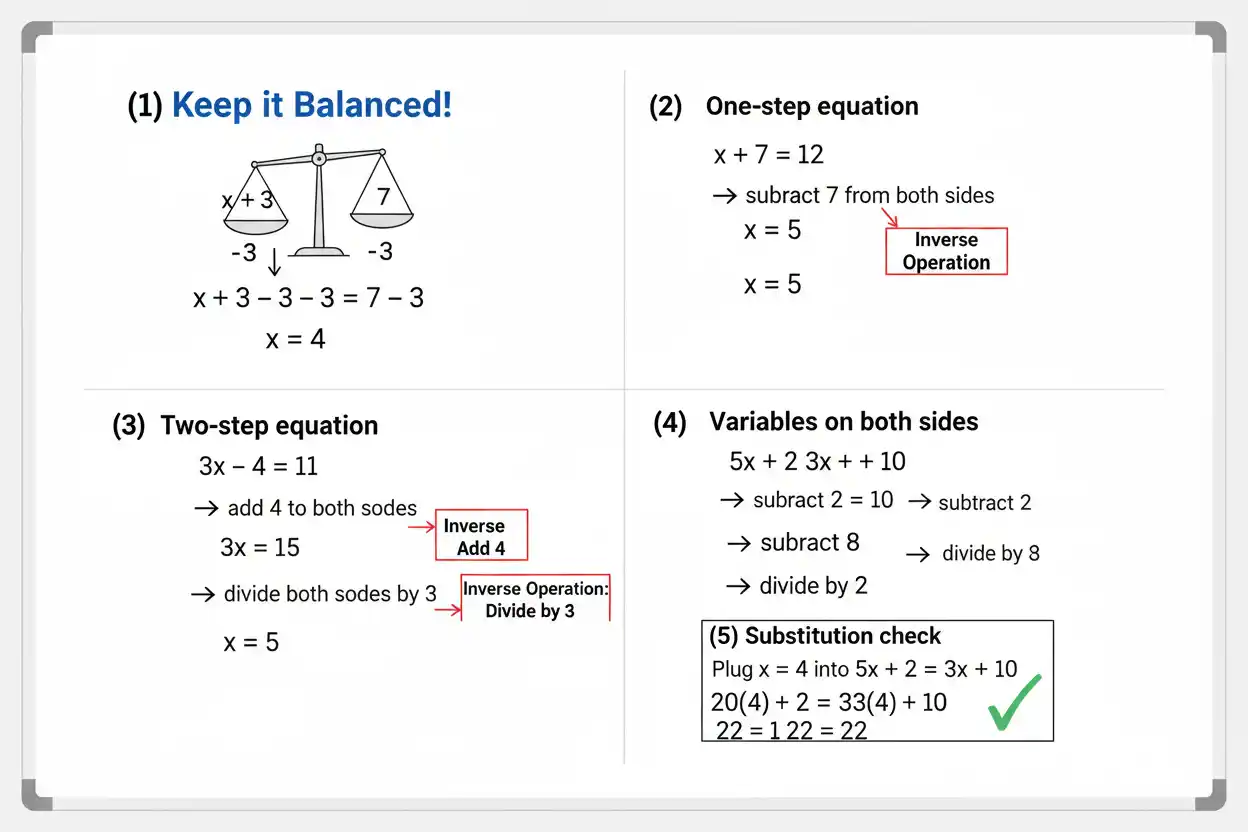

Solving equations means finding the value or values of a variable that make an equation true. When the variable is x, the goal is usually described as finding x or solving for x.
For example:
3x + 5 = 20
Subtract 5 from both sides:
3x = 15
Divide both sides by 3:
x = 5
Check:
3(5) + 5 = 20
20 = 20
The central principle is to preserve equality: whatever valid operation you perform on one side of an equation must also be performed on the other side.
What Does Solving an Equation Mean?
An equation states that two mathematical expressions have equal values.
For example:
2x + 3 = 11
To solve it, determine which x makes the equality true.
Subtract 3:
2x = 8
Divide by 2:
x = 4
Substitution confirms:
2(4) + 3 = 11
11 = 11
Therefore x = 4 is the solution.
Solving equations is one of the central skills in algebra because more specialized equation types build on the same idea of preserving equivalent relationships.
The Balance Rule for Equations
Think of an equation as a balanced scale.
If:
A = B
then adding the same quantity C to both sides preserves equality:
A + C = B + C
Subtracting the same quantity also preserves equality:
A – C = B – C
Multiplying both sides by the same quantity preserves equality:
AC = BC
Dividing both sides by the same nonzero quantity preserves equality:
A/C = B/C
The objective is usually to apply these operations until the variable is isolated.
Inverse Operations
Many equations are solved by reversing the operations applied to the variable.
Common inverse pairs are:
- addition and subtraction;
- multiplication and division;
- squaring and square roots, with appropriate care;
- exponentiation and logarithms in more advanced equations.
For:
x + 7 = 12
subtract 7.
For:
5x = 30
divide by 5.
For:
x/4 = 3
multiply by 4.
The operation that isolates x depends on how x appears in the equation.
One-Step Equation: Addition
Solve:
x + 9 = 17
Subtract 9 from both sides:
x = 8
Check:
8 + 9 = 17
Therefore:
x = 8
One-Step Equation: Subtraction
Solve:
x – 6 = 13
Add 6:
x = 19
Check:
19 – 6 = 13
One-Step Equation: Multiplication
Solve:
7x = 42
Divide both sides by 7:
x = 6
One-Step Equation: Division
Solve:
x/5 = 8
Multiply both sides by 5:
x = 40
These one-step examples show the basic principle of undoing the operation attached to x.
Solving Two-Step Equations
Consider:
4x + 3 = 23
First remove the constant:
4x = 20
Then divide by the coefficient:
x = 5
Check:
4(5) + 3 = 20 + 3 = 23
A common pattern is:
ax + b = c
which solves as:
x = (c – b)/a
provided:
a ≠ 0
This is the basic structure of a linear equation.
Example: Negative Constant
Solve:
3x – 11 = 7
Add 11:
3x = 18
Divide by 3:
x = 6
Check:
3(6) – 11 = 18 – 11 = 7
Example: Negative Coefficient
Solve:
-5x + 4 = 24
Subtract 4:
-5x = 20
Divide by -5:
x = -4
Check:
-5(-4) + 4 = 20 + 4 = 24
Unlike solving an inequality, dividing an equation by a negative number does not reverse any symbol. Equality remains equality.
Equations With Variables on Both Sides
Consider:
5x + 2 = 2x + 14
Subtract 2x from both sides:
3x + 2 = 14
Subtract 2:
3x = 12
Divide by 3:
x = 4
Check:
Left side:
5(4) + 2 = 22
Right side:
2(4) + 14 = 22
The solution is correct.
Choosing Which Variable Term to Move
Consider:
3x + 10 = 8x – 5
You could subtract 3x:
10 = 5x – 5
Then add 5:
15 = 5x
x = 3
You could instead subtract 8x and still obtain the same answer, but that creates a negative coefficient.
Choosing the easier direction can reduce sign errors.
Equations With Parentheses
Solve:
3(x + 4) = 27
One method is to divide by 3 first:
x + 4 = 9
x = 5
Another method is to distribute:
3x + 12 = 27
3x = 15
x = 5
Both preserve equality.
Distributive Property
For:
a(b + c)
the distributive property gives:
ab + ac
For example:
4(2x – 3) = 20
Expand:
8x – 12 = 20
Add 12:
8x = 32
Divide by 8:
x = 4
Check:
4(2(4) – 3)
= 4(8 – 3)
= 20
Distributing a Negative Number
Solve:
-2(x – 5) = 14
Distribute:
-2x + 10 = 14
Subtract 10:
-2x = 4
Divide by -2:
x = -2
The sign on each term inside the parentheses must be handled correctly.
Combining Like Terms
Consider:
3x + 5 + 2x – 7 = 18
Combine variable terms:
3x + 2x = 5x
Combine constants:
5 – 7 = -2
So:
5x – 2 = 18
Add 2:
5x = 20
x = 4
Simplifying each side before moving terms often makes an equation easier to solve.
Equations With Fractions
Solve:
x/3 + 2 = 7
Subtract 2:
x/3 = 5
Multiply by 3:
x = 15
Now consider:
x/4 + x/2 = 9
The least common denominator is 4.
Multiply every term by 4:
x + 2x = 36
3x = 36
x = 12
Clearing numerical fractions can make the equation much easier to read.
Fractions With Variable Denominators
If the variable itself appears in a denominator, additional restrictions apply.
For example:
1/(x – 2) = 3
requires:
x ≠ 2
This is no longer merely an ordinary fractional linear equation; it is a rational equation.
The denominator restriction must be preserved while solving.
Rational Expressions vs Equation Solving
An expression such as:
(x² – 4)/(x – 2)
can be factored and simplified, but there is no value of x to solve for unless the expression is placed inside an equation.
The rules for simplifying these algebraic fractions belong to rational expressions.
Once an equality is introduced:
(x² – 4)/(x – 2) = 5
the task becomes solving an equation, while still respecting the original denominator restriction.
Equations With Decimals
Solve:
0.4x + 1.2 = 5.6
Subtract 1.2:
0.4x = 4.4
Divide by 0.4:
x = 11
Alternatively, multiply the entire original equation by 10:
4x + 12 = 56
4x = 44
x = 11
Clearing decimals can make manual arithmetic more convenient.
Equations With Proportions
Suppose:
x/6 = 5/3
Multiply both sides by 6:
x = 6(5/3)
x = 10
You can also cross multiply:
3x = 30
x = 10
Cross multiplication is justified because the equation has one fraction on each side and the denominators are nonzero.
Solving for a Variable in a Formula
The variable you need to isolate does not always have to be x.
Suppose:
A = lw
Solve for w.
Divide both sides by l, assuming l ≠ 0:
w = A/l
Similarly, from slope-intercept form:
y = mx + b
you can solve for x:
y – b = mx
x = (y – b)/m
provided:
m ≠ 0
The form and interpretation of that line equation are covered under slope-intercept form.
Rearranging Standard Form of a Line
Suppose:
Ax + By = C
and you need to isolate y.
Subtract Ax:
By = -Ax + C
Divide by B:
y = (-A/B)x + C/B
provided:
B ≠ 0
This converts the equation into slope-intercept form.
The structure and conventions of:
Ax + By = C
are covered in standard form of a line.
Equations With No Solution
Consider:
4x + 3 = 4x + 9
Subtract 4x:
3 = 9
This is false.
Therefore:
No solution
No value of x can make the original equation true.
When the variable disappears and the remaining statement is false, the equation is inconsistent.
Equations With Infinitely Many Solutions
Consider:
3(x + 2) = 3x + 6
Expand:
3x + 6 = 3x + 6
Subtract 3x:
6 = 6
This statement is always true.
Therefore:
Every real x is a solution
This is an identity.
The variable disappears because both sides represent the same expression.
One Solution, No Solution, or Infinite Solutions
After simplifying an ordinary linear equation, three outcomes are common.
If you obtain:
x = number
there is one solution.
If you obtain a false statement such as:
2 = 9
there is no solution.
If you obtain a true identity such as:
5 = 5
there are infinitely many solutions within the equation’s original domain.
This classification is especially useful when variables appear on both sides.
Solving Quadratic Equations
Not every equation reduces to:
ax + b = c
For example:
x² – 5x + 6 = 0
is second degree.
Factor:
(x – 2)(x – 3) = 0
Then:
x = 2
or:
x = 3
Quadratic equations may require factoring, completing the square, square-root methods, or the quadratic formula. Those methods are covered in the dedicated quadratic equation guide rather than being duplicated here.
Equations Containing Radicals
An equation such as:
√(x + 5) = x – 1
requires special care because squaring both sides can introduce extraneous candidates.
The focused method is covered under radical equation.
The general equation-solving principle still applies: perform valid transformations and verify the final candidate in the original equation.
Equations Containing Logarithms
A logarithmic equation places an unknown inside a logarithm.
For example:
log₂(x) = 5
requires recognizing the equivalent exponential relationship:
x = 2^5
x = 32
Because logarithms impose domain restrictions, these problems have their own rules. The dedicated logarithmic equation guide handles that specialist intent.
Equations With Absolute Values
Consider:
|x| = 5
The distance of x from zero is 5, so:
x = 5
or:
x = -5
More complicated absolute-value equations usually split into separate cases. Those rules are covered under absolute value equation.
Factoring Identities When Solving Equations
Some higher-degree equations become manageable after recognizing a special factorization.
For example:
x³ – 8 = 0
is a difference of cubes:
x³ – 2³ = 0
The factorization is:
(x – 2)(x² + 2x + 4) = 0
The pattern belongs to sum and difference of cubes.
This illustrates an important general principle: solving equations often depends on first recognizing the expression’s structure, then applying the specialist algebraic rule appropriate to that structure.
Why You Should Not Divide by an Unknown Factor Too Early
Consider:
x(x – 5) = 0
If you divide both sides by x immediately, you get:
x – 5 = 0
and:
x = 5
But this loses the valid solution:
x = 0
Instead, use the zero-product property:
x = 0
or:
x – 5 = 0
Therefore:
x = 0, 5
Division by an expression that might equal zero can remove valid solutions.
Squaring Both Sides Can Change the Solution Set
If:
A = B
then:
A² = B²
is necessarily true.
But the reverse is not always true because:
A² = B²
allows:
A = B
or:
A = -B
For example:
3² = (-3)²
although:
3 ≠ -3
Therefore equation-solving steps that are not reversible in both directions can create extra candidate solutions.
This is why equations involving radicals require checking.
Multiplying by an Expression That May Be Zero
Suppose an equation contains denominators.
Multiplying by their least common denominator can simplify the equation, but values that made the original denominator zero remain excluded.
For example:
1/(x – 3) = 2/(x – 3)
requires:
x ≠ 3
Multiplying both sides by x – 3 gives:
1 = 2
which has no solution.
The multiplication does not restore x = 3 as a possible value.
Checking a Solution
A solution should make the original equation true.
Suppose:
5x – 7 = 18
Solving gives:
5x = 25
x = 5
Check:
5(5) – 7
= 25 – 7
= 18
Therefore x = 5 is correct.
Checking is particularly important after operations that may alter the solution set, such as squaring or multiplying by variable expressions.
Checking Fractional Solutions
Suppose:
6x + 1 = 4
Then:
6x = 3
x = 1/2
Check:
6(1/2) + 1
= 3 + 1
= 4
A fractional answer is not evidence of an error. Equations can have integer, fractional, irrational, or complex solutions depending on their structure.
Equations With Negative Solutions
Suppose:
4x + 9 = 1
Subtract 9:
4x = -8
Divide by 4:
x = -2
Check:
4(-2) + 9
= -8 + 9
= 1
Negative values are ordinary solutions when they satisfy the original equation.
Solving Word Problems With Equations
An equation can represent a verbal relationship.
Suppose a number increased by 7 equals 19.
Let the number be x:
x + 7 = 19
Subtract 7:
x = 12
The algebraic solving step is straightforward once the wording has been translated correctly.
In more complex applications, defining the variable clearly before writing the equation can prevent setup errors.
Example: Consecutive Numbers
Suppose two consecutive integers have a sum of 25.
Let the first integer be:
x
Then the next is:
x + 1
Write:
x + (x + 1) = 25
Simplify:
2x + 1 = 25
2x = 24
x = 12
The integers are:
12 and 13
Check:
12 + 13 = 25
Example: Percentage Equation
Suppose 20% of a number is 14.
Write:
0.20x = 14
Divide by 0.20:
x = 70
Check:
20% of 70 = 14
The main equation-solving rule is unchanged even though the coefficient is expressed as a percentage.
Example: Equation With Parentheses on Both Sides
Solve:
3(x – 2) + 4 = 2(x + 5)
Expand:
3x – 6 + 4 = 2x + 10
Combine:
3x – 2 = 2x + 10
Subtract 2x:
x – 2 = 10
Add 2:
x = 12
Check:
Left side:
3(12 – 2) + 4 = 34
Right side:
2(12 + 5) = 34
So:
x = 12
Example: Fractional Coefficients
Solve:
(2/3)x – 5 = 7
Add 5:
(2/3)x = 12
Multiply by 3/2:
x = 18
Check:
(2/3)(18) – 5
= 12 – 5
= 7
Multiplying by the reciprocal reverses multiplication by a nonzero fraction.
Order of Operations When Checking
When substituting a solution, follow the ordinary order of operations.
Suppose:
2x² – 3 = 15
and x = 3 is being checked.
Evaluate:
2(3²) – 3
First square:
3² = 9
Then multiply:
2 × 9 = 18
Then subtract:
18 – 3 = 15
The equation is satisfied.
Correct substitution can fail if the order of operations is ignored.
Common Solving Equations Mistakes
Performing an Operation on Only One Side
From:
x + 5 = 12
if you subtract 5, subtract it from both sides:
x + 5 – 5 = 12 – 5
Changing Signs Without Performing an Operation
Terms do not simply “move across the equals sign and change sign.” That shortcut represents adding or subtracting the same term from both sides.
Understanding the actual operation reduces sign mistakes.
Incorrect Distribution
For:
-3(x – 4)
the correct expansion is:
-3x + 12
Combining Unlike Terms
You cannot combine:
3x + 5
into 8x.
Only like terms can be combined.
Dividing by Zero
Division by zero is undefined. Never divide both sides by an expression unless the operation is valid for the solutions under consideration.
Losing Solutions by Dividing by a Variable
From:
x(x – 2) = 0
dividing by x loses x = 0.
Accepting Extraneous Solutions
Some transformations, especially squaring, can create candidates that do not satisfy the original equation.
Forgetting Domain Restrictions
Rational, logarithmic, and radical equations can restrict which x-values are permitted before solving even begins.
A Reliable Equation-Solving Checklist
For an ordinary algebraic equation, simplify each side first where useful. Remove parentheses correctly, combine like terms, and then collect variable terms on one side and constants on the other.
Use inverse operations to isolate the variable.
If the equation’s structure is specialized—rational, radical, quadratic, logarithmic, absolute-value, or higher-degree polynomial—apply the appropriate specialist method instead of forcing linear steps onto it.
Finally, substitute the answer into the original equation whenever checking is practical or necessary.
Worked Example
Solve:
4(2x – 3) + 5 = 3(x + 7) + 2
Expand both sides:
8x – 12 + 5 = 3x + 21 + 2
Combine like terms:
8x – 7 = 3x + 23
Subtract 3x:
5x – 7 = 23
Add 7:
5x = 30
Divide by 5:
x = 6
Check the original equation.
Left side:
4(2(6) – 3) + 5
= 4(12 – 3) + 5
= 4(9) + 5
= 41
Right side:
3(6 + 7) + 2
= 3(13) + 2
= 41
Therefore:
x = 6
Frequently Asked Questions
What does solving equations mean?
Solving equations means finding the value or values of a variable that make an equation true.
How do you find x?
Use equivalent operations to isolate x while preserving equality. The exact steps depend on how x appears in the equation.
What is the golden rule for solving equations?
Perform the same valid operation on both sides of the equation.
How do you solve x + a = b?
Subtract a from both sides:
x = b – a
How do you solve ax = b?
Divide both sides by a:
x = b/a
provided:
a ≠ 0
How do you solve ax + b = c?
Subtract b:
ax = c – b
then divide by a:
x = (c – b)/a
for a ≠ 0.
What if x appears on both sides?
Use addition or subtraction to collect variable terms on one side, then isolate x using ordinary inverse operations.
Can an equation have no solution?
Yes. If simplification produces a false statement such as:
4 = 9
the equation has no solution.
Can an equation have infinitely many solutions?
Yes. If both sides simplify to the same expression and produce an identity such as:
7 = 7
every value in the equation’s permitted domain may be a solution.
Why should an answer be checked?
Substitution confirms that the proposed value satisfies the original equation and can reveal extraneous or prohibited values.
Can x be a fraction or negative number?
Yes. A valid solution can be positive, negative, zero, fractional, irrational, or complex depending on the equation.
When do I need a specialist equation method?
Use a specialist method when the equation contains structures such as variable denominators, radicals, quadratic terms, logarithms, absolute values, or higher-degree polynomial factors. The general balancing principle still applies, but each structure can introduce additional rules or restrictions.