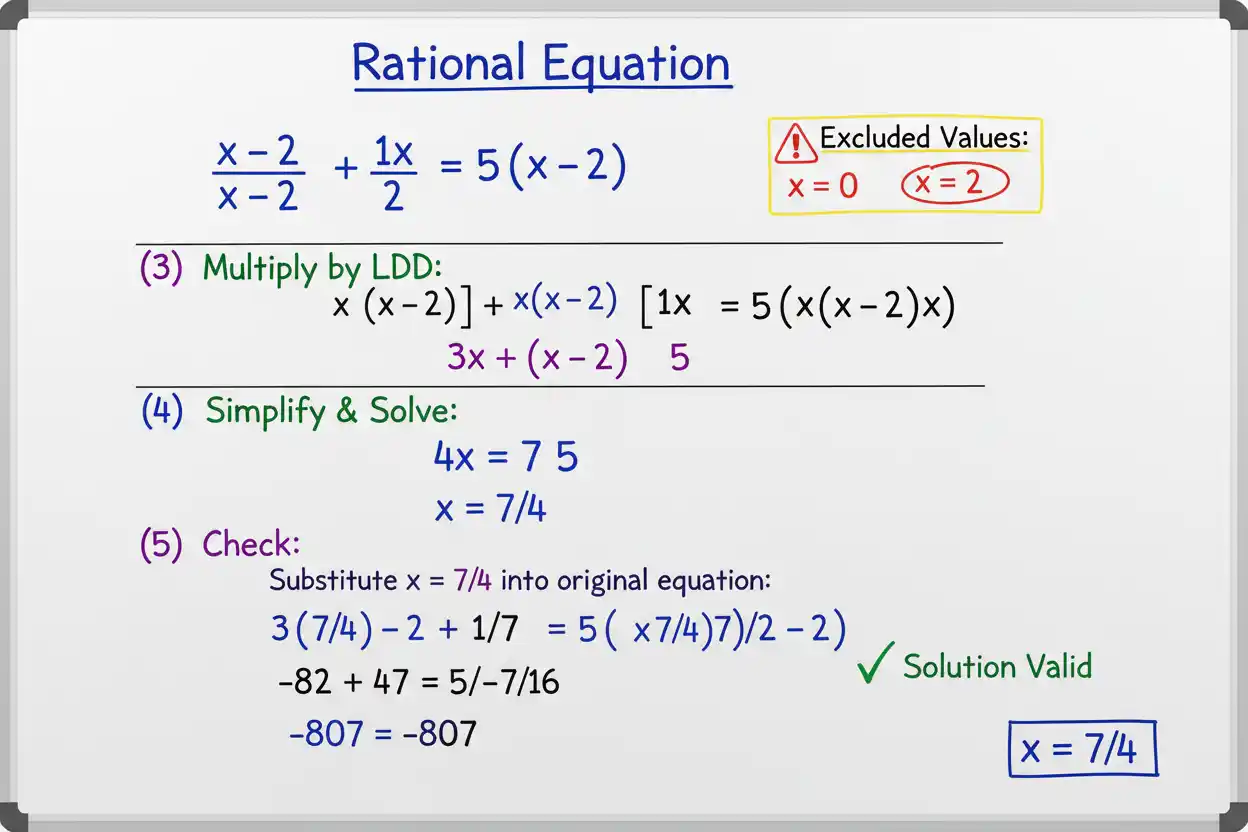

A rational equation is an equation containing one or more rational expressions, typically with a variable in a denominator.
For example:
1/(x – 2) = 3/(x + 1)
is a rational equation.
Before solving, identify values that make any denominator zero:
x ≠ 2
x ≠ -1
Then multiply the equation by the least common denominator:
LCD = (x – 2)(x + 1)
This gives:
x + 1 = 3(x – 2)
Solving:
x + 1 = 3x – 6
7 = 2x
x = 7/2
Since 7/2 does not violate either denominator restriction, it is a valid solution.
The essential rule is: find excluded values first, clear the denominators correctly, solve the resulting equation, and check each answer against the original rational equation.
What Is a Rational Equation?
A rational equation is an equation involving fractions whose numerators and denominators are polynomial expressions.
A general example is:
P(x)/Q(x) = R(x)/S(x)
where Q(x) and S(x) cannot equal zero.
Examples include:
2/x = 5
1/(x + 3) + 2/(x – 1) = 4
(x + 2)/(x – 4) = 3
2/x + 1/(x – 1) = 3
Rational equations are part of algebra because they combine ordinary equation-solving rules with denominator restrictions.
The fractions themselves are rational expressions. Once an equals sign creates a condition that must be solved, the problem becomes a rational equation.
Rational Equation Formula
There is no single formula that solves every rational equation. The standard method is based on the least common denominator.
If:
A/B = C/D
with:
B ≠ 0
and:
D ≠ 0
then multiplying both sides by BD gives:
AD = BC
This resembles cross multiplication, but the denominator restrictions must remain in force.
For equations containing more than two fractions, use the least common denominator rather than trying to cross multiply unrelated terms.
The Most Important Rational Equation Rule
Before manipulating the equation, determine every value that makes a denominator zero.
For example:
3/(x – 5) + 1/x = 2
has denominators:
x – 5
and:
x
Therefore:
x ≠ 5
and:
x ≠ 0
These values cannot be solutions under any circumstances because the original equation is undefined there.
Even if later algebra produces x = 5 or x = 0, those values must be rejected.
Why Denominator Restrictions Matter
Consider:
(x + 2)/(x – 3) = 5/(x – 3)
The denominator requires:
x ≠ 3
Multiply both sides by x – 3:
x + 2 = 5
Solve:
x = 3
But x = 3 was excluded from the original equation.
Therefore:
No solution
The algebraic candidate is not a valid solution because substituting x = 3 into the original equation would require division by zero.
How to Solve a Rational Equation
A reliable method is to identify denominator restrictions first. Then find the least common denominator, multiply every term by it, and simplify until the fractions disappear.
After that, solve the resulting linear, quadratic, or other algebraic equation.
Finally, compare every candidate with the original restrictions and substitute valid candidates into the original equation when useful.
The restrictions belong to the original rational equation and remain relevant even after the denominators disappear.
Example 1: One Fraction
Solve:
4/(x + 1) = 2
Restriction:
x ≠ -1
Multiply both sides by x + 1:
4 = 2(x + 1)
Expand:
4 = 2x + 2
Subtract 2:
2 = 2x
x = 1
Check the restriction:
1 ≠ -1
Check the original equation:
4/(1 + 1) = 4/2 = 2
Therefore:
x = 1
Example 2: Fractions on Both Sides
Solve:
3/(x – 2) = 5/(x + 4)
Restrictions:
x ≠ 2
x ≠ -4
The least common denominator is:
(x – 2)(x + 4)
Clear the denominators:
3(x + 4) = 5(x – 2)
Expand:
3x + 12 = 5x – 10
Add 10:
3x + 22 = 5x
Subtract 3x:
22 = 2x
x = 11
The value 11 is permitted.
Check:
3/(11 – 2) = 3/9 = 1/3
and:
5/(11 + 4) = 5/15 = 1/3
Therefore:
x = 11
Cross Multiplication in a Rational Equation
When there is exactly one fraction on each side:
A/B = C/D
you can write:
AD = BC
provided:
B ≠ 0
and:
D ≠ 0
For example:
(x + 1)/4 = (2x – 3)/5
Cross multiply:
5(x + 1) = 4(2x – 3)
Expand:
5x + 5 = 8x – 12
Add 12:
5x + 17 = 8x
17 = 3x
x = 17/3
Cross multiplication is simply a shortcut for multiplying both sides by the common denominator.
Do Not Cross Multiply Across a Sum
Consider:
1/x + 2/(x + 1) = 3
There are multiple terms on the left side, so ordinary two-fraction cross multiplication does not apply.
Instead, use the least common denominator:
LCD = x(x + 1)
This distinction prevents a common rational-equation error.
Example 3: Two Fractions on One Side
Solve:
1/x + 1/(x + 2) = 3/4
Restrictions:
x ≠ 0
x ≠ -2
The LCD is:
4x(x + 2)
Multiply every term by it.
First term:
4x(x + 2) × 1/x = 4(x + 2)
Second term:
4x(x + 2) × 1/(x + 2) = 4x
Right side:
4x(x + 2) × 3/4 = 3x(x + 2)
So:
4(x + 2) + 4x = 3x(x + 2)
Expand:
4x + 8 + 4x = 3x² + 6x
8x + 8 = 3x² + 6x
Move all terms to one side:
3x² – 2x – 8 = 0
Factor:
(3x + 4)(x – 2) = 0
Therefore:
x = -4/3
or:
x = 2
Neither value violates x ≠ 0 or x ≠ -2, so both remain candidates.
Check x = 2:
1/2 + 1/4 = 3/4
Valid.
Check x = -4/3:
1/(-4/3) + 1/(2/3)
= -3/4 + 3/2
= -3/4 + 6/4
= 3/4
Valid.
Therefore:
x = -4/3, 2
Rational Equations That Become Linear Equations
Many rational equations become linear after denominators are cleared.
For example:
2/(x – 1) = 6/(x + 3)
Restrictions:
x ≠ 1, -3
Cross multiply:
2(x + 3) = 6(x – 1)
Expand:
2x + 6 = 6x – 6
12 = 4x
x = 3
After the denominators disappear, the remaining calculation follows ordinary linear-equation rules.
Rational Equations That Become Quadratic
A rational equation can also become quadratic.
Consider:
2/x + 1/(x – 1) = 3
Restrictions:
x ≠ 0
x ≠ 1
Multiply every term by:
x(x – 1)
This gives:
2(x – 1) + x = 3x(x – 1)
Expand:
2x – 2 + x = 3x² – 3x
3x – 2 = 3x² – 3x
Move all terms to one side:
3x² – 6x + 2 = 0
This quadratic does not factor conveniently with integers, so the quadratic formula can be used.
Here:
a = 3
b = -6
c = 2
Therefore:
x = (6 ± √(36 – 24)) / 6
x = (6 ± √12) / 6
x = (6 ± 2√3) / 6
x = (3 ± √3) / 3
Neither solution equals 0 or 1, so both are valid.
Factoring the Least Common Denominator
Sometimes a denominator must be factored before the LCD becomes clear.
Suppose an equation contains:
1/(x² – 9)
Factor:
x² – 9 = (x – 3)(x + 3)
The restrictions are:
x ≠ 3
x ≠ -3
If another denominator is x – 3, the LCD does not need an additional copy of x – 3; the factor already appears in x² – 9.
Factoring denominators before forming the LCD prevents unnecessary complexity.
Repeated Denominator Factors
Suppose the denominators include:
x – 2
and:
(x – 2)²
The LCD must contain the highest required power:
LCD = (x – 2)²
Using only x – 2 would fail to clear every denominator.
The restriction remains:
x ≠ 2
regardless of how many times the factor appears.
Example 4: Factored Denominators
Solve:
1/(x – 2) + 2/(x + 2) = 8/(x² – 4)
Factor:
x² – 4 = (x – 2)(x + 2)
Restrictions:
x ≠ 2
x ≠ -2
The LCD is:
(x – 2)(x + 2)
Multiply each term:
x + 2 + 2(x – 2) = 8
Expand:
x + 2 + 2x – 4 = 8
3x – 2 = 8
3x = 10
x = 10/3
This value is not excluded.
Therefore:
x = 10/3
Rational Equations With a Candidate Excluded by the Domain
Solve:
(x + 5)/(x – 4) = 9/(x – 4)
Restriction:
x ≠ 4
Multiply by x – 4:
x + 5 = 9
x = 4
But:
x = 4
makes the original denominator zero.
Therefore:
No solution
This example shows why restrictions should be written before denominators are cleared.
Rational Equation With No Solution After Simplification
A rational equation can also lead directly to a contradiction.
For example:
1/(x – 2) = 1/(x – 2) + 3
Restriction:
x ≠ 2
Subtract the identical fraction from both sides:
0 = 3
This is false.
Therefore:
No solution
The result is not caused by an excluded candidate; the equation simply cannot be true for any value in its domain.
Rational Equation With Infinitely Many Solutions
Consider:
2/(x + 1) + 1 = (x + 3)/(x + 1)
Restriction:
x ≠ -1
Write 1 with the common denominator:
1 = (x + 1)/(x + 1)
Then the left side becomes:
2/(x + 1) + (x + 1)/(x + 1)
= (x + 3)/(x + 1)
which is exactly the right side.
Therefore every real number in the domain satisfies the equation:
All real x except x = -1
An identity does not restore values excluded from the original denominator.
Rational Equation vs Rational Expression
A rational expression is an algebraic quantity such as:
(x + 2)/(x – 5)
It may be simplified, multiplied, divided, added, or subtracted.
A rational equation adds an equality condition:
(x + 2)/(x – 5) = 3
and asks for the values of x that make the statement true.
The distinction matters because simplifying an expression does not involve finding a solution set, whereas solving an equation does.
Rational Equation vs Radical Equation
A radical equation places the unknown inside a root, such as:
√(x + 2) = 5
A rational equation places variable expressions in denominators.
Both types require restrictions and checking, but for different reasons. Rational equations prohibit denominator zeros, while even-root radical equations require appropriate radicands and may produce extraneous candidates after squaring.
Rational Equations Containing Radicals
An equation can contain both rational and radical structures.
For example:
1/√x = 2
has a radical in the denominator.
The square root requires:
x ≥ 0
while the denominator requires:
√x ≠ 0
Together:
x > 0
The techniques for simplifying the root itself come from radical expressions, while the equation still requires denominator restrictions and algebraic solving.
Rational Equations and Linear Functions
Rational equations can appear while solving for parameters in a linear relationship.
For instance, rearranging a formula may produce a variable in a denominator even though the final relationship is linear after simplification.
This is distinct from slope-intercept form:
y = mx + b
where m and b are constants. A fractional value of m does not by itself make the line a rational-equation problem; the defining issue is whether an unknown occurs inside a denominator that must be cleared during equation solving.
Clearing Denominators Correctly
Suppose:
2/x – 3/(x + 1) = 1
The LCD is:
x(x + 1)
Multiply the entire equation by the LCD:
x(x + 1)[2/x – 3/(x + 1)] = x(x + 1)
Each term must be multiplied.
That produces:
2(x + 1) – 3x = x(x + 1)
Skipping even one term changes the equation.
Why Canceling Across Addition Is Invalid
Consider:
(x + 2)/x
You cannot cancel the x from part of x + 2 because x is not a factor of the entire numerator.
By contrast:
x(x + 2)/x
can simplify to:
x + 2
provided:
x ≠ 0
Cancellation applies to common factors, not individual terms separated by addition or subtraction.
This rule is important both before and after clearing denominators.
Checking Rational Equation Solutions
A candidate can be checked by direct substitution into the original equation.
Suppose:
1/(x – 1) = 2/(x + 2)
Solving gives:
x = 4
Check:
1/(4 – 1) = 1/3
and:
2/(4 + 2) = 2/6 = 1/3
The two sides agree, and x = 4 does not make either denominator zero.
Therefore the solution is valid.
Common Rational Equation Mistakes
Forgetting Excluded Values
Every denominator must be nonzero.
Write the restrictions before clearing fractions.
Multiplying Only Some Terms by the LCD
The LCD must multiply every term on both sides.
Cross Multiplying Across Addition
Cross multiplication applies directly to one fraction equal to another fraction, not to a sum of several fractions.
Canceling Terms Instead of Factors
From:
(x + 3)/x
the x cannot be canceled because x + 3 is a sum.
Accepting an Excluded Candidate
A value obtained algebraically is not a solution if it makes an original denominator zero.
Using an Incomplete LCD
Repeated or factored denominators must be represented with the necessary factors and powers.
Forgetting to Factor Denominators First
A denominator such as:
x² – 9
should be recognized as:
(x – 3)(x + 3)
before the LCD is chosen.
Worked Rational Equation Example
Solve:
2/(x – 1) + 1/(x + 1) = 3/(x² – 1)
First factor:
x² – 1 = (x – 1)(x + 1)
Restrictions:
x ≠ 1
x ≠ -1
The LCD is:
(x – 1)(x + 1)
Multiply every term by the LCD:
2(x + 1) + (x – 1) = 3
Expand:
2x + 2 + x – 1 = 3
3x + 1 = 3
Subtract 1:
3x = 2
x = 2/3
The value 2/3 is neither 1 nor -1.
Check the original equation.
Left side:
2/(2/3 – 1) + 1/(2/3 + 1)
= 2/(-1/3) + 1/(5/3)
= -6 + 3/5
= -27/5
Right side:
3/((2/3)² – 1)
= 3/(4/9 – 1)
= 3/(-5/9)
= -27/5
Both sides agree.
Therefore:
x = 2/3
Frequently Asked Questions
What is a rational equation?
A rational equation is an equation containing one or more rational expressions, often with an unknown in a denominator.
How do you solve a rational equation?
Identify excluded denominator values, find the least common denominator, multiply every term by it, solve the resulting equation, and reject any value that makes an original denominator zero.
What values are excluded from a rational equation?
Any value that makes an original denominator equal zero is excluded.
Why should restrictions be found before solving?
Clearing denominators can make excluded values disappear from view. Writing the restrictions first prevents an invalid candidate from being accepted later.
Can rational equations become quadratic equations?
Yes. Clearing denominators can produce a quadratic or higher-degree polynomial equation.
What is the LCD in a rational equation?
The LCD is the least common denominator containing every denominator factor at the highest power needed to clear all fractions.
When can you cross multiply?
Cross multiplication applies directly when one fraction equals another fraction:
A/B = C/D
with nonzero denominators.
Can a rational equation have no solution?
Yes. It may produce only excluded candidates or simplify to a contradiction.
Can a rational equation have infinitely many solutions?
Yes. If both sides represent the same rational expression, every value in the original domain may satisfy the equation.
Why can’t a denominator equal zero?
Division by zero is undefined. Any x-value that produces a zero denominator is outside the equation’s domain.
How do you check a rational equation solution?
Substitute the candidate into the original equation. Verify that every denominator is nonzero and that both sides have the same value.
Is every fraction equation a rational equation?
In algebra, an equation involving quotients of polynomial expressions is a rational equation. A simple numerical fraction equation may not involve any variable denominator, but it still uses related fraction-solving principles.