
Rational expressions are ratios of polynomial expressions. Their general form is:
P(x) / Q(x)
where P(x) and Q(x) are polynomials and:
Q(x) ≠ 0
For example:
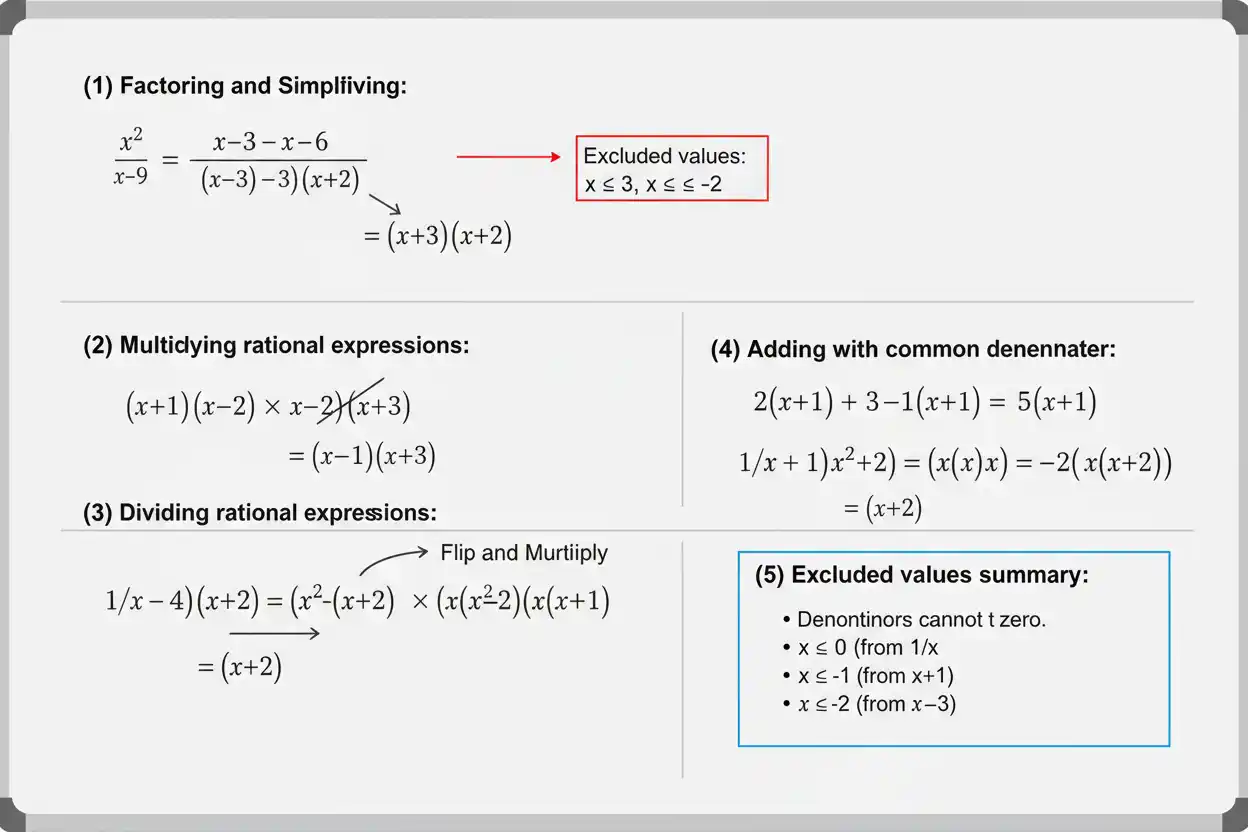
(x² – 9)/(x² – x – 6)
is a rational expression.
Factor the numerator and denominator:
x² – 9 = (x – 3)(x + 3)
x² – x – 6 = (x – 3)(x + 2)
Therefore:
[(x – 3)(x + 3)] / [(x – 3)(x + 2)]
Cancel the common factor x – 3:
(x + 3)/(x + 2)
but preserve the original restrictions:
x ≠ 3
x ≠ -2
The simplified expression has the same value as the original wherever the original expression is defined, but cancellation does not make an originally excluded value valid.
What Is a Rational Expression?
A rational expression is an algebraic fraction whose numerator and denominator are polynomials.
Examples include:
3/x
(x + 2)/(x – 5)
(x² – 4)/(x² + 3x + 2)
(2x³ + x)/(x² – 9)
A polynomial can itself be viewed as a rational expression with denominator 1:
x² + 3x + 1 = (x² + 3x + 1)/1
However, rational-expression problems are especially concerned with variable denominators, factoring, domain restrictions, and fraction operations.
Rational expressions are a core topic in algebra.
Rational Expression Formula
The general form is:
R(x) = P(x)/Q(x)
subject to:
Q(x) ≠ 0
The denominator restriction is part of the expression’s domain.
For example:
R(x) = (x + 1)/(x – 4)
requires:
x – 4 ≠ 0
so:
x ≠ 4
The expression is undefined at x = 4.
Why Denominator Restrictions Matter
Consider:
(x² – 4)/(x – 2)
Factor the numerator:
x² – 4 = (x – 2)(x + 2)
Then:
[(x – 2)(x + 2)]/(x – 2)
simplifies to:
x + 2
but the original denominator requires:
x ≠ 2
Therefore the correct simplified description is:
x + 2, with x ≠ 2
At x = 2, the simplified formula x + 2 has a numerical value, but the original rational expression does not.
How to Find Excluded Values
Set each original denominator equal to zero and solve.
For:
(x + 5)/(x² – 9)
factor the denominator:
x² – 9 = (x – 3)(x + 3)
Set each factor equal to zero:
x – 3 = 0
x + 3 = 0
Therefore:
x ≠ 3
x ≠ -3
These restrictions should be identified before canceling factors.
Simplifying Rational Expressions
The general procedure is to factor the numerator and denominator completely, identify excluded values from the original denominator, and cancel factors that appear in both numerator and denominator.
Cancellation applies to factors, not individual terms.
For example:
(x² + 5x + 6)/(x² + 4x + 3)
Factor:
x² + 5x + 6 = (x + 2)(x + 3)
x² + 4x + 3 = (x + 1)(x + 3)
Then:
[(x + 2)(x + 3)] / [(x + 1)(x + 3)]
Cancel x + 3:
(x + 2)/(x + 1)
The original restrictions are:
x ≠ -1
x ≠ -3
Why You Cannot Cancel Across Addition
Consider:
(x + 4)/x
It is incorrect to “cancel” x and write 4.
The numerator is a sum, not a product containing x as a factor.
By contrast:
x(x + 4)/x
has x as a common factor of the entire numerator and denominator, so it simplifies to:
x + 4
provided:
x ≠ 0
A factor must multiply the entire numerator or denominator before it can be canceled.
Example 1: Simplify a Rational Expression
Simplify:
(x² – 16)/(x² + x – 20)
Factor the numerator:
x² – 16 = (x – 4)(x + 4)
Factor the denominator:
x² + x – 20 = (x + 5)(x – 4)
Restrictions:
x ≠ -5
x ≠ 4
Now cancel x – 4:
(x + 4)/(x + 5)
Therefore:
(x² – 16)/(x² + x – 20) = (x + 4)/(x + 5)
with:
x ≠ 4, -5
Multiplying Rational Expressions
Multiply numerators together and denominators together:
A/B × C/D = AC/BD
where B and D are nonzero.
Factoring before multiplication often reveals factors that can be canceled.
For example:
(x² – 9)/(x² – 4) × (x + 2)/(x – 3)
Factor:
x² – 9 = (x – 3)(x + 3)
x² – 4 = (x – 2)(x + 2)
So:
[(x – 3)(x + 3)] / [(x – 2)(x + 2)] × (x + 2)/(x – 3)
Cancel x – 3 and x + 2:
(x + 3)/(x – 2)
Original restrictions include:
x ≠ 2
x ≠ -2
x ≠ 3
because those values made an original denominator zero.
Cross-Cancel Before Multiplying
When factors appear across numerators and denominators, canceling before expansion usually reduces the arithmetic.
For example:
[3(x – 2)/(x + 5)] × [(x + 5)/(6(x – 2))]
Cancel x – 2 and x + 5:
3/6
Simplify:
1/2
with the original restrictions:
x ≠ -5
x ≠ 2
Expanding the factors first would make the calculation longer without changing the result.
Dividing Rational Expressions
To divide by a rational expression, multiply by its reciprocal.
For:
A/B ÷ C/D
write:
A/B × D/C
provided the original expressions and the divisor are defined.
For example:
(x + 2)/(x – 3) ÷ (x + 2)/(x + 4)
Rewrite:
(x + 2)/(x – 3) × (x + 4)/(x + 2)
Cancel x + 2:
(x + 4)/(x – 3)
But the original problem imposes several restrictions.
From x – 3:
x ≠ 3
From x + 4:
x ≠ -4
And because the divisor:
(x + 2)/(x + 4)
cannot equal zero, require:
x ≠ -2
Therefore the simplified result has:
x ≠ 3, -4, -2
Why the Divisor Cannot Equal Zero
Ordinary division by zero is undefined, and the same rule applies to algebraic fractions.
If dividing by:
(x – 5)/(x + 2)
the expression itself requires:
x ≠ -2
But the divisor must also not equal zero:
x – 5 ≠ 0
so:
x ≠ 5
When dividing rational expressions, restrictions therefore come from both denominators and from values that make the entire divisor zero.
Adding Rational Expressions With Like Denominators
If the denominators are identical:
A/C + B/C = (A + B)/C
For example:
3/(x + 2) + 5/(x + 2)
combine the numerators:
8/(x + 2)
with:
x ≠ -2
Do not add the denominator twice.
Subtracting Rational Expressions With Like Denominators
For:
A/C – B/C
combine:
(A – B)/C
For example:
(2x + 5)/(x – 1) – (x – 3)/(x – 1)
Combine numerators:
[(2x + 5) – (x – 3)]/(x – 1)
Distribute the subtraction:
(2x + 5 – x + 3)/(x – 1)
(x + 8)/(x – 1)
with:
x ≠ 1
Parentheses are important when subtracting an entire numerator.
Adding Rational Expressions With Unlike Denominators
Unlike denominators require a common denominator.
Consider:
1/x + 1/(x + 2)
The LCD is:
x(x + 2)
Rewrite:
1/x = (x + 2)/[x(x + 2)]
and:
1/(x + 2) = x/[x(x + 2)]
Now add:
(x + 2 + x)/[x(x + 2)]
(2x + 2)/[x(x + 2)]
Factor the numerator if useful:
2(x + 1)/[x(x + 2)]
Restrictions:
x ≠ 0
x ≠ -2
Example 2: Add Rational Expressions
Simplify:
2/(x – 1) + 3/(x + 1)
The common denominator is:
(x – 1)(x + 1)
Rewrite:
2(x + 1)/[(x – 1)(x + 1)] + 3(x – 1)/[(x – 1)(x + 1)]
Combine numerators:
2(x + 1) + 3(x – 1)
Expand:
2x + 2 + 3x – 3
5x – 1
Therefore:
2/(x – 1) + 3/(x + 1) = (5x – 1)/[(x – 1)(x + 1)]
or:
(5x – 1)/(x² – 1)
with:
x ≠ 1, -1
Finding the Least Common Denominator
The least common denominator contains each denominator factor at the greatest power required.
Suppose the denominators are:
x
x + 2
and:
x(x + 2)
The LCD is simply:
x(x + 2)
Now suppose the denominators are:
x – 1
and:
(x – 1)²
The LCD is:
(x – 1)²
Repeated factors should not be unnecessarily duplicated beyond the highest required power.
Example With a Repeated Factor
Add:
1/(x – 2) + 3/(x – 2)²
The LCD is:
(x – 2)²
Rewrite the first term:
(x – 2)/(x – 2)²
Then:
(x – 2)/(x – 2)² + 3/(x – 2)²
Combine:
(x + 1)/(x – 2)²
with:
x ≠ 2
Subtracting Unlike Rational Expressions
Simplify:
3/x – 2/(x + 1)
The common denominator is:
x(x + 1)
Rewrite:
3(x + 1)/[x(x + 1)] – 2x/[x(x + 1)]
Combine:
[3(x + 1) – 2x]/[x(x + 1)]
Expand:
(3x + 3 – 2x)/[x(x + 1)]
(x + 3)/[x(x + 1)]
Restrictions:
x ≠ 0, -1
Complex Rational Expressions
A complex rational expression contains fractions within a larger fraction.
For example:
(1/x + 1/y) / (1/x)
One approach is to simplify the numerator first:
1/x + 1/y = (x + y)/(xy)
Then:
[(x + y)/(xy)] / (1/x)
Multiply by the reciprocal:
(x + y)/(xy) × x
Cancel x:
(x + y)/y
The original variables must satisfy:
x ≠ 0
y ≠ 0
Another approach is to multiply the numerator and denominator of the large fraction by the LCD xy.
Rational Expressions and Factoring
Factoring is central to rational-expression simplification because cancellation works only on factors.
For example:
(x² – 5x + 6)/(x² – 4)
Factor:
x² – 5x + 6 = (x – 2)(x – 3)
x² – 4 = (x – 2)(x + 2)
Then:
(x – 3)/(x + 2)
with original restrictions:
x ≠ 2, -2
Expanding first would hide the common factor rather than reveal it.
Rational Expressions and Radical Expressions
Radical expressions contain roots, while rational expressions are quotients of polynomials.
For example:
(x + 1)/(x – 2)
is rational.
√(x + 1)
is radical.
An expression such as:
√x/(x – 2)
contains both structures. Its real domain must satisfy the square-root restriction and the denominator restriction simultaneously.
Rational Expressions vs Rational Equations
A rational expression has no equality to solve:
(x + 3)/(x – 1)
A rational equation might be:
(x + 3)/(x – 1) = 4
Simplifying rational expressions focuses on algebraic form and domain restrictions. Solving a rational equation focuses on finding variable values that satisfy an equality.
The distinction is similar to the broader difference between simplifying an expression and solving equations.
Rational Expressions in Linear Formulas
A fraction appearing in a formula does not automatically mean that a variable is in a denominator.
For example, slope-intercept form can contain:
y = (2/3)x + 4
The value 2/3 is simply a constant slope.
By contrast:
y = 2/x + 4
has x in a denominator and represents a fundamentally different algebraic structure.
This distinction helps separate ordinary fractional coefficients from variable-dependent rational expressions.
Rational Expressions vs Radical Equations
A radical equation requires solving an equality containing a root. Rational expressions do not necessarily contain an equation at all.
The two structures impose different domain rules. A denominator cannot equal zero, while an even-root radicand must be nonnegative in the real number system.
An expression can contain both restrictions at once, such as:
1/√(x – 3)
Here the radicand must be nonnegative, but because the root is also in the denominator, zero is not allowed.
Therefore:
x – 3 > 0
so:
x > 3
Evaluating a Rational Expression
Suppose:
R(x) = (x + 4)/(x – 2)
Find R(5):
R(5) = (5 + 4)/(5 – 2)
R(5) = 9/3
R(5) = 3
Now consider x = 2:
R(2) = (2 + 4)/(2 – 2)
The denominator equals zero, so:
R(2) is undefined
Checking the denominator before evaluation prevents invalid division.
Simplified Form Does Not Restore a Hole
Consider:
R(x) = (x² – x – 6)/(x – 3)
Factor:
x² – x – 6 = (x – 3)(x + 2)
So:
R(x) = x + 2
after cancellation, but:
x ≠ 3
The simplified expression x + 2 describes the same values everywhere except the excluded input x = 3.
Graphically, the original rational expression would have a removable hole at the corresponding point rather than a filled point.
Restrictions After Multiplication
When multiplying:
(x – 2)/(x + 1) × (x + 1)/(x – 2)
everything cancels algebraically to:
1
But the original expressions require:
x ≠ -1
x ≠ 2
Therefore the product equals 1 only for:
x ≠ -1, 2
The simplified expression does not erase the original domain.
Common Rational Expression Mistakes
Canceling Terms Instead of Factors
Incorrect:
(x + 4)/x → 4
Correct cancellation requires a common factor multiplying the entire numerator and denominator.
Forgetting to Factor First
Expressions such as x² – 9 may contain hidden factors that are essential for simplification.
Losing Excluded Values After Cancellation
An original denominator zero remains excluded even if its factor later cancels.
Adding Denominators
For:
A/C + B/C
the answer is:
(A + B)/C
not:
(A + B)/(2C)
Adding Unlike Fractions Directly
For:
1/x + 1/(x + 1)
you need a common denominator before combining numerators.
Forgetting to Flip the Divisor
Division of rational expressions requires multiplication by the reciprocal of the divisor.
Ignoring Values That Make the Divisor Zero
When dividing by a rational expression, values that make the divisor’s numerator zero are also prohibited.
Forgetting Parentheses During Subtraction
For:
A/C – B/C
the entire numerator B must be subtracted.
Worked Rational Expression Example
Simplify:
(x² – 4x – 12)/(x² – x – 6) × (x² – 9)/(x² + x – 6)
Factor every polynomial.
First numerator:
x² – 4x – 12 = (x – 6)(x + 2)
First denominator:
x² – x – 6 = (x – 3)(x + 2)
Second numerator:
x² – 9 = (x – 3)(x + 3)
Second denominator:
x² + x – 6 = (x + 3)(x – 2)
So:
[(x – 6)(x + 2)] / [(x – 3)(x + 2)] × [(x – 3)(x + 3)] / [(x + 3)(x – 2)]
Cancel:
x + 2
x – 3
and:
x + 3
The result is:
(x – 6)/(x – 2)
Now preserve all restrictions from the original denominators:
From:
(x – 3)(x + 2)
we have:
x ≠ 3, -2
From:
(x + 3)(x – 2)
we have:
x ≠ -3, 2
Therefore:
(x² – 4x – 12)/(x² – x – 6) × (x² – 9)/(x² + x – 6) = (x – 6)/(x – 2)
with:
x ≠ -3, -2, 2, 3
Frequently Asked Questions
What is a rational expression?
A rational expression is a quotient of two polynomials:
P(x)/Q(x)
where:
Q(x) ≠ 0
How do you simplify rational expressions?
Factor the numerator and denominator completely, identify excluded values, and cancel common factors.
Can you cancel x from (x + 3)/x?
No. x is not a factor of the entire numerator x + 3.
What values are excluded from a rational expression?
Any value that makes an original denominator equal zero is excluded from the domain.
Does canceling a factor remove its restriction?
No. If a factor was originally in the denominator, the value that made it zero remains excluded even after cancellation.
How do you multiply rational expressions?
Factor when useful, multiply the numerators, multiply the denominators, and cancel common factors while preserving all original restrictions.
How do you divide rational expressions?
Multiply the first rational expression by the reciprocal of the second, then factor and simplify. Also exclude values that make the divisor zero.
How do you add rational expressions?
If the denominators match, combine the numerators. If they differ, first rewrite the expressions using a least common denominator.
How do you subtract rational expressions?
Find a common denominator if necessary, then subtract the entire second numerator using parentheses.
What is the difference between a rational expression and a rational equation?
A rational expression is an algebraic fraction. A rational equation contains an equality involving rational expressions and asks for values that make the equation true.
Can a rational expression contain a radical?
An expression may contain both rational and radical structure, but a strict rational expression is a quotient of polynomials. If radicals appear in variable expressions, additional domain rules may apply.
Why is factoring important with rational expressions?
Factoring reveals common factors that can be canceled and exposes denominator zeros that determine domain restrictions.