
A radical equation is an equation in which the variable appears inside a radical, such as a square root or cube root.
For example:
√(2x + 3) = 5
is a radical equation because x appears inside the square root.
To solve it, isolate the radical and raise both sides to the power that removes the radical:
√(2x + 3) = 5
Square both sides:
2x + 3 = 25
2x = 22
x = 11
Check the answer in the original equation:
√(2(11) + 3) = √25 = 5
So:
x = 11
The checking step is especially important for radical equations because raising both sides to an even power can create extraneous solutions—values that satisfy the transformed equation but not the original one.
What Is a Radical Equation?
A radical equation contains a variable within a radical expression.
Examples include:
√x = 7
√(x + 4) = x – 2
∛(2x – 1) = 3
√(x + 7) + √x = 7
The main objective is to remove the radical carefully while preserving the original equation’s restrictions.
Radical equations are part of algebra and often lead to linear, quadratic, or higher-degree equations after the radical has been eliminated.
Basic Radical Equation Rule
For a square-root equation:
√A = B
squaring both sides gives:
A = B²
However, because the principal square root is never negative, the original equation also requires:
B ≥ 0
This is why solving only the squared equation is not sufficient.
For an nth root, the general idea is to raise both sides to the corresponding power.
For example:
∛A = B
Cube both sides:
A = B³
Odd-power operations behave differently from even-power operations because cubing does not lose sign information in the same way squaring can.
How to Solve a Radical Equation
A reliable method is to simplify the equation first and isolate one radical expression. Then raise both sides to the power needed to eliminate that radical.
After the radical disappears, solve the resulting algebraic equation. If another radical remains, isolate it and repeat the process.
Finally, substitute every candidate solution into the original radical equation.
That last step is not optional when an even power such as squaring has been used.
Example 1: Simple Square-Root Equation
Solve:
√(x + 4) = 6
Square both sides:
x + 4 = 36
Subtract 4:
x = 32
Check:
√(32 + 4) = √36 = 6
Therefore:
x = 32
Example 2: Radical With a Coefficient
Solve:
2√(x – 1) = 8
Divide by 2:
√(x – 1) = 4
Square:
x – 1 = 16
Add 1:
x = 17
Check:
2√(17 – 1) = 2√16 = 2(4) = 8
So:
x = 17
Isolating the radical before squaring keeps the algebra simpler.
Example 3: Radical on One Side and a Variable on the Other
Solve:
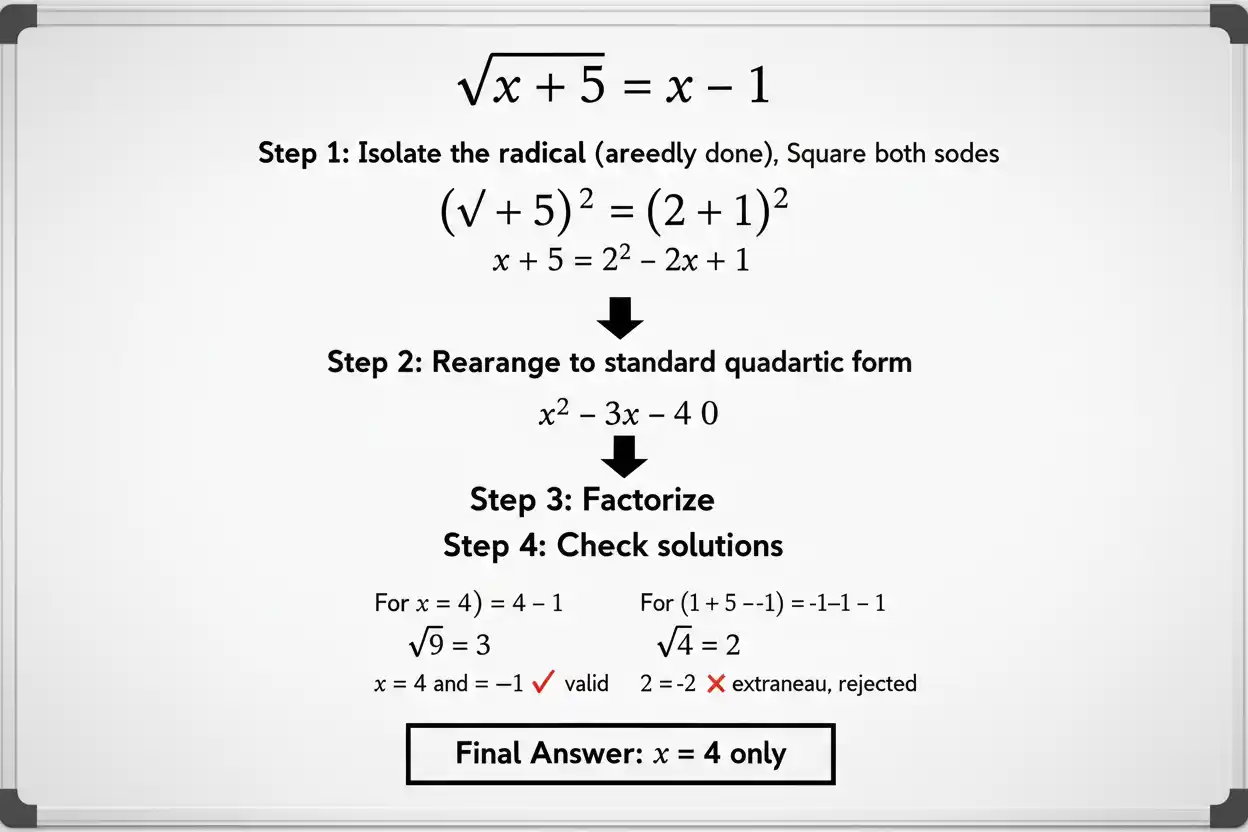
√(x + 5) = x – 1
Before squaring, note that the left side is nonnegative. Therefore the right side must satisfy:
x – 1 ≥ 0
so any valid solution must have:
x ≥ 1
Now square both sides:
x + 5 = (x – 1)²
Expand:
x + 5 = x² – 2x + 1
Move everything to one side:
x² – 3x – 4 = 0
Factor:
(x – 4)(x + 1) = 0
Candidate solutions are:
x = 4
and:
x = -1
Check x = 4:
√(4 + 5) = 4 – 1
3 = 3
Valid.
Check x = -1:
√(-1 + 5) = -1 – 1
2 = -2
False.
Therefore:
x = 4
is the only solution.
The candidate x = -1 is an extraneous solution.
Why Squaring Can Create Extraneous Solutions
Consider:
a = b
Squaring gives:
a² = b²
But the squared equation can also be true when:
a = -b
For example:
3 ≠ -3
but:
3² = (-3)²
This loss of sign information explains why squaring a radical equation can introduce values that were not solutions of the original equation.
For:
√A = B
the left side cannot be negative. If algebra later produces a value for which B is negative, that value must fail the original equation.
Example 4: An Extraneous Solution
Solve:
√(x + 6) = x
The left side is nonnegative, so any valid solution must satisfy:
x ≥ 0
Square both sides:
x + 6 = x²
Rearrange:
x² – x – 6 = 0
Factor:
(x – 3)(x + 2) = 0
Candidates:
x = 3
and:
x = -2
Check x = 3:
√(3 + 6) = 3
√9 = 3
3 = 3
Valid.
Check x = -2:
√(-2 + 6) = -2
2 = -2
False.
Therefore:
x = 3
The root x = -2 exists only in the squared equation.
Domain Restrictions for Square Roots
For a real square root:
√A
the radicand must satisfy:
A ≥ 0
For example, if an equation contains:
√(2x – 8)
then:
2x – 8 ≥ 0
2x ≥ 8
x ≥ 4
This restriction identifies the real-number domain of the radical expression before any equation solving occurs.
The algebraic manipulation of roots themselves—such as simplifying √72 or multiplying radicals—is handled more fully under radical expressions.
Odd Roots Have Different Domain Behavior
A real cube root can accept positive, zero, or negative radicands.
For example:
∛(-8) = -2
Therefore an expression such as:
∛(x – 5)
does not require x – 5 ≥ 0.
The square root:
√(x – 5)
does require:
x ≥ 5
This distinction matters when determining which restrictions must be applied before solving.
Example 5: Cube-Root Equation
Solve:
∛(x + 4) = 3
Cube both sides:
x + 4 = 27
Subtract 4:
x = 23
Check:
∛(23 + 4) = ∛27 = 3
Therefore:
x = 23
Cubing is one-to-one over the real numbers, so it does not introduce the same sign ambiguity that squaring can.
Example 6: Cube Root With a Negative Result
Solve:
∛(2x + 3) = -3
Cube both sides:
2x + 3 = -27
2x = -30
x = -15
Check:
∛(2(-15) + 3)
= ∛(-27)
= -3
Therefore:
x = -15
A negative right side is perfectly valid for an odd root.
Equations With Two Radicals
Some radical equations contain more than one radical.
For example:
√x + √(x – 5) = 5
The safest strategy is to isolate one radical first.
Move √x:
√(x – 5) = 5 – √x
Square both sides:
x – 5 = (5 – √x)²
Expand:
x – 5 = 25 – 10√x + x
Subtract x:
-5 = 25 – 10√x
Subtract 25:
-30 = -10√x
Divide by -10:
√x = 3
Square:
x = 9
Check in the original equation:
√9 + √(9 – 5)
= 3 + 2
= 5
Therefore:
x = 9
This example requires squaring twice because one radical remained after the first squaring step.
Why You Should Isolate a Radical First
Suppose an equation contains:
√(x + 2) + 3 = x
Squaring the entire left side immediately is possible, but it creates extra terms:
(√(x + 2) + 3)²
A cleaner approach is:
√(x + 2) = x – 3
Then square:
x + 2 = (x – 3)²
Isolating the radical reduces expansion errors and makes sign restrictions easier to identify.
Example 7: Radical Equation Leading to a Quadratic
Solve:
√(2x + 3) = x
The right side must be nonnegative:
x ≥ 0
Square:
2x + 3 = x²
Rearrange:
x² – 2x – 3 = 0
Factor:
(x – 3)(x + 1) = 0
Candidates:
x = 3
and:
x = -1
The restriction x ≥ 0 immediately eliminates -1.
Check x = 3:
√(2(3) + 3) = √9 = 3
Therefore:
x = 3
Once squaring produces a second-degree equation, the broader methods for a quadratic equation apply.
Using the Quadratic Formula After Squaring
A radical equation may lead to a quadratic that does not factor conveniently.
Suppose simplification produces:
2x² – 3x – 7 = 0
Then use the quadratic formula:
x = (3 ± √((-3)² – 4(2)(-7))) / 4
x = (3 ± √65) / 4
These are candidate values.
Because they originated from a radical equation, each must still be checked in the original equation before being accepted.
The quadratic formula finds roots of the transformed quadratic; it does not automatically verify the restrictions of the earlier radical equation.
Radical Equations With Fractions
Consider:
√(x + 1) / 2 = 3
Multiply both sides by 2:
√(x + 1) = 6
Square:
x + 1 = 36
x = 35
Check:
√36 / 2 = 6/2 = 3
So:
x = 35
Removing ordinary numerical denominators before squaring often makes the equation easier to handle.
Radical Equations and Rational Equations
A rational equation contains variable expressions in denominators, whereas a radical equation contains variables within radicals.
For example:
√(x + 1) = 4
is radical.
By contrast:
1/(x + 1) = 4
is rational.
An equation can contain both structures, but they impose different restrictions. Radical expressions may require nonnegative radicands, while rational expressions prohibit denominator values that produce zero.
Radical Equations After Polynomial Manipulation
More complicated algebra can produce a radical equation after another operation has already been performed.
Similarly, eliminating a radical may create a polynomial equation that must then be factored or reduced.
If a known factor later needs to be removed from a higher-degree polynomial, polynomial long division can help with that polynomial stage.
The original radical restrictions still remain relevant even if the later algebra no longer displays a radical.
Equations With Radicals on Both Sides
Consider:
√(x + 5) = √(2x – 1)
Both sides are principal square roots.
Square:
x + 5 = 2x – 1
Subtract x:
5 = x – 1
Add 1:
x = 6
Check:
√(6 + 5) = √11
and:
√(12 – 1) = √11
Therefore:
x = 6
Because both sides were nonnegative square roots, this equation is especially straightforward once the domains are valid.
Radical Equation With a Radical Isolated After Rearrangement
Solve:
x + 1 = √(5x + 9)
Because the right side is nonnegative, require:
x + 1 ≥ 0
so:
x ≥ -1
Square:
(x + 1)² = 5x + 9
Expand:
x² + 2x + 1 = 5x + 9
Move everything to one side:
x² – 3x – 8 = 0
The roots are:
x = (3 ± √41) / 2
Only candidates satisfying x ≥ -1 can possibly survive. Each should then be substituted into the original equation for final verification.
This illustrates why domain restrictions can eliminate candidates before full numerical checking.
Checking Radical Equation Solutions
Checking means substituting the candidate into the original equation, not merely into the equation obtained after squaring.
Suppose squaring led to:
x = 2
and:
x = -6
If the original equation was:
√(x + 7) = x + 1
then each candidate must be evaluated there.
For x = 2:
√9 = 3
2 + 1 = 3
Valid.
For x = -6:
√1 = 1
but:
-6 + 1 = -5
Invalid.
The transformed equation alone cannot detect this failure.
Common Radical Equation Mistakes
Squaring Before Isolating the Radical
Isolating the radical first usually produces simpler algebra and fewer cross terms.
Forgetting to Square the Entire Side
If:
√(x + 1) = x – 2
then squaring gives:
x + 1 = (x – 2)²
not:
x + 1 = x² – 4
The entire expression x – 2 must be squared.
Forgetting Domain Restrictions
For:
√(x – 4)
the real-number domain requires:
x ≥ 4
Accepting Every Root of the Squared Equation
Every candidate must be checked in the original radical equation.
Assuming a Square Root Can Equal a Negative Number
An equation such as:
√(x + 3) = -5
has no real solution because a principal square root cannot be negative.
Squaring would produce a misleading candidate unless this sign condition is recognized.
Applying Square-Root Restrictions to Cube Roots
A cube root can have a negative radicand and a negative output. The nonnegative rule applies to principal even roots, not odd roots.
No-Solution Radical Equation
Consider:
√(x + 4) = -2
The left side satisfies:
√(x + 4) ≥ 0
for every real x in its domain.
It therefore cannot equal -2.
So the equation has:
No real solution
If you squared blindly:
x + 4 = 4
x = 0
but checking gives:
√4 = 2
not -2.
This is a direct example of why sign analysis should happen before squaring.
Worked Radical Equation Example
Solve:
√(3x + 4) = x + 2
The right side must be nonnegative:
x + 2 ≥ 0
x ≥ -2
Square both sides:
3x + 4 = (x + 2)²
Expand:
3x + 4 = x² + 4x + 4
Move all terms to one side:
0 = x² + x
Factor:
x(x + 1) = 0
Candidates:
x = 0
and:
x = -1
Both satisfy the preliminary restriction x ≥ -2.
Now check x = 0:
√(3(0) + 4) = 0 + 2
2 = 2
Valid.
Check x = -1:
√(3(-1) + 4) = -1 + 2
√1 = 1
1 = 1
Valid.
Therefore:
x = -1, 0
This example shows that squaring does not always create an extraneous root; it merely creates the possibility, which is why checking remains necessary.
Frequently Asked Questions
What is a radical equation?
A radical equation is an equation in which a variable appears inside a radical, such as √x or ∛x.
What is the main rule for solving a square-root equation?
Isolate the square root, square both sides, solve the resulting equation, and check every candidate in the original equation.
Why do radical equations need to be checked?
Squaring can create extraneous solutions because numbers with opposite signs have the same square.
What is an extraneous solution?
An extraneous solution is a value produced during algebraic manipulation that does not satisfy the original equation.
Can a square root equal a negative number?
A principal real square root cannot be negative. Therefore an equation such as √x = -3 has no real solution.
What restriction does √(x – 5) impose?
For real values:
x – 5 ≥ 0
so:
x ≥ 5
Does a cube root require a nonnegative radicand?
No. Real cube roots are defined for negative, zero, and positive radicands.
What if a radical equation has two square roots?
Usually isolate one radical, square, simplify, then isolate the remaining radical and square again if necessary. Check all final candidates.
Can a radical equation become a quadratic equation?
Yes. Squaring often produces a quadratic equation, which can then be solved by factoring, completing the square, or the quadratic formula.
Can a radical equation have no solution?
Yes. Domain restrictions, sign conditions, or failed substitution checks may eliminate every candidate.
Should I check a solution before or after simplifying radicals?
Perform whatever simplification is needed to solve the equation, but the final verification must always use the original equation.
Is √(x²) always equal to x?
No. Over the real numbers:
√(x²) = |x|
because the principal square root is nonnegative.