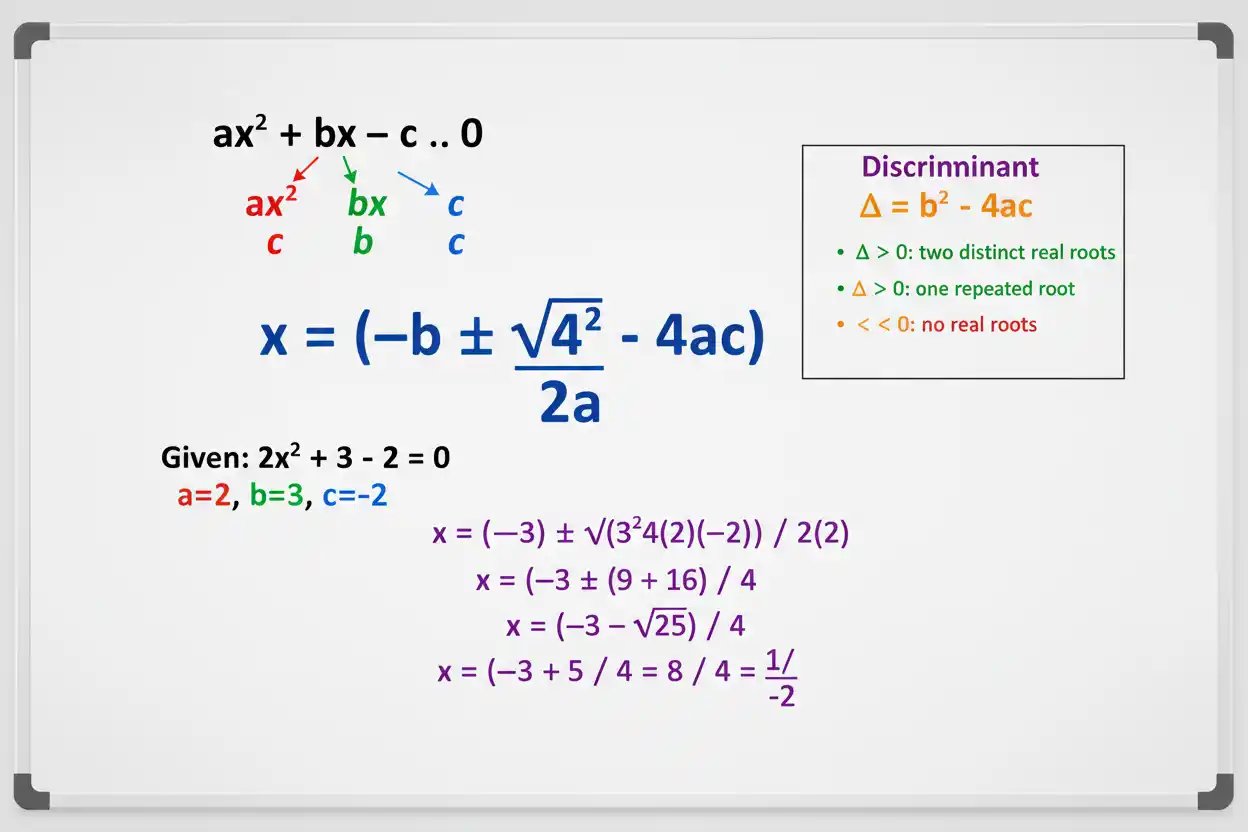

The quadratic formula gives the solutions of any quadratic equation written in standard form:
ax² + bx + c = 0
where:
a ≠ 0
The formula is:
x = (-b ± √(b² – 4ac)) / 2a
Here, a, b, and c are the coefficients from the quadratic equation.
For example, consider:
x² – 5x + 6 = 0
The coefficients are:
a = 1
b = -5
c = 6
Substitute them into the quadratic formula:
x = (-(-5) ± √((-5)² – 4(1)(6))) / 2(1)
x = (5 ± √1) / 2
x = (5 ± 1) / 2
Therefore:
x = 3
or:
x = 2
The quadratic formula works even when a quadratic equation does not factor conveniently.
What Is the Quadratic Formula?
The quadratic formula is a general solution formula for second-degree equations.
For:
ax² + bx + c = 0
use:
x = (-b ± √(b² – 4ac)) / 2a
The symbols mean:
- a = coefficient of x²
- b = coefficient of x
- c = constant term
- ± = calculate once with plus and once with minus
- √ = square root
The quantity:
b² – 4ac
inside the square root determines the type of solutions the equation has.
When Should You Use the Quadratic Formula?
The quadratic formula can solve every quadratic equation with:
a ≠ 0
It is especially useful when a quadratic does not factor easily.
For example:
x² + 2x – 7 = 0
does not factor into simple integer binomials, but the quadratic formula gives an exact answer immediately.
The formula can also verify solutions obtained through factoring quadratics or another method.
Step 1: Put the Equation in Standard Form
Before using the quadratic formula, write the equation as:
ax² + bx + c = 0
Suppose:
2x² + 7 = 5x
Move every term to one side:
2x² – 5x + 7 = 0
Now identify:
a = 2
b = -5
c = 7
Using the coefficients before the equation is in standard form is a common source of errors.
Step 2: Identify a, b, and c
Read the coefficients together with their signs.
For:
3x² – 8x – 4 = 0
the coefficients are:
a = 3
b = -8
c = -4
The negative signs are part of b and c.
This matters because the formula contains both:
-b
and:
-4ac
Substituting a positive value when the coefficient is actually negative changes the result.
Step 3: Substitute Into the Quadratic Formula
For:
3x² – 8x – 4 = 0
write:
x = (-(-8) ± √((-8)² – 4(3)(-4))) / 2(3)
Do not rush the arithmetic. Keeping each negative coefficient inside parentheses makes sign errors less likely.
Simplify the discriminant:
(-8)² – 4(3)(-4)
= 64 + 48
= 112
Therefore:
x = (8 ± √112) / 6
Simplify the radical:
√112 = √(16 × 7)
√112 = 4√7
So:
x = (8 ± 4√7) / 6
Divide numerator and denominator by 2:
x = (4 ± 2√7) / 3
These are the exact solutions.
The ± Symbol
The symbol:
±
means that two calculations may be required.
From:
x = (6 ± 2) / 4
use plus:
x = (6 + 2) / 4 = 8/4 = 2
Then use minus:
x = (6 – 2) / 4 = 4/4 = 1
Therefore the roots are:
x = 2
and:
x = 1
Forgetting one branch of ± can cause one valid solution to be missed.
The Discriminant in the Quadratic Formula
The expression:
D = b² – 4ac
is called the discriminant.
It appears inside the square root:
√(b² – 4ac)
The sign of D determines the root type.
When:
D > 0
the quadratic formula gives two distinct real roots.
When:
D = 0
the plus and minus calculations produce the same value, resulting in one repeated real root.
When:
D < 0
the square root involves a negative number, producing complex roots.
The discriminant can therefore be checked before fully evaluating the formula.
Example 1: Two Distinct Real Solutions
Solve:
2x² – 5x – 3 = 0
Identify:
a = 2
b = -5
c = -3
Substitute:
x = (-(-5) ± √((-5)² – 4(2)(-3))) / 2(2)
Simplify:
x = (5 ± √(25 + 24)) / 4
x = (5 ± √49) / 4
x = (5 ± 7) / 4
Use plus:
x = (5 + 7) / 4
x = 12/4
x = 3
Use minus:
x = (5 – 7) / 4
x = -2/4
x = -1/2
Therefore:
x = 3, -1/2
Verify Example 1
Check x = 3:
2(3²) – 5(3) – 3
= 18 – 15 – 3
= 0
Check x = -1/2:
2(-1/2)² – 5(-1/2) – 3
= 2(1/4) + 5/2 – 3
= 1/2 + 5/2 – 3
= 3 – 3
= 0
Both values satisfy the original equation.
Example 2: One Repeated Solution
Solve:
x² – 6x + 9 = 0
Here:
a = 1
b = -6
c = 9
Substitute:
x = (-(-6) ± √((-6)² – 4(1)(9))) / 2(1)
x = (6 ± √(36 – 36)) / 2
x = (6 ± 0) / 2
Therefore:
x = 3
The plus and minus branches are identical because the discriminant is zero.
This is a repeated root.
Example 3: Complex Solutions
Solve:
x² + 2x + 5 = 0
Identify:
a = 1
b = 2
c = 5
Substitute:
x = (-2 ± √(2² – 4(1)(5))) / 2(1)
x = (-2 ± √(4 – 20)) / 2
x = (-2 ± √(-16)) / 2
Using:
√(-16) = 4i
gives:
x = (-2 ± 4i) / 2
Therefore:
x = -1 ± 2i
The formula works without changing its structure; a negative discriminant simply moves the solutions into the complex number system. The behavior of these results is covered more fully under complex roots.
Example 4: Missing Linear Term
Solve:
2x² – 18 = 0
The equation is already in standard form:
2x² + 0x – 18 = 0
Therefore:
a = 2
b = 0
c = -18
Substitute:
x = (0 ± √(0² – 4(2)(-18))) / 4
x = ±√144 / 4
x = ±12/4
Therefore:
x = ±3
A missing term does not mean the corresponding coefficient should be skipped. It means that coefficient equals zero.
Example 5: Missing Constant Term
Solve:
3x² – 12x = 0
Write:
3x² – 12x + 0 = 0
So:
a = 3
b = -12
c = 0
Use the formula:
x = (12 ± √((-12)² – 4(3)(0))) / 6
x = (12 ± √144) / 6
x = (12 ± 12) / 6
Therefore:
x = 4
or:
x = 0
Factoring would be faster here, but the quadratic formula still works correctly.
Example 6: Decimal Coefficients
Solve:
0.5x² – 2x – 1 = 0
You can use decimal coefficients directly, but clearing the decimal first is cleaner.
Multiply every term by 2:
x² – 4x – 2 = 0
Now:
a = 1
b = -4
c = -2
Substitute:
x = (4 ± √16 + 8) / 2
The radical expression must be understood as:
√(16 + 8) = √24
so:
x = (4 ± √24) / 2
Simplify:
√24 = 2√6
Therefore:
x = (4 ± 2√6) / 2
x = 2 ± √6
Writing the entire discriminant inside the radical is essential when working through the substitution.
Exact Answers vs Decimal Answers
Suppose the formula gives:
x = (3 ± √13) / 2
This exact form is usually preferable unless a decimal approximation is requested.
Using:
√13 ≈ 3.6055
gives approximately:
x ≈ 3.3028
and:
x ≈ -0.3028
Exact forms preserve full mathematical precision. Decimal approximations are useful when a numerical interpretation is needed.
Simplifying Radicals in the Formula
Suppose:
x = (6 ± √48) / 4
Simplify:
√48 = √(16 × 3)
√48 = 4√3
Then:
x = (6 ± 4√3) / 4
Divide every term in the numerator by 2 along with the denominator:
x = (3 ± 2√3) / 2
The specialist rules for manipulating roots and radical forms are covered under radical expressions.
Be Careful When Simplifying Fractions
Consider:
x = (8 ± √20) / 6
Since:
√20 = 2√5
we have:
x = (8 ± 2√5) / 6
All terms share a factor of 2:
x = (4 ± √5) / 3
However, from:
(8 ± √5) / 6
you cannot cancel 2 from only the 8 and denominator because √5 does not contain the same factor.
Cancellation must apply to a common factor of the entire numerator.
Why the Quadratic Formula Works
The quadratic formula can be derived by completing the square on the general equation:
ax² + bx + c = 0
First divide by a:
x² + (b/a)x + c/a = 0
Move the constant:
x² + (b/a)x = -c/a
Add:
b² / 4a²
to both sides:
x² + (b/a)x + b²/(4a²) = -c/a + b²/(4a²)
The left side becomes:
(x + b/2a)²
The right side simplifies to:
(b² – 4ac) / 4a²
Take square roots:
x + b/2a = ±√(b² – 4ac) / 2a
Subtract b/2a:
x = (-b ± √(b² – 4ac)) / 2a
This derivation explains why the formula applies to every quadratic equation in standard form.
Quadratic Formula and Factoring
Factoring and the quadratic formula solve the same underlying type of equation but by different methods.
For:
x² – 7x + 12 = 0
factoring quickly gives:
(x – 3)(x – 4) = 0
so:
x = 3, 4
The quadratic formula produces the same roots.
For:
x² – 3x – 1 = 0
simple integer factoring does not work, so the quadratic formula is more efficient:
x = (3 ± √13) / 2
The formula is therefore particularly useful when factorization is not obvious.
Quadratic Formula and Radical Equations
A radical equation can sometimes produce a quadratic equation after squaring.
Once the resulting equation has the form:
ax² + bx + c = 0
the quadratic formula may be used to find candidate solutions.
However, squaring an equation can introduce extraneous solutions. Therefore any values obtained after using the quadratic formula must still be checked against the original radical equation.
The quadratic formula itself does not create the extraneous solution; the earlier squaring step can.
Quadratic Formula and Polynomial Equations
A quadratic is a degree-2 polynomial equation.
The quadratic formula is special because every second-degree polynomial equation has a universal closed-form solution of this type.
Higher-degree polynomial equations may sometimes be reduced to quadratic factors. When that happens, the formula can solve those remaining factors.
Quadratic Formula After Polynomial Division
Suppose polynomial long division reduces a cubic polynomial to the quotient:
2x² + x – 4
Setting that factor equal to zero gives:
2x² + x – 4 = 0
The quadratic formula can then solve the remaining second-degree equation:
x = (-1 ± √(1 + 32)) / 4
x = (-1 ± √33) / 4
Polynomial division and the quadratic formula therefore perform different stages of the problem.
Formula Errors With Negative b
Suppose:
2x² – 7x + 1 = 0
Then:
b = -7
The formula begins with:
-b
so:
-(-7) = 7
A safe substitution is:
x = (-(-7) ± √((-7)² – 4(2)(1))) / 2(2)
Writing parentheses around negative coefficients substantially reduces sign errors.
Formula Errors With Negative c
Suppose:
x² + 3x – 10 = 0
Then:
c = -10
The discriminant is:
3² – 4(1)(-10)
= 9 + 40
= 49
The two negative signs create addition.
Forgetting the sign on c would incorrectly produce:
9 – 40
instead.
Why the Entire Numerator Matters
The formula is:
x = (-b ± √(b² – 4ac)) / 2a
The denominator 2a divides the entire numerator:
-b ± √(b² – 4ac)
It does not divide only the radical.
For example:
x = (6 ± 2) / 4
means:
(6 + 2)/4
and:
(6 – 2)/4
not:
6 ± (2/4)
Parentheses make the intended order explicit.
Can a Equal Zero?
No.
The quadratic formula assumes:
a ≠ 0
If a = 0, the standard equation:
ax² + bx + c = 0
reduces to:
bx + c = 0
which is linear when b ≠ 0.
The denominator:
2a
would also become zero, so the quadratic formula would be undefined.
Checking a Quadratic Formula Answer
Substitute each solution into the original equation.
Suppose:
x² + x – 6 = 0
The quadratic formula gives:
x = 2
and:
x = -3
Check x = 2:
2² + 2 – 6 = 4 + 2 – 6 = 0
Check x = -3:
(-3)² – 3 – 6 = 9 – 3 – 6 = 0
Both solutions are correct.
Common Quadratic Formula Mistakes
Using the Formula Before Standardizing the Equation
First write:
ax² + bx + c = 0
Then identify the coefficients.
Losing the Sign of b or c
The signs are part of the coefficient values.
Forgetting the ± Symbol
Both plus and minus branches must be evaluated unless the radical is zero.
Squaring b Incorrectly
If:
b = -5
then:
b² = (-5)² = 25
not -25.
Forgetting That 2a Is the Entire Denominator
The full numerator must be divided by 2a.
Calculating the Discriminant in the Wrong Order
Compute:
b² – 4ac
carefully before taking the square root.
Rejecting a Negative Discriminant as “No Answer”
A negative discriminant means no real solutions, not no solutions at all. Complex solutions still exist.
Converting to Decimals Too Early
Keeping radicals exact until the final step reduces rounding error.
Worked Quadratic Formula Example
Solve:
3x² + 4x – 2 = 0
Identify:
a = 3
b = 4
c = -2
Use the quadratic formula:
x = (-4 ± √(4² – 4(3)(-2))) / 2(3)
Calculate the discriminant:
D = 16 + 24
D = 40
So:
x = (-4 ± √40) / 6
Simplify:
√40 = √(4 × 10)
√40 = 2√10
Therefore:
x = (-4 ± 2√10) / 6
Factor 2 from the numerator:
x = (-2 ± √10) / 3
The exact solutions are:
x = (-2 + √10) / 3
and:
x = (-2 – √10) / 3
Since:
D = 40 > 0
the two roots are distinct and real.
Frequently Asked Questions
What is the quadratic formula?
The quadratic formula is:
x = (-b ± √(b² – 4ac)) / 2a
It solves quadratic equations written as ax² + bx + c = 0.
What do a, b, and c mean?
For:
ax² + bx + c = 0
a is the x² coefficient, b is the x coefficient, and c is the constant term.
When should I use the quadratic formula?
Use it for any quadratic equation, especially when factoring is difficult or does not produce simple factors.
Does the quadratic formula always work?
Yes, for quadratic equations with a ≠ 0. A negative discriminant produces complex rather than real roots.
What does ± mean?
It means calculate two possibilities: one using addition and one using subtraction.
What is the discriminant?
The discriminant is:
D = b² – 4ac
It determines whether the quadratic has two distinct real roots, one repeated real root, or two complex roots.
What happens when the discriminant is zero?
The ± term becomes zero, so both branches give the same value. The equation has one repeated real root.
What happens when the discriminant is negative?
The square root involves a negative number, producing two complex roots.
Why must the equation equal zero first?
The quadratic formula is derived for:
ax² + bx + c = 0
Putting the equation in standard form ensures that a, b, and c are identified correctly.
What if the x term is missing?
Then:
b = 0
For example, in 2x² – 8 = 0, the coefficients are a = 2, b = 0, and c = -8.
What if the constant term is missing?
Then:
c = 0
For example, in x² – 5x = 0, c = 0.
Should quadratic formula answers be decimals or radicals?
Use exact radical form unless a decimal approximation is requested or more useful for the application. Exact answers avoid unnecessary rounding.