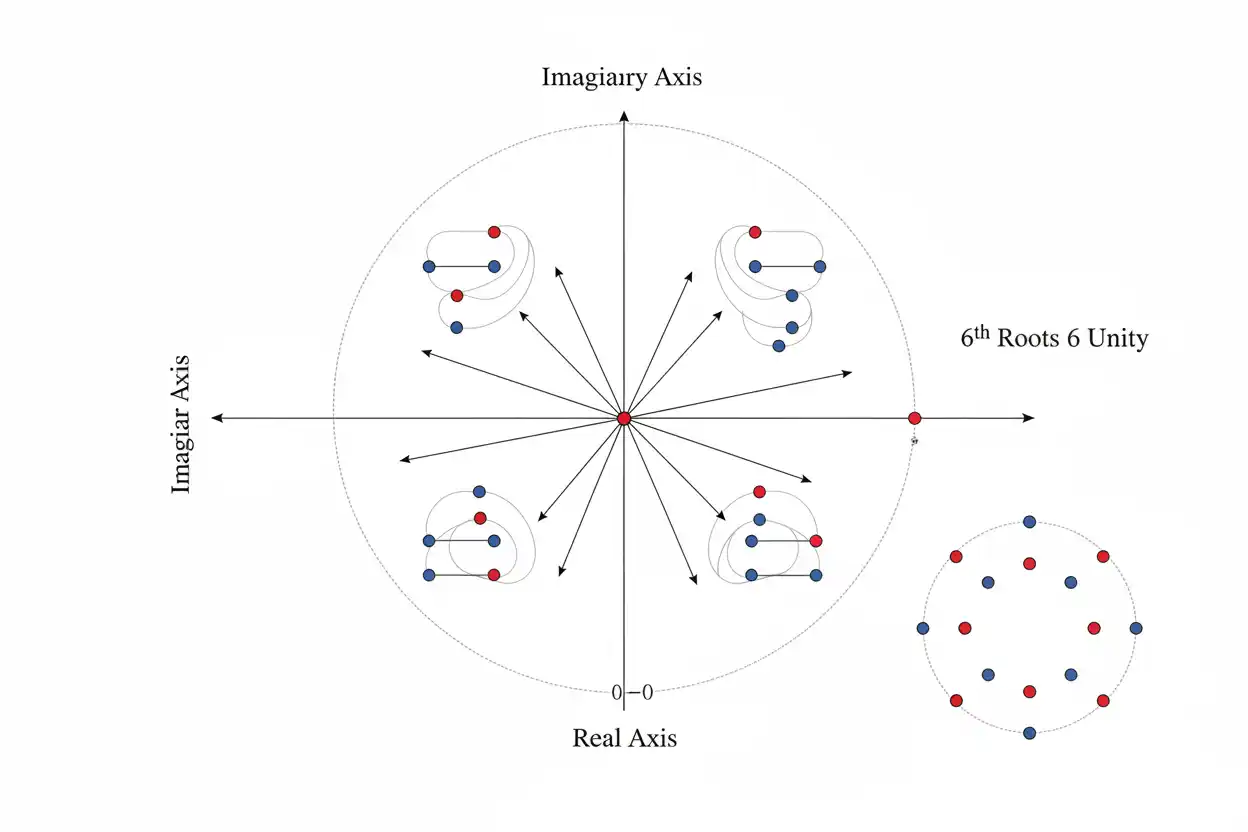

Complex roots are complex-number values that satisfy an equation or produce a specified complex number when raised to a power.
For example:
Equation: x² + 1 = 0
Rearrange:
x² = -1
Because:
i² = -1
the roots are:
x = i or x = -i
These are complex roots because they belong to the complex numbers system rather than the real numbers alone.
Complex roots appear naturally in quadratic, cubic, and higher-degree polynomial equations. They also arise when finding square roots, cube roots, or general nth roots of complex numbers.
What Are Complex Roots?
A root of an equation is a value that makes the equation true.
For a polynomial:
P(x) = 0
a complex number z is a root when:
P(z) = 0
Consider:
x² – 6x + 13 = 0
The equation does not have real roots.
Using the quadratic formula:
x = (-b ± √(b² – 4ac)) / 2a
with:
a = 1
b = -6
c = 13
gives:
x = (6 ± √(36 – 52)) / 2
x = (6 ± √-16) / 2
Since:
√-16 = 4i
we get:
x = (6 ± 4i) / 2
Therefore:
x = 3 + 2i
or:
x = 3 – 2i
Both are complex roots.
Complex Root Formula for a Quadratic
For:
ax² + bx + c = 0
the quadratic formula is:
x = (-b ± √(b² – 4ac)) / 2a
The quantity:
D = b² – 4ac
is the discriminant.
For real coefficients:
D > 0 → Two distinct real roots
D = 0 → One repeated real root
D < 0 → Two nonreal complex conjugate roots
When D < 0, write:
√(-m) = i√m
for positive m.
Complex Roots Example
Solve:
x² + 4x + 8 = 0
Use:
a = 1
b = 4
c = 8
Discriminant:
D = 4² – 4(1)(8)
D = 16 – 32
D = -16
Quadratic formula:
x = (-4 ± √-16) / 2
Replace:
√-16 = 4i
Then:
x = (-4 ± 4i) / 2
Therefore:
x = -2 + 2i
and:
x = -2 – 2i
Why Complex Roots Come in Conjugate Pairs
For a polynomial with real coefficients, nonreal complex roots occur in conjugate pairs.
If:
a + bi
is a root, then:
a – bi
is also a root.
For example, if:
3 + 4i
is a root of a polynomial with real coefficients, then:
3 – 4i
must also be a root.
This is called the complex conjugate root theorem.
Complex Conjugate Root Example
Suppose a quadratic has roots:
2 + 3i
and:
2 – 3i
Construct its factors:
[x – (2 + 3i)][x – (2 – 3i)]
Rewrite:
[(x – 2) – 3i][(x – 2) + 3i]
Using the difference-of-squares structure:
(x – 2)² – (3i)²
Since:
i² = -1
we get:
(x – 2)² + 9
Expand:
x² – 4x + 4 + 9
Therefore:
x² – 4x + 13
So:
x² – 4x + 13 = 0
has roots:
2 ± 3i
Finding a Polynomial From Complex Roots
Suppose a polynomial with real coefficients has one known root:
4 + i
The conjugate root theorem tells us another root must be:
4 – i
Corresponding factors:
[x – (4 + i)][x – (4 – i)]
Rewrite:
[(x – 4) – i][(x – 4) + i]
Multiply:
(x – 4)² – i²
Since:
i² = -1
this becomes:
(x – 4)² + 1
Expand:
x² – 8x + 17
Therefore one real-coefficient polynomial with those roots is:
P(x) = x² – 8x + 17
Fundamental Theorem of Algebra
The fundamental theorem of algebra states that every nonconstant polynomial of degree n has exactly n complex roots when multiplicities are counted.
For example, a quadratic has:
2 roots
A cubic equation has:
3 roots
A fourth-degree polynomial has:
4 roots
Some or all of those roots may be real, but real numbers are themselves complex numbers with zero imaginary part.
This is one reason the complex-number system is so important: it provides enough numbers for polynomial equations to have their expected number of roots.
Real Roots Are Also Complex Roots
A number such as:
5
can be written as:
5 + 0i
Therefore a real root is technically also a complex root.
For:
x² – 9 = 0
the solutions are:
x = 3
and:
x = -3
In complex notation:
3 + 0i
and:
-3 + 0i
The phrase nonreal complex roots is more precise when referring specifically to roots with a nonzero imaginary component.
Complex Roots of x² + 1
Solve:
x² + 1 = 0
Subtract 1:
x² = -1
Therefore:
x = ±i
The roots are:
i
and:
-i
Factorization over the complex numbers is:
x² + 1 = (x – i)(x + i)
Although x² + 1 cannot be factored into real linear factors, it factors completely over the complex numbers.
Complex Roots of x² + 9
Solve:
x² + 9 = 0
Then:
x² = -9
Therefore:
x = ±3i
So:
x² + 9 = (x – 3i)(x + 3i)
Complex Roots of a Cubic
Consider:
x³ – 1 = 0
Factor using:
x³ – 1 = (x – 1)(x² + x + 1)
One root is:
x = 1
Solve the quadratic:
x² + x + 1 = 0
Quadratic formula:
x = (-1 ± √(1 – 4)) / 2
x = (-1 ± √-3) / 2
Therefore:
x = (-1 ± i√3) / 2
All three roots are:
1
-1/2 + (√3/2)i
-1/2 – (√3/2)i
The two nonreal roots form a conjugate pair.
Cube Roots of 1
The equation:
z³ = 1
has three complex roots, not just the obvious real root 1.
They are:
z₀ = 1
z₁ = -1/2 + (√3/2)i
z₂ = -1/2 – (√3/2)i
All satisfy:
z³ = 1
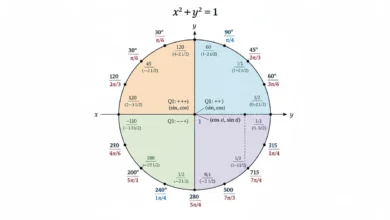
Geometrically, the three roots are equally spaced around the unit circle.
nth Roots of a Complex Number
Suppose a complex number is written in polar form:
z = r[cos(θ) + i sin(θ)]
Its n distinct nth roots are:
wₖ = r^(1/n) [cos((θ + 2πk)/n) + i sin((θ + 2πk)/n)]
where:
k = 0, 1, 2, …, n – 1
This formula gives every distinct nth root.
The roots all have modulus:
r^(1/n)
and are equally spaced around a circle in the complex plane.
Why k Runs From 0 to n – 1
Angles differing by:
2π
represent the same direction.
When finding nth roots, adding multiples of 2π before dividing the angle by n creates:
n distinct angles
After k = n - 1, the pattern begins repeating.
Therefore:
k = 0 through n – 1
generates every distinct root exactly once.
Square Roots of a Complex Number in Polar Form
Suppose:
z = r[cos(θ) + i sin(θ)]
Its two square roots are:
w₀ = √r [cos(θ/2) + i sin(θ/2)]
and:
w₁ = √r [cos((θ + 2π)/2) + i sin((θ + 2π)/2)]
The two roots differ by 180 degrees on the complex plane.
If one square root is:
w
the other is:
-w
Square Roots of -1
Write:
-1 = cos(π) + i sin(π)
Here:
r = 1
θ = π
Square-root angles:
π/2
and:
3π/2
Therefore:
w₀ = i
w₁ = -i
which matches:
i² = (-i)² = -1
Fourth Roots of 1
Solve:
z⁴ = 1
The fourth roots have modulus:
1
and angles:
0
π/2
π
3π/2
Therefore:
z = 1
z = i
z = -1
z = -i
All four roots lie equally spaced around the unit circle.
Geometric Pattern of Complex Roots
The nth roots of a nonzero complex number form the vertices of a regular n-sided polygon centered at the origin.
For n = 3, the roots form an equilateral triangle.
For n = 4, they form a square.
For n = 5, they form a regular pentagon.
The angle between consecutive roots is:
Angle Spacing = 2π / n
or in degrees:
Angle Spacing = 360° / n
This geometric structure is one of the most useful features of complex roots.
Example: Angle Spacing for Sixth Roots
For:
n = 6
angle spacing is:
360° / 6 = 60°
Therefore six roots of a nonzero complex number are separated by 60 degrees.
They all lie on the same circle because they have the same modulus.
De Moivre’s Theorem and Complex Roots
De Moivre’s theorem states:
[r(cos θ + i sin θ)]ⁿ = rⁿ[cos(nθ) + i sin(nθ)]
The nth-root formula effectively reverses this process.
Instead of multiplying the angle by n, root extraction divides possible angles by n.
This is why polar form is particularly efficient for calculating powers and roots of complex numbers.
Complex Roots Using De Moivre’s Structure
Suppose:
z³ = 8
Write 8 in polar form:
8[cos(0) + i sin(0)]
Cube-root modulus:
8^(1/3) = 2
Angles:
(0 + 2πk) / 3
for:
k = 0, 1, 2
The roots are:
For k = 0:
2
For k = 1:
2[cos(2π/3) + i sin(2π/3)]
= -1 + i√3
For k = 2:
2[cos(4π/3) + i sin(4π/3)]
= -1 – i√3
Therefore:
z³ = 8
has roots:
2
-1 + i√3
-1 – i√3
Checking a Complex Root
Suppose the proposed root is:
z = -1 + i√3
for:
z³ = 8
The safest verification is to substitute or use polar form.
The number has modulus:
√[(-1)² + (√3)²] = 2
and angle:
120°
Cubing gives modulus:
2³ = 8
and angle:
3 × 120° = 360°
Therefore:
z³ = 8
The candidate is valid.
Complex Roots and Polynomial Factorization
If:
r
is a root of:
P(x)
then:
x – r
is a factor.
For example, if roots are:
2
3 + i
3 – i
then a corresponding polynomial is:
P(x) = (x – 2)[x – (3 + i)][x – (3 – i)]
Multiply the conjugate pair first:
[(x – 3) – i][(x – 3) + i]
= (x – 3)² + 1
= x² – 6x + 10
Then:
P(x) = (x – 2)(x² – 6x + 10)
Expand:
P(x) = x³ – 8x² + 22x – 20
The resulting polynomial has real coefficients.
Repeated Complex Roots
A root can appear more than once.
For:
P(x) = (x – i)²(x + i)²
the roots are:
i with multiplicity 2
-i with multiplicity 2
The polynomial has degree:
4
and four roots when multiplicity is counted.
Expanding:
(x² + 1)²
gives:
x⁴ + 2x² + 1
Root Multiplicity
If a factor appears as:
(x – r)ᵐ
then:
r
is a root with multiplicity:
m
For example:
(x – 2)³(x² + 1)
has:
2 with multiplicity 3
plus:
i
and:
-i
Total multiplicity:
3 + 1 + 1 = 5
matching the polynomial’s degree.
Complex Roots and Real Coefficients
If a polynomial has real coefficients, nonreal complex roots must come in conjugate pairs.
But if a polynomial itself has complex coefficients, that requirement no longer applies.
For example:
P(x) = x – (2 + i)
has the single root:
2 + i
and no requirement for:
2 – i
because the polynomial coefficient itself is complex.
Always check whether the polynomial’s coefficients are real before applying the conjugate-root rule.
Complex Roots and the Binomial Theorem
The binomial theorem can help expand factors constructed from complex roots.
For example:
[x – (1 + i)]²
can be expanded as:
x² – 2(1 + i)x + (1 + i)²
Then:
(1 + i)² = 2i
So:
x² – (2 + 2i)x + 2i
This polynomial has complex coefficients, so a conjugate companion root is not automatically required.
Complex Roots and Cubic Equations
A cubic equation always has three complex roots when multiplicity is counted.
For example:
x³ – 1 = 0
has one real root and two nonreal complex roots.
Another cubic can have three real roots.
The degree determines the total number of complex roots, while the coefficients determine whether those roots are real or nonreal.
Complex Roots and Composite Functions
A composite function can produce equations whose solutions include complex roots.
Suppose:
f(x) = x² + 1
and:
g(x) = x + 2
Then:
f(g(x)) = (x + 2)² + 1
Set:
f(g(x)) = 0
Then:
(x + 2)² + 1 = 0
So:
(x + 2)² = -1
Therefore:
x + 2 = ±i
and:
x = -2 ± i
The function composition determines the equation structure; complex-number algebra provides the roots.
Complex Roots and Arithmetic Series
An arithmetic series is not a root-finding method, but complex numbers can appear as terms in an arithmetic sequence.
For example:
1 + i, 2 + 2i, 3 + 3i, …
has common difference:
1 + i
The complex number system supports ordinary algebraic addition, while complex roots address solutions to powers and equations.
These are different uses of the same broader algebraic system.
Complex Roots and Algebra
Within algebra, complex roots solve an important limitation of the real number system.
Without complex numbers:
x² + 4 = 0
has no real solution.
With complex numbers:
x = ±2i
More generally, polynomial equations can be analyzed without stopping merely because a square root becomes negative.
Complex Root Symmetry on the Complex Plane
The nth roots of a complex number have equal angular spacing.
If one root has angle:
α
the next root has angle:
α + 2π/n
and so on.
All roots also have identical modulus:
r^(1/n)
Therefore the roots have both rotational and radial structure.
This makes complex root sets highly predictable geometrically.
Roots of Unity
Solutions to:
zⁿ = 1
are called the nth roots of unity.
Their formula is:
zₖ = cos(2πk/n) + i sin(2πk/n)
for:
k = 0, 1, …, n – 1
Because the modulus of 1 is 1, every root lies on the unit circle.
Third Roots of Unity
For:
z³ = 1
the roots are:
1
-1/2 + (√3/2)i
-1/2 – (√3/2)i
Their angles are:
0°
120°
240°
They are equally spaced by:
120°
Fifth Roots of Unity
For:
z⁵ = 1
there are five roots.
Their angles are:
0°
72°
144°
216°
288°
Each lies on the unit circle.
Their exact rectangular forms can be more complicated, but polar form describes the set immediately.
Product of Conjugate Roots
If roots are:
a + bi
and:
a – bi
their product is:
(a + bi)(a – bi)
= a² + b²
which is real.
Their sum is:
2a
which is also real.
That is why a conjugate pair combines naturally into a quadratic factor with real coefficients.
Quadratic Factor From a Conjugate Pair
For roots:
a ± bi
the corresponding real quadratic factor is:
[x – (a + bi)][x – (a – bi)]
Simplify:
(x – a)² + b²
Expand:
x² – 2ax + a² + b²
This provides a useful formula for constructing a polynomial from known complex conjugate roots.
Common Complex Roots Mistakes
A common mistake is assuming a polynomial has no solution when the discriminant is negative.
Another is forgetting:
√(-a) = i√a
for positive a.
Students may find one nth root and stop, even though a nonzero complex number has exactly n distinct nth roots.
Another common error is forgetting to add:
2πk
before dividing an angle by n.
When a polynomial has real coefficients, a nonreal root’s conjugate must also be included.
Students can also confuse root multiplicity with the number of distinct roots.
Finally, using degree incorrectly can lead to missing solutions: a degree-n polynomial has n complex roots when multiplicities are counted.
Frequently Asked Questions
What is a complex root?
A complex root is a complex-number value that satisfies an equation or polynomial.
Can a real number be a complex root?
Yes. Every real number can be written as:
a + 0i
so real roots belong to the complex number system.
What is a nonreal complex root?
A nonreal complex root has a nonzero imaginary part:
a + bi, where b ≠ 0
When does a quadratic have complex roots?
For a real-coefficient quadratic:
ax² + bx + c = 0
nonreal complex roots occur when:
b² – 4ac < 0
What is the quadratic formula for complex roots?
x = (-b ± √(b² – 4ac)) / 2a
If the discriminant is negative, simplify the negative square root using i.
Why do complex roots occur in conjugate pairs?
For polynomials with real coefficients, if:
a + bi
is a root, then:
a – bi
must also be a root.
What are the roots of x² + 1 = 0?
x = i and x = -i
What are the roots of x² + 9 = 0?
x = 3i and x = -3i
How many complex roots does a degree-4 polynomial have?
Four roots when multiplicity is counted.
How many nth roots does a nonzero complex number have?
Exactly:
n distinct nth roots
What is the nth-root formula for a complex number?
wₖ = r^(1/n) [cos((θ + 2πk)/n) + i sin((θ + 2πk)/n)]
for:
k = 0, 1, …, n – 1
How far apart are nth roots geometrically?
Their angular spacing is:
360° / n
or:
2π / n radians
What are roots of unity?
They are solutions to:
zⁿ = 1
What are the fourth roots of unity?
1, i, -1, -i
What is root multiplicity?
Multiplicity is the number of times a root occurs as a factor. If:
(x – r)³
appears, r has multiplicity 3.
Does every complex root require its conjugate?
Only when the polynomial has real coefficients and the root is nonreal.
Why are complex roots important?
They allow polynomial equations to be solved within a complete number system and reveal geometric patterns involving conjugates, rotations, roots of unity, and equally spaced points on the complex plane.