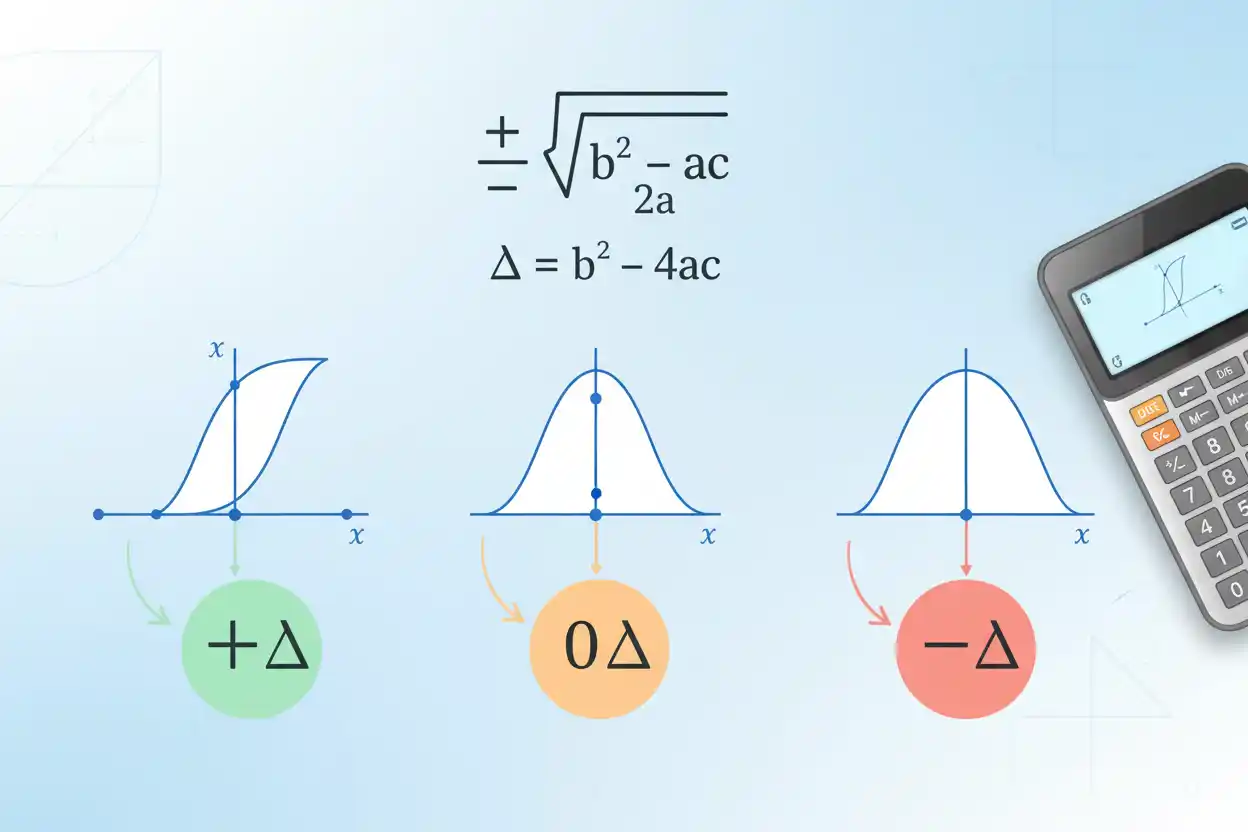

The discriminant is the part of the quadratic formula that determines the number and type of solutions a quadratic equation has.
For a quadratic equation:
ax² + bx + c = 0
the discriminant formula is:
D = b² – 4ac
The value of D tells you what kind of roots to expect:
D > 0 → Two distinct real roots
D = 0 → One repeated real root
D < 0 → Two nonreal complex-conjugate roots
For example, consider:
x² – 5x + 6 = 0
Here:
a = 1
b = -5
c = 6
Calculate:
D = (-5)² – 4(1)(6)
D = 25 – 24
D = 1
Because:
D > 0
the equation has two distinct real roots.
The discriminant lets you classify those roots before solving the entire quadratic equation.
What Is the Discriminant?
The discriminant is the expression:
b² – 4ac
inside the quadratic formula:
x = (-b ± √(b² – 4ac)) / 2a
The discriminant matters because the expression under the square root determines what kind of number the square root produces.
If it is positive, there are two different real square-root values.
If it is zero, the ± produces the same result twice.
If it is negative, the square root requires the complex numbers system.
The discriminant therefore classifies the roots without requiring the complete solution calculation.
Discriminant Formula
For:
ax² + bx + c = 0
use:
Discriminant = b² – 4ac
or simply:
D = b² – 4ac
where:
a = coefficient of x²
b = coefficient of x
c = constant term
The equation must first be written in standard form.
Why Standard Form Matters
Consider:
x² + 5 = 6x
Before identifying a, b, and c, rearrange:
x² – 6x + 5 = 0
Now:
a = 1
b = -6
c = 5
Discriminant:
D = (-6)² – 4(1)(5)
D = 36 – 20
D = 16
If you incorrectly treated b as positive 6 before moving all terms to one side, the coefficient signs would not match the standard equation.
What Does D > 0 Mean?
When:
D > 0
the quadratic has:
Two distinct real roots
Example:
x² – 7x + 10 = 0
Coefficients:
a = 1
b = -7
c = 10
Discriminant:
D = (-7)² – 4(1)(10)
D = 49 – 40
D = 9
Because 9 is positive, there are two different real solutions.
Indeed:
x² – 7x + 10 = (x – 2)(x – 5)
so:
x = 2 or x = 5
This is also a straightforward factoring quadratics problem.
What Does D = 0 Mean?
When:
D = 0
the quadratic has one repeated real root.
Example:
x² – 6x + 9 = 0
Here:
a = 1
b = -6
c = 9
Then:
D = (-6)² – 4(1)(9)
D = 36 – 36
D = 0
The quadratic factors as:
(x – 3)² = 0
Therefore:
x = 3
with multiplicity 2.
Why D = 0 Produces a Repeated Root
Start with the quadratic formula:
x = (-b ± √D) / 2a
If:
D = 0
then:
√D = 0
so:
x = (-b ± 0) / 2a
Both the plus and minus cases become:
x = -b / 2a
Therefore there is only one distinct real solution.
What Does D < 0 Mean?
When:
D < 0
there are no real roots.
Instead, the quadratic has:
Two nonreal complex-conjugate roots
Example:
x² + 4x + 8 = 0
Here:
a = 1
b = 4
c = 8
Then:
D = 4² – 4(1)(8)
D = 16 – 32
D = -16
Because the discriminant is negative, the equation has two complex roots.
Using the quadratic formula:
x = (-4 ± √-16) / 2
Since:
√-16 = 4i
we get:
x = -2 ± 2i
These are complex roots.
Discriminant and the Quadratic Formula
The full formula is:
x = (-b ± √D) / 2a
where:
D = b² – 4ac
This separation is useful because you can calculate D first.
Suppose:
2x² + 3x – 5 = 0
Calculate:
D = 3² – 4(2)(-5)
D = 9 + 40
D = 49
Then:
√D = 7
Now:
x = (-3 ± 7) / 4
giving:
x = 1
or:
x = -5/2
Calculating the discriminant first makes the remaining steps clearer.
Positive Perfect-Square Discriminant
When D is a positive perfect square, a quadratic with rational coefficients often has rational roots.
Example:
x² – 9x + 14 = 0
Discriminant:
D = (-9)² – 4(1)(14)
D = 81 – 56
D = 25
Since:
√25 = 5
the quadratic formula produces rational values.
Indeed:
x = (9 ± 5) / 2
so:
x = 7 or x = 2
Positive Non-Square Discriminant
A positive discriminant does not have to be a perfect square.
Consider:
x² – 2x – 1 = 0
Then:
D = (-2)² – 4(1)(-1)
D = 4 + 4
D = 8
Because:
D > 0
there are two distinct real roots.
But:
√8 = 2√2
is irrational.
Therefore:
x = (2 ± 2√2) / 2
x = 1 ± √2
The roots are real but irrational.
Root Classification With Integer Coefficients
For a quadratic with integer coefficients:
D > 0 and D is a perfect square → Often rational roots
D > 0 and D is not a perfect square → Irrational real roots
D = 0 → Repeated rational root when coefficients are rational
D < 0 → Nonreal complex roots
This adds more detail than merely counting the number of roots.
Example: Determine Root Type Without Solving
Consider:
3x² + 4x + 7 = 0
Calculate:
D = 4² – 4(3)(7)
D = 16 – 84
D = -68
Because:
D < 0
you can immediately conclude:
Two nonreal complex-conjugate roots
There is no need to finish the quadratic formula if the problem asks only for root classification.
Example: Two Irrational Real Roots
Consider:
2x² – 4x – 3 = 0
Discriminant:
D = (-4)² – 4(2)(-3)
D = 16 + 24
D = 40
Since:
40 > 0
there are two real roots.
Since:
40 is not a perfect square
the roots are irrational.
Example: Repeated Root
Consider:
4x² – 12x + 9 = 0
Discriminant:
D = (-12)² – 4(4)(9)
D = 144 – 144
D = 0
Therefore:
One repeated real root
The expression factors as:
(2x – 3)² = 0
so:
x = 3/2
Discriminant and the Graph of a Quadratic
A quadratic function:
y = ax² + bx + c
produces a parabola.
Its real roots are the x-coordinates where the graph meets:
y = 0
The discriminant describes the relationship between the parabola and the x-axis.
D > 0 → Graph crosses the x-axis twice
D = 0 → Graph touches the x-axis once
D < 0 → Graph does not meet the x-axis
This gives the discriminant a clear geometric meaning.
Graph Example With D > 0
Consider:
y = x² – 5x + 6
Discriminant:
D = 1
The graph crosses the x-axis at:
x = 2
and:
x = 3
Two crossings correspond to two distinct real roots.
Graph Example With D = 0
Consider:
y = x² – 4x + 4
Discriminant:
D = (-4)² – 4(1)(4)
D = 16 – 16
D = 0
The parabola touches the x-axis at:
x = 2
but does not cross it.
The point is also the vertex.
Graph Example With D < 0
Consider:
y = x² + 2x + 5
Discriminant:
D = 2² – 4(1)(5)
D = 4 – 20
D = -16
The upward-opening parabola stays above the x-axis.
Therefore it has no real x-intercepts.
Its two algebraic roots are complex.
Discriminant and the Vertex
The x-coordinate of a quadratic’s vertex is:
x = -b / 2a
Notice that this is also the repeated root when:
D = 0
This makes sense geometrically.
When the discriminant is zero, the vertex lies exactly on the x-axis.
The parabola touches the axis at only one point.
Completing the Square and the Discriminant
The discriminant can also be understood through completing the square.
Starting with:
ax² + bx + c = 0
the equation can eventually be rearranged into a form containing:
b² – 4ac
under a square root.
The discriminant is therefore not an arbitrary add-on to the quadratic formula. It emerges naturally from the algebra used to solve a general quadratic.
Discriminant and Factoring
Before trying to factor a quadratic, the discriminant can indicate what kind of factorization to expect.
Suppose:
D = 36
The quadratic has two real roots and, with suitable rational coefficients, may factor cleanly into rational linear factors.
If:
D = 5
there are two real roots, but ordinary integer factoring will not produce them.
If:
D < 0
there is no factorization into real linear factors.
This makes the discriminant a useful companion to factoring quadratics.
Discriminant and Difference of Squares
A difference of squares equation provides a simple discriminant example.
Consider:
x² – a² = 0
Quadratic coefficients:
A = 1
B = 0
C = -a²
Then:
D = 0² – 4(1)(-a²)
D = 4a²
For nonzero real a:
D > 0
Therefore there are two distinct real roots:
x = a
and:
x = -a
This agrees with:
x² – a² = (x – a)(x + a)
Discriminant and Exponential Equations
An exponential equation can sometimes be transformed into a quadratic equation through substitution.
For example:
4ˣ – 5(2ˣ) + 4 = 0
Let:
u = 2ˣ
Then:
4ˣ = (2ˣ)² = u²
The equation becomes:
u² – 5u + 4 = 0
Its discriminant is:
D = 25 – 16
D = 9
The quadratic has two possible values of u, which can then be converted back to values of x.
The discriminant classifies the transformed quadratic, not the original exponential equation directly.
Solving the Exponential Example
From:
u² – 5u + 4 = 0
factor:
(u – 1)(u – 4) = 0
Therefore:
u = 1 or u = 4
Recall:
u = 2ˣ
So:
2ˣ = 1 → x = 0
and:
2ˣ = 4 → x = 2
The original exponential equation has:
x = 0 or x = 2
Discriminant and Domain Restrictions
The discriminant tells you about quadratic roots, but it does not automatically guarantee those roots are allowed in a larger problem.
Suppose a quadratic appears inside a function with a restricted domain and range.
A root can be algebraically valid for the quadratic but excluded by an original denominator, radical, logarithm, or application constraint.
Always check the original problem after using the discriminant or quadratic formula.
Discriminant Inside a Radical Problem
Suppose solving a radical equation eventually produces:
x² – 5x + 4 = 0
The discriminant is:
D = 25 – 16
D = 9
so the transformed quadratic has two real candidates:
x = 1
and:
x = 4
However, squaring a radical equation can introduce extraneous solutions.
Both values must still be checked in the original radical equation.
Discriminant Inside a Rational Equation
A rational equation can similarly reduce to a quadratic.
Suppose the transformed equation is:
x² – 7x + 12 = 0
The discriminant indicates:
D = 49 – 48 = 1
so there are two real candidate roots.
But if the original rational expression excludes one of those values because it makes a denominator zero, that candidate must be rejected.
The discriminant classifies roots of the quadratic, not domain validity of the original rational expression.
Discriminant and Direct Variation
A basic direct variation has the form:
y = kx
and is linear, so it does not require a quadratic discriminant.
However, a variation problem can produce a quadratic after additional constraints are introduced.
At that point:
D = b² – 4ac
becomes relevant to the transformed equation.
This distinction keeps the discriminant scoped to polynomial root classification rather than every type of algebraic relationship.
Quadratic Discriminant vs. Cubic Discriminant
The familiar formula:
D = b² – 4ac
belongs specifically to a quadratic.
ax³ + bx² + cx + d = 0
has a different discriminant:
Δ = 18abcd – 4b³d + b²c² – 4ac³ – 27a²d²
For real cubic coefficients:
Δ > 0 → Three distinct real roots
Δ < 0 → One real root and two nonreal complex-conjugate roots
Δ = 0 → Repeated root or roots
Do not apply the quadratic formula b² - 4ac to a cubic.
Discriminant and De Moivre’s Theorem
A negative quadratic discriminant leads to complex roots, which can later be represented in polar form.
Once complex numbers are in polar form, De Moivre’s theorem can be useful for powers and roots.
The discriminant answers:
What type of roots does the quadratic have?
De Moivre’s theorem answers a different question:
How can powers and roots of complex numbers be calculated efficiently?
Discriminant and Complex Conjugates
Suppose:
D = -20
Then:
√D = √-20
= 2i√5
The quadratic roots have the form:
x = (-b ± 2i√5) / 2a
The ± produces conjugate values:
p + qi
and:
p – qi
when the original coefficients are real.
This is why negative discriminants produce complex-conjugate pairs.
Finding a Parameter for Two Real Roots
The discriminant is useful when an equation contains an unknown parameter.
Suppose:
x² + kx + 9 = 0
For two distinct real roots:
D > 0
So:
k² – 4(1)(9) > 0
k² – 36 > 0
Therefore:
k² > 36
which gives:
k < -6 or k > 6
Those parameter values produce two distinct real roots.
Parameter for One Repeated Root
Using the same equation:
x² + kx + 9 = 0
For a repeated root:
D = 0
Therefore:
k² – 36 = 0
So:
k² = 36
and:
k = 6 or k = -6
Both parameter values produce one repeated real root.
Parameter for No Real Roots
Again:
x² + kx + 9 = 0
For no real roots:
D < 0
Therefore:
k² – 36 < 0
So:
k² < 36
which means:
-6 < k < 6
The discriminant converts a root-condition problem into an inequality.
Tangency Condition
A line or another curve can sometimes intersect a quadratic in a way that creates a quadratic equation.
If the two graphs are tangent, they meet at exactly one point.
That often means the resulting intersection equation has:
D = 0
This is a powerful geometric use of the discriminant.
Example: Line Tangent to a Parabola
Suppose:
y = x²
and:
y = 4x – 4
Set them equal:
x² = 4x – 4
Rearrange:
x² – 4x + 4 = 0
Discriminant:
D = 16 – 16
D = 0
Therefore the graphs meet at exactly one x-value.
Indeed:
(x – 2)² = 0
so the tangency occurs at:
x = 2
Discriminant and Function Intersections
More generally, if setting two functions equal produces:
ax² + bx + c = 0
then the discriminant tells you the number of real intersection x-values.
D > 0 → Two intersections
D = 0 → One intersection
D < 0 → No real intersections
This extends the discriminant beyond isolated equation solving into graph analysis.
Discriminant Formulas
The core formulas is:
Quadratic Equation: ax² + bx + c = 0
Discriminant: D = b² – 4ac
D > 0 → Two distinct real roots
D = 0 → One repeated real root
D < 0 → Two nonreal complex-conjugate roots
Quadratic Formula: x = (-b ± √D) / 2a
These use standard symbols and do not require LaTeX or a mathematics plugin.
Common Discriminant Mistakes
A common mistake is forgetting to put the equation into standard form before identifying a, b, and c.
Another is losing the sign of b.
If:
b = -5
then:
b² = (-5)² = 25
not -25.
Students also sometimes calculate:
b² – 4a + c
instead of:
b² – 4ac
Another error is concluding that D > 0 always means integer roots. It guarantees two distinct real roots, not necessarily rational or integer ones.
A negative discriminant does not mean the equation has no solutions at all; it means there are no real solutions.
Finally, the quadratic discriminant should not be used for cubic or higher-degree equations as though the same formula applies unchanged.
Frequently Asked Questions
What is the discriminant?
The discriminant is the expression inside the square root of the quadratic formula that identifies the number and type of quadratic roots.
What is the discriminant formula?
D = b² – 4ac
for:
ax² + bx + c = 0
What does a positive discriminant mean?
D > 0
means the quadratic has two distinct real roots.
What does a zero discriminant mean?
D = 0
means the quadratic has one repeated real root.
What does a negative discriminant mean?
D < 0
means the quadratic has two nonreal complex-conjugate roots.
Does a positive discriminant always mean rational roots?
No. A positive non-square discriminant produces two real irrational roots.
What if the discriminant is a perfect square?
With suitable rational coefficients, a positive perfect-square discriminant produces rational roots.
Where is the discriminant in the quadratic formula?
In:
x = (-b ± √(b² – 4ac)) / 2a
the discriminant is:
b² – 4ac
Why does D = 0 produce only one distinct root?
Because:
√0 = 0
so the plus and minus versions of the quadratic formula become identical.
Can a quadratic with a negative discriminant be solved?
Yes, using complex numbers.
How is the discriminant related to a graph?
For a quadratic parabola:
D > 0 → Two x-intercepts
D = 0 → One x-intercept
D < 0 → No real x-intercepts
Can the discriminant determine whether a quadratic factors?
It helps. A positive perfect-square discriminant often signals rational linear factors, while a negative discriminant rules out real linear factors.
How do you use the discriminant with an unknown parameter?
Substitute the parameter into:
D = b² – 4ac
then impose:
D > 0, D = 0, or D < 0
depending on the required root condition.
Is the cubic discriminant the same formula?
No. Cubic equations have a different discriminant formula.
Why is the discriminant important?
The discriminant lets you classify quadratic roots, understand graph intersections, identify repeated solutions, detect complex roots, and analyze parameter conditions without fully solving the quadratic first.