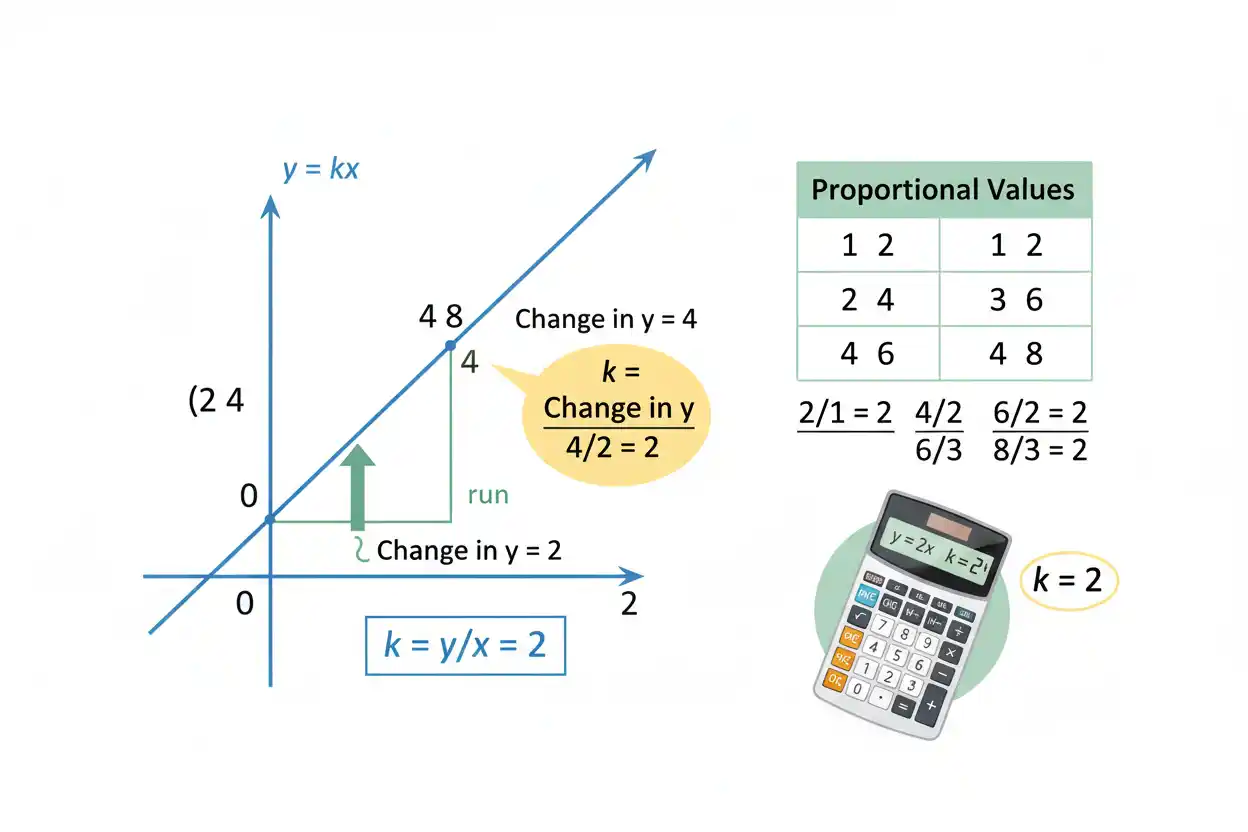

Direct variation describes a relationship in which one variable changes in constant proportion to another.
The standard formula is:
y = kx
where:
k = constant of variation
If x doubles, y doubles. If x triples, y triples. If x is cut in half, y is also cut in half, provided the same constant k continues to apply.
For example:
y = 4x
is a direct variation with:
k = 4
If:
x = 5
then:
y = 4 × 5 = 20
The ratio:
y/x
remains constant at 4 for every nonzero x in the relationship.
What Is Direct Variation?
Two variables vary directly when one is a constant multiple of the other.
The general relationship is:
y = kx
Suppose:
y = 3x
Then:
| x | y |
|---|---|
| 1 | 3 |
| 2 | 6 |
| 4 | 12 |
| 10 | 30 |
For every nonzero input:
y/x = 3
The ratio does not change.
That constant ratio is what makes the relationship a direct variation.
Direct Variation Formula
The main formula is:
y = kx
To find the constant:
k = y/x
provided:
x ≠ 0
If two corresponding values are known:
x = 6
y = 24
then:
k = 24/6
k = 4
The direct variation equation is:
y = 4x
Constant of Variation
The number k is called the constant of variation or constant of proportionality.
It tells you how much y changes for each unit of x.
For:
y = 7x
we have:
k = 7
For:
y = 0.5x
we have:
k = 0.5
For:
y = -3x
we have:
k = -3
The sign and magnitude of k determine the direction and steepness of the relationship.
Basic Direct Variation Example
Suppose y varies directly with x.
When:
x = 4
we know:
y = 20
Find the direct variation equation.
Start with:
y = kx
Substitute:
20 = k(4)
Solve:
k = 5
Therefore:
y = 5x
If:
x = 9
then:
y = 5(9)
y = 45
Direct Variation Using Two Known Pairs
Suppose:
y = 18 when x = 3
Find y when:
x = 10
First calculate:
k = 18/3 = 6
So:
y = 6x
Then:
y = 6(10)
y = 60
Proportion Form of Direct Variation
Because:
y = kx
we have:
y/x = k
For two points on the same direct variation:
y₁/x₁ = y₂/x₂
provided the denominators are nonzero.
This gives another useful formula:
y₁/x₁ = y₂/x₂
For example:
12/3 = y/8
Since:
12/3 = 4
we get:
y/8 = 4
Therefore:
y = 32
Cross-Multiplication Form
From:
y₁/x₁ = y₂/x₂
cross-multiply:
y₁x₂ = y₂x₁
For:
15/5 = y/12
we have:
15 × 12 = 5y
180 = 5y
y = 36
This is equivalent to finding the constant k first.
Direct Variation Graph
The graph of:
y = kx
is a straight line through the origin:
(0, 0)
Why?
When:
x = 0
then:
y = k(0)
y = 0
Therefore every ordinary direct-variation graph passes through the origin.
This is one of the quickest ways to distinguish direct variation from a general linear equation with a nonzero intercept.
Direct Variation and Slope
Compare:
y = kx
with the linear form:
y = mx + b
For direct variation:
m = k
and:
b = 0
Therefore the constant of variation is also the slope of the graph.
If:
y = 5x
the slope is:
5
If:
y = -2x
the slope is:
-2
Direct variation is therefore a special type of linear relationship.
Positive Direct Variation
When:
k > 0
the variables move in the same direction.
As x increases, y increases.
As x decreases, y decreases.
For:
y = 4x
positive x values produce positive y values, and negative x values produce negative y values.
The graph rises from left to right.
Negative Constant of Variation
When:
k < 0
the equation still has the direct-variation form:
y = kx
but the graph slopes downward.
For:
y = -3x
if:
x = 2
then:
y = -6
If:
x = -2
then:
y = 6
The ratio:
y/x = -3
remains constant.
This should not be confused with inverse variation, which has the form:
y = k/x
Direct Variation vs. Inverse Variation
Direct variation:
y = kx
Inverse variation:
y = k/x
In direct variation, multiplying x by a factor multiplies y by the same factor.
For example:
x doubles → y doubles
In inverse variation:
x doubles → y is divided by 2
when k remains constant.
The two relationships describe fundamentally different proportional behavior.
Direct Variation vs. Joint Variation
Joint variation involves two or more independent variables multiplying together.
For example:
z = kxy
Here z varies jointly with x and y.
Direct variation with one independent variable uses:
y = kx
Joint variation extends the same proportional principle to multiple factors.
Direct Variation vs. General Linear Relationship
Consider:
y = 3x + 5
This is linear, but it is not direct variation because:
y ≠ kx
and the graph does not pass through the origin.
When:
x = 0
we get:
y = 5
For direct variation:
x = 0 → y = 0
The zero intercept is a defining characteristic.
Is y = 4x + 0 Direct Variation?
Yes.
Because:
y = 4x + 0
simplifies to:
y = 4x
The intercept is zero.
Therefore:
k = 4
and the relationship is direct variation.
Is y = x/5 Direct Variation?
Yes.
Rewrite:
y = (1/5)x
Therefore:
k = 1/5
It has exactly the form:
y = kx
Fractions and decimals are valid constants of variation.
Is xy = 12 Direct Variation?
No.
Rearrange:
y = 12/x
This is inverse variation.
The product:
xy = 12
remains constant instead of the ratio y/x.
Is y/x = 7 Direct Variation?
Yes.
Multiply both sides by x:
y = 7x
Therefore:
k = 7
A constant ratio:
y/x
is one of the defining signatures of direct variation.
Finding k From a Table
Suppose:
| x | y |
|---|---|
| 2 | 10 |
| 4 | 20 |
| 7 | 35 |
Calculate:
10/2 = 5
20/4 = 5
35/7 = 5
Because:
y/x = 5
for every pair, the relationship is direct variation with:
k = 5
Therefore:
y = 5x
Detecting a Non-Direct Relationship From a Table
Suppose:
| x | y |
|---|---|
| 2 | 7 |
| 4 | 11 |
| 6 | 15 |
Ratios:
7/2 = 3.5
11/4 = 2.75
15/6 = 2.5
The ratios are not constant.
Therefore the table does not represent direct variation.
The values do follow a linear pattern:
y = 2x + 3
but the nonzero intercept prevents direct variation.
Direct Variation in Function Notation
A direct variation can be expressed with function notation:
f(x) = kx
For example:
f(x) = 6x
Then:
f(4) = 24
The function has:
f(0) = 0
and constant ratio:
f(x)/x = 6
for nonzero x.
Domain and Range of Direct Variation
For the unrestricted real-number function:
y = kx
with nonzero k, the usual:
Domain = All real numbers
Range = All real numbers
But real-world applications can impose different restrictions.
For example, if:
Cost = Price per Unit × Quantity
then quantity may be restricted to:
x ≥ 0
or perhaps nonnegative integers.
The domain and range should therefore reflect the actual mathematical or practical context.
Direct Variation With Restricted Domain
Suppose:
C = 12q
where:
C = total cost
and:
q = number of identical items
Mathematically, C = 12q has a direct-variation structure.
If physical items must be counted individually, a practical domain might be:
q = 0, 1, 2, 3, …
Then the corresponding outputs are:
C = 0, 12, 24, 36, …
The algebraic rule remains direct variation even though the application restricts the possible inputs.
Direct Variation Example: Constant Unit Price
Suppose each item costs:
$8
Total cost C varies directly with quantity q:
C = 8q
Here:
k = 8
For:
q = 15
we get:
C = 8 × 15
C = $120
If quantity doubles from 15 to 30:
Cost doubles from $120 to $240
provided the unit price remains constant.
Direct Variation Example: Constant Speed
At a constant speed, distance varies directly with time:
d = rt
If rate r is fixed, it acts as the constant of variation.
Suppose:
r = 60 miles per hour
Then:
d = 60t
After 2 hours:
d = 120 miles
After 5 hours:
d = 300 miles
The ratio:
d/t = 60
remains constant.
Direct Variation Example: Hourly Pay
If someone earns a fixed hourly rate with no additional adjustments:
Pay = Hourly Rate × Hours
Suppose:
P = 25h
Then:
k = 25
For 8 hours:
P = $200
For 20 hours:
P = $500
The relationship is direct as long as the same hourly rate applies and there are no fixed bonuses, overtime changes, or deductions inside the model.
Direct Variation Example: Circumference and Diameter
For a circle:
C = πd
Circumference C varies directly with diameter d.
The constant is:
k = π
If diameter doubles, circumference doubles.
For:
d = 10
then:
C = 10π
For:
d = 20
then:
C = 20π
This is a geometric example of exact direct proportionality.
Solving for x
From:
y = kx
solve for x:
x = y/k
provided:
k ≠ 0
For example:
y = 7x
and:
y = 56
Then:
x = 56/7
x = 8
Solving for k
From:
y = kx
solve:
k = y/x
provided:
x ≠ 0
Example:
y = 45
when:
x = 9
Then:
k = 45/9
k = 5
Solving for a Missing y Value
Suppose:
y varies directly with x
and:
y = 14 when x = 2
First:
k = 14/2 = 7
Equation:
y = 7x
When:
x = 11
then:
y = 77
Solving for a Missing x Value
Suppose:
y varies directly with x
and:
y = 30 when x = 6
Then:
k = 30/6 = 5
If:
y = 85
solve:
85 = 5x
Therefore:
x = 17
Direct Variation With Decimals
Suppose:
y = 0.75x
Then:
k = 0.75
If:
x = 40
then:
y = 30
If:
x = 100
then:
y = 75
A decimal constant does not change the direct-variation structure.
Direct Variation With Fractions
Suppose:
y = (3/4)x
Then:
k = 3/4
If:
x = 20
then:
y = 15
The constant of variation can be any appropriate real constant within the model.
Scaling Rule
If:
y = kx
and x is multiplied by some factor c, then:
New x = cx
New y becomes:
k(cx) = c(kx)
Therefore:
New y = cy
This proves the central scaling property of direct variation.
Doubling Example
Suppose:
y = 7x
At:
x = 4
we have:
y = 28
Double x:
x = 8
Then:
y = 56
Both variables doubled.
Tripling Example
Suppose:
y = 2.5x
At:
x = 6
we have:
y = 15
Triple x:
x = 18
Then:
y = 45
Again:
45 = 3 × 15
Percentage Change in Direct Variation
When k remains fixed, the same percentage change in x produces the same percentage change in y.
Suppose:
y = 4x
and x increases:
From 50 to 60
Percentage increase:
(60 – 50)/50 × 100 = 20%
Original:
y = 200
New:
y = 240
Percentage increase:
(240 – 200)/200 × 100 = 20%
Direct variation preserves proportional percentage changes.
Direct Variation Through the Origin
A graph can often be checked visually.
If a straight line does not pass through:
(0, 0)
then it is not a direct variation of the form:
y = kx
For example:
y = 4x + 2
passes through:
(0, 2)
not the origin.
Therefore it is linear but not directly proportional.
Direct Variation and Inequalities
A direct-variation formula can also appear inside an inequality.
Suppose:
C = 5x
and the budget requires:
C ≤ 100
Then:
5x ≤ 100
so:
x ≤ 20
The direct variation describes the cost relationship; the inequality adds a constraint.
Direct Variation and Composite Functions
Suppose:
g(x) = 3x
is a direct variation and:
f(x) = x + 5
Then the composite function:
f(g(x)) = 3x + 5
is no longer a direct variation because of the nonzero intercept.
By contrast, if:
f(x) = 2x
then:
f(g(x)) = 6x
remains a direct variation.
The composition of two pure scaling functions creates another pure scaling function.
Composition of Direct Variations
Suppose:
f(x) = ax
and:
g(x) = bx
Then:
f(g(x)) = a(bx)
Therefore:
f(g(x)) = abx
The new constant of variation is:
k = ab
This shows that repeated proportional scaling preserves the direct-variation structure.
Direct Variation and Polynomial Relationships
A direct variation specifically requires:
y = kx
If the model instead becomes:
y = kx²
then y varies directly with x², but not directly with x in the ordinary first-degree sense.
Similarly:
y = kx³
is proportional to the cube of x.
If rearranging a problem produces a cubic equation, cubic-solving methods—not the basic direct-variation formula—may be required to recover the unknown.
Direct Variation and Difference of Squares
The direct-variation identity itself does not use difference of squares.
However, a larger algebra problem can begin with a proportional relationship and later produce an expression such as:
x² – a²
after substitution or rearrangement.
At that stage:
x² – a² = (x – a)(x + a)
is a factoring step, not a direct-variation rule.
Keeping these operations distinct prevents different algebraic patterns from being confused.
Direct Variation and the Discriminant
A basic direct variation:
y = kx
is linear and therefore does not require the discriminant.
If a model becomes quadratic after substitution—for example:
ax² + bx + c = 0
then the discriminant can help classify the quadratic roots.
That means the original proportional relationship has become part of a broader equation-solving problem rather than remaining a simple direct-variation calculation.
Direct Variation vs. Exponential Relationships
Direct variation grows by constant multiplication of the input:
y = kx
An exponential relationship instead has the variable in an exponent, such as:
y = abˣ
If x increases by equal additive amounts, exponential outputs change by constant multiplicative factors rather than maintaining a constant y/x ratio.
An exponential equation therefore belongs to a different relationship family.
Direct Variation vs. Arithmetic Patterns
An arithmetic series involves adding terms from a sequence with a constant difference.
Direct variation instead describes a proportional relationship between two variables.
A table from:
y = 4x
using equally spaced x values can produce equally spaced y values, but that does not make the function itself an arithmetic series.
One concept concerns proportional functions; the other concerns sequences and sums.
Direct Variation and Complex Numbers
The basic direct-variation structure can also be expressed algebraically over complex numbers as:
w = kz
where k and z may be complex.
However, ordinary introductory direct-variation problems generally use real quantities.
Advanced complex-number transformations involving rotations and powers can require tools such as De Moivre’s theorem, but those are not necessary for solving standard equations of the form:
y = kx
How to Tell Whether a Relationship Is Direct Variation
From an equation, check whether it can be simplified to:
y = kx
From a table, check whether:
y/x
is constant for nonzero x.
From a graph, check whether it is a straight line through:
(0, 0)
These three representations should agree.
Equation Test Example
Is:
3y = 12x
a direct variation?
Divide by 3:
y = 4x
Yes.
The constant is:
k = 4
Equation Test With an Intercept
Is:
2y = 8x + 6
direct variation?
Divide by 2:
y = 4x + 3
Because the equation contains a nonzero constant term:
+3
it is not direct variation.
Table Test Example
Suppose:
| x | y |
|---|---|
| 3 | 12 |
| 5 | 20 |
| 8 | 32 |
Calculate:
12/3 = 4
20/5 = 4
32/8 = 4
The constant ratio confirms:
y = 4x
Graph Test Example
Suppose a straight line contains:
(0, 0)
and:
(4, 12)
Slope:
k = (12 – 0)/(4 – 0)
k = 3
Therefore:
y = 3x
and the graph represents direct variation.
Finding k From Two Points
For direct variation, if one point is:
(x, y) = (8, 28)
then:
k = 28/8
k = 3.5
Equation:
y = 3.5x
A second point on the same relationship must preserve that ratio.
For example:
x = 12
gives:
y = 42
Direct Variation With Zero
Because:
y = kx
setting:
x = 0
always gives:
y = 0
However:
k = y/x
cannot be calculated from the point:
(0, 0)
because that would require:
0/0
which is undefined.
You need a nonzero input-output pair to determine k from a ratio.
Is k = 0 Allowed?
Algebraically:
y = 0x
gives:
y = 0
for every x.
Some textbook definitions require the constant of variation to be nonzero so that the relationship represents meaningful proportional change.
In practical direct-variation problems, k is normally determined from a nonzero proportional relationship.
When terminology matters, use the convention specified by the course or problem.
Direct Variation Formulas
The main formulas:
Direct Variation: y = kx
Constant of Variation: k = y/x
Two-Pair Proportion: y₁/x₁ = y₂/x₂
Solve for x: x = y/k
No LaTeX, MathJax, or mathematics plugin is required for these forms.
Common Direct Variation Mistakes
A common mistake is assuming every straight-line equation is direct variation.
A line such as:
y = 3x + 4
is not direct variation because it does not pass through the origin.
Another mistake is checking differences instead of ratios.
Direct variation requires:
y/x = constant
not merely a constant difference between values.
Students can also confuse direct variation with inverse variation.
Another error is trying to calculate k from:
(0, 0)
which creates the undefined expression 0/0.
Real-world restrictions on domain and range are also sometimes ignored.
Finally, once a problem becomes quadratic, cubic, exponential, or otherwise nonlinear, the direct-variation formula alone is no longer sufficient.
Frequently Asked Questions
What is direct variation?
Direct variation is a proportional relationship between two variables that can be written:
y = kx
What is the direct variation formula?
y = kx
What does k mean?
k is the constant of variation or constant of proportionality.
How do you find the constant of variation?
k = y/x
for a known pair with:
x ≠ 0
If y = 20 when x = 4, what is k?
k = 20/4 = 5
Therefore:
y = 5x
How do you find y in direct variation?
Once k is known:
y = kx
Substitute the required x.
How do you find x?
x = y/k
provided k ≠ 0.
What is the proportion formula for direct variation?
y₁/x₁ = y₂/x₂
Does a direct variation graph pass through the origin?
Yes. For:
y = kx
setting x = 0 gives:
y = 0
Is every linear equation a direct variation?
No.
Only a linear equation with zero intercept:
y = kx
has direct-variation form.
Is y = 5x direct variation?
Yes.
k = 5
Is y = 5x + 2 direct variation?
No.
The nonzero intercept means it does not pass through the origin.
Is y = x/4 direct variation?
Yes.
Rewrite:
y = (1/4)x
so:
k = 1/4
Is y = 4/x direct variation?
No.
That is inverse variation.
What happens if x doubles?
In direct variation, y also doubles as long as k remains constant.
What happens if x increases 20%?
y also increases 20% when the same direct-variation relationship continues to apply.
Can k be negative?
Yes. A negative k gives a straight line through the origin with negative slope.
How do you recognize direct variation from a table?
Calculate:
y/x
for the nonzero input pairs. If the ratio is constant, the data represents direct variation.
How is direct variation different from joint variation?
Direct variation typically relates one dependent variable to one independent variable:
y = kx
Joint variation involves two or more variables multiplying together, such as:
z = kxy
Why is direct variation important?
Direct variation is one of the simplest mathematical models of proportional change. It connects ratios, linear functions, slopes, scaling, unit rates, graphs, and real-world relationships in which one quantity remains a constant multiple of another.