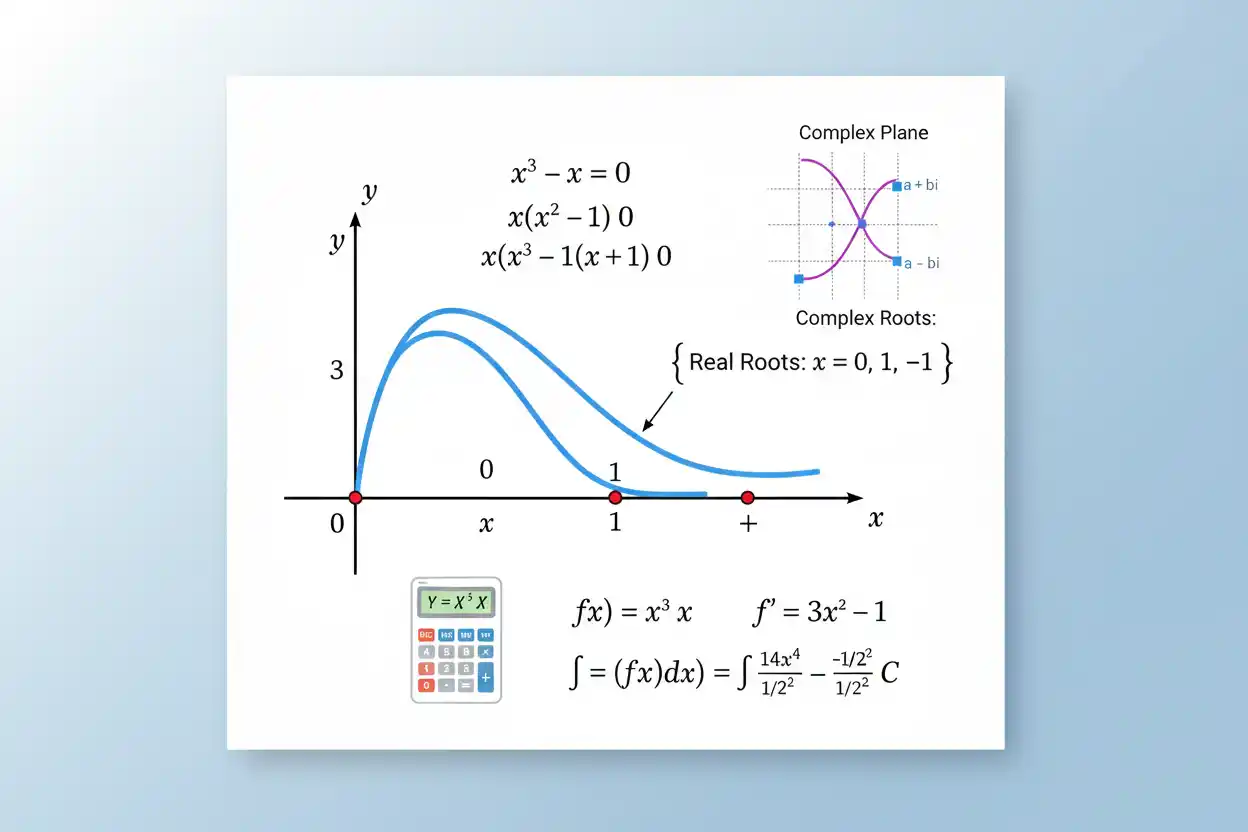

A cubic equation is a polynomial equation whose highest variable power is 3.
Its general form is:
ax³ + bx² + cx + d = 0
where:
a ≠ 0
The coefficient a cannot equal zero because removing the cubic term would reduce the equation to a quadratic or lower-degree equation.
For example:
x³ – 6x² + 11x – 6 = 0
is cubic.
It factors as:
(x – 1)(x – 2)(x – 3) = 0
so the roots are:
x = 1, 2, 3
Cubic equations can have three real roots, one real root with two nonreal complex roots, or repeated roots. Every cubic has three roots in the complex numbers when multiplicity is counted.
What Is a Cubic Equation?
A cubic equation is an equation that can be written as:
ax³ + bx² + cx + d = 0
with:
a ≠ 0
Examples include:
x³ – 8 = 0
2x³ + 5x² – 3x + 7 = 0
x³ + x = 0
4x³ – 12x² = 0
Each is a polynomial equation of degree 3.
The highest exponent determines the degree, not the number of terms.
For example:
7x³ – 2 = 0
contains only two terms but is still cubic.
General Cubic Equation Formula
The standard form is:
ax³ + bx² + cx + d = 0
The coefficients are:
a = cubic coefficient
b = quadratic coefficient
c = linear coefficient
d = constant term
The first practical objective is usually not to apply the full general cubic formula immediately. Many cubic equations can be solved much more cleanly by factoring, identifying a rational root, substitution, or recognizing a special algebraic pattern.
How Many Roots Does a Cubic Equation Have?
A cubic equation has:
3 complex roots when multiplicity is counted
This follows from the fundamental theorem of algebra.
The possible real-root patterns include:
Three distinct real roots
One real root and two nonreal complex-conjugate roots
Repeated roots
For real coefficients, any nonreal complex roots occur as conjugate pairs.
Because a cubic has odd degree, a real-coefficient cubic always has at least one real root.
Simple Cubic Equation Example
Solve:
x³ = 27
Take the cube root:
x = ∛27
Therefore:
x = 3
For the equation:
x³ – 27 = 0
the value 3 is one real root.
However, over the complex numbers, the cubic has two additional roots.
Factoring reveals all three.
Difference of Cubes
One useful identity is:
a³ – b³ = (a – b)(a² + ab + b²)
For:
x³ – 27
write:
x³ – 3³
Then:
x³ – 27 = (x – 3)(x² + 3x + 9)
Set each factor equal to zero.
First:
x – 3 = 0
so:
x = 3
Then solve:
x² + 3x + 9 = 0
The quadratic produces the other two complex roots.
Sum of Cubes
The related identity is:
a³ + b³ = (a + b)(a² – ab + b²)
For:
x³ + 8
write:
x³ + 2³
Therefore:
x³ + 8 = (x + 2)(x² – 2x + 4)
So:
x³ + 8 = 0
has the real root:
x = -2
plus two nonreal complex roots from the quadratic factor.
Solving a Cubic by Factoring
Consider:
x³ – 4x² – x + 4 = 0
Group terms:
(x³ – 4x²) + (-x + 4) = 0
Factor each group:
x²(x – 4) – 1(x – 4) = 0
Factor the common binomial:
(x – 4)(x² – 1) = 0
Now use the difference of squares:
x² – 1 = (x – 1)(x + 1)
Therefore:
(x – 4)(x – 1)(x + 1) = 0
Roots:
x = 4, 1, -1
Cubic Equation With a Common Factor
Solve:
x³ – 5x² = 0
Factor out:
x²
giving:
x²(x – 5) = 0
Therefore:
x² = 0
or:
x – 5 = 0
Roots:
x = 0
with multiplicity 2,
and:
x = 5
The total root multiplicity is:
2 + 1 = 3
which matches the degree.
Root Multiplicity in a Cubic
Suppose:
(x – 2)³ = 0
The only distinct root is:
x = 2
but its multiplicity is:
3
This still counts as three roots under the fundamental theorem of algebra.
Another example:
(x – 1)²(x + 4) = 0
has:
x = 1 with multiplicity 2
and:
x = -4 with multiplicity 1
Rational Root Strategy
For a cubic with integer coefficients, possible rational roots can often be identified from factors of the constant term and leading coefficient.
For a monic cubic:
x³ + bx² + cx + d = 0
any integer root must divide:
d
For example:
x³ – 6x² + 11x – 6 = 0
possible integer roots include factors of 6:
±1, ±2, ±3, ±6
Test:
x = 1
Substitute:
1 – 6 + 11 – 6 = 0
So x = 1 is a root.
Therefore:
x – 1
is a factor.
Using Polynomial Division After Finding a Root
Divide:
x³ – 6x² + 11x – 6
by:
x – 1
The quotient is:
x² – 5x + 6
Therefore:
x³ – 6x² + 11x – 6 = (x – 1)(x² – 5x + 6)
Factor the quadratic:
x² – 5x + 6 = (x – 2)(x – 3)
So:
(x – 1)(x – 2)(x – 3) = 0
Roots:
1, 2, 3
The same division principle is developed further in polynomial long division.
Factor Theorem
The factor theorem states:
If P(r) = 0, then (x – r) is a factor of P(x)
This rule is extremely useful for cubic equations.
Once one root is known, dividing the cubic by its corresponding linear factor reduces the problem to a quadratic.
That remaining quadratic can then be solved by factoring or the quadratic formula.
Example With One Real and Two Complex Roots
Solve:
x³ – 2x² + 5x – 10 = 0
Group:
x²(x – 2) + 5(x – 2) = 0
Factor:
(x – 2)(x² + 5) = 0
First root:
x = 2
For:
x² + 5 = 0
we get:
x² = -5
Therefore:
x = ±i√5
All roots are:
2, i√5, -i√5
Why the Complex Roots Form a Conjugate Pair
The cubic above has real coefficients.
One nonreal root is:
i√5
Its complex conjugate is:
-i√5
Both must occur.
This conjugate pairing is why a real-coefficient cubic with nonreal solutions generally has:
one real root + one complex-conjugate pair
rather than three unrelated nonreal roots.
Graph of a Cubic Equation
A cubic polynomial can be represented as:
y = ax³ + bx² + cx + d
Its real roots occur where the graph crosses or touches the x-axis:
y = 0
A cubic graph may intersect the x-axis three times or only once.
For example:
y = x³ – x
factors as:
x(x – 1)(x + 1)
so it has x-intercepts:
-1, 0, 1
By contrast:
y = x³ + x + 1
has only one real x-intercept.
Cubic Equation in Depressed Form
The general cubic:
ax³ + bx² + cx + d = 0
can be transformed so the squared term disappears.
After dividing by a, write:
x³ + Ax² + Bx + C = 0
Use the substitution:
x = t – A/3
The equation becomes a depressed cubic:
t³ + pt + q = 0
This simpler form is the foundation of Cardano’s formula.
Depressed Cubic Coefficients
Starting with:
ax³ + bx² + cx + d = 0
the depressed-cubic coefficients can be written:
p = (3ac – b²) / (3a²)
and:
q = (27a²d – 9abc + 2b³) / (27a³)
after using:
x = t – b/(3a)
The transformed equation is:
t³ + pt + q = 0
Cardano Formula
For the depressed cubic:
t³ + pt + q = 0
one solution is:
t = ∛[-q/2 + √((q/2)² + (p/3)³)] + ∛[-q/2 – √((q/2)² + (p/3)³)]
Then convert back using:
x = t – b/(3a)
Cardano’s formula is mathematically general, but it is often less practical than factoring when a simple rational root exists.
Cardano Formula Example
Solve:
x³ – 3x – 2 = 0
This is already depressed:
p = -3
q = -2
Compute:
-q/2 = 1
and:
(q/2)² + (p/3)³ = (-1)² + (-1)³
= 1 – 1
= 0
Therefore:
x = ∛1 + ∛1
x = 2
So one root is:
x = 2
Factor the cubic:
x³ – 3x – 2 = (x – 2)(x + 1)²
The complete root set is:
x = 2
and:
x = -1 with multiplicity 2
Cubic Discriminant
For:
ax³ + bx² + cx + d = 0
a useful discriminant is:
Δ = 18abcd – 4b³d + b²c² – 4ac³ – 27a²d²
For real coefficients:
Δ > 0 → Three distinct real roots
Δ < 0 → One real root and two nonreal complex-conjugate roots
Δ = 0 → At least two roots are repeated
This is different from the quadratic discriminant formula:
b² – 4ac
because the cubic has four coefficients and a more complicated root structure.
Cubic With Three Distinct Real Roots
Consider:
x³ – 6x² + 11x – 6 = 0
Its roots are:
1, 2, 3
All three are distinct and real.
Graphically, the cubic crosses the x-axis three times.
Cubic With One Real Root
Consider:
x³ + x + 1 = 0
This cubic does not factor easily over the integers.
Its real graph crosses the x-axis only once.
The other two roots are a nonreal complex-conjugate pair.
The full cubic formula or numerical approximation can be used when an exact simple factorization is unavailable.
Repeated-Root Cubic
Consider:
x³ – 3x² + 3x – 1 = 0
Recognize the binomial pattern:
(x – 1)³ = 0
This identity follows from the binomial theorem.
The root is:
x = 1
with multiplicity 3.
Cubic Equation From Known Roots
Suppose the roots are:
1, 2, 5
Construct factors:
(x – 1)(x – 2)(x – 5)
First:
(x – 1)(x – 2) = x² – 3x + 2
Multiply by:
x – 5
Then:
(x² – 3x + 2)(x – 5)
= x³ – 8x² + 17x – 10
Therefore one cubic with those roots is:
x³ – 8x² + 17x – 10 = 0
Cubic Equation From a Real Root and Complex Pair
Suppose the roots are:
2
1 + 3i
1 – 3i
The conjugate-pair factors are:
[x – (1 + 3i)][x – (1 – 3i)]
This becomes:
(x – 1)² + 9
= x² – 2x + 10
Include the real root:
(x – 2)(x² – 2x + 10)
Expand:
x³ – 4x² + 14x – 20
Therefore:
x³ – 4x² + 14x – 20 = 0
has the required roots.
Relationship Between Roots and Coefficients
For:
ax³ + bx² + cx + d = 0
with roots:
r₁, r₂, r₃
the root relationships are:
r₁ + r₂ + r₃ = -b/a
r₁r₂ + r₁r₃ + r₂r₃ = c/a
r₁r₂r₃ = -d/a
These are Vieta-style relationships for a cubic.
They can be useful for checking roots or finding missing information without expanding the entire polynomial again.
Example Using the Sum of Roots
For:
x³ – 6x² + 11x – 6 = 0
we have:
a = 1
b = -6
Therefore:
r₁ + r₂ + r₃ = -(-6)/1
= 6
Known roots:
1 + 2 + 3 = 6
The relationship is verified.
Example Using the Product of Roots
For the same equation:
r₁r₂r₃ = -d/a
Here:
d = -6
so:
r₁r₂r₃ = 6
Indeed:
1 × 2 × 3 = 6
These relationships provide useful consistency checks.
Cubic Equations and Composite Functions
A composite function can produce a cubic equation.
Suppose:
f(x) = x³ – 8
and:
g(x) = x + 1
Then:
f(g(x)) = (x + 1)³ – 8
Set:
f(g(x)) = 0
Then:
(x + 1)³ = 8
Taking the real cube root gives:
x + 1 = 2
x = 1
The composition creates the equation; cubic methods determine its solutions.
Cubic Equations and De Moivre’s Theorem
De Moivre’s theorem becomes useful when cubic equations are interpreted through complex roots and polar form.
For example:
z³ = 1
has three complex solutions.
Instead of attempting ordinary real-number cube roots only, De Moivre’s theorem generates all three roots with equal angular spacing on the complex plane.
This is especially useful for equations of the form:
zⁿ = w
Cubic Roots of Unity
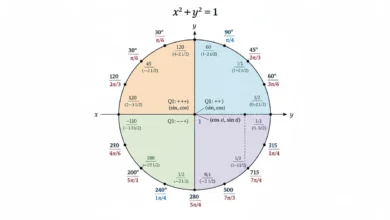
Solve:
z³ = 1
The three roots are:
1
-1/2 + (√3/2)i
-1/2 – (√3/2)i
They lie at:
0°
120°
240°
on the unit circle.
Their equal spacing is a geometric consequence of complex root theory.
Cubic Equation vs. Quadratic Equation
A quadratic equation has degree 2:
ax² + bx + c = 0
A cubic has degree 3:
ax³ + bx² + cx + d = 0
A quadratic has two roots when multiplicity is counted.
A cubic has three.
The quadratic formula is relatively compact, while the general cubic formula requires a transformation to depressed form and substantially more algebra.
Cubic Equation vs. Linear Equation
A linear equation has variable degree 1.
Example:
2x + 3 = 0
A cubic can produce turning behavior and multiple real roots that a one-variable linear equation cannot.
The degree fundamentally changes both the algebraic and graphical structure.
Cubic Equation and Difference of Squares
The difference of squares often appears after a cubic has been partially factored.
For example:
x³ – 4x = 0
Factor:
x(x² – 4) = 0
Then:
x(x – 2)(x + 2) = 0
Roots:
x = 0, 2, -2
The cubic step reduces to a quadratic factor that has a familiar special form.
Cubic Equation and Complex Numbers
Complex numbers ensure that every cubic has all three roots within one number system.
For a real-coefficient cubic, the number of nonreal roots cannot be exactly one.
If a nonreal root exists, its conjugate also exists.
Therefore the typical real-coefficient patterns are:
3 real roots
or:
1 real root + 2 nonreal complex roots
counting repeated-root variations separately.
Approximate Numerical Solutions
Not every cubic has a convenient exact factorization.
When an exact symbolic result is unnecessary, a root can be approximated numerically.
For example, if:
f(x) = x³ + x – 1
then:
f(0) = -1
and:
f(1) = 1
so a real root lies between 0 and 1.
Numerical methods can refine that estimate.
The exact cubic formula remains available, but a numerical solution can be much easier to interpret in applied work.
Checking Cubic Roots
Every proposed root should satisfy the original equation.
Suppose:
x = 2
is proposed for:
x³ – 3x – 2 = 0
Substitute:
2³ – 3(2) – 2
= 8 – 6 – 2
= 0
Therefore:
x = 2
is confirmed as a root.
Checking is particularly valuable after synthetic or polynomial division, sign-sensitive factorization, or complicated symbolic formulas.
Common Cubic Equation Mistakes
A common mistake is treating:
ax³ + bx² + cx + d = 0
as though the quadratic formula applies directly.
Another is finding one real root and stopping even though a cubic has three roots when multiplicity is counted.
Students can also miss repeated roots.
Sign errors are common when factoring sums and differences of cubes.
Another mistake is forgetting that nonreal roots of real-coefficient cubics occur in conjugate pairs.
When using Cardano’s method, the substitution that removes the quadratic term must be applied consistently.
Finally, the full cubic formula should not be used automatically when simple factoring or a rational root can solve the equation much more cleanly.
Frequently Asked Questions
What is a cubic equation?
A cubic equation is a polynomial equation whose highest variable power is 3.
What is the general cubic equation formula?
ax³ + bx² + cx + d = 0
with:
a ≠ 0
How many roots does a cubic equation have?
It has three complex roots when multiplicity is counted.
Does every cubic equation have a real root?
Every cubic polynomial with real coefficients has at least one real root.
Can a cubic have three real roots?
Yes.
For example:
x³ – 6x² + 11x – 6 = 0
has roots:
1, 2, 3
Can a cubic have complex roots?
Yes.
A real-coefficient cubic can have one real root and two nonreal complex-conjugate roots.
What is the easiest way to solve a cubic?
Try simple factoring, a common factor, grouping, special cube identities, or rational roots before using the general cubic formula.
What is the factor theorem?
If P(r) = 0, then (x – r) is a factor of P(x)
What happens after finding one cubic root?
Divide the cubic by its linear factor. The remaining factor is quadratic and can be solved separately.
What is a depressed cubic?
It is a cubic written as:
t³ + pt + q = 0
with no squared term.
How do you convert a general cubic to depressed form?
For:
ax³ + bx² + cx + d = 0
use:
x = t – b/(3a)
What is Cardano’s formula?
For:
t³ + pt + q = 0
one root is:
t = ∛[-q/2 + √((q/2)² + (p/3)³)] + ∛[-q/2 – √((q/2)² + (p/3)³)]
What is the cubic discriminant?
Δ = 18abcd – 4b³d + b²c² – 4ac³ – 27a²d²
It helps classify the root pattern.
What does a positive cubic discriminant mean?
For real coefficients:
Δ > 0
means three distinct real roots.
What does a negative cubic discriminant mean?
For real coefficients:
Δ < 0
means one real root and two nonreal complex-conjugate roots.
Can a cubic have a triple root?
Yes.
(x – r)³ = 0
has the root r with multiplicity 3.
How are cubic roots connected to De Moivre’s theorem?
De Moivre’s theorem provides an efficient method for finding all complex cube roots when a number is written in polar form.
Why are cubic equations important?
Cubic equations are the first polynomial equations beyond quadratics to exhibit richer root behavior, multiple turning patterns, repeated roots, and general solutions involving substantial algebra. They also connect factorization, complex numbers, polynomial division, and higher-degree equation solving.