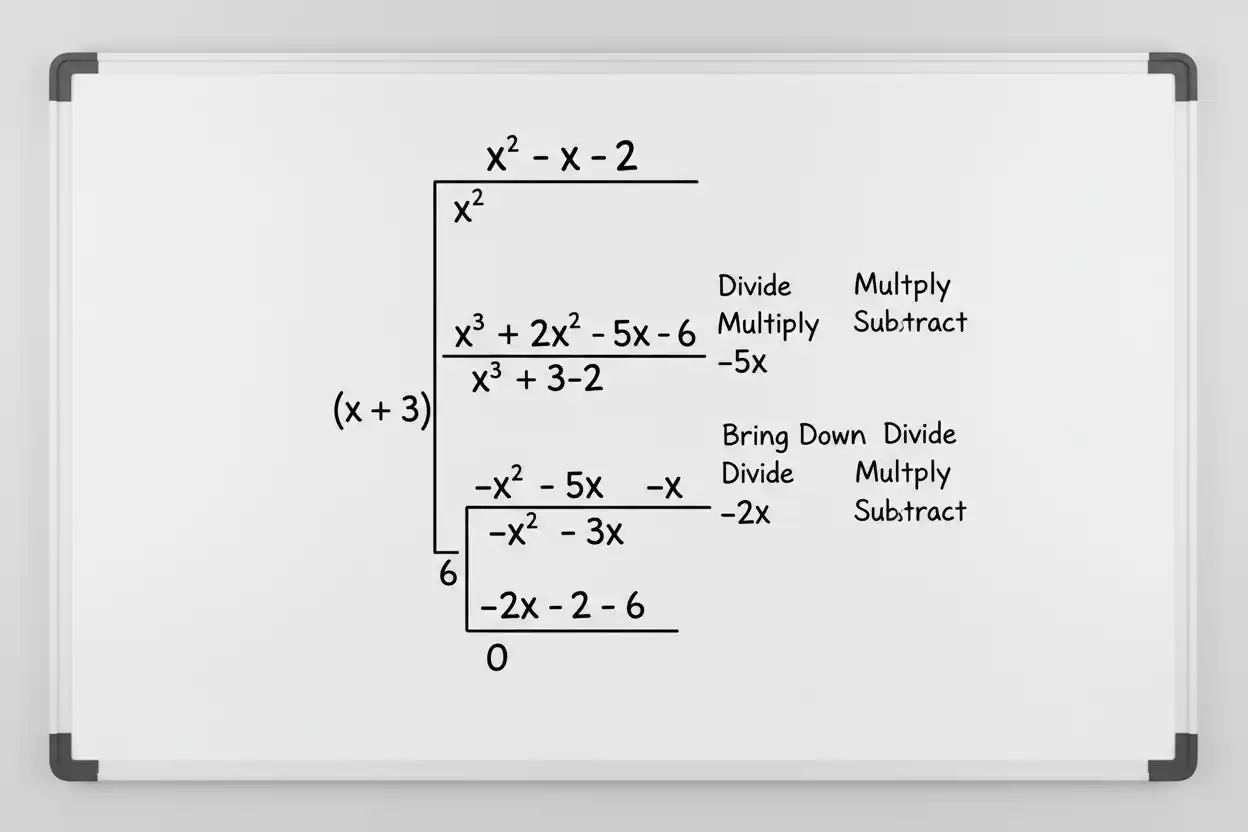

Polynomial long division is a method for dividing one polynomial by another polynomial. It works similarly to long division with ordinary numbers: divide the leading terms, multiply, subtract, bring down the next term, and repeat.
The fundamental relationship is:
Dividend = Divisor × Quotient + Remainder
For polynomials:
P(x) = D(x)Q(x) + R(x)
where:
- P(x) = dividend
- D(x) = divisor
- Q(x) = quotient
- R(x) = remainder
When the remainder is nonzero, its degree must be lower than the degree of the divisor.
For example:
(x³ + 2x² – 5x – 6) ÷ (x + 3)
has quotient:
x² – x – 2
and remainder:
0
because:
x³ + 2x² – 5x – 6 = (x + 3)(x² – x – 2)
What Is Polynomial Long Division?
Polynomial long division divides a polynomial of higher or equal degree by a nonzero polynomial of lower or equal degree.
Suppose:
P(x) ÷ D(x)
The goal is to find Q(x) and R(x) such that:
P(x) = D(x)Q(x) + R(x)
with:
degree of R < degree of D
or:
R(x) = 0
This method works with linear, quadratic, and higher-degree divisors. It is therefore more general than shortcuts designed only for certain linear divisors.
Polynomial Long Division Formula
The division algorithm for polynomials is:
P(x) = D(x)Q(x) + R(x)
Solving for the rational expression gives:
P(x) / D(x) = Q(x) + R(x)/D(x)
For example, if division produces:
Q(x) = 2x² + 7x + 9
and:
R(x) = 25
when dividing by x – 2, then:
P(x)/(x – 2) = 2x² + 7x + 9 + 25/(x – 2)
This form is useful when an exact polynomial division leaves a remainder.
The Polynomial Long Division Steps
The process repeats four main operations:
Divide. Divide the leading term of the current dividend by the leading term of the divisor.
Multiply. Multiply the entire divisor by that quotient term.
Subtract. Subtract the result from the current polynomial.
Repeat. Bring down the remaining terms and continue until the remainder has lower degree than the divisor.
Keeping polynomial terms in descending powers of the variable makes these steps much easier to organize.
Example 1: Exact Polynomial Division
Divide:
x³ + 2x² – 5x – 6
by:
x + 3
First division step
Divide the leading terms:
x³ / x = x²
The first quotient term is:
x²
Multiply the divisor by x²:
x²(x + 3) = x³ + 3x²
Subtract:
(x³ + 2x²) – (x³ + 3x²) = -x²
Bring down -5x:
-x² – 5x
Second division step
Divide:
-x² / x = -x
Add -x to the quotient.
Multiply:
-x(x + 3) = -x² – 3x
Subtract:
(-x² – 5x) – (-x² – 3x)
= -2x
Bring down -6:
-2x – 6
Third division step
Divide:
-2x / x = -2
Multiply:
-2(x + 3) = -2x – 6
Subtract:
(-2x – 6) – (-2x – 6) = 0
Therefore:
Q(x) = x² – x – 2
and:
R(x) = 0
So:
(x³ + 2x² – 5x – 6) / (x + 3) = x² – x – 2
Verify the Division
Use:
Dividend = Divisor × Quotient + Remainder
Substitute:
(x + 3)(x² – x – 2) + 0
Multiply:
x(x² – x – 2) + 3(x² – x – 2)
= x³ – x² – 2x + 3x² – 3x – 6
Combine like terms:
= x³ + 2x² – 5x – 6
This matches the original dividend exactly.
Example 2: Division With a Remainder
Divide:
2x³ + 3x² – 5x + 7
by:
x – 2
First term
Divide:
2x³ / x = 2x²
Multiply:
2x²(x – 2) = 2x³ – 4x²
Subtract:
(2x³ + 3x²) – (2x³ – 4x²)
= 7x²
Bring down -5x:
7x² – 5x
Second term
Divide:
7x² / x = 7x
Multiply:
7x(x – 2) = 7x² – 14x
Subtract:
(7x² – 5x) – (7x² – 14x)
= 9x
Bring down +7:
9x + 7
Third term
Divide:
9x / x = 9
Multiply:
9(x – 2) = 9x – 18
Subtract:
(9x + 7) – (9x – 18)
= 25
The remainder is now a constant, which has lower degree than the linear divisor.
Therefore:
Q(x) = 2x² + 7x + 9
R(x) = 25
The result is:
(2x³ + 3x² – 5x + 7)/(x – 2) = 2x² + 7x + 9 + 25/(x – 2)
Checking a Nonzero Remainder
Use the division identity:
P(x) = D(x)Q(x) + R(x)
For the previous example:
P(x) = (x – 2)(2x² + 7x + 9) + 25
Multiply:
(x – 2)(2x² + 7x + 9)
= 2x³ + 7x² + 9x – 4x² – 14x – 18
= 2x³ + 3x² – 5x – 18
Add the remainder:
2x³ + 3x² – 5x – 18 + 25
= 2x³ + 3x² – 5x + 7
The original dividend is recovered.
Missing Polynomial Terms
One of the most common polynomial long division errors occurs when a power is missing.
For example:
x⁴ – 5x + 2
should be organized as:
x⁴ + 0x³ + 0x² – 5x + 2
The zero coefficients preserve place value.
This plays the same role as zeros in numerical long division: they keep corresponding powers aligned.
Example 3: Missing Terms
Divide:
x⁴ – 1
by:
x² + 1
Write the dividend as:
x⁴ + 0x³ + 0x² + 0x – 1
Divide the leading terms:
x⁴ / x² = x²
Multiply:
x²(x² + 1) = x⁴ + x²
Subtract:
(x⁴ + 0x²) – (x⁴ + x²) = -x²
Bring down -1:
-x² – 1
Now divide:
-x² / x² = -1
Multiply:
-1(x² + 1) = -x² – 1
Subtract:
0
Therefore:
(x⁴ – 1)/(x² + 1) = x² – 1
The identity can be checked directly:
(x² + 1)(x² – 1) = x⁴ – 1
Dividing by a Polynomial With More Than One Term
Polynomial long division is not restricted to divisors such as x – a.
Consider:
(2x³ + 5x² – 4x + 3) ÷ (x² + x – 2)
Divide leading terms:
2x³ / x² = 2x
Multiply:
2x(x² + x – 2) = 2x³ + 2x² – 4x
Subtract:
3x² + 0x + 3
Now divide:
3x² / x² = 3
Multiply:
3(x² + x – 2) = 3x² + 3x – 6
Subtract:
-3x + 9
Since the remainder has degree 1 and the divisor has degree 2, the division stops.
Therefore:
Q(x) = 2x + 3
R(x) = -3x + 9
and:
(2x³ + 5x² – 4x + 3)/(x² + x – 2) = 2x + 3 + (-3x + 9)/(x² + x – 2)
When Does Polynomial Long Division Stop?
Stop when either:
R(x) = 0
or:
degree of R < degree of divisor
For example, if the divisor is quadratic, a linear or constant remainder is small enough to stop.
You do not continue dividing once the remainder’s degree is below the divisor’s degree.
Exact Division
A polynomial divides another polynomial exactly when:
R(x) = 0
For example:
x³ – 4x² + x + 6
is exactly divisible by x – 2 if division leaves zero remainder.
An exact division gives:
P(x) = D(x)Q(x)
so the divisor is a factor of the dividend.
This connection is particularly useful when solving a polynomial equation.
Polynomial Long Division and Factors
Suppose:
P(x) = (x – 3)Q(x)
Then dividing P(x) by x – 3 produces:
R(x) = 0
Conversely, if division by x – 3 gives zero remainder, then x – 3 is a factor of P(x).
This allows a higher-degree polynomial to be reduced after a factor has been identified.
For example, dividing a cubic by one known linear factor can leave a quadratic quotient, which may then be solved using the methods for a quadratic equation.
Remainders and Polynomial Values
For a linear divisor:
x – a
the remainder is a constant.
If:
P(x) = (x – a)Q(x) + R
set x = a:
P(a) = (a – a)Q(a) + R
P(a) = R
Therefore the remainder when dividing P(x) by x – a equals P(a).
This provides a useful check even when full long division has already been completed.
Example: Check the Remainder by Substitution
Earlier, dividing:
P(x) = 2x³ + 3x² – 5x + 7
by:
x – 2
gave remainder:
25
Evaluate P(2):
P(2) = 2(2³) + 3(2²) – 5(2) + 7
= 16 + 12 – 10 + 7
= 25
The value matches the long-division remainder.
Polynomial Long Division and Partial Fractions
Partial fractions normally begin with a proper rational expression:
degree numerator < degree denominator
If a rational expression is improper, polynomial long division should usually be performed first.
For example:
(x² + 4x + 7)/(x + 1)
has a numerator of higher degree than its denominator.
Long division gives:
x + 3 + 4/(x + 1)
Only the remaining proper rational part would need further decomposition if its denominator structure required it.
The two techniques therefore often occur consecutively, but their purposes are different.
Polynomial Long Division and Piecewise Functions
A piecewise function selects different formulas for different portions of its domain.
Polynomial long division does not split a domain into cases. It rewrites one polynomial division problem as:
quotient + remainder/divisor
A quotient obtained from long division could appear inside a piecewise formula, but that does not make the division process itself piecewise.
Polynomial Long Division and the Quadratic Formula
Long division can reduce a higher-degree polynomial to a quadratic factor.
Suppose a cubic equation has a known factor x – r. After division, the quotient may be:
ax² + bx + c
If that quadratic does not factor conveniently, its roots can then be found using the quadratic formula.
Long division’s job is to reduce the polynomial. The quadratic formula’s job is to solve the resulting second-degree equation.
Pascal Triangle and Polynomial Division
Pascal triangle is commonly used to generate coefficients when expanding powers of binomials.
Those expansions may produce polynomials that are later divided, but Pascal triangle is not a division method.
For polynomial long division, the essential requirement is to arrange all terms in descending powers and preserve missing powers with zero coefficients.
Why Order of Terms Matters
Consider:
3 + 2x³ – x
For long division, rewrite it as:
2x³ + 0x² – x + 3
This ensures that:
- cubic terms align with cubic terms;
- quadratic terms align with quadratic terms;
- linear terms align with linear terms;
- constants align with constants.
Misaligned powers are one of the fastest ways to produce an incorrect quotient.
Leading Terms Control Each Step
At every stage, divide the leading term of the current remainder by the leading term of the divisor.
Suppose the current polynomial begins:
6x⁴ + …
and the divisor begins:
2x² + …
The next quotient term must be:
6x⁴ / 2x² = 3x²
That term is chosen specifically so that multiplication will cancel the current leading term.
The same logic repeats until no further cancellation is possible because the remaining degree is too small.
Subtraction Requires Parentheses
Suppose a step requires:
(5x² – 3x) – (5x² + 2x)
Subtract the entire second polynomial:
5x² – 3x – 5x² – 2x
= -5x
A frequent error is to change only the first sign and leave the remaining signs unchanged.
Writing the polynomial being subtracted inside parentheses helps prevent this mistake.
Polynomial Long Division With a Constant Divisor
If the divisor is merely a nonzero constant, ordinary term-by-term division is enough.
For example:
(6x³ – 9x² + 12x)/3
becomes:
2x³ – 3x² + 4x
Long division is most useful when the divisor itself contains a variable.
Polynomial Long Division vs Numerical Long Division
The structures are closely related.
In numerical long division, you divide leading digits, multiply, subtract, and bring down the next digit.
In polynomial long division, you divide leading terms, multiply polynomials, subtract like terms, and bring down terms of the next lower degree.
The main additional requirement is careful exponent alignment.
Common Polynomial Long Division Mistakes
Forgetting Missing Powers
Write:
x³ + 0x² + 2x – 5
rather than leaving the missing x² position unmarked during setup.
Dividing the Wrong Terms
Each quotient step starts with:
leading term of current dividend / leading term of divisor
Multiplying Only the Leading Term
After finding a quotient term, multiply it by the entire divisor, not just the divisor’s first term.
Incorrect Subtraction
Distribute the subtraction sign across every term in the polynomial being subtracted.
Stopping Too Early
Continue while the current remainder has degree at least as large as the divisor’s degree.
Continuing Too Long
Stop when:
degree remainder < degree divisor
A lower-degree remainder cannot be divided further within polynomial division.
Ignoring the Remainder
If R(x) ≠ 0, the final result is not just Q(x).
Write:
Q(x) + R(x)/D(x)
Forgetting to Check the Result
Use:
P(x) = D(x)Q(x) + R(x)
to verify the quotient and remainder.
Worked Polynomial Long Division Example
Divide:
2x³ – 3x² – 11x + 6
by:
x – 3
First divide:
2x³ / x = 2x²
Multiply:
2x²(x – 3) = 2x³ – 6x²
Subtract:
(2x³ – 3x²) – (2x³ – 6x²)
= 3x²
Bring down -11x:
3x² – 11x
Divide:
3x² / x = 3x
Multiply:
3x(x – 3) = 3x² – 9x
Subtract:
(3x² – 11x) – (3x² – 9x)
= -2x
Bring down +6:
-2x + 6
Divide:
-2x / x = -2
Multiply:
-2(x – 3) = -2x + 6
Subtract:
0
Therefore:
Q(x) = 2x² + 3x – 2
and:
R(x) = 0
So:
(2x³ – 3x² – 11x + 6)/(x – 3) = 2x² + 3x – 2
Verify:
(x – 3)(2x² + 3x – 2)
= 2x³ + 3x² – 2x – 6x² – 9x + 6
= 2x³ – 3x² – 11x + 6
The result is correct.
Frequently Asked Questions
What is polynomial long division?
Polynomial long division is a method for dividing one polynomial by another by repeatedly dividing leading terms, multiplying, subtracting, and continuing with the remainder.
What is the polynomial division formula?
The fundamental identity is:
P(x) = D(x)Q(x) + R(x)
where the remainder has lower degree than the divisor.
What do you divide first in polynomial long division?
Divide the leading term of the current dividend by the leading term of the divisor.
When do you stop polynomial long division?
Stop when the remainder is zero or its degree is lower than the degree of the divisor.
What if a term is missing from the dividend?
Insert a zero coefficient as a placeholder.
For example:
x³ + 2x – 1
should be organized as:
x³ + 0x² + 2x – 1
What does a zero remainder mean?
A zero remainder means the divisor divides the polynomial exactly and is a factor of the dividend.
How do you write an answer with a remainder?
If the quotient is Q(x) and remainder is R(x):
P(x)/D(x) = Q(x) + R(x)/D(x)
Can you divide by a quadratic polynomial?
Yes. Polynomial long division can use linear, quadratic, or higher-degree polynomial divisors, provided the divisor is not zero.
How do you check polynomial long division?
Verify:
Dividend = Divisor × Quotient + Remainder
Expanding the right side should reproduce the original dividend.
Why are zero placeholders important?
They keep like powers aligned during subtraction and prevent terms from shifting into the wrong polynomial degree.
How is polynomial long division used in partial fractions?
If a rational expression is improper, polynomial long division can separate out its polynomial quotient before the remaining proper rational expression is decomposed into partial fractions.
Can polynomial long division help solve polynomial equations?
Yes. If a root or factor is known, division can reduce a higher-degree polynomial to a lower-degree quotient that is easier to factor or solve.