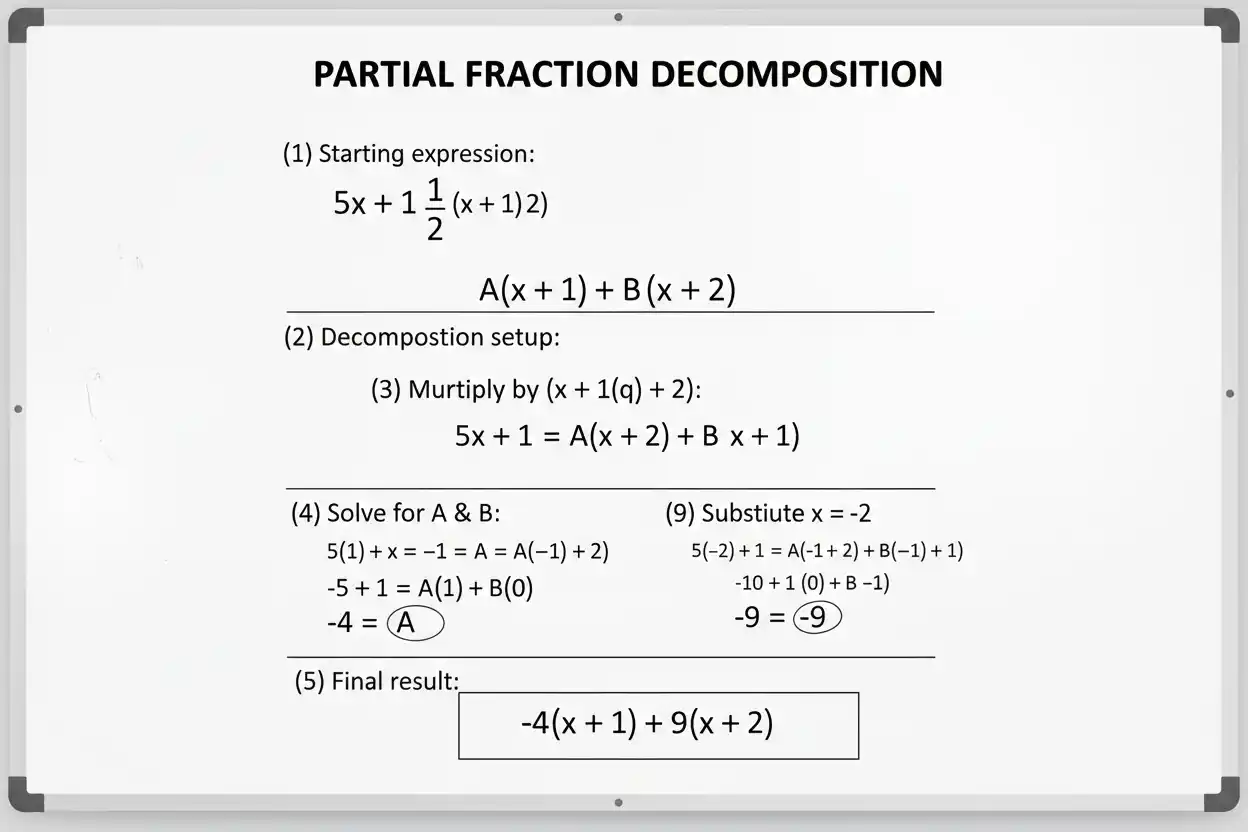

Partial fractions are simpler rational expressions whose sum equals a more complicated rational expression. Partial fraction decomposition reverses the process of adding algebraic fractions.
For example:
5 / ((x + 1)(x + 2))
can be written as:
5 / ((x + 1)(x + 2)) = A/(x + 1) + B/(x + 2)
The constants A and B are then determined algebraically.
For this example:
5 = A(x + 2) + B(x + 1)
Solving gives:
A = 5
B = -5
so:
5 / ((x + 1)(x + 2)) = 5/(x + 1) – 5/(x + 2)
Partial fraction decomposition is useful because simpler fractions are often easier to manipulate than the original rational expression.
What Are Partial Fractions?
A rational expression has the form:
P(x) / Q(x)
where P(x) and Q(x) are polynomials and:
Q(x) ≠ 0
Partial fraction decomposition rewrites certain rational expressions as sums of simpler rational terms.
For example:
(3x + 5) / ((x + 1)(x + 2))
may be decomposed into:
A/(x + 1) + B/(x + 2)
The original fraction and its decomposition are algebraically equivalent wherever both are defined.
Partial fractions are an algebra technique. The main challenge is choosing the correct decomposition form from the factorization of the denominator.
When Can You Use Partial Fractions?
Standard partial fraction decomposition begins with a proper rational expression, meaning:
degree of numerator < degree of denominator
For example:
(2x + 3) / (x² + 5x + 6)
is proper because the numerator has degree 1 and the denominator has degree 2.
By contrast:
(x² + 3x + 1) / (x + 2)
is improper because the numerator’s degree is at least as large as the denominator’s degree.
An improper rational expression should first be rewritten using polynomial long division. Partial fraction decomposition can then be applied to any proper rational remainder.
Basic Partial Fractions Formula
If the denominator contains two distinct linear factors:
(x – a)(x – b)
a proper rational expression can typically be written as:
P(x) / ((x – a)(x – b)) = A/(x – a) + B/(x – b)
where A and B are constants to be determined.
For example:
(5x + 7) / ((x + 1)(x + 2))
takes the form:
A/(x + 1) + B/(x + 2)
Multiplying through by the common denominator gives an equation that can be solved for A and B.
Why Partial Fractions Work
Start with:
A/(x + 1) + B/(x + 2)
The common denominator is:
(x + 1)(x + 2)
Combining the fractions gives:
[A(x + 2) + B(x + 1)] / ((x + 1)(x + 2))
The numerator becomes:
A(x + 2) + B(x + 1)
= Ax + 2A + Bx + B
= (A + B)x + (2A + B)
By choosing A and B appropriately, this numerator can be made equal to the numerator of the original rational expression.
Partial fraction decomposition therefore finds the simpler fractions that combine back into the original one.
Step 1: Make Sure the Fraction Is Proper
Before decomposing:
P(x) / Q(x)
compare the polynomial degrees.
If:
degree P < degree Q
continue directly.
If:
degree P ≥ degree Q
divide first.
This step matters because the usual partial fraction templates represent proper rational expressions, not an entire improper fraction by themselves.
Step 2: Factor the Denominator
The denominator’s factorization determines the correct decomposition structure.
For example:
x² + 3x + 2
factors as:
(x + 1)(x + 2)
so a fraction with this denominator can use:
A/(x + 1) + B/(x + 2)
If a denominator factor repeats or contains an irreducible quadratic, a different form is required.
Distinct Linear Factors
Suppose the denominator factors into different linear expressions:
(x – a)(x – b)
Then use:
A/(x – a) + B/(x – b)
For three distinct factors:
(x – a)(x – b)(x – c)
use:
A/(x – a) + B/(x – b) + C/(x – c)
Each distinct linear factor receives its own constant numerator.
Example 1: Two Distinct Linear Factors
Decompose:
(5x + 7) / ((x + 1)(x + 2))
Write:
(5x + 7) / ((x + 1)(x + 2)) = A/(x + 1) + B/(x + 2)
Multiply by:
(x + 1)(x + 2)
to clear denominators:
5x + 7 = A(x + 2) + B(x + 1)
Expand:
5x + 7 = Ax + 2A + Bx + B
5x + 7 = (A + B)x + (2A + B)
Compare coefficients:
A + B = 5
2A + B = 7
Subtract the first equation from the second:
A = 2
Then:
B = 3
Therefore:
(5x + 7) / ((x + 1)(x + 2)) = 2/(x + 1) + 3/(x + 2)
Solving Coefficients by Substitution
The same example can often be solved faster by choosing values that eliminate terms.
From:
5x + 7 = A(x + 2) + B(x + 1)
set:
x = -1
Then:
5(-1) + 7 = A(1)
2 = A
So:
A = 2
Now set:
x = -2
Then:
5(-2) + 7 = B(-1)
-3 = -B
B = 3
The decomposition is again:
2/(x + 1) + 3/(x + 2)
This substitution method is especially convenient for distinct linear factors because each selected root makes all but one term vanish.
Coefficient Comparison Method
Instead of substituting special values, you can expand the right-hand side and compare coefficients.
Suppose:
7x + 1 = A(x – 3) + B(x + 2)
Expand:
7x + 1 = Ax – 3A + Bx + 2B
Group terms:
7x + 1 = (A + B)x + (-3A + 2B)
Then compare corresponding coefficients:
A + B = 7
-3A + 2B = 1
This creates a small system of linear equations whose solution determines A and B.
Both substitution and coefficient comparison are valid; one may simply be more efficient for a particular expression.
Repeated Linear Factors
If a linear factor occurs more than once, include a fraction for every power of that factor up to its multiplicity.
For example, if the denominator contains:
(x – 2)³
the decomposition must include:
A/(x – 2) + B/(x – 2)² + C/(x – 2)³
Leaving out one of these terms creates an incomplete decomposition.
For a denominator:
(x + 1)²(x – 3)
use:
A/(x + 1) + B/(x + 1)² + C/(x – 3)
Example 2: Repeated Linear Factor
Decompose:
(3x + 5) / (x + 1)²
Write:
(3x + 5) / (x + 1)² = A/(x + 1) + B/(x + 1)²
Multiply through by:
(x + 1)²
to obtain:
3x + 5 = A(x + 1) + B
Set x = -1:
3(-1) + 5 = B
2 = B
So:
B = 2
Expand the right side:
3x + 5 = Ax + A + 2
Compare the x-coefficient:
A = 3
Therefore:
(3x + 5) / (x + 1)² = 3/(x + 1) + 2/(x + 1)²
Irreducible Quadratic Factors
Some quadratic factors cannot be factored into real linear factors.
For an irreducible quadratic such as:
x² + 1
the numerator of its partial fraction term must be linear:
Ax + B
Therefore a denominator containing:
(x – 2)(x² + 1)
requires the form:
A/(x – 2) + (Bx + C)/(x² + 1)
Using only a constant numerator over the quadratic would not provide enough flexibility to reproduce a general numerator.
Repeated Irreducible Quadratic Factors
If an irreducible quadratic repeats, include a linear numerator over every power.
For:
(x² + 1)²
the decomposition includes:
(Ax + B)/(x² + 1) + (Cx + D)/(x² + 1)²
This is the quadratic equivalent of including every power of a repeated linear factor.
Partial Fraction Forms at a Glance
The denominator determines the setup.
For a distinct linear factor:
(x – a)
use:
A/(x – a)
For a repeated factor:
(x – a)^n
include:
A₁/(x – a) + A₂/(x – a)² + … + Aₙ/(x – a)^n
For an irreducible quadratic:
x² + bx + c
use:
(Ax + B)/(x² + bx + c)
For a repeated irreducible quadratic, repeat the linear-numerator term for each required power.
Choosing the correct form before solving coefficients is the most important structural step in partial fraction decomposition.
Example 3: Distinct Factors With a Constant Numerator
Decompose:
6 / ((x – 1)(x + 2))
Write:
6 / ((x – 1)(x + 2)) = A/(x – 1) + B/(x + 2)
Clear denominators:
6 = A(x + 2) + B(x – 1)
Set x = 1:
6 = 3A
A = 2
Set x = -2:
6 = -3B
B = -2
Therefore:
6 / ((x – 1)(x + 2)) = 2/(x – 1) – 2/(x + 2)
Example 4: Three Distinct Linear Factors
Suppose the denominator is:
(x – 1)(x + 2)(x + 3)
The correct decomposition form is:
A/(x – 1) + B/(x + 2) + C/(x + 3)
After clearing denominators:
P(x) = A(x + 2)(x + 3) + B(x – 1)(x + 3) + C(x – 1)(x + 2)
Setting x equal to 1, -2, and -3 isolates A, B, and C respectively.
This is the same principle used in the two-factor case, extended to an additional linear factor.
Improper Rational Expressions
Consider:
(x² + 4x + 7) / (x + 1)
The numerator and denominator do not satisfy the proper-fraction condition because:
degree numerator = 2
degree denominator = 1
Divide first.
Polynomial division gives:
(x² + 4x + 7) / (x + 1) = x + 3 + 4/(x + 1)
The rational remainder:
4/(x + 1)
is already simple.
Trying to apply a standard partial-fractions template directly to the original improper expression would omit the polynomial portion x + 3.
Partial Fractions and Factoring
Factoring the denominator is essential because the factors determine the decomposition.
For example:
x² + 5x + 6
must first be recognized as:
(x + 2)(x + 3)
before writing:
A/(x + 2) + B/(x + 3)
When a denominator contains a quadratic expression, familiar algebraic factorization methods—including techniques related to factoring quadratics—may therefore be required before decomposition begins.
Restrictions on the Variable
Partial fraction decomposition does not remove the original denominator restrictions.
If:
Q(x) = (x – 2)(x + 5)
then the original rational expression is undefined at:
x = 2
and:
x = -5
Its partial fraction decomposition represents the same rational function only on the domain where the original expression is defined.
These excluded values should be preserved even if individual algebraic manipulations temporarily hide them.
Verifying a Partial Fraction Decomposition
The safest check is to recombine the partial fractions.
Suppose:
2/(x + 1) + 3/(x + 2)
Use the common denominator:
(x + 1)(x + 2)
The numerator becomes:
2(x + 2) + 3(x + 1)
Expand:
2x + 4 + 3x + 3
5x + 7
Therefore:
2/(x + 1) + 3/(x + 2) = (5x + 7)/((x + 1)(x + 2))
which confirms the decomposition.
Partial Fractions vs Polynomial Long Division
These techniques solve different stages of rational-expression simplification.
Polynomial long division is used when:
degree numerator ≥ degree denominator
Partial fraction decomposition is normally applied after the rational part is proper.
For an improper rational expression, the usual order is therefore:
Polynomial division → proper rational remainder → partial fractions if needed
This prevents the decomposition from missing the polynomial portion of the expression.
Partial Fractions vs Piecewise Functions
A piecewise function uses different formulas on different portions of its domain.
Partial fractions do something very different: they rewrite one rational expression as an algebraically equivalent sum of simpler rational expressions.
For example:
A/(x – 1) + B/(x + 2)
does not mean that one formula applies for some x-values and another formula applies elsewhere. Both terms are part of the same expression wherever the decomposition is defined.
Partial Fractions and Other Algebraic Equations
After denominators are cleared, determining unknown coefficients typically produces ordinary algebraic equations.
For example:
5x + 7 = A(x + 2) + B(x + 1)
leads to:
A + B = 5
2A + B = 7
These are linear equations in A and B.
Partial fractions therefore use familiar equation-solving tools, but their defining task is decomposing a rational expression, not solving a standalone equation.
Methods for a logarithmic equation address a different structure in which an unknown occurs inside logarithms.
Common Partial Fractions Mistakes
Decomposing an Improper Fraction Directly
If the numerator degree is at least the denominator degree, perform polynomial division first.
Failing to Factor the Denominator Completely
The decomposition form depends on the complete factorization of the denominator.
Missing Powers of a Repeated Factor
For:
(x – 2)³
you need terms over:
(x – 2)
(x – 2)²
and:
(x – 2)³
Using a Constant Numerator Over an Irreducible Quadratic
For:
x² + 1
use:
(Ax + B)/(x² + 1)
not merely:
A/(x² + 1)
Forgetting the Original Domain Restrictions
Decomposition does not make denominator zeros valid inputs.
Making Sign Errors When Substituting Roots
When a factor is x + 3, its zero is:
x = -3
not x = 3.
Failing to Verify the Result
Recombining the final fractions is an efficient way to detect incorrect coefficients.
Worked Partial Fractions Example
Decompose:
(8x + 13) / ((x + 2)(x + 3))
The denominator already consists of two distinct linear factors, so write:
(8x + 13) / ((x + 2)(x + 3)) = A/(x + 2) + B/(x + 3)
Clear denominators:
8x + 13 = A(x + 3) + B(x + 2)
Set:
x = -2
Then:
8(-2) + 13 = A(1)
-16 + 13 = A
A = -3
Now set:
x = -3
Then:
8(-3) + 13 = B(-1)
-24 + 13 = -B
-11 = -B
B = 11
Therefore:
(8x + 13) / ((x + 2)(x + 3)) = -3/(x + 2) + 11/(x + 3)
Verify by recombining:
[-3(x + 3) + 11(x + 2)] / ((x + 2)(x + 3))
Expand the numerator:
-3x – 9 + 11x + 22
8x + 13
which matches the original numerator.
The decomposition is correct.
Frequently Asked Questions
What are partial fractions?
Partial fractions are simpler rational expressions whose sum is equal to a more complicated rational expression.
What is partial fraction decomposition?
Partial fraction decomposition is the process of rewriting a proper rational expression as a sum of simpler fractions determined by the factors of its denominator.
What condition should be checked before decomposition?
The rational expression should be proper:
degree numerator < degree denominator
If it is improper, perform polynomial division first.
What form is used for distinct linear factors?
For:
(x – a)(x – b)
use:
A/(x – a) + B/(x – b)
What do you do with a repeated linear factor?
For:
(x – a)³
include:
A/(x – a) + B/(x – a)² + C/(x – a)³
Every power up to the repeated factor’s full multiplicity is required.
What numerator is used over an irreducible quadratic?
Use a linear numerator:
Ax + B
For example:
(Ax + B)/(x² + 1)
How do you find the constants in partial fractions?
Clear the denominators and then use convenient substitution values, compare polynomial coefficients, or solve the resulting system of equations.
How can you check a partial fraction answer?
Add the decomposed fractions back together. Their combined numerator and denominator should reproduce the original rational expression.
Do partial fractions change excluded x-values?
No. Any value that makes the original denominator zero remains excluded from the domain.
Why is factoring important in partial fractions?
The denominator’s factors determine exactly which partial fraction terms must appear in the decomposition.