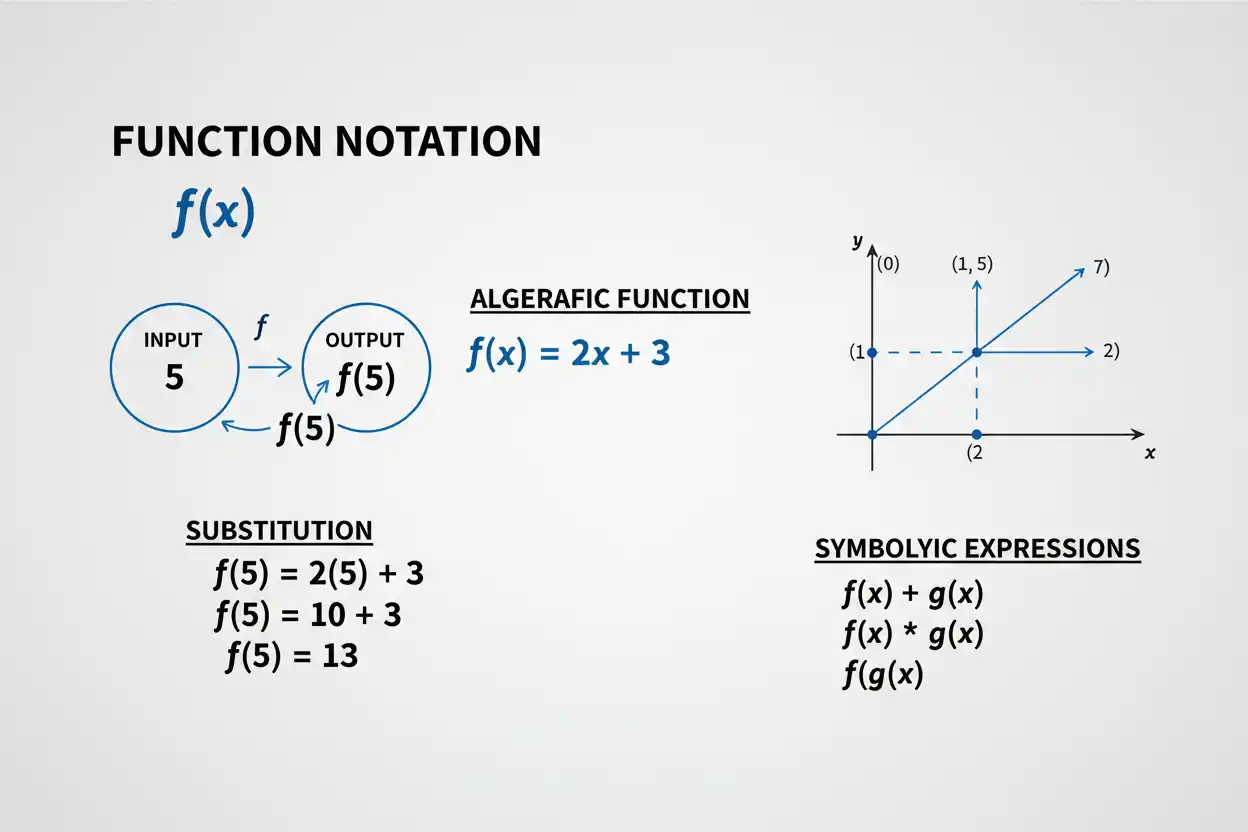

Function notation is a compact way to describe a rule that assigns an output to an input. If a function is written as f(x), the letter x represents the input and f(x) represents the output produced by the function.
For example:
f(x) = 2x + 3
means that the function named f takes an input x, multiplies it by 2, and adds 3.
If x = 4:
f(4) = 2(4) + 3 = 11
So the output corresponding to an input of 4 is 11.
Function notation is fundamental throughout algebra because it makes relationships between variables easier to evaluate, compare, compose, and analyze.
What Is Function Notation?
Function notation describes a function using a name followed by an input inside parentheses.
The general form is:
f(x) = expression involving x
Here:
- f is the name of the function.
- x is the input or independent variable.
- f(x) is the function’s output.
- The expression on the right tells you how to calculate that output.
For example:
f(x) = x² + 4
If x = 3:
f(3) = 3² + 4
f(3) = 9 + 4
f(3) = 13
The notation f(3) therefore means “the value of function f when the input is 3.”
It does not mean f multiplied by 3.
How to Read f(x)
The expression:
f(x)
is normally read as “f of x.”
Suppose:
f(x) = 5x – 2
Then:
f(1) = 5(1) – 2 = 3
and:
f(6) = 5(6) – 2 = 28
Changing the value inside the parentheses changes the input supplied to the function.
This input-output relationship connects closely with domain and range. The domain describes permissible inputs, while the range describes outputs the function can produce.
Basic Function Notation Formula
A function can be represented generally as:
y = f(x)
The expression y = f(x) states that y is the output determined by input x.
For instance:
f(x) = 3x + 7
is equivalent to:
y = 3x + 7
Function notation is often more useful than simply writing y because functions can be given distinct names such as f, g, or h.
For example:
f(x) = 2x + 1
g(x) = x²
This immediately distinguishes two different rules operating on the same possible input.
How to Evaluate a Function
To evaluate a function, replace every occurrence of the variable with the specified input.
Suppose:
f(x) = 4x – 9
Find f(5).
Substitute 5 for x:
f(5) = 4(5) – 9
Calculate:
f(5) = 20 – 9
f(5) = 11
Therefore:
f(5) = 11
The substitution must apply to every occurrence of x in the function.
Example With a Quadratic Expression
Suppose:
f(x) = x² – 3x + 2
Find f(4).
Substitute 4 for each x:
f(4) = 4² – 3(4) + 2
f(4) = 16 – 12 + 2
f(4) = 6
This type of polynomial may later be manipulated using methods such as factoring quadratics, but evaluating the function itself requires only correct substitution and simplification.
Evaluating a Function at a Negative Number
Parentheses become especially important when the input is negative.
Suppose:
f(x) = x² + 2x – 5
Find f(-3).
Substitute -3:
f(-3) = (-3)² + 2(-3) – 5
f(-3) = 9 – 6 – 5
f(-3) = -2
A common mistake is to write -3² instead of (-3)². The parentheses make it clear that the entire negative number is being squared.
Evaluating Function Notation With Variables
The input does not have to be a number. It can also be another variable or algebraic expression.
Suppose:
f(x) = 2x + 5
Then:
f(a) = 2a + 5
because a replaces x.
Similarly:
f(t) = 2t + 5
The function rule remains unchanged; only the input symbol changes.
Example: Finding f(2x)
Suppose:
f(x) = x² + 3
To calculate f(2x), replace every x in the original rule with 2x:
f(2x) = (2x)² + 3
f(2x) = 4x² + 3
Notice that:
f(2x) ≠ 2f(x)
in general.
Here:
2f(x) = 2(x² + 3) = 2x² + 6
which is different from 4x² + 3.
Finding f(x + h)
Expressions such as f(x + h) appear frequently in algebra and later in calculus.
Suppose:
f(x) = x² + 2x – 1
Replace each x with x + h:
f(x + h) = (x + h)² + 2(x + h) – 1
Expand:
f(x + h) = x² + 2xh + h² + 2x + 2h – 1
The safest method is to place the replacement expression inside parentheses before simplifying.
Function Notation With More Than One Function
Different function names represent different rules.
Suppose:
f(x) = 2x + 4
and:
g(x) = x² – 1
Then:
f(3) = 2(3) + 4 = 10
while:
g(3) = 3² – 1 = 8
Even though both functions receive the same input, their outputs differ because their rules are different.
When one function is applied to the result of another, the operation becomes a composite function, which is a separate function concept rather than ordinary evaluation of f(x).
Function Notation and Ordered Pairs
A function value can also be interpreted as an ordered pair.
If:
f(2) = 7
then the point:
(2, 7)
lies on the graph of the function.
Likewise, if:
f(-1) = 4
then:
(-1, 4)
is a point on its graph.
This correspondence explains why the input is commonly identified with the x-coordinate and the output with the y-coordinate.
Function Notation in a Linear Function
Consider:
f(x) = 3x – 4
Evaluating several inputs gives:
| x | f(x) |
|---|---|
| -1 | -7 |
| 0 | -4 |
| 1 | -1 |
| 2 | 2 |
| 3 | 5 |
Each pair of values represents a point on the line.
The underlying equation is a linear equation, but function notation emphasizes the mapping from each input to its corresponding output.
Function Notation in an Exponential Function
Function notation is not limited to linear or polynomial expressions.
For example:
f(x) = 2^x
Then:
f(0) = 2^0 = 1
f(1) = 2^1 = 2
f(3) = 2^3 = 8
When the unknown appears in an exponent and must be determined, the problem becomes an exponential equation rather than simply an exercise in function notation.
Function Notation for Piecewise Rules
A function may use different rules for different inputs. This is the idea behind a piecewise function.
For example, suppose a function follows one rule for negative inputs and another for nonnegative inputs. Evaluating f(x) then requires first deciding which rule applies to the specified input.
The important principle remains unchanged: the value inside the parentheses is the input.
How to Find an Input From a Function Value
Sometimes the output is given and the input must be found.
Suppose:
f(x) = 2x + 7
and:
f(x) = 19
Set the function rule equal to the stated output:
2x + 7 = 19
Subtract 7:
2x = 12
Divide by 2:
x = 6
Check:
f(6) = 2(6) + 7 = 19
So the required input is 6.
This uses the same algebraic principles involved in solving equations, although the function notation tells you how the equation originated.
Function Notation and Inequalities
A condition can also be placed on a function output.
For example:
f(x) > 0
means “find the inputs for which the function produces a positive value.”
If:
f(x) = x – 4
then:
x – 4 > 0
so:
x > 4
The detailed rules for solving and representing these conditions belong to inequalities; function notation simply expresses the condition in terms of the function’s output.
Function Notation and Inverse Functions
The notation f⁻¹(x) has a specific meaning: it represents an inverse function when an inverse exists.
It does not ordinarily mean:
1 / f(x)
For example, if:
f(x) = 2x + 3
then f⁻¹(x) describes a function that reverses the mapping performed by f. That is a separate concept from evaluating ordinary function notation such as f(2) or f(a).
Common Function Notation Mistakes
Treating f(x) as multiplication
The expression:
f(x)
does not mean:
f × x
It means the output of function f for input x.
Replacing only one occurrence of x
If:
f(x) = x² + 3x – 2
then:
f(4) = 4² + 3(4) – 2
Every x must be replaced.
Losing parentheses with negative inputs
For:
f(x) = x²
the value f(-5) is:
f(-5) = (-5)² = 25
not -25.
Confusing f(2x) with 2f(x)
These expressions generally produce different results. The first changes the input; the second multiplies the output.
Assuming every real number is a valid input
Some function rules restrict possible inputs. A function involving division cannot use an input that makes its denominator zero, for example. Input restrictions belong to the function’s domain and range analysis.
Worked Function Notation Example
Suppose:
f(x) = 3x² – 2x + 1
Find f(-2).
Substitute -2 everywhere x appears:
f(-2) = 3(-2)² – 2(-2) + 1
Evaluate the power:
f(-2) = 3(4) + 4 + 1
f(-2) = 12 + 4 + 1
f(-2) = 17
Therefore:
f(-2) = 17
Now find f(a):
f(a) = 3a² – 2a + 1
The procedure is identical whether the new input is numerical or symbolic.
Function Notation Rules at a Glance
The essential rules are straightforward. Read f(x) as “f of x,” treat the value inside parentheses as the input, substitute that entire input everywhere the original variable appears, preserve parentheses during substitution, and simplify only after the replacement has been made correctly.
These rules work whether the underlying expression is linear, polynomial, exponential, or another valid function type.
Frequently Asked Questions
What does f(x) mean?
f(x) means the output of a function named f when its input is x. It does not mean f multiplied by x.
What is the basic function notation formula?
The general relationship can be written as:
y = f(x)
where x is the input and f(x), or y, is the corresponding output.
How do you evaluate f(3)?
Replace every x in the function rule with 3, then simplify. If f(x) = 2x + 5, then:
f(3) = 2(3) + 5 = 11
Can a function have a letter other than f?
Yes. Functions may be named g(x), h(x), P(x), or almost any other suitable symbol. The letter identifies the function; it does not change the basic notation rules.
What is the difference between f(x) and f(2)?
f(x) describes the function using a variable input. f(2) asks for the specific output produced when the input equals 2.
Is f(x + 1) the same as f(x) + 1?
Not generally. f(x + 1) replaces the function’s input with x + 1, while f(x) + 1 adds 1 to the function’s output.
Is f⁻¹(x) the same as 1/f(x)?
No. f⁻¹(x) normally denotes the inverse of f when an inverse exists. The reciprocal of the function is written 1/f(x).
How does function notation relate to a graph?
If f(a) = b, then the ordered pair (a, b) is a point on the graph of the function. The input becomes the horizontal coordinate and the output becomes the vertical coordinate.