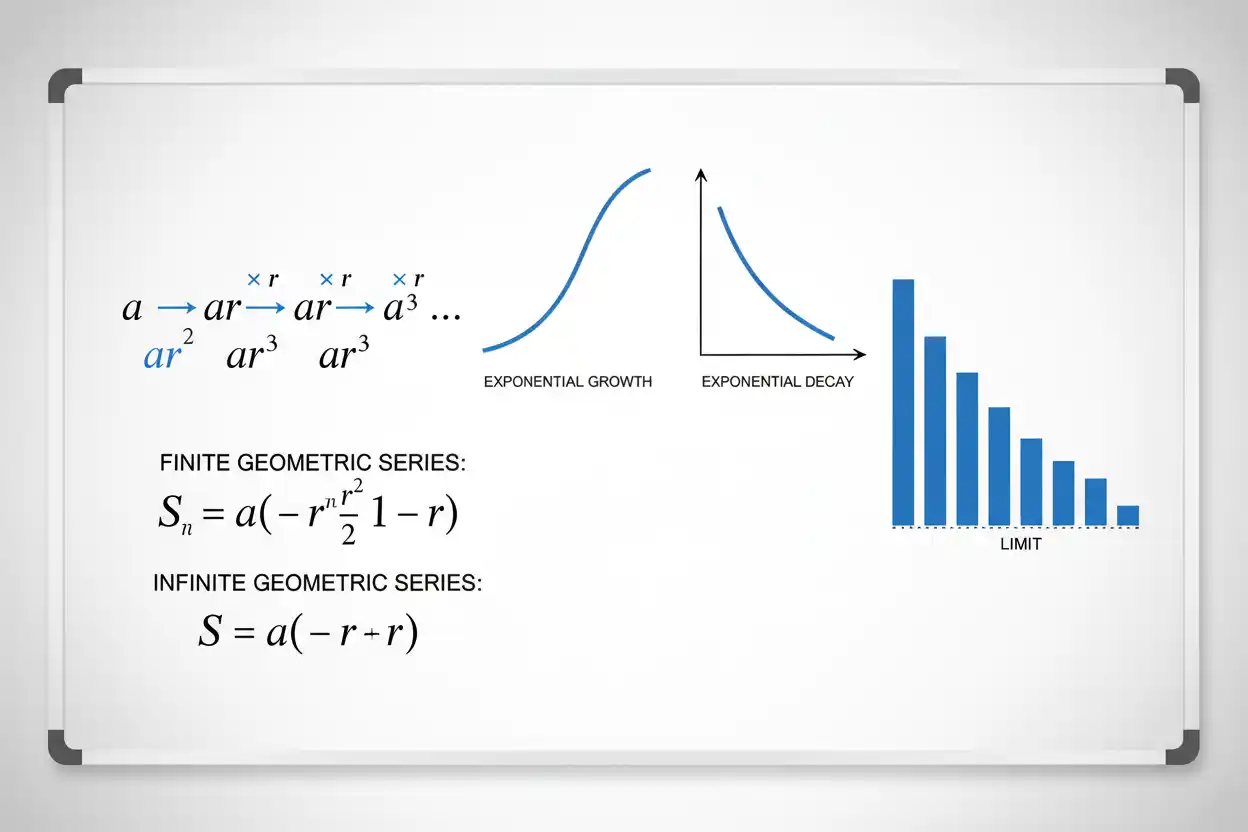

A geometric series is the sum of the terms of a geometric sequence, where each term after the first is obtained by multiplying the previous term by the same constant called the common ratio.
For example:
3 + 6 + 12 + 24 + 48
is a geometric series because every term is 2 times the preceding term.
Its common ratio is:
r = 2
For a finite geometric series with first term a₁, common ratio r, and n terms, the standard sum formula is:
Sₙ = a₁(1 – r^n) / (1 – r)
provided:
r ≠ 1
A geometric series can also continue indefinitely. An infinite geometric series has a finite sum only when:
|r| < 1
In that case:
S∞ = a₁ / (1 – r)
These formulas make geometric series an important part of algebra and many problems involving repeated multiplication, growth, decay, and accumulated values.
What Is a Geometric Series?
A geometric series is created by adding the terms of a geometric sequence.
Consider:
2, 6, 18, 54
This is a geometric sequence because each term is obtained by multiplying the preceding term by 3.
Adding the terms produces the geometric series:
2 + 6 + 18 + 54
The sum is:
80
The distinction is important:
Geometric sequence: a list of terms.
2, 6, 18, 54
Geometric series: the sum of those terms.
2 + 6 + 18 + 54
A common ratio distinguishes geometric patterns from an arithmetic series, where consecutive terms differ by a constant amount rather than a constant multiplication factor.
How to Find the Common Ratio
For consecutive nonzero terms, divide a term by the term immediately before it:
r = next term / previous term
For example, consider:
5, 15, 45, 135
The ratio is:
r = 15 / 5 = 3
Checking another pair:
r = 45 / 15 = 3
Because the ratio stays constant, the terms form a geometric pattern.
Example With a Fractional Ratio
Consider:
80, 40, 20, 10
Then:
r = 40 / 80 = 1/2
Each term is half of the one before it.
Example With a Negative Ratio
Consider:
4, -8, 16, -32
Then:
r = -8 / 4 = -2
A negative common ratio causes the signs of successive terms to alternate.
Finite Geometric Series Formula
For a geometric series containing exactly n terms:
a₁ + a₁r + a₁r² + … + a₁r^(n – 1)
the sum is:
Sₙ = a₁(1 – r^n) / (1 – r)
where:
- Sₙ = sum of the first n terms
- a₁ = first term
- r = common ratio
- n = number of terms
This formula applies when:
r ≠ 1
An equivalent form is:
Sₙ = a₁(r^n – 1) / (r – 1)
Both formulas give the same result. The first form is often convenient when |r| < 1, while the second may look cleaner when r > 1.
Why the Geometric Series Formula Works
Start with:
Sₙ = a₁ + a₁r + a₁r² + … + a₁r^(n – 1)
Multiply the entire equation by r:
rSₙ = a₁r + a₁r² + a₁r³ + … + a₁r^n
Subtract the second equation from the first:
Sₙ – rSₙ = a₁ – a₁r^n
Factor both sides:
Sₙ(1 – r) = a₁(1 – r^n)
Divide by 1 – r:
Sₙ = a₁(1 – r^n) / (1 – r)
The cancellation of all the intermediate terms is what makes the formula so efficient.
Example 1: Finite Geometric Series With r > 1
Find the sum:
3 + 6 + 12 + 24 + 48
Identify the values:
a₁ = 3
r = 2
n = 5
Use the formula:
S₅ = 3(1 – 2^5) / (1 – 2)
Calculate the power:
S₅ = 3(1 – 32) / (-1)
S₅ = 3(-31) / (-1)
S₅ = 93
Checking by direct addition:
3 + 6 + 12 + 24 + 48 = 93
So:
S₅ = 93
Example 2: Geometric Series With a Fractional Ratio
Find:
160 + 80 + 40 + 20
The first term is:
a₁ = 160
The ratio is:
r = 1/2
There are four terms:
n = 4
Use the finite sum formula:
S₄ = 160(1 – (1/2)^4) / (1 – 1/2)
Since:
(1/2)^4 = 1/16
we get:
S₄ = 160(1 – 1/16) / (1/2)
S₄ = 160(15/16) / (1/2)
S₄ = 150 / (1/2)
S₄ = 300
Direct addition confirms the result:
160 + 80 + 40 + 20 = 300
Example 3: Negative Common Ratio
Find the sum:
5 – 10 + 20 – 40
Here:
a₁ = 5
r = -2
n = 4
Use:
Sₙ = a₁(1 – r^n) / (1 – r)
Substitute:
S₄ = 5(1 – (-2)^4) / (1 – (-2))
Because:
(-2)^4 = 16
we get:
S₄ = 5(1 – 16) / 3
S₄ = 5(-15) / 3
S₄ = -25
Direct addition gives the same answer:
5 – 10 + 20 – 40 = -25
The negative ratio causes alternating signs, but the standard geometric series formula still works.
What Happens When r = 1?
The usual geometric sum formula has a denominator of 1 – r. If r = 1, that denominator becomes zero, so the formula cannot be used directly.
When r = 1, every term equals the first term:
a₁ + a₁ + a₁ + …
With n terms, the sum is simply:
Sₙ = na₁
For example:
7 + 7 + 7 + 7 + 7
has:
a₁ = 7
n = 5
Therefore:
S₅ = 5(7) = 35
Infinite Geometric Series Formula
An infinite geometric series continues without a final term:
a₁ + a₁r + a₁r² + a₁r³ + …
If the magnitude of the common ratio is less than 1, the terms become progressively smaller and the series approaches a finite value.
The condition is:
|r| < 1
When this condition is satisfied:
S∞ = a₁ / (1 – r)
This is called a convergent geometric series.
If:
|r| ≥ 1
the infinite geometric series does not converge to a finite sum.
Example 4: Infinite Geometric Series
Find the sum:
12 + 6 + 3 + 1.5 + …
The first term is:
a₁ = 12
The ratio is:
r = 1/2
Because:
|1/2| < 1
the series converges.
Use:
S∞ = a₁ / (1 – r)
Substitute:
S∞ = 12 / (1 – 1/2)
S∞ = 12 / (1/2)
S∞ = 24
Therefore:
12 + 6 + 3 + 1.5 + … = 24
The individual terms continue forever, but their total approaches 24.
Example 5: Infinite Series With a Negative Ratio
Consider:
9 – 3 + 1 – 1/3 + …
The first term is:
a₁ = 9
The common ratio is:
r = -1/3
Since:
|-1/3| < 1
the series converges.
Apply the formula:
S∞ = 9 / (1 – (-1/3))
S∞ = 9 / (4/3)
S∞ = 27/4
S∞ = 6.75
The alternating signs do not prevent convergence because the magnitude of the ratio is below 1.
When Does an Infinite Geometric Series Converge?
The decisive rule is:
|r| < 1
This means:
-1 < r < 1
When r lies inside this interval, successive powers of r approach zero.
For example:
(1/2)^n → 0 as n becomes large
and:
(-1/3)^n → 0 as n becomes large
That allows the partial sums to approach a fixed limit.
By contrast, if r = 2, the terms grow. If r = -2, their magnitudes grow while their signs alternate. If r = 1, the same term repeats indefinitely. None of these cases produces a finite infinite sum.
Geometric Series and Exponential Patterns
The terms in a geometric series involve successive powers of the common ratio:
a₁, a₁r, a₁r², a₁r³, …
This exponential structure explains why geometric series commonly appear in repeated growth and decay processes.
For instance, with:
a₁ = 5
and:
r = 2
the terms are:
5, 10, 20, 40, 80, …
The exponent on r increases by one from term to term. Problems that require solving for an unknown appearing in an exponent are closely related to exponential equations.
Geometric Series Versus Arithmetic Series
The quickest distinction is to ask whether consecutive terms have a constant difference or a constant ratio.
Consider:
4 + 7 + 10 + 13
The difference between terms is 3, so this is arithmetic.
Now consider:
4 + 12 + 36 + 108
The ratio between terms is 3, so this is geometric.
An arithmetic series grows through repeated addition. A geometric series grows or decays through repeated multiplication.
How to Check Whether a Series Is Geometric
Take consecutive nonzero terms and compare their ratios.
For:
2 + 8 + 32 + 128
calculate:
8 / 2 = 4
32 / 8 = 4
128 / 32 = 4
Because the ratio stays constant:
r = 4
The series is geometric.
Now consider:
2 + 6 + 18 + 55
The ratios are:
6 / 2 = 3
18 / 6 = 3
but:
55 / 18 ≠ 3
Therefore, the terms do not form a geometric series.
Finding a Missing Term
Suppose:
6, 18, ?, 162
The first ratio is:
r = 18 / 6 = 3
Multiply 18 by 3:
18 × 3 = 54
Check:
54 × 3 = 162
So the missing term is:
54
Once the common ratio is known, repeated multiplication generates the remaining terms.
Finding the Number of Terms
If the first term, common ratio, and final term are known, the nth-term relationship can help identify n:
aₙ = a₁r^(n – 1)
For example, suppose a geometric pattern begins with 3, has ratio 2, and ends at 96:
96 = 3 × 2^(n – 1)
Divide by 3:
32 = 2^(n – 1)
Since:
32 = 2^5
then:
n – 1 = 5
n = 6
If the powers do not match conveniently, determining the exponent may require the methods used for a logarithmic equation.
Function Notation and Geometric Patterns
A geometric pattern can also be represented by a function.
For example:
f(n) = 3 × 2^(n – 1)
generates:
3, 6, 12, 24, 48, …
Here n identifies the term number. Understanding function notation helps distinguish the input n from the value generated by the exponential rule.
The geometric series itself is the sum of selected terms produced by that rule.
Common Geometric Series Mistakes
Confusing a sequence with a series
A sequence lists terms:
2, 4, 8, 16
A series adds them:
2 + 4 + 8 + 16
The sum formula applies to the series.
Using a difference instead of a ratio
A geometric pattern requires constant multiplication. Subtracting consecutive terms is the correct test for an arithmetic pattern, not a geometric one.
Using the wrong number of terms
The exponent in the finite sum formula is n:
Sₙ = a₁(1 – r^n) / (1 – r)
Carefully count the number of terms rather than assuming the last exponent equals n.
Forgetting the convergence condition
The infinite formula:
S∞ = a₁ / (1 – r)
is valid only when:
|r| < 1
Using it for r = 2, r = -1, or another nonconvergent ratio produces an invalid interpretation.
Losing the sign of a negative ratio
If r is negative, preserve parentheses when raising it to a power:
(-2)^4 = 16
but:
(-2)^5 = -32
The parity of the exponent matters.
Mishandling algebra around the formula
If a geometric-series problem produces an equation involving an unknown, solve that equation carefully. Depending on the form, the manipulation may involve standard inequality or equation-solving rules, but the geometric-series formula itself should first be set up correctly.
Worked Geometric Series Example
Find the sum of the first six terms of:
4 + 12 + 36 + …
Identify the first term:
a₁ = 4
Find the ratio:
r = 12 / 4 = 3
The required number of terms is:
n = 6
Apply the finite formula:
S₆ = 4(1 – 3^6) / (1 – 3)
Calculate:
3^6 = 729
Therefore:
S₆ = 4(1 – 729) / (-2)
S₆ = 4(-728) / (-2)
S₆ = 1456
The first six terms are:
4 + 12 + 36 + 108 + 324 + 972
Their direct sum is also:
1456
So:
S₆ = 1456
Frequently Asked Questions
What is a geometric series?
A geometric series is the sum of terms in a geometric sequence. Each term after the first is obtained by multiplying the previous term by a constant common ratio.
What is the finite geometric series formula?
For first term a₁, common ratio r, and n terms:
Sₙ = a₁(1 – r^n) / (1 – r)
for r ≠ 1.
What is the infinite geometric series formula?
When |r| < 1:
S∞ = a₁ / (1 – r)
If |r| ≥ 1, the infinite geometric series does not have a finite sum.
How do you find the common ratio?
Divide any nonzero term by the term immediately before it:
r = next term / previous term
The same ratio must hold across the geometric pattern.
Can a geometric series have a negative ratio?
Yes. A negative common ratio causes alternating signs. For example, 4 – 8 + 16 – 32 has r = -2.
What happens if the common ratio is 1?
Every term is identical. For a finite series of n terms:
Sₙ = na₁
The usual formula with denominator 1 – r cannot be used because that denominator would be zero.
What is the difference between a geometric sequence and a geometric series?
A geometric sequence is the ordered list of terms. A geometric series is the result of adding those terms.
When does an infinite geometric series converge?
It converges exactly when:
|r| < 1
Under that condition, the terms shrink toward zero and the partial sums approach a finite limit.
Can a geometric series have a common ratio of zero?
Yes, depending on how the sequence is defined. If a₁ is nonzero and r = 0, the terms after the first become zero:
a₁ + 0 + 0 + …
so the sum is simply a₁.
Why does the geometric series formula use r^n?
A finite series with n terms ends with a₁r^(n – 1). During the derivation, multiplying the series by r creates an additional final term a₁r^n. Subtracting the two expressions produces the r^n term in the sum formula.