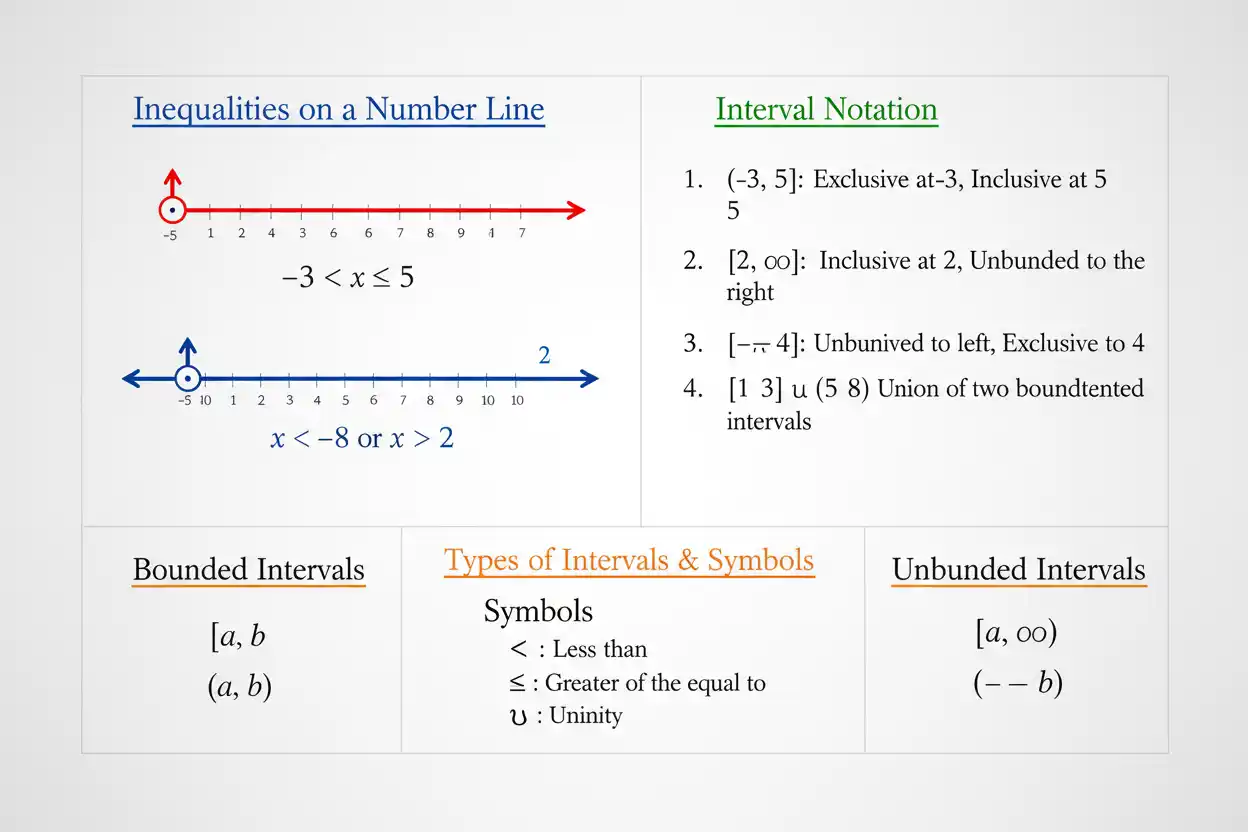

Inequalities compare quantities that are not necessarily equal. Instead of identifying one exact value, an inequality often describes an entire set of possible values.
For example:
x > 3
means x can be any real number greater than 3.
The same solution set in interval notation is:
(3, ∞)
Likewise:
-2 ≤ x ≤ 5
becomes:
[-2, 5]
Interval notation provides a compact way to represent the solution sets of inequalities, especially when the answer contains infinitely many real numbers.
Within algebra, this notation is frequently used alongside equations, functions, domains, ranges, and polynomial conditions.
What Is an Inequality?
An inequality states that one expression is greater than, less than, greater than or equal to, or less than or equal to another expression.
The main inequality symbols are:
| Symbol | Meaning | Example |
|---|---|---|
| > | Greater than | x > 4 |
| < | Less than | x < 4 |
| ≥ | Greater than or equal to | x ≥ 4 |
| ≤ | Less than or equal to | x ≤ 4 |
| ≠ | Not equal to | x ≠ 4 |
For example:
x ≥ 6
includes 6 itself and every number greater than 6.
By contrast:
x > 6
excludes 6.
That distinction determines whether interval notation uses a bracket or a parenthesis at the endpoint.
The algebraic procedures used to isolate a variable—including the rule for reversing the inequality sign after multiplication or division by a negative number—are covered more directly in inequality. Here, the focus is on understanding and representing inequality solution sets.
What Is Interval Notation?
Interval notation represents a continuous set of real numbers by giving its endpoints.
Four symbols are especially important:
( )
Parentheses indicate that an endpoint is not included.
[ ]
Brackets indicate that a finite endpoint is included.
The symbols:
-∞
and:
∞
represent negative infinity and positive infinity.
Because infinity is not an actual number or attainable endpoint, infinity always uses a parenthesis.
For example:
x < 7
becomes:
(-∞, 7)
while:
x ≤ 7
becomes:
(-∞, 7]
The only change is whether 7 belongs to the solution set.
Inequality to Interval Notation Rules
The most common conversions are:
| Inequality | Interval Notation |
|---|---|
| x > a | (a, ∞) |
| x ≥ a | [a, ∞) |
| x < a | (-∞, a) |
| x ≤ a | (-∞, a] |
| a < x < b | (a, b) |
| a ≤ x ≤ b | [a, b] |
| a < x ≤ b | (a, b] |
| a ≤ x < b | [a, b) |
The left endpoint is always written first because interval notation follows the number line from smaller values to larger values.
Parentheses vs Brackets
Choosing between parentheses and brackets is one of the most important interval notation rules.
Use a Parenthesis for a Strict Inequality
If the inequality uses:
<
or:
>
the boundary value is excluded.
For example:
x > 2
means 2 is not part of the solution.
Therefore:
(2, ∞)
Similarly:
x < 10
becomes:
(-∞, 10)
Use a Bracket When Equality Is Included
If the inequality uses:
≤
or:
≥
the finite boundary value is included.
For example:
x ≥ -4
becomes:
[-4, ∞)
and:
x ≤ 9
becomes:
(-∞, 9]
A bracket corresponds to a closed endpoint on a number line.
Why Infinity Always Uses Parentheses
Infinity is not a real number that can be reached or included in a set.
Therefore these forms are correct:
(-∞, 5)
(-∞, 5]
(3, ∞)
[3, ∞)
These are not correct:
[-∞, 5]
[3, ∞]
Even when the inequality extends without limit, infinity itself is never an included endpoint.
Writing x > a in Interval Notation
Suppose:
x > 5
The solution contains every real number greater than 5 but excludes 5.
The interval is:
(5, ∞)
On a number line, this corresponds to an open circle at 5 and shading to the right.
If the inequality changes to:
x ≥ 5
then 5 is included:
[5, ∞)
The number line uses a closed circle at 5.
Writing x < a in Interval Notation
Suppose:
x < -2
The solution contains every real number less than -2.
In interval notation:
(-∞, -2)
If the boundary is included:
x ≤ -2
then:
(-∞, -2]
The direction of the interval follows the natural order of the real-number line.
Bounded Inequalities
A bounded inequality restricts x between two finite values.
For example:
2 < x < 8
means x is greater than 2 and less than 8.
Neither endpoint is included:
(2, 8)
Now consider:
2 ≤ x ≤ 8
Both endpoints are included:
[2, 8]
Mixed endpoints are also possible.
For:
2 < x ≤ 8
the interval is:
(2, 8]
For:
2 ≤ x < 8
the interval is:
[2, 8)
The inequality symbols determine each endpoint independently.
Compound Inequalities and “And”
An and inequality requires both conditions to be true simultaneously.
For example:
x > 1 and x < 6
can be written:
1 < x < 6
Its interval notation is:
(1, 6)
The solution consists only of values that satisfy both conditions.
If the endpoints are included:
x ≥ 1 and x ≤ 6
then:
1 ≤ x ≤ 6
and:
[1, 6]
An “and” condition normally produces the overlap, or intersection, of the two solution sets.
Compound Inequalities and “Or”
An or inequality allows values satisfying either condition.
Consider:
x < -3 or x > 4
There are two separate intervals:
(-∞, -3)
and:
(4, ∞)
They are joined using the union symbol:
(-∞, -3) ∪ (4, ∞)
The symbol:
∪
means union.
It combines separate portions of the solution set.
If the endpoints are included:
x ≤ -3 or x ≥ 4
then:
(-∞, -3] ∪ [4, ∞)
Interval Notation From a Number Line
A number line communicates the same information visually.
An open circle means the endpoint is excluded. A closed circle means it is included.
Suppose a number line has an open circle at -1 and extends to the right.
The inequality is:
x > -1
The interval notation is:
(-1, ∞)
If the circle at -1 is closed:
x ≥ -1
and the interval becomes:
[-1, ∞)
For a bounded region, inspect both endpoints separately.
An open circle at 2, a closed circle at 7, and shading between them represents:
2 < x ≤ 7
or:
(2, 7]
Converting Interval Notation Back to an Inequality
The process also works in reverse.
Suppose:
(-4, 9]
The parenthesis at -4 means -4 is excluded.
The bracket at 9 means 9 is included.
Therefore:
-4 < x ≤ 9
Now consider:
[3, ∞)
The bracket includes 3, and the interval extends toward larger numbers:
x ≥ 3
For:
(-∞, 12)
the solution is:
x < 12
Union of Two Intervals
Some inequalities create disconnected solution sets.
For example:
x < -2 or x ≥ 5
becomes:
(-∞, -2) ∪ [5, ∞)
The first interval ends before -2, while the second begins at 5.
There is no solution between -2 and 5, so the two intervals cannot be combined into one continuous interval.
This form commonly appears when polynomial expressions have multiple boundary points.
For instance, after using techniques such as factoring quadratics, a quadratic inequality may divide the number line into several intervals. Test values can then determine which intervals satisfy the condition.
Intersection of Intervals
When two conditions must both hold, only their overlap remains.
Suppose:
x > 1
and:
x ≤ 7
The corresponding intervals are:
(1, ∞)
and:
(-∞, 7]
Their common portion is:
(1, 7]
Therefore:
1 < x ≤ 7
An intersection keeps only numbers belonging to both sets.
All Real Numbers in Interval Notation
If every real number satisfies an inequality, the solution is:
(-∞, ∞)
For example, consider:
x + 3 > x – 5
Subtract x from both sides:
3 > -5
This statement is always true.
Therefore every real x is a solution:
(-∞, ∞)
No Solution
Sometimes simplifying an inequality produces a false statement.
For example:
x + 2 > x + 9
Subtract x:
2 > 9
This is never true.
Therefore the inequality has no solution.
A no-solution result is not written as a numerical interval because there are no real values to include. It may be represented by the empty-set symbol:
∅
Excluded Individual Values
Not every solution set consists of one continuous interval.
For example:
x ≠ 4
means every real number except 4.
Interval notation is:
(-∞, 4) ∪ (4, ∞)
The value 4 is excluded, so the real line is split into two intervals.
Inequalities With Functions
Inequalities can describe the output of a function.
For example:
f(x) > 0
asks for all inputs where the output of f is positive.
If:
f(x) = x – 3
then:
x – 3 > 0
which gives:
x > 3
The solution in interval notation is:
(3, ∞)
Understanding function notation helps separate the function’s input from the condition imposed on its output.
Function restrictions can also matter when working with an inverse function, where a domain may need to be limited to ensure that the inverse itself behaves as a function.
Absolute-Value Style Intervals
An inequality can describe all numbers within a certain distance of a center.
For example:
|x| < 5
means x lies less than 5 units from zero:
-5 < x < 5
Therefore:
(-5, 5)
If:
|x| ≤ 5
then the endpoints are included:
[-5, 5]
By contrast:
|x| > 5
describes values farther than 5 units from zero:
x < -5 or x > 5
so:
(-∞, -5) ∪ (5, ∞)
Inequality Conditions in Other Algebraic Topics
Inequalities often appear as conditions rather than as standalone problems.
A clear example occurs with an infinite geometric series, which converges only when its common ratio satisfies:
|r| < 1
That is equivalent to:
-1 < r < 1
or, in interval notation:
(-1, 1)
This shows why inequality notation is useful beyond ordinary variable-solving exercises: it can state the allowable range for a parameter or mathematical condition concisely.
Worked Example: From Inequality to Interval Notation
Convert:
-3 ≤ 2x + 1 < 9
into interval notation.
Subtract 1 throughout:
-4 ≤ 2x < 8
Divide throughout by 2:
-2 ≤ x < 4
Now inspect the endpoints.
The lower endpoint -2 is included because the inequality uses ≤.
The upper endpoint 4 is excluded because the inequality uses <.
Therefore:
[-2, 4)
Worked Example With Two Separate Intervals
Suppose the solution of an inequality is:
x ≤ -4 or x > 2
Translate each part separately.
For:
x ≤ -4
the interval is:
(-∞, -4]
For:
x > 2
the interval is:
(2, ∞)
Join them with union:
(-∞, -4] ∪ (2, ∞)
Common Interval Notation Mistakes
Using Brackets With Infinity
Infinity must always use parentheses.
Correct:
[2, ∞)
Incorrect:
[2, ∞]
Reversing Endpoint Order
Intervals are written from smaller values to larger values.
Correct:
(-3, 8]
not:
[8, -3)
Using a Bracket for a Strict Inequality
For:
x > 5
5 is excluded.
Therefore:
(5, ∞)
not:
[5, ∞)
Forgetting the Union Symbol
For:
x < 1 or x > 6
the solution has two disconnected parts:
(-∞, 1) ∪ (6, ∞)
It cannot be written as one continuous interval.
Confusing “And” With “Or”
“And” usually keeps the overlap between conditions.
“Or” combines values satisfying either condition.
Mixing them can completely change the solution set.
Frequently Asked Questions
What are inequalities?
Inequalities are mathematical statements comparing two quantities using symbols such as <, >, ≤, or ≥. Their solutions often contain ranges of values rather than one exact number.
What is interval notation?
Interval notation is a compact method for representing continuous sets of real numbers using endpoints, parentheses, brackets, and infinity symbols.
What does (2, 7) mean?
(2, 7)
means all real numbers greater than 2 and less than 7:
2 < x < 7
Neither endpoint is included.
What does [2, 7] mean?
[2, 7]
means:
2 ≤ x ≤ 7
Both endpoints belong to the interval.
What does (2, 7] mean?
It means:
2 < x ≤ 7
The value 2 is excluded, while 7 is included.
What does (-∞, 4) mean?
It represents every real number less than 4:
x < 4
Why does infinity always use parentheses?
Infinity is not a real endpoint that can be included in a set. Therefore ∞ and -∞ always appear with parentheses.
What does the union symbol mean in interval notation?
The symbol:
∪
combines separate solution intervals. For example:
(-∞, -2) ∪ (3, ∞)
means x < -2 or x > 3.
How do you write all real numbers in interval notation?
All real numbers are written:
(-∞, ∞)
How do you write x ≠ 5 in interval notation?
Because every real number except 5 is allowed:
(-∞, 5) ∪ (5, ∞)
What is the interval notation for -3 ≤ x < 8?
The correct interval is:
[-3, 8)
The bracket includes -3, while the parenthesis excludes 8.